
CRE-220 · Lesson 11 of 12 · 25 min
Collaborations, co-hosting and on-camera chemistry
Some of the most popular creator content features two or more people: co-hosted podcasts and shows, friends taking on challenges together, creators appearing on each other's channels, panels and group projects. Collaboration can introduce creators to new audiences, add energy and variety, and make content more fun to make. It also brings new challenges: sharing the spotlight, balancing personalities, coordinating schedules and agreeing on credit and money. This lesson covers why collaborations work, choosing collaborators, planning a collaboration, co-hosting roles, turn-taking and conversational flow, building on-camera chemistry, disagreement and debate on camera, group and panel formats, appearing as a guest on others' content, and agreements and fairness in collaborations.
Why collaborations work
Collaborations work for audiences and creators. For audiences, interaction between people creates dynamics that a single presenter cannot: banter, contrast, debate, shared discovery and genuine reactions. For creators, collaborations introduce each creator to the other's audience, often the most effective form of cross-promotion (CRE-301 covers growth strategy); spread the work of creating; and spark new ideas. Platforms also offer features that support collaboration, such as co-authored posts, joint live streams and collaboration tags that show content in more than one creator's profile (CRE-210). The best collaborations are mutually beneficial: each person brings something the other lacks, and the content is better together than either could make alone.
Choosing collaborators
Good collaborators share some overlap with your audience and values but bring something different: complementary expertise (a chef and a nutritionist), contrasting personalities (an enthusiast and a sceptic), or different perspectives on a shared topic. Audience size matters less than fit; collaborations between creators of different sizes can work well if both bring value. Before collaborating, watch their content to understand their style, values and how they treat others; check that they disclose sponsorships honestly and behave respectfully, since associating with a creator who has a history of harassment or deception can damage your reputation; and talk informally first to see whether you enjoy working together. Chemistry is easier to find than to manufacture.
Planning a collaboration
Successful collaborations are planned like any other production, with extra attention to coordination. Agree on the concept and who it is for; the format, length and platforms; who will film, edit and publish which pieces; how each creator will appear on the other's channel, if at all; the timeline; and how sponsorships, revenue and credit will be shared. A shared outline or run sheet, with roles for each person, prevents confusion on the day. For larger collaborations, a short written agreement or email confirming these points avoids misunderstandings later (see below). Plan the content so that each person has moments to shine, rather than one creator dominating.
| Decision | Questions to agree |
|---|---|
| Concept | What is the idea, and for which audience? |
| Format | Length, platforms, number of videos? |
| Roles | Who hosts, films, edits, publishes? |
| Cross-posting | One video each, or one shared video? |
| Money | How are sponsorships and revenue shared? |
| Credit and rights | Who owns the footage and how is credit given? |
| Approval | Does each person review the edit before publishing? |
Co-hosting roles
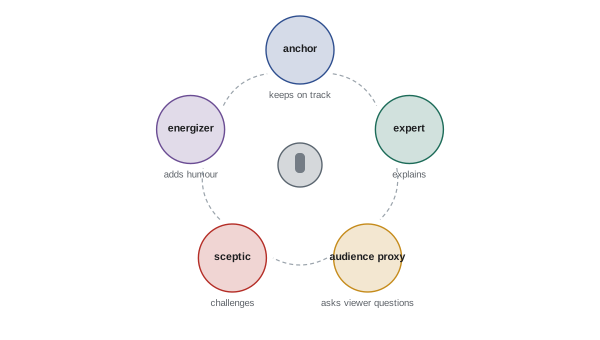
Co-hosts often fall into complementary roles, which can be planned or develop naturally:
- The anchor or host: keeps the conversation on track, introduces segments, manages time and asks questions.
- The expert: provides knowledge and explanation.
- The enthusiast or audience proxy: asks the questions viewers would ask, reacts with curiosity or surprise, and keeps things accessible.
- The sceptic or contrarian: challenges assumptions, adds tension and keeps the conversation honest.
- The comic or energizer: adds humour and lifts the mood.
Roles need not be fixed: in many successful shows, co-hosts switch roles depending on the topic. What matters is that each person contributes something distinct; two co-hosts who agree on everything and play the same role can feel redundant.
Turn-taking and conversational flow
Good conversation on camera has rhythm: each person speaks, others listen and respond, and the conversation builds. Common problems include talking over each other, which is confusing on audio and hard to edit; one person dominating; long monologues; and awkward silences when no one knows who should speak next. Techniques for smooth flow include signalling handovers with names, questions or glances ("Sam, you tried this last week, right?"); keeping contributions concise; listening actively and building on what others say ("yes, and", Lesson 9); and agreeing in advance who leads each segment. Visible listening, nodding, reacting and looking at whoever is speaking, makes the conversation feel real and gives editors useful reaction shots. Slight pauses before speaking reduce overlaps, especially in remote recordings with lag.
Worked problem
Fixing a lopsided co-hosted episode
Two co-hosts review their latest episode and notice that one spoke for about 75 % of the time, frequently interrupting, while the other mostly said "yeah" and "totally". What changes could balance future episodes?
Show solution
- Plan segments with a clear lead for each, so both have sections to drive.
- Give the quieter co-host prepared topics, stories or questions to bring.
- Agree on handover signals, such as naming the other person or asking a direct question.
- The dominant co-host practises pausing for two seconds after the other speaks before responding.
- Review the next episode's talk-time balance and the quality of exchanges, not just the split.
Answer: Assign segment leads, prepare material for the quieter host, use handover signals and deliberate pauses, and review balance after each episode.
Building on-camera chemistry
Chemistry, the sense that people genuinely enjoy each other and play off one another, is one of the main reasons audiences return to co-hosted content. It grows from real relationships: spending time together off camera, sharing a sense of humour and respecting each other. It can be supported by formats that encourage interaction, such as challenges, debates, games and shared experiences; by allowing spontaneous moments and running jokes to develop; by genuine reactions rather than performed ones; and by generosity, letting the other person have the funny line or the big moment. Forced chemistry, fake laughter or scripted banter that does not sound like the people involved is easy for viewers to spot. New collaborations often start awkwardly; chemistry tends to develop over several sessions.
Disagreement and debate on camera
Disagreement can make content compelling, as long as it is respectful and genuine. Debates between co-hosts or guests with different views can inform audiences, model respectful disagreement and reveal the reasoning behind positions. Good on-camera disagreement focuses on ideas rather than people; acknowledges good points on the other side; uses evidence and examples; avoids interrupting and talking over; and allows each side time to explain. Manufactured conflict, staged arguments or "drama" presented as real, may attract short-term views but often damages trust and can lead to harassment of the people involved (Lesson 7). If a real disagreement becomes heated, the anchor should slow the conversation, summarize each position fairly and, if needed, move on.
Groups and panels
Group formats, with three or more people, such as panels, roundtables and group challenges, need more structure. A moderator or host is essential to introduce participants, manage time, ensure each person speaks, and keep the conversation focused. Techniques include directing questions to specific people, setting time limits for answers, summarizing between topics, and drawing in quieter participants. Seating and camera setup matter: participants should be able to see each other, and cameras should capture each person and the group. In remote panels, clear speaking order, mute discipline and a producer monitoring the call help. Fewer participants usually produce better conversation: three or four is often ideal.
Appearing as a guest
Appearing on other creators' channels and podcasts is a powerful way to reach new audiences. Good guests prepare: they watch or listen to the show, understand its audience and tone, and prepare stories, insights and examples relevant to that audience rather than repeating a generic pitch. They are generous, answering questions fully, engaging with the host's ideas, and avoiding over-promoting their own content (a brief mention at the end is usually welcome). They respect the host's format and time, test their technical setup in advance for remote appearances, and share the finished content with their own audience afterwards, which hosts appreciate. Being a good guest leads to more invitations and to collaborations that continue.
Agreements and fairness
Collaborations between friends often begin informally, but misunderstandings about money, credit and ownership can damage relationships. A short written agreement, even an email that both people confirm, should cover who owns the footage and can reuse it, how revenue from the content and any sponsorships will be shared, how each person will be credited and tagged, whether each can approve the final edit, what happens if a co-host leaves a shared show, and how sponsorship disclosures will be handled, since each creator remains responsible for disclosing paid relationships under advertising law (CRE-320). For long-running co-hosted shows or businesses, a formal partnership or company agreement drafted with a lawyer is wise (CRE-330). Fairness also means giving credit generously, not taking collaborators' ideas for your own content without permission, and supporting collaborators who face harassment because of a joint project.
Remote collaborations
Many collaborations take place remotely, with creators in different cities or countries. Remote co-hosting works best with good technical preparation: each person using a quality microphone and headphones, local recording of each participant where possible, a stable internet connection and a shared run sheet. Agree on speaking cues, since overlapping speech is common with lag; brief pauses and naming the next speaker help. Time zones, schedules and different platform norms require planning. Some collaborations combine remote conversation with separately filmed segments that each creator records and edits into a shared piece.
When collaborations go wrong
Not every collaboration works. Problems include mismatched effort, disputes over credit or money, creative disagreements, a collaborator's controversial behaviour, or simply a lack of chemistry. Prevent problems by agreeing terms in advance and communicating openly during the project. If problems arise, address them privately and early, refer back to agreements, and look for fair compromises. If a collaborator behaves in ways that conflict with your values, you may decide to end the partnership; doing so calmly and without public drama protects both reputations. If a co-host leaves a shared show, agreements about ownership and the show's name become especially important.
Building a collaboration network
Over time, creators build networks of collaborators: friends in the same niche, experts they can call on, and creators in adjacent fields. Nurturing these relationships, by supporting others' work, sharing opportunities and being reliable, makes future collaborations easier and often leads to unexpected opportunities. Creator communities, events and online groups are good places to meet potential collaborators. Treat collaborations as long-term relationships rather than one-off transactions.
Collaborating across niches
Collaborations between creators in different niches can be especially fresh: a fitness creator and a chef making healthy meal-prep content, a historian and a travel creator exploring a city, or a musician and an animator creating a short film. Cross-niche collaborations introduce each audience to new topics and often produce content neither creator could make alone. They work best when the connection between niches is natural and when each creator explains their world clearly to the other's audience, avoiding jargon and inside references. Planning a format that showcases both creators' strengths, such as a challenge where each teaches the other a skill, helps both audiences engage.
Credit and visibility on screen
Fair collaborations give each person visible credit: names and handles on screen and in descriptions, tags in posts, and equal billing in titles where appropriate. Agree how collaborators will be introduced and how links will appear. Small courtesies, such as thanking a collaborator on screen and sharing their work, strengthen relationships and encourage audiences to follow both creators. When collaborators are less experienced, consider helping them present well, for example by sharing your setup tips, which makes the content better for everyone.
Common mistakes
MistakeChoosing collaborators only for audience size.
InsteadChoose for fit, complementary strengths and values.
MistakeCollaborating without agreeing roles and money.
InsteadAgree concept, roles, credit and revenue in writing.
MistakeTalking over each other.
InsteadUse handover signals and brief pauses.
MistakeManufacturing drama for views.
InsteadKeep disagreement genuine and respectful.
MistakeOver-promoting yourself as a guest.
InsteadServe the host's audience and mention your work briefly.
Summary and key terms
- Collaborations create dynamics, cross-promotion and shared work.
- Choose collaborators for fit, complementary strengths and shared values.
- Plan concept, format, roles, money, credit and approval.
- Co-hosts play complementary roles that can shift by topic.
- Smooth turn-taking needs handovers, concise contributions and listening.
- Chemistry grows from real relationships and generous play.
- Debate respectfully, structure panels, be a generous guest and put agreements in writing.
- Collaboration
- Content created jointly by two or more creators.
- Cross-promotion
- Introducing each creator to the other's audience.
- Co-host
- A presenter sharing hosting duties.
- Anchor
- Co-host who leads and manages the conversation.
- Audience proxy
- Co-host who asks questions viewers would ask.
- Turn-taking
- The rhythm of who speaks when.
- Handover
- Signal passing the conversation to another person.
- Chemistry
- Natural rapport and interplay between people.
- Moderator
- Person who manages a panel conversation.
- Collaboration agreement
- Written terms for ownership, credit and money.
Practice problems
Work each problem on paper first, then reveal the answer to check.
Name two benefits of collaborations for creators.
Show answer
Cross-promotion, shared work, new ideas.
What should you check before collaborating?
Show answer
Style, values, behaviour and disclosure practices.
Name four decisions to agree in advance.
Show answer
Concept, format, roles, money, credit, approval.
Name three co-host roles.
Show answer
Anchor, expert, enthusiast, sceptic, comic.
How can co-hosts avoid talking over each other?
Show answer
Handover signals and brief pauses.
Where does chemistry come from?
Show answer
Real relationships, generosity and interactive formats.
What makes on-camera disagreement good?
Show answer
Focus on ideas, evidence, respect and time for each side.
Ideal number of panellists?
Show answer
Three or four.
What makes a good guest?
Show answer
Preparation for the audience, generosity, brief self-promotion.
What should a collaboration agreement cover?
Show answer
Ownership, revenue, credit, approval, departures, disclosure.
Lesson quiz · 5 questions
Score 60% or more to complete this lesson.
Create a free account to save your progress, take quizzes and earn a certificate.