
CRE-220 · Lesson 3 of 12 · 25 min
Finding and shaping personal stories
The stories creators tell most often are their own: what happened when they tried something, what they learned from a failure, how they came to care about their subject, a funny thing that happened on the way to the shoot. Personal stories build connection, because they let viewers know the person behind the content, and they are a creator's most distinctive material, since nobody else has the same experiences. But personal stories also raise questions of privacy, honesty and the people who appear in them. This lesson covers where personal stories come from, recognizing a story in everyday life, shaping raw experience into a told story, finding the point, scenes and summary, dialogue and detail, telling stories about other people, deciding what not to share, and keeping personal storytelling sustainable.
Where personal stories come from
Many creators believe they have no interesting stories, usually because they are looking for dramatic events. In practice, the best creator stories often come from ordinary moments examined closely. Rich sources include:
- Firsts: the first attempt at a skill, the first client, the first video, the first time something went wrong.
- Mistakes and failures: what went wrong, why, and what you learned. Audiences find honest failure stories more relatable than success stories.
- Turning points: decisions, realizations and changes of mind.
- Conflicts and surprises: disagreements, unexpected results, moments when expectations were overturned.
- Small observations: something a child said, a conversation overheard, a detail noticed on a walk.
- Origin stories: how you became interested in your topic or started creating, which viewers often ask about.
- Audience and community stories: what happened when viewers tried your advice, or how your community helped you.
Recognizing a story
A moment becomes a story when it contains change: something was one way and became another. A useful question is "What did I believe, feel or know before, and what changed?". If the answer is "nothing", the moment may be an anecdote or an observation rather than a story, which can still be useful as colour but will not carry a video. Another test is surprise: a story usually contains at least one moment where events did not go as expected. A third is stakes: something mattered to you, whether money, pride, safety, a relationship or simply a goal. Moments that make you laugh, wince or pause when you remember them are often worth exploring, because the feeling that has stayed with you is likely to reach viewers too.
From raw experience to told story
Experience is messy and long; stories are shaped and short. Shaping a personal story typically involves:
- Writing down everything you remember, quickly, without editing.
- Finding the change and the point: what is this story about?
- Choosing where to start: usually as close to the moment of tension as possible, not at the beginning of the day or the background of your life.
- Selecting the key moments that lead to the change, and cutting everything else.
- Identifying the turning point, the moment when things change, and slowing down there.
- Ending soon after the change, with a line that shows what it meant.
This process is similar to editing footage: most of what happened is left out so that what remains is clear.
Worked problem
Shaping a travel mishap into a story
A creator's notes about a trip read: flight delayed, arrived late, hotel had lost the booking, walked around at midnight, a café owner who was closing offered a sofa, talked for hours, learned the owner had started the café after losing a job, stayed in touch, later filmed a video about the café. How can this become a two-minute story?
Show solution
- Change and point: arriving stranded and anxious, leaving with a friendship and a lesson about kindness from strangers.
- Start: "It was midnight, I had no hotel, and my phone was on 3 %."
- Key moments: the closing café, the offer of a sofa, the conversation about the owner's past.
- Turning point: slow down on the moment the owner says why she opened the café.
- End: "I came for the architecture. What I remember is a stranger who had every reason to send me away, and didn't."
Answer: Start at the moment of tension, keep only the moments that lead to the change, slow down at the turning point and end with its meaning.
Finding the point
A story's point is what it means, the idea or feeling the audience takes away. Without a point, a personal story can feel self-indulgent: "here is something that happened to me". With a point, it becomes useful or moving to the viewer: "here is something that happened to me, and here is what it might mean for you". Points can be lessons ("start before you feel ready"), insights about people ("most experts were beginners who did not quit"), emotions (the joy of a small success), or questions left open. Stating the point explicitly at the end works in many creator formats, especially educational ones, but it can also be implied, trusting viewers to understand. Avoid tacking on a moral that the story does not support; the point should arise naturally from what happened.
Scenes and summary
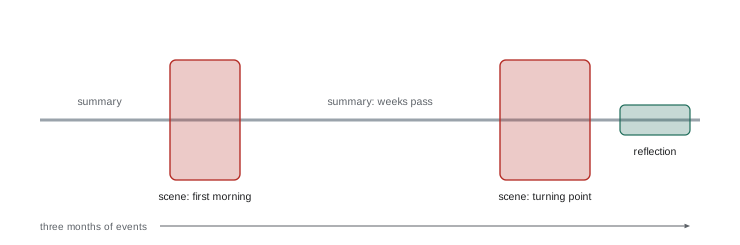
Storytellers alternate between two modes. Summary compresses time ("for three months, I practised every morning"), moving the story along quickly. Scene slows time and shows a specific moment in detail, with sights, sounds, actions and words ("the first morning, my neighbour banged on the wall at 6:02 and shouted that it sounded like a dying goose"). Scenes create emotion and vividness; summary provides context and pace. Good stories use summary for the parts in between and scenes for the moments that matter most, especially the turning point. A common weakness in creator storytelling is summarizing everything, which keeps viewers at a distance. Choosing one or two key scenes and telling them in rich detail makes stories come alive.
| Mode | What it does | Example |
|---|---|---|
| Summary | Compresses time, gives context | "For months I edited every night after work." |
| Scene | Shows one moment in detail | "At 2 a.m. the export bar froze at 99 %, and I just stared at it." |
| Reflection | Explains meaning | "That night taught me to back up before every export." |
Dialogue and detail
Brief quoted lines of dialogue bring scenes to life: what someone said, exactly, at a key moment. In spoken storytelling, creators can perform dialogue with a change of voice or position, which audiences enjoy, though it should never mock the person quoted. Sensory details, such as the smell of a workshop, the sound of rain on a tent or the weight of a camera bag, place viewers in the moment. Specific numbers and names (the café's name, the exact time, the price) add credibility. Use detail selectively: a few well-chosen details are more powerful than many, and details should serve the point.
Telling stories about other people
Personal stories usually involve other people: family, friends, partners, colleagues, clients, strangers. Their privacy and dignity matter. Before telling a story that features someone else, consider whether they would recognize themselves, whether the story could embarrass, harm or expose them, and whether they would agree to it being told. Ask permission where possible, especially for identifiable people and sensitive topics; change or omit names and details where appropriate; and be especially careful with children, who cannot meaningfully consent to having their stories broadcast and may later object to what was shared about them. Stories that criticize named people can raise legal issues such as defamation if they include false statements of fact, and they can provoke harassment of the person by viewers. Telling the story from your own perspective ("I felt hurt when ...") rather than accusing others is usually both fairer and more effective.
Deciding what not to share
Personal storytelling is powerful partly because it involves vulnerability, but creators need boundaries. Useful questions before sharing include: Am I sharing this from a place of reflection, or am I still processing it? Could this information be used to locate, harass or harm me or others? Would I be comfortable with this story being public permanently, including to future employers, partners or children? Am I sharing because it helps the audience, or because I feel pressure to reveal more? Many creators follow a principle of sharing scars rather than wounds: telling stories about difficulties they have come through and can reflect on, rather than raw, ongoing crises. CRE-110 covers boundaries and privacy in brand building, and CRE-350 covers creator wellbeing.
Keeping personal storytelling sustainable
Creators who rely heavily on personal stories can feel that they must turn every part of life into content, or that they are running out of material. Sustainable habits include collecting stories continuously in a story bank (Lesson 1); telling the same core stories in different ways for different contexts, since audiences change and good stories bear repeating; balancing personal stories with stories from others, such as guests, viewers and research; and protecting parts of life that remain private. Personal stories should serve the content and the audience, not consume the creator.
Prompts for finding stories
When your story bank feels empty, prompts can help. Try completing sentences such as: "The first time I ...", "I was completely wrong about ...", "The best advice I ignored was ...", "The day everything changed was ...", "I still remember the moment when ...", "Nobody told me that ...", and "The hardest part of ... was ...". Looking through old photos, messages or calendars also triggers memories, as can asking friends and family which stories about you they tell. Many creators set aside time each week to review recent experiences for story material, noting the specific details while they are fresh.
Telling the same story differently
The same personal story can be told in many ways for different purposes and formats. A 20-second version for a short video might contain only the turning point and the punchline; a two-minute version for a talking-head video adds the setup and a scene; a ten-minute version for a podcast adds reflection, context and secondary characters. The point may also change with the context: a story about failing a driving test might illustrate perseverance in one video and the value of preparation in another. Keeping notes on how you have told each story, and how audiences responded, helps you refine it over time, as stand-up comedians refine their routines.
Truth, memory and composite stories
Memory is imperfect, and storytellers inevitably reconstruct details. Dialogue remembered years later is approximate, sequences may be simplified, and minor characters may be combined. These are normal features of storytelling, but where they matter to the audience's understanding, signal them ("she said something like ..."). Composite stories, which combine several real events or people into one, should be acknowledged if the audience would otherwise assume they are a single true account. Fabricating events entirely, especially to claim experiences you have not had, crosses from storytelling into deception.
Practising personal stories aloud
Personal stories improve dramatically when told aloud before filming. Tell the story to a friend, a family member or even your phone's voice recorder, and notice where listeners lean in, laugh or lose interest. Each telling reveals which details matter and which can go, and the phrasing becomes more natural. Professional storytellers often tell a story dozens of times before it reaches its best form.
Asking for others' stories
Viewers, guests and community members have stories too. Inviting viewers to share their experiences, with permission to feature them, broadens your material and makes the audience part of the content. Always ask before telling someone else's story, credit them as they wish and remove identifying details if they prefer anonymity.
Common mistakes
MistakeWaiting for dramatic events.
InsteadExamine ordinary moments for change and surprise.
MistakeStarting with background.
InsteadStart near the moment of tension.
MistakeSummarizing everything.
InsteadSlow down into scenes at key moments.
MistakeAdding a moral the story does not support.
InsteadLet the point arise from what happened.
MistakeSharing others' stories without thought.
InsteadConsider privacy, ask permission and protect children.
Summary and key terms
- Personal stories come from firsts, mistakes, turning points, surprises and observations.
- A story contains change, surprise and stakes.
- Shape experience by finding the change, starting late and cutting the rest.
- The point turns a personal anecdote into something meaningful for viewers.
- Alternate summary and scene, slowing down at key moments.
- Brief dialogue and selective sensory detail bring stories to life.
- Respect others' privacy, set boundaries and keep storytelling sustainable.
- Personal story
- Story drawn from the teller's own experience.
- Anecdote
- Short account of an incident, without necessarily a change.
- Origin story
- Story of how a creator or interest began.
- Turning point
- Moment when things change.
- Point
- The meaning a story leaves behind.
- Summary
- Compressed narration of time.
- Scene
- Detailed telling of a specific moment.
- Reflection
- Narration explaining meaning.
- Sensory detail
- Detail of sight, sound, smell, touch or taste.
- Scars not wounds
- Sharing difficulties already processed.
Practice problems
Work each problem on paper first, then reveal the answer to check.
Name four sources of personal stories.
Show answer
Firsts, mistakes, turning points, surprises, observations, origins.
What question reveals a story's change?
Show answer
What did I believe or feel before, and what changed?
Where should a shaped story usually start?
Show answer
Close to the moment of tension.
Where should a storyteller slow down?
Show answer
At the turning point.
What does a point do?
Show answer
Makes the story meaningful to viewers.
What is the difference between scene and summary?
Show answer
Scene shows a moment in detail; summary compresses time.
Why use brief dialogue?
Show answer
It brings scenes to life.
Why be careful with stories about children?
Show answer
They cannot meaningfully consent and may later object.
What does "scars not wounds" mean?
Show answer
Share processed difficulties, not raw ongoing ones.
Name a sustainable storytelling habit.
Show answer
Story bank, retelling core stories, others' stories, privacy.
Lesson quiz · 5 questions
Score 60% or more to complete this lesson.
Create a free account to save your progress, take quizzes and earn a certificate.