
CRE-240 · Lesson 2 of 12 · 25 min
Formats, concepts and positioning a show
Thousands of new podcasts launch every month, and most fade within a few episodes. Shows that last usually start with a clear concept: who the show is for, what it gives them, why this host, and why this format. A good concept makes every later decision easier, from guest selection to episode length to artwork, and it gives potential listeners a reason to press play instead of choosing one of the millions of existing shows. This lesson covers the main podcast formats, defining a concept, researching the competition, positioning and differentiation, naming, show descriptions and artwork, choosing length and frequency, and testing a concept before committing to a full launch.
The main formats
Podcasts come in a range of formats, each with different strengths, workloads and audiences:
- Interview: a host talks with a different guest each episode. Interviews bring fresh voices and expertise and allow guests to promote the show, but they depend on booking good guests and on interviewing skill (Lesson 6).
- Co-hosted conversation: two or more regular hosts discuss topics, news or culture. Chemistry between hosts is the main attraction (Lesson 7).
- Solo: one host teaches, reflects or comments. Solo shows are easy to schedule but demand strong preparation and delivery.
- Panel or roundtable: a host with several regular or rotating guests, common in news, sports and industry shows.
- Narrative or documentary: scripted, reported stories with interviews, narration, sound design and music, the format of Serial and many public-radio shows. They are powerful but very labour-intensive.
- Fiction and audio drama: scripted stories performed by actors with sound design.
- Educational and how-to: structured teaching, lessons or tips.
- News and daily briefings: short, frequent episodes summarizing developments.
- Hybrid: combinations, such as a solo segment followed by an interview, or a narrative show with interview episodes between seasons.
| Format | Main appeal | Workload | Key risk |
|---|---|---|---|
| Interview | Expertise, variety, guest audiences | Medium | Depends on guests and interviewing skill |
| Co-hosted | Chemistry, personality | Low to medium | Rambling without structure |
| Solo | Expertise, intimacy | Medium | Delivery and energy |
| Narrative | Story, craft, emotion | Very high | Time and cost |
| News or daily | Timeliness, habit | High (frequency) | Burnout |
| Fiction | Immersion, imagination | Very high | Discovery and production cost |
Defining a concept
A concept answers a few questions clearly:
- Who is it for? A specific audience defined by interests, situation or need, not "everyone". "First-time managers in tech companies" is a stronger audience than "people interested in business".
- What does it give them? Information, entertainment, companionship, inspiration, practical help, a sense of community or insider access.
- Why this host? Expertise, experience, a distinctive perspective, access to people or communities, or a personality that listeners enjoy.
- Why this format? The format should suit the content: a show about complicated true crimes may need narrative; a show about weekly developments in a field may need news-style briefings.
- What makes it different? A clear angle that distinguishes it from existing shows on similar topics.
Writing a one-sentence concept, sometimes called a logline, focuses these answers: "A weekly 30-minute interview show in which an emergency physician talks with people who survived extraordinary medical events, for listeners curious about medicine and resilience." If you cannot write such a sentence, the concept needs more work.
Researching the competition
Before committing to a concept, search podcast apps and YouTube for shows on the same topic. Listen to several episodes of the most popular and the most recent. Note their formats, lengths, hosts, strengths, weaknesses and reviews, especially complaints, which reveal unmet needs. Competition is not necessarily bad: a topic with many popular shows has proven demand, and a new show can succeed by serving a narrower audience, taking a different angle or offering better quality. A topic with no shows at all may lack demand, or may be an opportunity; testing (below) helps tell the difference. Communities such as forums, subreddits and social groups related to the topic reveal the questions and frustrations of potential listeners.
Positioning and differentiation
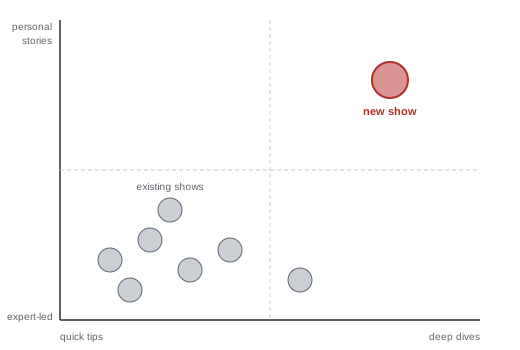
Positioning is the place a show occupies in listeners' minds relative to alternatives. Ways to differentiate include audience (a show about personal finance for nurses, for farmers, or for new immigrants to Canada or the United States), perspective (the same topic from a scientist, a practitioner or a critic), tone (serious, funny, calm, energetic), depth (quick tips versus deep dives), format (narrative instead of interview), access (guests or communities others cannot reach), and production (exceptional sound design or editing). A useful exercise is a positioning statement: "For [audience] who [need], [show] is a [format] that [benefit]. Unlike [alternatives], it [difference]." Strong positioning also guides what the show will not do, which helps keep episodes focused.
Naming a show
A show's name appears in search results, app listings and conversations, so it should be memorable, easy to say and spell when heard aloud, and ideally signal what the show is about. Descriptive names ("The Beginner's Garden Podcast") help search and clarity; creative names are memorable but may need a descriptive subtitle. Check that the name is not already used by another podcast, a trademark or a business in the same field, and that the matching domain and social handles are available or that suitable variations exist. Avoid names that limit future direction, such as including a year or a narrow topic you may outgrow. Remember that some apps search titles, authors and descriptions, so including key topic words in the title or author field can help discovery, but stuffing keywords looks spammy and may breach platform rules.
Descriptions and artwork
The show description, shown on every app's show page, should state clearly who the show is for, what listeners will get, and the format and frequency, in the first sentence or two, since apps often truncate descriptions. Use natural language that includes the words people would search for. Episode descriptions should summarize each episode, list guests and key topics, and include links or timestamps where useful.
Cover art is the show's visual identity in apps, displayed as small as a postage stamp. Apple Podcasts requires square artwork between 1400 × 1400 and 3000 × 3000 pixels in JPEG or PNG format in the RGB colour space at the time of writing; most other platforms accept the same image. Effective artwork uses a bold, simple design with a large, readable title, strong contrast and few elements, and avoids small text, low-resolution photos and imagery that misrepresents the content. Check how it looks at about 60 pixels wide, roughly its size in app lists. CRE-230 covers design for small screens.
Worked problem
Writing a show description
Write the opening of a description for a weekly 25-minute show in which a registered dietitian answers listener questions about everyday nutrition.
Show solution
- State the audience and benefit: busy people who want clear, evidence-based answers about food.
- State the format and frequency: weekly, about 25 minutes, listener questions.
- State the host's credibility: a registered dietitian.
- Draft: "Clear, evidence-based answers to your everyday nutrition questions, from a registered dietitian. Every week in about 25 minutes, [host] answers listener questions about meals, labels, supplements and food myths, without fads or guilt."
Answer: A two-sentence opening that names the audience, benefit, host credential, format and frequency, using words people search for.
Length and frequency
There is no ideal podcast length; the right length is as long as the content deserves and the audience wants. Commute-length episodes of 20 to 45 minutes suit many shows; long-form conversations of 90 minutes or more work for some interview and comedy shows with dedicated audiences; daily news shows often run 10 to 25 minutes. Consistency matters more than any particular length, because listeners build habits around shows. Frequency involves a similar trade-off: weekly is common and builds habit, biweekly reduces workload, daily requires a team or very efficient production, and seasonal shows release a batch of episodes, then pause, which suits narrative and documentary formats and allows production in advance. Choose a schedule you can sustain for at least a year; irregular publishing and long unexplained breaks lose listeners.
Testing a concept
Before investing in equipment, artwork and a launch, test the concept cheaply. Record two or three pilot episodes and share them with a small group of people from the target audience, asking specific questions: Would you subscribe? What would you skip? What was most useful? Post short clips or a written version of the content on social platforms to gauge interest. Interview potential listeners about their needs. Recording pilots also reveals practical problems with the format, such as how long editing takes or whether co-hosts have chemistry. Many successful shows changed format, length or focus after their first episodes; it is better to make those changes before a public launch.
Choosing a format you can sustain
The best format on paper may not be the best format for you. Consider your skills, such as interviewing, storytelling, improvising or teaching; your time, since narrative and daily shows are far more demanding than weekly conversations; your access to guests and co-hosts; your budget for equipment and editing; and your personality, since some people thrive on solo delivery while others need someone to talk with. A realistic test is to imagine making episode 40: if the format still sounds manageable and interesting after a year, it is a good choice. Many creators begin with a simpler format and add more ambitious elements, such as narrative episodes or video, once the show is established.
Trailers and the first episodes
Before launch, most shows publish a short trailer of one to three minutes that explains the show, the host and what listeners will get, ideally with excerpts from upcoming episodes. A trailer allows the show to be approved and listed by directories before the full launch, gives the show a page to share, and lets potential listeners sample the concept. Many shows launch with two or three episodes at once, so that new listeners can binge and get a fuller sense of the show. The first episodes should represent the show at its best; a rough "episode zero" explaining why you are starting a podcast rarely interests new listeners.
Show names and searchability
Podcast apps search show titles, author names and descriptions, so the words in these fields affect whether people can find a show. A creative title can be paired with a descriptive subtitle in the author or description fields, for example a show called "Rooted" with the description "A gardening podcast for cold climates". Apple and other directories prohibit keyword stuffing, such as repeating search terms or adding unrelated names, and may reject or remove shows that do it. Using the same name across the podcast, website and social handles makes the show easier to recommend and find.
Explicit content and categories
Directories ask whether a show contains explicit content, such as strong language or adult themes, and listeners can filter explicit shows. Mark shows and individual episodes accurately; mislabelled content can lead to complaints or removal. Choose categories and subcategories that reflect the show's main topic, since they affect browsing and charts; most directories allow one primary category and sometimes additional ones. The show's language setting should match its content, which matters for bilingual creators producing separate English and French feeds.
Concept checklist
Before recording a pilot, check the concept against a short list. Can you describe the audience in one sentence? Can you name three existing shows on the topic and explain how yours differs? Can you list twenty episode ideas without strain, a sign that the concept has enough depth? Does the format suit the content and your available time? Is the name clear when spoken aloud, and is it available? Would you listen to this show yourself? If several answers are uncertain, refine the concept before investing in production, since changing a show's identity after launch is harder than adjusting it beforehand.
Common mistakes
MistakeLaunching a show "for everyone".
InsteadDefine a specific audience and benefit.
MistakeChoosing narrative format without considering workload.
InsteadMatch format to time, budget and skills.
MistakePicking a name already used by another show.
InsteadSearch apps, trademarks and handles first.
MistakeArtwork with small text.
InsteadUse a bold title readable at thumbnail size.
MistakePublishing irregularly.
InsteadChoose a sustainable schedule and keep it.
Summary and key terms
- Common formats include interview, co-hosted, solo, panel, narrative, fiction and news.
- A concept defines audience, benefit, host, format and difference.
- Research competing shows and audience communities.
- Positioning differentiates by audience, perspective, tone, depth, format or access.
- Names should be memorable, clear when spoken and available.
- Descriptions lead with audience and benefit; artwork must work at tiny sizes.
- Choose sustainable length and frequency, and test with pilots.
- Format
- The basic structure of a show, such as interview or narrative.
- Concept
- Definition of a show's audience, benefit and approach.
- Logline
- One-sentence summary of a show.
- Positioning
- A show's place relative to alternatives.
- Differentiation
- What makes a show distinct.
- Cover art
- Square image representing a show in apps.
- Show description
- Text describing a show on app pages.
- Seasonal show
- Show released in batches with breaks.
- Pilot
- Test episode recorded before launch.
- Evergreen
- Content that stays relevant over time.
Practice problems
Work each problem on paper first, then reveal the answer to check.
Name four podcast formats.
Show answer
Interview, co-hosted, solo, narrative, panel, fiction, news.
What is the main risk of narrative shows?
Show answer
High workload and cost.
List the concept questions.
Show answer
Who for, what benefit, why host, why format, what difference.
What is a logline?
Show answer
A one-sentence summary of the show.
Why read negative reviews of competitors?
Show answer
They reveal unmet needs.
Name three ways to differentiate.
Show answer
Audience, perspective, tone, depth, format, access, production.
Apple artwork size range at the time of writing?
Show answer
1400 × 1400 to 3000 × 3000 pixels.
What should a description say first?
Show answer
Audience, benefit, format and frequency.
Why does consistency matter?
Show answer
Listeners build habits around shows.
How can you test a concept?
Show answer
Pilots shared with target listeners, clips, interviews.
Lesson quiz · 5 questions
Score 60% or more to complete this lesson.
Create a free account to save your progress, take quizzes and earn a certificate.