
CRE-240 · Lesson 7 of 12 · 25 min
Solo, co-hosted and narrative shows
Not every podcast is an interview. Solo shows build an intimate relationship between one host and the listener; co-hosted shows thrive on chemistry, banter and contrasting views; narrative and documentary shows use scripting, tape and sound design to tell stories with the craft of radio documentary. Each demands different skills and production methods. CRE-220 covered voice, presence and co-hosting on camera; this lesson focuses on audio-only craft: writing for the ear, preparing and delivering solo episodes, structuring co-hosted conversations, roles and chemistry in audio, the elements of narrative podcasts, scripting with tape, narration, sound design and music, fact-checking, and the workflows of narrative production.
Writing for the ear
Writing that will be heard differs from writing that will be read. Listeners cannot reread a sentence, see paragraph breaks or skim headings, so audio scripts use:
- Short sentences and one idea per sentence.
- Active voice and concrete nouns and verbs.
- Conversational language, including contractions, that sounds natural when spoken.
- Signposting and repetition of key points, which would be redundant in print but help listeners.
- Numbers rounded and explained: "about one in four" rather than "24.7 per cent".
- Attribution before the quote: "As the study's author put it…", so listeners know who is speaking.
- Avoiding tongue twisters, long lists and acronyms that are hard to say or hear.
Read scripts aloud while writing; anything that trips you up will trip up the listener. Many writers mark scripts with slashes for pauses and underline words to stress.
| Written for the page | Rewritten for the ear |
|---|---|
| According to a 2024 survey of 3,000 respondents, 24.7 % reported… | About one in four people in a large survey last year said… |
| The NCBI-indexed meta-analysis, which included 40 RCTs, found… | A big review of forty clinical trials found… |
| "We were unprepared," said the mayor. | The mayor admitted that the city was not ready: "We were unprepared." |
| Factors include cost, time, staffing, training and maintenance. | Three things drive the decision: cost, time and people. |
Solo shows
A solo host speaks directly to one listener, which can create remarkable intimacy and authority, but there is no one to bounce off, so energy, structure and preparation matter more than in any other format. Effective solo shows usually have a clear structure announced at the start, such as three ideas, five mistakes, or one story and its lessons; stories and examples to illustrate each point; a conversational outline rather than a word-for-word script, unless the host reads very naturally; variation in pace, such as moving between explanation, story and listener questions; and a strong ending. Many solo hosts imagine talking to a single specific listener, which helps the tone stay personal. Recording in shorter sections and editing them together is common and makes delivery easier.
Worked problem
Outlining a 20-minute solo episode
A personal finance host plans a solo episode on building an emergency fund. Draft a structure.
Show solution
- Cold open (0:30): a listener's story of an unexpected car repair bill.
- Promise and roadmap (1:00): "Today: how big your fund should be, where to keep it, and how to build it on a tight budget."
- Point 1 (5:00): how big, with a worked example for monthly expenses of $3,200.
- Point 2 (5:00): where to keep it, comparing account types.
- Point 3 (6:00): three ways to build it, with stories.
- Recap and call to action (2:00): one step to take this week; preview of next episode.
Answer: A cold open, a clear roadmap, three timed points with examples and a recap with one call to action, totalling about 20 minutes.
Co-hosted shows
Co-hosted shows depend on chemistry: the way two or more hosts complement, challenge and entertain each other. Chemistry cannot be manufactured, but it can be supported. Successful co-hosts often have distinct roles: one may be the expert and the other the curious stand-in for the listener; one may steer the structure while the other brings energy and tangents; or each may bring a different perspective. Clear structure prevents the most common problem of co-hosted shows, rambling: a topic list, segments with rough timings, and a host who is responsible for moving things along. Hosts should prepare individually so that each brings something to the conversation, and avoid inside jokes and references that exclude new listeners.
In audio, turn-taking is harder than on video because listeners cannot see who is about to speak. Distinct voices help, as does using each other's names, especially early in episodes, and avoiding constant crosstalk, which is tiring to listen to and hard to edit. Recording each host on a separate microphone and track (Lesson 4) allows editors to reduce overlaps and balance levels.
Narrative and documentary podcasts
Narrative podcasts tell stories through a combination of elements, a style refined by public radio and shows such as This American Life, Radiolab and Serial:
- Narration: the host's scripted voice guiding the listener.
- Tape: recorded interviews, field recordings, archival audio and phone calls, often called actuality.
- Scenes: moments recorded or reconstructed in which events unfold, with sound placing listeners in a location.
- Music: scoring that sets mood, marks transitions and supports emotion.
- Sound design: ambient sound, effects and silence used to build atmosphere.
- Structure: story arcs within episodes and across a season, with questions, revelations and cliffhangers.
Narrative production follows a process similar to documentary film: research and pitching, reporting and recording interviews, logging and transcribing tape, outlining the story, writing scripts with tape selected, recording narration, editing and scoring, fact-checking and final mixing.
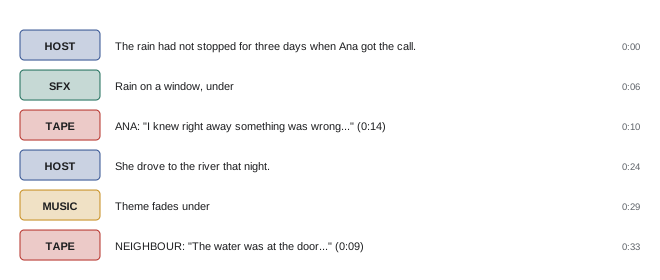
Scripting with tape
Narrative scripts alternate narration with tape. Good narration sets up each piece of tape, introducing who is speaking and why it matters, then lets the tape carry the emotion and detail; afterward, narration moves the story forward rather than repeating what the tape said. Tape selections are usually short, from a few seconds to a minute, chosen for vivid, emotional or surprising moments. Scripts indicate each tape cue with the speaker, the in words and out words, and the duration. Writers often build the structure around their strongest tape, a principle sometimes summarized as "find the best moments, then write the bridges". A common error is narration that explains everything, leaving no space for tape; another is tape that drifts without narrative purpose.
Narration and performance
Narration should sound like a person telling a story, not reading a document. Techniques include writing in your own voice, marking scripts for pauses and emphasis, recording narration after the tape is selected so that delivery matches the story, recording multiple takes of important lines, and listening back with music and tape in place. Pace usually slows slightly for emotional moments and speeds up for exposition. Consistency across recording sessions, such as the same microphone, distance, room and energy, prevents noticeable shifts in the host's sound across a season.
Music and sound design
Music and sound design shape the listener's emotions and sense of place. Music can establish the show's identity with a theme, mark transitions between scenes and acts, underscore emotional moments, and create tension. Use it with restraint: constant music behind speech is fatiguing and can feel manipulative, and silence is often more powerful. Mix music well below speech, typically 15 to 25 dB lower under narration (Lesson 9). Sound design includes ambient recordings of real places, effects and the deliberate use of silence. All music and effects must be properly licensed: library music, commissioned scores, or music you own, as Lesson 8 discusses.
Fact-checking and accuracy
Narrative and documentary podcasts make factual claims about real people and events, and errors can mislead listeners, harm the people discussed and expose producers to legal claims. Professional narrative shows fact-check scripts line by line before publication: verifying names, dates, numbers, quotes and descriptions against documents and sources, confirming that tape is presented in context, and checking that claims about individuals are fair and supported. Independent creators can adopt a simplified version: keep a source note for every factual claim in the script, verify key facts with primary sources, and ask an experienced colleague to review sensitive episodes. Corrections should be made promptly and acknowledged in show notes or a later episode.
Narrative workflows and teams
Narrative shows are often made by teams: a host or reporter, producers who book interviews and cut tape, an editor who shapes the story, a sound designer and mixer, a composer, and a fact-checker. A season of six to ten narrative episodes may take months of work. Independent creators can make narrative shows by limiting scope, for example with shorter episodes, fewer locations and a simpler sound palette, by producing seasons in advance, and by building skills through shorter narrative segments within an existing interview show before attempting a full series.
Scripting a solo episode
Solo hosts choose between full scripts and outlines. Full scripts guarantee precision and are useful for complex explanations, legal or medical topics and tightly timed segments, but many hosts sound stilted reading them. Techniques that help include writing in the host's natural voice, reading the script aloud several times before recording, marking emphasis and pauses, and allowing small departures from the text. Outlines with key phrases, examples and transitions often sound more natural but risk rambling. A hybrid approach scripts the opening, transitions and closing word for word and outlines the body. Recording a practice take and listening back reveals which approach suits a particular host.
Handling disagreement between co-hosts
Disagreement can be the most engaging part of a co-hosted show, if it is genuine and respectful. Hosts can agree in advance on topics where they disagree and let the debate develop naturally, steelmanning each other's views rather than mocking them, and acknowledging when they are persuaded. Personal conflicts that spill into episodes, or manufactured arguments, alienate listeners. Off air, co-hosts should agree on decision-making, responsibilities, revenue sharing and what happens if one leaves, ideally in a written agreement, since disputes over the show's name, feed and revenue are a common cause of shows ending badly.
Building scenes in audio
A scene puts listeners in a place and moment. In narrative audio, scenes are built from ambient sound recorded on location, dialogue and action captured as it happens, narration that sets the time and place, and specific sensory details. Recording scenes requires planning: arriving early to capture room tone and ambience, recording people doing things rather than only talking about them, and asking participants to describe what they are doing. When scenes must be reconstructed from interviews, narration should make clear what is reconstruction and what was recorded live, to maintain trust.
Logging and transcribing tape
Narrative producers often record many hours of tape for each episode. Logging, noting the content and timestamps of each recording, and transcribing key interviews make it possible to find the best moments and build scripts. Automatic transcription tools make this far faster, but transcripts must be checked against the audio, especially for quotes used in scripts. Many producers highlight strong moments in transcripts, assemble them into a rough "radio cut", and then write narration around them.
Audio drama basics
Fiction podcasts and audio dramas use actors, scripts written entirely for sound, music and detailed sound design. Writers must convey setting, action and character through dialogue and sound alone, avoiding visual descriptions that would be awkward to speak. Production involves casting, directing actors remotely or in studios, recording dialogue cleanly, building soundscapes in layers, and mixing for immersion. Audio drama is among the most ambitious podcast formats, but small, well-written stories with a few characters can be made by independent creators.
Pacing and length in solo shows
Solo episodes can feel long more quickly than conversations, because listeners hear only one voice. Shorter episodes, varied pace and clear segments help; so does including other voices through listener questions, short clips from interviews, or a recurring guest segment. Track where listeners stop in solo episodes and adjust length accordingly.
Common mistakes
MistakeScripts written like essays.
InsteadWrite short, spoken sentences and read them aloud.
MistakeSolo episodes without structure.
InsteadAnnounce a roadmap and follow it.
MistakeCo-hosts rambling with inside jokes.
InsteadUse a topic list, roles and a host who steers.
MistakeNarration that repeats the tape.
InsteadSet up tape, let it speak, then move forward.
MistakeWall-to-wall music under speech.
InsteadUse music with restraint and silence for impact.
Summary and key terms
- Writing for the ear uses short sentences, signposting and spoken language.
- Solo shows need structure, stories and personal delivery.
- Co-hosted shows depend on chemistry, roles and structure.
- Narrative shows combine narration, tape, scenes, music and sound design.
- Scripts set up tape and let it carry emotion.
- Music and sound design should be used with restraint and properly licensed.
- Fact-checking protects listeners, subjects and producers.
- Writing for the ear
- Writing designed to be heard rather than read.
- Solo show
- Podcast with a single host.
- Chemistry
- The engaging dynamic between co-hosts.
- Crosstalk
- People speaking over each other.
- Narration
- Scripted host voice guiding a narrative.
- Tape
- Recorded interview or field audio.
- Actuality
- Recorded sound of real events or speech.
- Scene
- Moment in which events unfold for the listener.
- Sound design
- Use of ambient sound, effects and silence.
- Fact-checking
- Verifying claims before publication.
Practice problems
Work each problem on paper first, then reveal the answer to check.
Name three techniques for writing for the ear.
Show answer
Short sentences, active voice, signposting, rounded numbers, attribution first.
Rewrite "24.7 per cent" for the ear.
Show answer
About one in four.
Why read scripts aloud?
Show answer
To find phrases that trip up speaker and listener.
What helps solo shows hold attention?
Show answer
Roadmap, stories, varied pace, strong ending.
Name two co-host roles.
Show answer
Expert and curious listener; steerer and energy.
Why use names in co-hosted audio?
Show answer
Listeners cannot see who is speaking.
List four elements of narrative podcasts.
Show answer
Narration, tape, scenes, music, sound design, structure.
What do tape cues include?
Show answer
Speaker, in words, out words, duration.
Typical music level under narration?
Show answer
About 15–25 dB below speech.
What does a fact-check verify?
Show answer
Names, dates, numbers, quotes, context and fairness.
Lesson quiz · 5 questions
Score 60% or more to complete this lesson.
Create a free account to save your progress, take quizzes and earn a certificate.