
CRE-340 · Lesson 4 of 12 · 26 min
Finding and vetting creators
Choosing the right creators is the single biggest driver of campaign results. Two creators with similar follower counts can differ tenfold in real reach, audience fit and persuasive power, and one poorly vetted creator can turn a campaign into a crisis. This lesson covers where to find creators, how to build and narrow a long list, how to check audience authenticity and fit, how to audit past content for brand safety and how to score candidates consistently.
Where to find creators
Brands find creators through several channels, and most programs use more than one. Each has strengths and blind spots.
- Your own customers and followers. People who already tag your products, review them or follow your accounts are often the most authentic advocates. Social listening tools and a simple search of tagged posts can surface them.
- Platform marketplaces. Major platforms run tools that let brands search creators who have opted in, see first-party audience data and manage branded content. Names and features change often, so check what is currently offered on each platform you plan to use.
- Third-party discovery software. Commercial tools index millions of public creator profiles, estimate audience demographics and flag suspicious growth. Their estimates are modelled rather than first-party, so treat them as screening data.
- Manual search. Searching hashtags, keywords, locations and competitor mentions on each platform finds creators that databases miss, especially nano creators and those in niche communities.
- Agencies and talent managers. Influencer agencies and management firms bring rosters, relationships and negotiation experience, at the cost of fees and sometimes a bias towards their own talent.
- Inbound applications. Brands with strong reputations receive pitches from creators. An application form that asks for audience data and examples can turn these into a useful pipeline.
- Referrals. Creators you already work with often know others in their niche who would be a good fit.
From long list to shortlist
A typical selection process narrows a long list in stages, applying cheap checks first and expensive checks later. A first screen removes creators who fail obvious criteria: wrong country, wrong language, wrong platform, wrong niche, too small or too large for the budget, or recent work for a direct competitor. A second screen looks at performance data: median views, reach and engagement on recent posts, posting frequency and growth trend. A third, deeper stage checks audience authenticity, audience fit and past content. Only then does the brand contact creators to confirm interest, availability and rates.
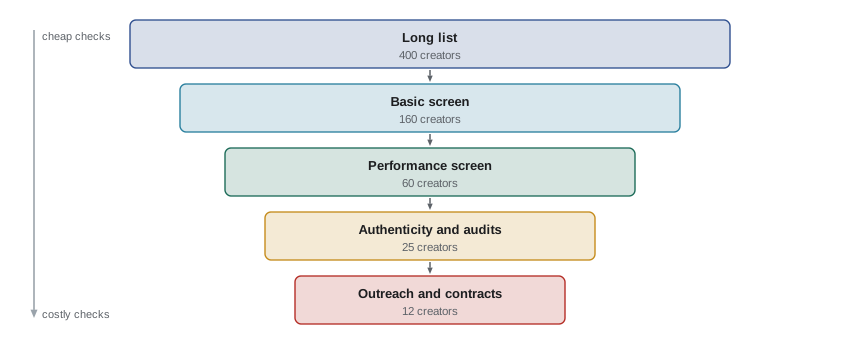
Keep records of why creators were excluded at each stage. Records make the process repeatable, help defend decisions if a creator asks why they were not chosen and reveal patterns, such as a discovery tool that keeps suggesting accounts with suspicious audiences.
Performance data that matters
Follower counts say little about future results. More useful measures are median views or reach per post over a recent period, typically the last 10 to 20 posts or the last 90 days; engagement rate by reach or views; the ratio of saves and shares to likes, which signals content people value enough to keep or pass on; the performance of previous sponsored posts compared with organic posts; and the trend in views over time. Medians are better than averages because a single viral post can lift an average far above what a typical post achieves.
Ask creators for screenshots or, better, direct exports of their platform analytics, including audience demographics and location. Some platforms let creators share verified insights with brands through their marketplace tools. Public data is enough for screening but not for final decisions on large spends.
Audience authenticity and fake followers
Fraud in influencer marketing usually takes the form of purchased followers, purchased likes, comments and views, or participation in engagement pods, groups of creators who agree to like and comment on each other's posts to game algorithms. The aim is to look bigger and more engaging than the account really is. Brands that pay for fake audiences pay for people who do not exist.
Common warning signs include:
- Sudden jumps in follower count that do not match a viral post, media appearance or other plausible cause.
- Engagement rates far below or far above what is typical for the tier and platform.
- Generic, repetitive or irrelevant comments, such as strings of emojis or "nice pic" from accounts with no posts.
- A large share of followers in countries unrelated to the creator's language and content.
- Followers with no profile picture, no posts and random usernames.
- High follower counts with very low views on video content.
Discovery tools estimate the share of suspicious followers, but their methods differ and none is perfect. Combine tool estimates with your own inspection and with first-party analytics from the creator. When fake followers are present but the creator is otherwise attractive, adjust the numbers rather than relying on the headline count.
Worked problem
Adjusting for suspicious followers
Creator A has 120,000 followers, an estimated 30 % suspicious followers and 50 % of real followers in the target market. Creator B has 70,000 followers, 5 % suspicious followers and 70 % target fit. Which has the larger useful audience?
Show solution
- Creator A: 120,000 × (1 − 0.30) × 0.50 = 120,000 × 0.70 × 0.50 = 42,000.
- Creator B: 70,000 × (1 − 0.05) × 0.70 = 70,000 × 0.95 × 0.70 = 46,550.
- Creator B has the larger useful audience despite having 50,000 fewer followers, and the high suspicious share at A is itself a risk to the brand.
Answer: Creator B, with about 46,550 useful followers against about 42,000 for Creator A.
Audience fit
Fit means the creator's real audience matches the campaign's target audience. Check location, age, gender and language data against the target, but also look at what the audience talks about in comments, what other content they respond to and whether they ask the creator for recommendations. A beauty creator whose comments are full of product questions has a buying audience; one whose comments are mostly reactions to personal life may have a loyal but less commercial audience.
Fit also includes values and tone. A brand that positions itself as calm and expert may not suit a creator known for chaotic humour, however large the audience. A good test is to imagine the creator's typical content with your product in it and ask whether it feels natural to both the creator's audience and your existing customers.
Brand safety and content audits
A content audit reviews a creator's past posts, comments and public statements for anything that could embarrass the brand or conflict with its values. Brand safety concerns commonly include hate speech or harassment, sexual content, dangerous stunts, promotion of illegal or regulated products, misinformation, undisclosed sponsorships and repeated feuds. The audit should cover a reasonable period, often one to three years, on all platforms the creator uses, not only the one in the campaign. Search the creator's name with terms such as controversy, apology and scam.
Audits require judgement. Most people have posted something they would phrase differently today, and a creator who acknowledged and learned from a past mistake may be lower risk than one with a spotless but short history. The aim is not perfection but a documented, consistent decision. Write down what was checked, what was found and why the creator was approved or rejected.
Audits should also check past disclosure habits. A creator who regularly fails to label sponsored posts creates legal risk for any brand that hires them, because both the creator and the brand can be responsible for missing disclosures. Lesson 6 covers this in more detail.
| Check | What to look for | Typical source |
|---|---|---|
| Performance | Median reach and views, engagement by reach, sponsored versus organic results | Platform analytics export, discovery tool |
| Authenticity | Growth spikes, suspicious followers, comment quality, view-to-follower ratio | Discovery tool, manual review |
| Audience fit | Location, age, language, interests and buying intent | First-party insights, comments |
| Brand safety | Offensive content, misinformation, risky behaviour, feuds | Manual audit, news search |
| Disclosure history | Consistent and clear labels on past paid posts | Manual audit |
| Competitor conflicts | Recent or current deals with competitors | Manual audit, creator questionnaire |
| Professionalism | Responsiveness, deadlines, references from other brands | Outreach, references |
Scoring candidates consistently
When many people help choose creators, a weighted scorecard keeps decisions consistent and makes trade-offs explicit. The brand chooses criteria, assigns weights that reflect the campaign's priorities and scores each creator, say from 1 to 5. Some criteria are gates rather than scores: a creator who fails the brand-safety audit or has a severe authenticity problem is excluded regardless of other scores.
Worked problem
Weighted creator scorecard
A brand weights audience fit 35 %, performance 25 %, content quality 20 %, authenticity 10 % and cost efficiency 10 %. Creator C scores 5, 3, 4, 4 and 2. Creator D scores 3, 5, 3, 5 and 4. Both pass the brand-safety gate. Which scores higher?
Show solution
- Creator C: 0.35 × 5 + 0.25 × 3 + 0.20 × 4 + 0.10 × 4 + 0.10 × 2 = 1.75 + 0.75 + 0.80 + 0.40 + 0.20 = 3.90.
- Creator D: 0.35 × 3 + 0.25 × 5 + 0.20 × 3 + 0.10 × 5 + 0.10 × 4 = 1.05 + 1.25 + 0.60 + 0.50 + 0.40 = 3.80.
- Creator C edges ahead because the brand weighted audience fit most heavily.
Answer: Creator C scores 3.90 and Creator D 3.80; with weights this close, the team might hire both or test each with a small first deal.
Scorecards are tools for judgement, not substitutes for it. Revisit the weights after each campaign: if creators who scored high on content quality consistently outperformed, increase that weight next time.
Outreach and first contact
Once a shortlist exists, outreach should be personal and specific. Creators receive many generic pitches, and the best ones ignore messages that misspell their name or clearly come from a mass mailing. A good first message explains who the brand is, why this creator specifically, what the campaign involves at a high level, the expected timing and the next step, and invites the creator to share rates. Use the creator's preferred contact route, often a business email listed in their profile or their manager.
Outreach by email to creators is business communication, but Canada's Anti-Spam Legislation (CASL) applies to commercial electronic messages, and its consent rules are strict. Messages to an address a creator has conspicuously published for business enquiries, with no statement that they do not want unsolicited messages, and that relate to their business role, generally fall within an implied-consent exception. Mass marketing to creators who have not published their contact for business purposes may not. Include identification and an unsubscribe mechanism in bulk outreach and check with counsel for large programs.
Due diligence for larger deals
For large or long-term deals, add more due diligence: references from other brands, a call with the creator and their manager, a review of any existing exclusivity commitments, confirmation of the legal entity that will sign and be paid, and, for high-profile creators, a professional background check within the limits of privacy law. The cost of an extra week of checks is small compared with the cost of a public controversy two weeks after launch.
Common mistakes
MistakeSelecting creators from follower counts and a single viral post.
InsteadUse medians over a recent period and compare sponsored with organic results.
MistakeTrusting a discovery tool's audience estimate as fact.
InsteadCombine tool data with manual review and first-party analytics.
MistakeAuditing only the campaign platform.
InsteadAudit all platforms and search news coverage over one to three years.
MistakeIgnoring a creator's past disclosure habits.
InsteadCheck that previous paid posts were clearly labelled.
MistakeSending generic mass outreach.
InsteadPersonalize messages and follow anti-spam rules.
Summary and key terms
- Use several discovery routes: customers, platform marketplaces, tools, manual search, agencies, applications and referrals.
- Narrow long lists in stages, cheapest checks first, and record exclusion reasons.
- Judge performance by medians, engagement by reach and sponsored-post history.
- Look for growth spikes, odd comments and mismatched audience locations as fraud signals.
- Useful audience = followers × (1 − fake share) × target fit.
- Audit past content and disclosure habits, and document decisions.
- Use weighted scorecards with brand-safety gates for consistent decisions.
- Long list
- The broad initial list of possible creators.
- Shortlist
- The creators who pass screening and audits.
- Discovery tool
- Software that indexes creator profiles and estimates audience data.
- Engagement pod
- A group that trades likes and comments to game algorithms.
- Fake followers
- Purchased or automated accounts that inflate follower counts.
- Content audit
- A review of past content for brand-safety risks.
- Brand safety
- Avoiding association with harmful or embarrassing content.
- Weighted scorecard
- A scoring tool with weights for each criterion.
- Gate criterion
- A requirement that excludes a creator regardless of other scores.
- First-party data
- Data from the platform itself, shared by the creator.
Practice problems
Work each problem on paper first, then reveal the answer to check.
Name four places to find creators.
Show answer
Customers, platform marketplaces, discovery tools, manual search, agencies, applications, referrals.
Why use medians rather than averages for views?
Show answer
Viral outliers inflate averages.
Followers 90,000, 20 % suspicious, 60 % fit. Useful audience?
Show answer
90,000 × 0.8 × 0.6 = 43,200.
Give three warning signs of fake followers.
Show answer
Growth spikes, generic comments, odd audience locations, low views.
What is an engagement pod?
Show answer
A group trading engagement to game algorithms.
How far back should a content audit usually go?
Show answer
About one to three years, across all platforms.
Weights 0.5, 0.3, 0.2; scores 4, 3, 5. Weighted score?
Show answer
2.0 + 0.9 + 1.0 = 3.9.
What is a gate criterion?
Show answer
A must-pass requirement such as brand safety.
Why check past disclosure habits?
Show answer
The brand can share liability for missing disclosures.
What should a first outreach message include?
Show answer
Who you are, why them, campaign outline, timing and next step.
Lesson quiz · 5 questions
Score 60% or more to complete this lesson.
Create a free account to save your progress, take quizzes and earn a certificate.