
CRE-340 · Lesson 6 of 12 · 27 min
Briefs, contracts and compliance from the brand side
A good creator campaign rests on two documents: a brief that explains what the brand wants and why, and a contract that sets out what each side has agreed to. Brands also carry legal responsibility for what creators say on their behalf, so compliance has to be built into both. This lesson looks at writing briefs that get good work, the contract terms brands care about most and the disclosure and claims rules brands must manage. CRE-320 covers the law in depth and CRE-330 covers contracts from the creator's side; this lesson focuses on what a campaign manager needs to do.
What a creator brief is for
A brief gives creators everything they need to make content that meets the campaign objective while still sounding like themselves. Brands often err in one of two directions. Some briefs are so vague that creators guess and miss the point. Others are so prescriptive, with scripts, shot lists and mandatory phrases, that the content looks like an ad and loses the trust that made the creator worth hiring. The best briefs are clear about the goal, the audience, the key message and the rules, and open about how the creator gets there.
A typical brief includes:
- Background: the brand, the product and why this campaign exists.
- Objective and KPI: what success looks like, in plain language.
- Audience: who the content is for and what they care about.
- Key message: one main idea, with no more than two or three supporting points.
- Mandatories: things that must appear, such as the product name, a link or code, and disclosure.
- Do's and don'ts: claims to avoid, competitors not to mention, safety requirements and brand guidelines.
- Deliverables and formats: platforms, number of posts, length, aspect ratio and any raw footage for the brand.
- Timeline: draft deadline, review windows, posting dates and reporting deadline.
- Approval process: who reviews, how many rounds are included and how feedback will be given.
- Usage: how the brand may reuse the content, matching the contract.
Keep the brief short, ideally two or three pages, and give examples of content you liked rather than scripts. Invite creators to pitch their own concepts within the brief. Many brands hold a short kickoff call to answer questions; it often saves a round of revisions later.
Claims creators may and may not make
Creators can only say what the brand can substantiate. If a brand cannot prove that a supplement boosts energy or that a cleaning product kills 99.9 % of germs, a creator cannot say it either, however enthusiastically. The brief should list approved claims with their support, claims that must not be made, and any required qualifiers. Health, financial, environmental and children's products carry extra rules, which CRE-320 covers in detail.
Creators must also give their honest opinion. A brand can ask a creator to mention features and benefits, but it should not script false personal experiences, require a creator to claim they have used a product they have not, or ask them to hide negatives they genuinely experienced. If a creator dislikes the product, the right response is to let them decline or to pay the kill fee, not to pressure them into a positive review.
Disclosure: the brand's responsibility
Every paid or otherwise rewarded post must clearly disclose the material connection between the creator and the brand. Material connections include payment, free products, commissions, travel, employment and family relationships. Disclosure must be clear, prominent and in the content itself, placed so the audience sees it before or as they engage, not hidden in a list of hashtags or behind a "more" link. Platform branded-content labels help, but regulators in both countries have said brands and creators should not assume a platform tool is enough on its own.
In Canada, the Competition Act prohibits false or misleading representations, and the Competition Bureau has said that businesses that hire influencers, and the agencies that work for them, can be held responsible for misleading influencer posts, including missing disclosures. Penalties under the civil provisions can be substantial: for corporations, up to the greater of $10 million ($15 million for later orders), three times the benefit derived or 3 % of worldwide revenue. Ad Standards' Influencer Marketing Disclosure Guidelines, updated in 2025, set out practical expectations, including clear hashtags such as #ad or #sponsored, disclosure in every post, and disclosure where AI has been used to create or significantly alter content in a way that could mislead. Ad Standards expects advertisers to require disclosure in contracts, educate creators and monitor posts.
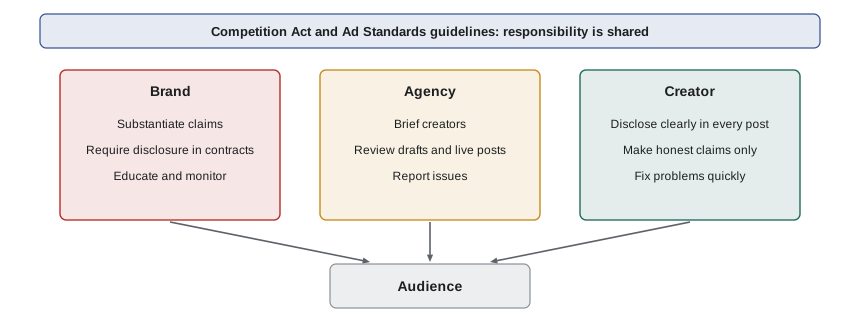
A brand compliance program
Regulators look more kindly on brands that have a real compliance program than on brands that blame individual creators after the fact. A practical program has five parts. First, policy: a written standard covering disclosure, claims and conduct, included or referenced in every contract. Second, training: a short guide or video for creators and staff, refreshed when rules change. Third, review: checking drafts before posting for disclosure and claims. Fourth, monitoring: checking live posts after publication, because creators sometimes edit captions or post extra content. Fifth, enforcement: a clear process for asking creators to fix problems, withholding payment until they do and ending relationships with repeat offenders.
Worked problem
Monitoring disclosure across a campaign
A brand runs 60 sponsored posts. It checks every post within 24 hours of going live and finds that 51 had clear disclosure, 6 had disclosure only in the hashtags at the end of a long caption and 3 had none. What is the compliance rate, and what should the brand do?
Show solution
- Clearly compliant posts: 51 of 60.
- Compliance rate: 51 ÷ 60 = 0.85, or 85 %.
- The 6 buried disclosures and 3 missing ones need fixing: contact the 9 creators, require edits within 24 hours and confirm the fixes.
- Record the issues and, if the same creators repeat them, withhold final payments or end the relationship.
Answer: An 85 % compliance rate; the brand should get all nine posts fixed promptly, document the follow-up and tighten training before the next wave.
Contract terms brands care about
Contracts translate the brief and the negotiation into enforceable promises. Many brands use a master agreement with each creator or agency and a short statement of work for each campaign. The terms below are the ones that most often cause trouble when they are vague.
| Term | What the brand should specify | Common pitfalls |
|---|---|---|
| Deliverables | Platforms, formats, number, length, posting window, raw files | Vague counts such as "a few stories" |
| Approvals | Who reviews, response times, rounds included, what counts as a change of scope | Unlimited revisions; slow brand feedback |
| Usage rights | Channels, paid or organic, duration, territory, edits allowed | Assuming ownership; perpetual rights by default |
| Paid amplification | Whitelisting or partnership-ad authorization, duration, approval of ad copy | Running ads after rights expire |
| Exclusivity | Competitor category, duration, platforms | Overly broad categories that creators cannot honour |
| Disclosure and claims | Required labels, approved claims, compliance with law and guidelines | Leaving disclosure to chance |
| Conduct and morals | Conduct that allows termination, process and payment consequences | Clauses so broad they are unfair or unenforceable |
| Payment | Amount, currency, schedule, invoicing, late-payment terms | Long payment terms that deter creators |
| Cancellation and kill fees | Fees if the brand cancels at each stage | No fee for work already done |
| AI and likeness | Whether either side may use AI to alter content or create synthetic versions of the creator | Silence on digital replicas |
| Data and analytics | Which metrics the creator will share, in what form and by when | Screenshots that cannot be verified |
Usage rights deserve particular care. By default, the creator usually owns the copyright in content they make, and the brand gets only the rights the contract grants. A licence lets the brand use content on stated terms; an assignment transfers ownership and costs more. Most campaigns need a licence that names channels, duration and territory. If the brand later wants to run a creator's video as an ad for a year, it must negotiate and pay for that use.
Worked problem
Costing usage rights from the brand side
A creator's base fee is $2,500. Their rate card prices organic reposting on brand channels at 20 % of base per month and paid ad usage at 35 % of base per month. The brand wants three months of organic reposting and two months of paid usage. What is the total cost?
Show solution
- Organic reposting: 0.20 × 2,500 × 3 = $1,500.
- Paid usage: 0.35 × 2,500 × 2 = $1,750.
- Total: 2,500 + 1,500 + 1,750 = $5,750.
Answer: The total is $5,750; usage more than doubles the base fee, which is why usage needs its own budget line.
Morals clauses and creator conduct
A morals clause allows the brand to end a contract, and sometimes recover payments, if the creator engages in conduct that could harm the brand's reputation. Brands understandably want this protection, but very broad clauses can be unfair to creators and hard to enforce. A balanced clause describes the kinds of conduct covered, such as criminal charges, hate speech or conduct that becomes the subject of significant public controversy, applies to conduct during the contract term, sets out a process including notice, and states what happens to payments for work already delivered. Some creators negotiate reciprocal clauses that let them leave if the brand becomes embroiled in scandal.
Children, privacy and regulated categories
Some campaigns raise extra legal issues that the brand must plan for. Advertising to children is heavily restricted in Quebec, where the Consumer Protection Act bans commercial advertising directed at children under 13, and in the US, where collecting personal information from children under 13 online is governed by COPPA. Campaigns involving alcohol, cannabis, gambling, financial products, health products or prescription medicines face specific rules in each country. Contests run through creators must follow contest laws, and collecting entrants' data raises privacy obligations. Lesson 9 covers privacy in tracking, and CRE-320 covers regulated categories in depth.
Canadian brands collecting personal information through creator campaigns, such as contest entries or sign-ups, must follow PIPEDA or substantially similar provincial laws and, in Quebec, Law 25, which requires clear consent, a privacy officer and privacy impact assessments for certain projects. Sending commercial emails or texts to people who entered through a creator campaign requires consent under CASL.
Templates and workflow
Brands running more than a handful of creators should standardize. A brief template, a master agreement, a statement-of-work template, a disclosure guide, a claims sheet and an approval checklist save time and reduce mistakes. Lawyers should review the templates; campaign managers then fill in campaign details without redrafting legal terms. Lesson 7 shows how these documents fit into a workflow for campaigns with many creators.
Briefing for different platforms
A single brief often covers several platforms, but each platform has its own formats, lengths and audience expectations. Short vertical video needs a strong hook in the first seconds; long-form video can explain and demonstrate in depth; image posts rely on a striking first frame and a caption; podcasts and audio need a natural spoken read with clear disclosure at the start. A good brief notes platform-specific requirements, such as the need for an on-screen disclosure as well as a spoken one in video, while leaving the creative approach to the creator.
Common mistakes
MistakeWriting scripts that make creators sound like ads.
InsteadBrief on goal, audience, message and rules, and let creators choose the approach.
MistakeLetting creators make claims the brand cannot substantiate.
InsteadProvide an approved claims sheet with support and forbidden claims.
MistakeAssuming the creator alone is responsible for disclosure.
InsteadRequire, train, review and monitor disclosure as the brand.
MistakeAssuming paying for content means owning it.
InsteadSpecify licence channels, duration and territory, and budget for usage.
MistakeUsing one-sided, very broad morals clauses.
InsteadDefine covered conduct, process and payment consequences clearly.
Summary and key terms
- A good brief is short and clear about objective, audience, message, mandatories, rules, deliverables, timeline, approvals and usage.
- Creators can only make claims the brand can substantiate and must give honest opinions.
- Disclosure of material connections must be clear, prominent and in every paid post.
- Brands share legal responsibility for creator content under Canadian and US law.
- A compliance program combines policy, training, review, monitoring and enforcement.
- Contracts should specify deliverables, approvals, usage, amplification, exclusivity, disclosure, conduct, payment, cancellation, AI and data.
- Usage rights are licensed, not owned by default, and need their own budget.
- Creative brief
- A document setting out what the brand wants from creator content.
- Mandatories
- Elements that must appear in content.
- Substantiation
- Evidence that supports a claim.
- Material connection
- A relationship that could affect how an audience views an endorsement.
- Licence
- Permission to use content on stated terms.
- Assignment
- Transfer of ownership of rights.
- Statement of work
- A campaign-specific document under a master agreement.
- Morals clause
- A term allowing termination for harmful conduct.
- Kill fee
- Payment due if the brand cancels after work has started.
- Digital replica
- A synthetic version of a person's likeness or voice.
Practice problems
Work each problem on paper first, then reveal the answer to check.
Name six sections of a creator brief.
Show answer
Background, objective, audience, key message, mandatories, rules, deliverables, timeline, approvals, usage.
Can a creator say a product "boosts immunity" if the brand has no evidence?
Show answer
No.
Give three examples of material connections.
Show answer
Payment, free product, commission, travel, employment, family ties.
Is a platform branded-content label always enough on its own?
Show answer
Not necessarily; clear disclosure in the content is expected.
48 of 60 posts compliant. Compliance rate?
Show answer
80 %.
Name the five parts of a compliance program.
Show answer
Policy, training, review, monitoring, enforcement.
Base $2,000; paid usage 30 % per month for 3 months. Usage cost?
Show answer
$1,800.
Licence or assignment: which usually costs more?
Show answer
Assignment.
What should a balanced morals clause include?
Show answer
Covered conduct, term, notice process and payment consequences.
Why should contracts address AI and likeness?
Show answer
To control alteration of content and synthetic replicas of the creator.
Lesson quiz · 5 questions
Score 60% or more to complete this lesson.
Create a free account to save your progress, take quizzes and earn a certificate.