
CRE-350 · Lesson 12 of 12 · 28 min
Capstone: a personal sustainability and safety plan
The previous eleven lessons each covered one part of a sustainable creative life: workload, mental health, routines, money, harassment, privacy, moderation, the law, physical safety and support. This capstone brings them together into one practical document: a personal sustainability and safety plan. The plan is something you write once, share with the people who need it and review regularly. When things go wrong, it lets you act from a calm decision you made in advance rather than a panicked one in the moment.
The lesson works through a fictional example creator, Maya, and then gives you a template and checklist for your own plan. Maya is a 26-year-old creator who makes lifestyle and personal finance videos on two platforms, with 180,000 followers on her main platform. She works alone with a part-time editor and two volunteer moderators.
The structure of the plan
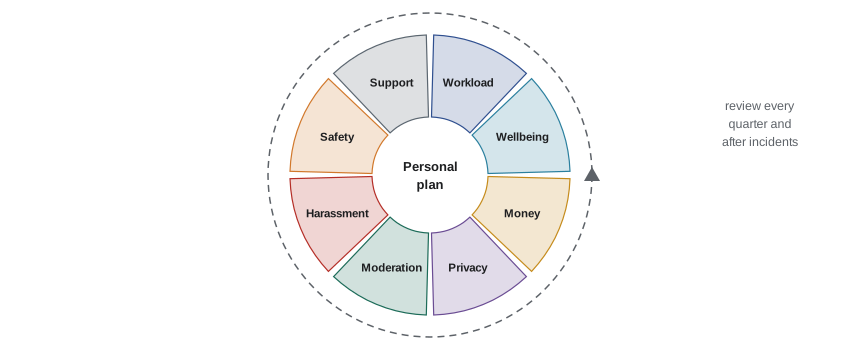
A good plan has eight sections, each linked to earlier lessons.
- Workload and schedule: cadence, working hours, batching and buffer targets (Lessons 2 and 4).
- Wellbeing check-ins and warning signs: what you track and what triggers action (Lessons 2 and 3).
- Money: emergency fund target, salary, tax set-aside and lean-month plan (Lesson 5).
- Privacy and account security: privacy rules, audit results and security settings (Lesson 7).
- Moderation and community: guidelines, filters, moderators and escalation (Lesson 8).
- Harassment response: severity scale, evidence log and reporting contacts (Lessons 6 and 9).
- Physical safety: event risk scoring, home and travel practices (Lesson 10).
- Support: people, professionals, crisis lines and team responsibilities (Lessons 3 and 11).
Step 1: workload and schedule
Maya's time audit showed a 58-hour week, with editing taking 16 hours even with her part-time editor's help and comments taking 9 hours. She publishes three long videos and six shorts a week.
Worked problem
Setting Maya's new schedule
Maya decides to move to two long videos and five shorts a week. Each long video takes 11 hours of her time and each short takes 1.5 hours. Other work (brand deals, admin, planning and comments) will take 14 hours after she introduces comment windows. What is her new weekly workload?
Show solution
- Long videos: 2 × 11 = 22 hours.
- Shorts: 5 × 1.5 = 7.5 hours.
- Other work: 14 hours.
- Total: 22 + 7.5 + 14 = 43.5 hours.
Answer: About 43.5 hours a week, down from 58, a cut of 14.5 hours, or 25 %.
She sets a buffer target of three long videos and plans to build it by batching scripting on Mondays and filming on Tuesdays. She decides on core hours of 9:00 to 17:30 on weekdays, a short Saturday comment window and Sundays off.
Step 2: wellbeing check-ins
Maya will rate her energy, enjoyment and sleep from 1 to 5 every Sunday evening. Her trigger rule: if her average score falls below 3 for two weeks in a row, she will reduce output for the following two weeks and talk to her counsellor. She lists her personal warning signs: skipping workouts, dreading filming days and checking analytics in bed.
Worked problem
Applying the check-in trigger
Over four weeks, Maya's scores (energy, enjoyment, sleep) are week 1: 4, 4, 3; week 2: 3, 3, 3; week 3: 3, 2, 2; week 4: 2, 3, 2. Does her trigger fire, and when?
Show solution
- Week 1 average: (4 + 4 + 3) ÷ 3 ≈ 3.67.
- Week 2 average: 3.00.
- Week 3 average: (3 + 2 + 2) ÷ 3 ≈ 2.33.
- Week 4 average: (2 + 3 + 2) ÷ 3 ≈ 2.33.
- Two consecutive weeks below 3: weeks 3 and 4.
Answer: Yes; the trigger fires after week 4, so she reduces output for two weeks and books a counselling session.
Step 3: money
Maya's essential monthly costs are $3,600. Her average monthly income over the past year was $7,200 before tax, ranging from $3,100 to $14,000. She has $9,000 saved.
Worked problem
Maya's financial plan
Maya targets 6 months of essential costs, sets aside 25 % of income for tax and 10 % for business costs, and pays herself a fixed salary. How large should her emergency fund be, how far is she from it and what salary is sustainable on average?
Show solution
- Emergency fund target: $3,600 × 6 = $21,600.
- Gap: $21,600 − $9,000 = $12,600.
- Average after tax and costs: $7,200 × (1 − 0.25 − 0.10) = $7,200 × 0.65 = $4,680.
- Salary: she chooses $4,000 a month, leaving about $680 a month on average to build the fund.
- Time to target: $12,600 ÷ $680 ≈ 18.5 months.
Answer: Fund target $21,600; a $4,000 monthly salary leaves about $680 a month for savings, reaching the target in about 18 to 19 months.
Her lean-month plan lists, in order: pause two software subscriptions, delay a camera upgrade, publish an affiliate-focused video, pitch an evergreen sponsorship package to two past partners and, if needed, draw on the business buffer.
Step 4: privacy and account security
Maya's privacy audit scored 11 out of 18, with high scores for real-time posting and data broker listings. Her actions: post all location content with a delay of at least a day, move fan mail and brand packages to a mailbox service, remove listings from people-search sites, turn off camera location tagging and switch all accounts to an authenticator app with unique passwords in a password manager. She writes her privacy rules: no content showing her building, street or car; no real-time location posts; partner and family not shown by name.
Step 5: moderation and community
Maya publishes five community guidelines in a pinned comment. Her keyword filter caught 80 % of abusive comments in a test week, with 70 % precision, so she adds 40 new terms and turns on the held-for-review queue. Her two moderators each cover set days, with no shift longer than two hours, and both can escalate threats directly to her by text. She offers each moderator a monthly payment and a quarterly check-in.
Step 6: harassment response
Maya adopts the five-step framework from Lesson 6 and the severity scale: severity, spread and personal information, each scored 1 to 3. Scores of 7 or more trigger police reporting and a safety review. Her editor keeps the evidence log in a shared spreadsheet so that Maya does not need to read every abusive message. She writes a short holding statement for brand partners and saves the reporting links for each platform.
Her reporting contacts include her local police non-emergency number, 911 for emergencies, Cybertip.ca for any images of minors, StopNCII.org for intimate image abuse and a lawyer referral service from her provincial law society.
Step 7: physical safety
Maya uses the event risk score from Lesson 10 for every in-person activity. Events scoring 10 or more need a written plan, a companion and confirmed security. She never holds informal meetups alone, posts travel content after leaving each place and has a friend's home as a backup place to stay. She has asked her local police whether they offer address flagging for swatting risk.
Step 8: support
Maya lists her support circles: her partner and two close friends; a group chat with four creators at a similar stage; her part-time editor and moderators; and her counsellor, family doctor, accountant and a crisis line.
Her crisis line is 9-8-8, which she can call or text at any hour.
She budgets $195 a month for counselling and blocks one evening a week for friends with no work. She agrees with her editor on response times and a two-week notice period for any schedule change.
Reviewing and updating the plan
A plan is only useful if it stays current. Review it every quarter and after any significant incident, such as a harassment wave, a burnout episode, a big change in income or audience size, or a move. Ask the people named in the plan whether their roles still work. Keep a copy somewhere easy to reach, and share the relevant sections with your manager, moderators and close supporters.
| Section | Key question at review | Example metric |
|---|---|---|
| Workload | Is the schedule sustainable? | Average weekly hours; buffer in weeks |
| Wellbeing | Are check-in scores stable? | Monthly average score |
| Money | Is the fund growing? | Months of essential costs saved |
| Privacy | Has exposure changed? | Audit score out of 18 |
| Moderation | Are filters and moderators keeping up? | Filter recall; moderator hours |
| Harassment | Did the response work? | Incidents logged; time to resolve |
| Physical safety | Were plans followed? | Events with written plans |
| Support | Is support being used? | Sessions attended; time off taken |
Your turn
Use the eight sections as your template. For each, write what you will do, who is involved and what would trigger a change. Keep the language simple and specific: "I read comments at 12:00 and 18:00 on weekdays" is more useful than "I will manage comments better". Start with the sections that feel most urgent, and add detail over time. A rough plan you actually use is far better than a perfect plan you never finish.
Building a sustainable creative life is an ongoing practice, not a single decision. The tools in this course will not remove every pressure, but they give you more control over how much the job takes from you and how much support you have when it takes too much. Look after yourself, and look after the people who make the work with you.
Common obstacles
Many creators start a plan and then let it slip. Common obstacles include feeling too busy to plan, worrying that limits will slow growth and finding it uncomfortable to think about harassment or illness. Some practical responses: schedule a single two-hour session to write a first draft; treat the plan as a business document like a content calendar; start with the three sections that feel most urgent; and ask a peer to review your plan in exchange for reviewing theirs. Remember that the plan is meant to make your work easier and more enjoyable, not to add another obligation.
Finally, celebrate progress. Building a buffer, reaching an emergency fund milestone, taking a planned break or handling a harassment incident calmly are real achievements. Note them in your quarterly review. Over time, these small wins add up to a career that you can sustain, and to a creative life that leaves room for the rest of your life.
If you work with a team, run a short planning session in which each person reviews the sections that involve them. Their feedback will make the plan more realistic, and the conversation itself builds shared understanding of how everyone will respond when things get difficult.
Common mistakes
MistakeWriting a plan so detailed that it never gets finished.
InsteadStart with the most urgent sections and add detail over time.
MistakeKeeping the plan only in your head.
InsteadWrite it down and share relevant sections with the people involved.
MistakeUsing vague commitments.
InsteadWrite specific actions, owners and triggers.
MistakeNever reviewing the plan.
InsteadReview every quarter and after significant incidents.
MistakeBuilding a plan that depends entirely on you.
InsteadAssign roles to moderators, managers and supporters so the plan works when you are struggling.
Summary and key terms
- A personal plan brings together workload, wellbeing, money, privacy, moderation, harassment response, safety and support.
- Specific schedules, buffers and check-in triggers turn good intentions into action.
- A fund target, fixed salary and lean-month plan reduce money stress.
- Privacy rules, account security and moderation reduce exposure to harm.
- A severity scale, evidence log and reporting contacts make harassment responses calm and consistent.
- Event risk scoring and travel practices protect physical safety.
- Review the plan quarterly and after incidents, and share it with the people involved.
- Sustainability plan
- A written plan for keeping creative work healthy and manageable over time.
- Trigger rule
- A pre-set condition that prompts a specific action.
- Check-in score
- A self-rating used to track wellbeing over time.
- Holding statement
- A short prepared message for partners or the public in a crisis.
- Quarterly review
- A check of the plan every three months.
- Escalation
- Passing a serious issue to someone with more authority or capacity.
- Lean-month plan
- A list of actions for low-income months.
- Privacy rules
- Written decisions about what personal information will not be shared.
- Support circles
- Layers of personal, peer and professional support.
- Incident review
- A look back at what happened and what to change after a problem.
Practice problems
Work each problem on paper first, then reveal the answer to check.
Name the eight sections of the plan.
Show answer
Workload, wellbeing, money, privacy and security, moderation, harassment response, physical safety, support.
Two long videos at 10 hours, four shorts at 2 hours, 12 hours other work. Weekly hours?
Show answer
20 + 8 + 12 = 40 hours.
Check-in scores 3, 2, 2. Average?
Show answer
About 2.33.
Essential costs $3,000; 6-month target with $6,000 saved. Gap?
Show answer
$18,000 − $6,000 = $12,000.
Average income $6,000, 30 % tax and 10 % costs. Available?
Show answer
$6,000 × 0.6 = $3,600.
What score on the severity scale triggers police reporting in Maya's plan?
Show answer
7 or more.
How often should the plan be reviewed?
Show answer
Every quarter and after significant incidents.
Why should the evidence log be kept by someone else?
Show answer
To reduce the creator's exposure to abuse.
Rewrite "I'll manage comments better" as a specific action.
Show answer
For example: "I read comments at 12:00 and 18:00 on weekdays after moderator filtering."
Name a metric for the money section.
Show answer
Months of essential costs saved.
Lesson quiz · 5 questions
Score 60% or more to complete this lesson.
Create a free account to save your progress, take quizzes and earn a certificate.