
CRE-350 · Lesson 3 of 12 · 26 min
Mental health, comparison and parasocial pressures
Burnout is about work. This lesson widens the lens to mental health more generally, and to three pressures that are especially strong for people who live part of their lives in public: constant feedback, comparison with others and the one-sided relationships audiences form with creators. It also covers how to recognize when you or a creator you work with may be struggling, and how to have a supportive conversation. It is not a substitute for professional care, and it does not teach anyone to diagnose.
Mental health as a continuum
Mental health is not a switch between well and ill. Many organizations describe it as a continuum, with people moving between healthy, reacting, injured and ill zones depending on what is happening in their lives. In the healthy zone, a person copes with normal stress, sleeps reasonably well and enjoys their work and relationships. In the reacting zone, they show common and reversible signs of stress, such as irritability, trouble sleeping or nervousness. In the injured zone, the signs are more persistent: anxiety, low mood, withdrawal or difficulty functioning. In the ill zone, symptoms are severe and ongoing and usually need professional treatment.
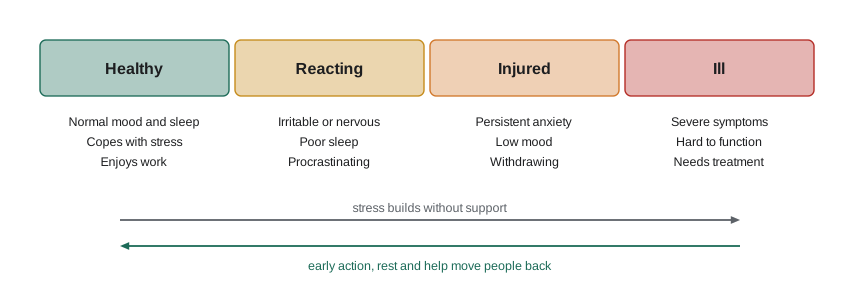
The continuum is useful because it encourages early action. Most people spend time in the reacting zone during stressful periods. Noticing that you are there, and doing something about it, such as resting, talking to someone or cutting back, can stop the slide into injury or illness. It also reduces stigma: needing support is a normal part of life rather than a sign of being broken.
Constant public feedback
Most people receive feedback on their work occasionally, privately and from people who know them. Creators receive it constantly, publicly and often from strangers. View counts, likes, comments, shares and revenue all arrive in real time. The feedback is also lopsided. Research on negativity bias shows that people tend to weigh negative information more heavily than positive information. A creator can read a hundred warm comments and remember only the one cruel remark.
Public feedback also blends criticism of the work with criticism of the person. A comment about poor audio is useful. A comment about your face, voice, body or identity is not feedback at all, but it lands in the same place and can feel equally relevant. Over time, constant evaluation can make self-worth feel tied to metrics: a good day means good numbers, and a bad day means you are failing.
Practical responses include separating feedback channels, scheduling when you read comments, asking a trusted person or moderator to screen comments first, and keeping a folder of messages that reminded you why you do the work. Some creators set a rule of not reading comments for the first few hours after a post goes live, when reactions are most extreme.
Comparison
Social platforms present a highlight reel. Creators see other creators' best moments, biggest wins and most polished work, while living through their own messy process. Social comparison theory, first described by psychologist Leon Festinger in the 1950s, suggests that people judge themselves partly by comparing with others. Upward comparison, with people who seem better off, can motivate, but it can also lead to envy, discouragement and a sense of falling behind.
For creators, comparison is built into the tools. Follower counts, view counts and platform rankings make it easy to measure yourself against peers. Comparisons are often unfair: a creator with a team of ten, years of experience or a lucky viral moment is not a fair benchmark for a solo creator in their first year. Comparisons also ignore what is hidden, such as debts, burnout or private struggles behind a successful channel.
| Comparison habit | Why it misleads | Alternative |
|---|---|---|
| Comparing follower counts with bigger creators | Ignores time, team size, niche and luck | Track your own growth rate over months |
| Measuring yourself against viral posts | Viral hits are outliers | Use your median results as the baseline |
| Assuming others have no problems | Highlights hide struggles | Remember that you see the edit, not the process |
| Scrolling peers' content when low | Mood makes comparison harsher | Set limits on scrolling, especially late at night |
Parasocial relationships
In 1956 researchers Donald Horton and Richard Wohl described parasocial interaction: the sense of intimacy audiences feel with media figures they have never met. Creators intensify this effect because they speak directly to the camera, share personal details and reply to comments. Audiences can feel they know a creator as a friend. That feeling is part of why creator marketing works, and much of it is harmless and even comforting for viewers.
For creators, parasocial relationships bring pressures as well as benefits. Audiences may expect constant access, personal replies and emotional support. They may feel entitled to know about your relationships, health or location. They may react with hurt or anger when you change direction, take a break or set a boundary. A small number may cross into obsessive or threatening behaviour, which later lessons address.
Healthy boundaries help both sides. You can be warm and genuine without being available all the time or sharing everything. Many creators decide in advance which topics are off limits, such as their partner, children, home or health, and stick to that decision even when asked. It also helps to be clear, kindly and consistently, that you cannot provide counselling or crisis support to viewers, and to point people to proper services instead.
When audience members reach out in crisis
Creators who talk openly about mental health often receive messages from viewers in distress, sometimes including thoughts of suicide. This can be frightening and heavy. You are not a counsellor and you are not responsible for saving anyone, but you can respond in a caring, safe way. Thank them for trusting you, take what they say seriously and point them to a crisis service. You can save a short, kind template so you can respond quickly without having to compose words under pressure.
A simple template: "Thank you for telling me. I'm really sorry you're going through this, and I want you to get support from someone who can help right now. You can call or text 9-8-8 any time, day or night, anywhere in Canada. If you're in immediate danger, please call 911."
If a message suggests someone is in immediate danger and you know where they are, contacting emergency services is appropriate. Most platforms also have reporting tools for self-harm content that alert their safety teams. After handling a message like this, take care of yourself as well: talk to someone you trust and do not carry it alone.
When you make content about mental health or suicide, follow safe messaging guidance from public health organizations. Do not describe methods or locations, avoid presenting suicide as a solution or as inevitable, do not use sensational language and include information about where to get help. Stories of people who got support and recovered can be protective.
Recognizing when someone is struggling
Whether you are a creator, a manager or a team member, you may notice that someone is not doing well. Signs can include changes in mood or behaviour, withdrawal, missed deadlines from someone usually reliable, increased substance use, talking about feeling hopeless or trapped, or giving away important possessions. None of these proves anything, but a pattern is worth a conversation.
A supportive conversation does not need special training. Choose a private, calm moment. Say what you have noticed without judgement, such as "You've seemed really worn out lately, and I wanted to check in." Listen more than you talk. Avoid rushing to fix things or minimizing their feelings. If you are worried they may be thinking about suicide, it is okay to ask directly: "Are you thinking about suicide?" Asking does not plant the idea, and it can bring relief. If the answer is yes, stay with them, help them contact a crisis line or emergency services and do not promise to keep it secret.
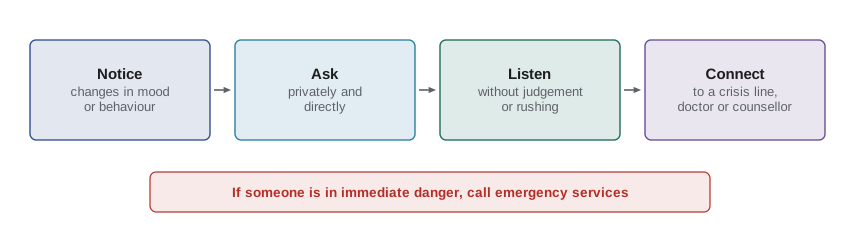
Programs such as Mental Health First Aid teach these skills in more depth over a short course, and many workplaces and community groups offer them. Lesson 11 covers how to find professional support.
Protective habits
Research and clinical experience point to a set of habits that protect mental health for most people. None is a cure, but together they make a difference: regular sleep, physical activity, time outdoors, time with people who know you offline, activities that have nothing to do with your channel, limits on alcohol and other substances, and something to look forward to. For creators, an identity outside the channel matters especially. If your sense of worth rests entirely on your content, every bad week becomes a crisis. Hobbies, relationships and goals unrelated to your audience give you somewhere to stand when the numbers drop.
Worked problem
Setting a comment-reading routine
A creator spends about 90 minutes a day reading comments across platforms, spread through the day and night. They decide to read comments in two 20-minute windows a day after a moderator has filtered abusive messages. How much time do they save each week, and how many fewer times do they open the apps for comments if they used to check about 15 times a day?
Show solution
- Old time: 90 minutes × 7 = 630 minutes a week.
- New time: 2 × 20 × 7 = 280 minutes a week.
- Saved: 630 − 280 = 350 minutes, about 5.8 hours a week.
- Checks: from about 15 × 7 = 105 to 2 × 7 = 14 a week, 91 fewer.
Answer: About 5.8 hours a week saved and about 91 fewer comment checks, with less exposure to unfiltered abuse.
Worked problem
Using your own baseline instead of comparison
Over the last 10 videos, a creator's views were 4,000, 5,500, 3,800, 4,200, 6,000, 4,800, 5,100, 3,900, 4,600 and 21,000. A peer's latest video got 80,000 views. What is a fairer benchmark for the creator's next video?
Show solution
- Sort the values: 3,800, 3,900, 4,000, 4,200, 4,600, 4,800, 5,100, 5,500, 6,000, 21,000.
- The median is the average of the 5th and 6th values: (4,600 + 4,800) ÷ 2 = 4,700.
- The mean is 62,900 ÷ 10 = 6,290, pulled up by one outlier.
- The peer's 80,000 reflects a different channel and is not a useful benchmark.
Answer: Use the median of about 4,700 views as the baseline; it reflects typical performance without the outlier or the peer's very different channel.
Common mistakes
MistakeThinking of mental health as either fine or broken.
InsteadUse the continuum and act early when you notice reacting signs.
MistakeReading every comment as soon as it arrives.
InsteadSchedule comment windows and use moderators or filters first.
MistakeBenchmarking against bigger creators or viral hits.
InsteadUse your own median results and growth over time.
MistakeTrying to act as a counsellor for viewers in crisis.
InsteadRespond kindly and point them to a crisis line or emergency services.
MistakeAvoiding the word suicide when you are worried about someone.
InsteadAsk directly and calmly; it does not plant the idea.
Summary and key terms
- Mental health is a continuum from healthy through reacting and injured to ill, and people move in both directions.
- Constant public feedback and negativity bias make criticism loom larger than praise.
- Comparison with others' highlight reels is often unfair; your own median results are a better benchmark.
- Parasocial relationships bring benefits and pressures; clear boundaries protect both creator and audience.
- Viewers in crisis should be thanked, taken seriously and pointed to crisis services.
- Safe messaging avoids method details and sensational language and includes help information.
- A supportive conversation means noticing, asking directly, listening and connecting to help.
- Mental health continuum
- A model showing mental health as a range from healthy to ill rather than two states.
- Negativity bias
- The tendency to weigh negative information more heavily than positive.
- Social comparison
- Judging oneself by comparing with others.
- Upward comparison
- Comparing with people who seem better off.
- Parasocial relationship
- A one-sided bond an audience member feels with a media figure.
- Safe messaging
- Guidelines for discussing suicide in ways that reduce risk.
- Median
- The middle value of a sorted data set, less affected by outliers than the mean.
- Boundary
- A limit on what a creator shares or how available they are.
- Mental Health First Aid
- A training program teaching people to support someone experiencing a mental health problem.
- Protective factor
- A habit or condition that lowers the risk of mental health problems.
Practice problems
Work each problem on paper first, then reveal the answer to check.
Name the four zones of the mental health continuum.
Show answer
Healthy, reacting, injured and ill.
What is negativity bias?
Show answer
Weighing negative information more heavily than positive.
Who first described parasocial interaction, and when?
Show answer
Horton and Wohl, in 1956.
Give two topics creators often keep off limits.
Show answer
Partners, children, home location, health.
What should a reply to a viewer in crisis include?
Show answer
Thanks, concern and a pointer to 9-8-8 or 911 if in immediate danger.
Does asking someone directly about suicide increase risk?
Show answer
No; it can bring relief and open the door to help.
Views of 3,000, 3,500, 4,000, 4,500 and 30,000. Median?
Show answer
4,000.
Name three protective habits.
Show answer
Sleep, activity, time outdoors, offline relationships, hobbies, limits on substances.
A creator reads comments 60 minutes a day and cuts to 30. Weekly minutes saved?
Show answer
30 × 7 = 210 minutes.
What should safe messaging about suicide avoid?
Show answer
Describing methods or locations and sensational language.
Lesson quiz · 5 questions
Score 60% or more to complete this lesson.
Create a free account to save your progress, take quizzes and earn a certificate.