
CRE-350 · Lesson 4 of 12 · 30 min
Sustainable schedules: sleep, routines, boundaries and breaks
Earlier lessons showed how workload, algorithms and constant feedback push creators toward exhaustion. This lesson is about the structures that push back: sleep, routines, content buffers, batching, boundaries and planned breaks. These are not luxuries for successful creators. They are the operating system that lets a creative business run for years rather than months.
Sleep first
Sleep is the foundation of mood, creativity, memory and physical health. Public health guidance in both Canada and the US recommends that most adults get seven to nine hours of sleep a night, and teenagers more. Short sleep makes people more irritable, more sensitive to criticism and worse at judging risk, which is exactly the wrong combination for someone about to read comments or reply to a brand.
Creator work threatens sleep in several ways: late-night editing sessions, live streams in other time zones, checking analytics in bed and the blue light and stimulation of screens. Practical sleep habits include a regular bedtime and wake time, even on weekends; a wind-down period without work or comments for the last hour before bed; keeping the phone out of the bedroom or on a do-not-disturb schedule; avoiding caffeine late in the day; and getting daylight in the morning. If you stream late for an overseas audience, protect a consistent sleep window afterward rather than letting the schedule drift every night.
Routines and working hours
Without an employer, creators have to build their own structure. A routine does not need to be rigid, but it should define when you work and when you do not. Many creators find it helps to set core working hours, for example 9 a.m. to 5 p.m. on weekdays, with planned exceptions for shoots or events. Others work best in blocks, such as mornings for creative work and afternoons for administration.
Matching tasks to energy helps. Many people do their best creative thinking at a particular time of day. If your ideas flow in the morning, protect that time for scripting or filming and push email and invoicing to the afternoon. Grouping similar tasks also reduces the mental cost of switching between very different kinds of work.
Batching
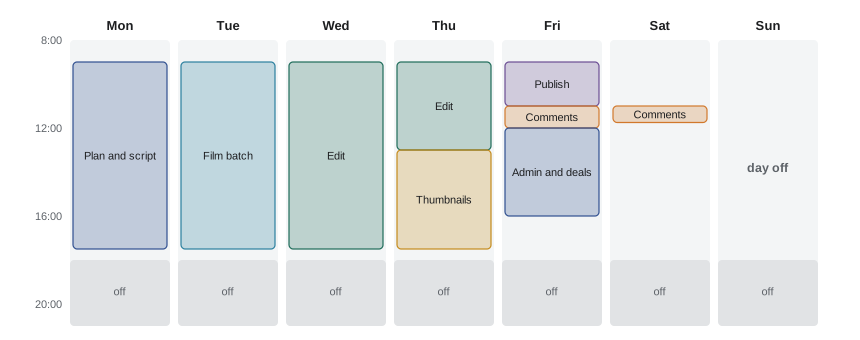
Batching means doing the same kind of task in one longer block rather than scattering it through the week. Instead of scripting, filming and editing one video at a time, a batching creator might script three videos on Monday, film all three on Tuesday and edit over the following days. Batching reduces set-up time, such as arranging lights, makeup and props, and reduces the mental effort of switching tasks. It also creates a natural buffer, because finished videos can be scheduled for later release.
Batching suits some formats better than others. Evergreen tutorials, explainers and reviews batch well. Reactive content about news or trends does not. Most creators use a mix: a batched backbone of planned content plus a smaller amount of timely work.
Content buffers
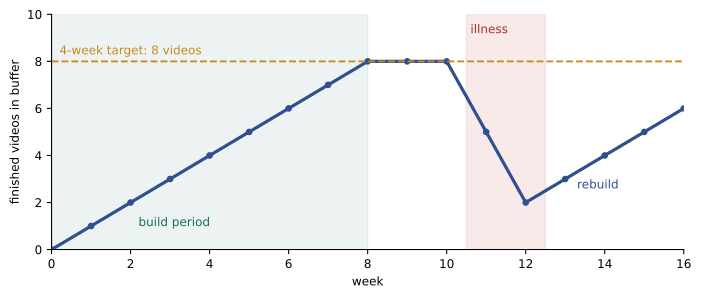
A content buffer is a stock of finished or nearly finished content ready to publish. It is one of the most powerful resources a creator can build, because it turns a bad week, an illness or a family emergency from a crisis into an inconvenience. A buffer is measured in weeks: the number of finished pieces divided by the number you publish per week.
Worked problem
Building a buffer
A creator publishes 2 videos a week. They want a 4-week buffer. They can produce 3 videos a week in a batching period while still publishing 2. How long will it take to build the buffer?
Show solution
- Buffer needed: 2 videos a week × 4 weeks = 8 videos.
- Net gain per week: 3 produced − 2 published = 1 video.
- Time to build: 8 ÷ 1 = 8 weeks.
Answer: About 8 weeks of producing one extra video a week to reach an 8-video, 4-week buffer.
Worked problem
How long a buffer lasts during illness
A creator has 6 finished videos and publishes 3 a week. They fall ill and produce nothing for 10 days. Will the buffer cover the gap, and how many will be left?
Show solution
- Buffer length: 6 ÷ 3 = 2 weeks, or 14 days.
- Videos needed in 10 days: 3 × 10 ÷ 7 ≈ 4.3, so about 4 or 5 posts.
- Remaining after 10 days: about 6 − 4.3 ≈ 1.7, so 1 or 2 videos.
Answer: Yes; the buffer covers the 10 days with 1 or 2 videos left, so the creator should rebuild it gradually after recovering.
Boundaries with audiences and partners
Boundaries are the limits that protect your time, energy and privacy. With audiences, they might include reply windows, topics you do not discuss, times you do not stream or a rule that you do not move conversations to private messages. With brands and managers, they might include response times, how many revision rounds a contract allows, how much notice you need for changes and when you are unavailable.
Boundaries work best when they are clear, consistent and stated in advance. A short note in your profile or community guidelines, such as "I read comments on weekdays and don't reply to private messages", sets expectations. In contracts, build in reasonable timelines and revision limits so that a last-minute brand request does not consume your weekend. Most professional partners respect clear boundaries; the ones who do not are worth noticing.
| Area | Example boundary | How to state it |
|---|---|---|
| Comments | Read twice a day on weekdays | Pinned comment or profile note |
| Private messages | No personal replies; business email only | Auto-reply and profile link to email |
| Personal topics | No content about partner or home | Decide privately and stay consistent |
| Brand revisions | Two rounds included; more at extra cost | Contract clause |
| Availability | No calls after 6 p.m. or on Sundays | Email signature and calendar settings |
Digital boundaries and screen time
Creators need their phones, but not every minute of the day. Screen-time tools built into phones can show how many hours you spend in each app and set limits. Separating work and personal use can help, for example by using a separate device or profile for the channel, turning off non-essential notifications and keeping social apps off the home screen.
Worked problem
Setting a screen-time budget
A creator's phone report shows an average of 7.5 hours a day on social apps, of which they estimate 3 hours is necessary work (posting, replying in windows, checking analytics weekly). They want to cut non-work scrolling in half. What should their daily limit be?
Show solution
- Non-work time: 7.5 − 3 = 4.5 hours.
- Half of non-work time: 4.5 ÷ 2 = 2.25 hours.
- New daily total: 3 + 2.25 = 5.25 hours.
Answer: Set a limit of about 5.25 hours a day, with alerts as the limit approaches, and review after two weeks.
Planned breaks and hiatuses
Even with good routines, creators need longer breaks. Planned breaks are far better than unplanned collapses. A planned break can be scheduled for a quiet season, supported by a buffer and announced in advance. An unplanned collapse usually arrives at a bad time, with no content ready, and often leaves the creator feeling guilty and anxious about returning.
Options range from a lighter schedule, such as posting reruns, shorts or community posts, to a full hiatus with no posting at all. Some creators take a week off every quarter and a longer break once a year. Others reduce output during a slow month for their niche. Brand deals and contract deadlines should be planned around breaks, and managers should be part of the planning.
Telling the audience is usually best done briefly and honestly. You do not owe anyone detailed personal information. A simple message such as "I'm taking two weeks off to rest and recharge. Back on the 15th with new videos" is enough. Audiences generally respond well to creators who look after themselves, and a return date gives them something to look forward to. Use scheduled posts or pinned messages so you do not have to log in during the break, and consider asking a moderator to watch the comments.
Worked problem
Planning a break around the calendar
A creator's income dips about 30 % in January compared with an average month, and brand deals are rare that month. Their average monthly income is $6,000. If they take January off entirely and lose all of January's income, how much do they give up compared with taking off an average month?
Show solution
- January income: $6,000 × (1 − 0.30) = $4,200.
- Average month income: $6,000.
- Difference: $6,000 − $4,200 = $1,800 less lost by choosing January.
Answer: Taking January off costs about $4,200, which is $1,800 less than taking an average month off, so a slow season is the cheaper time for a break.
Returning from a break
Returning can feel daunting. Plan a gentle restart: have one or two pieces ready before you announce your return, start at a lighter cadence and avoid checking analytics obsessively in the first week. Views may dip at first and recover over a few weeks. Use the break as a chance to review the schedule that led you there, and keep the changes that helped.
Sustainable schedules are personal. A routine that suits one creator would exhaust another. The common principles are a cadence you can keep for a year, a buffer that absorbs shocks, boundaries that protect rest and planned breaks rather than collapses.
Rest that actually restores
Not all time off is restful. Scrolling other creators' content on a day off can feel like work, because your brain keeps comparing and planning. Researchers who study recovery from work describe four experiences that help people recharge: psychological detachment, meaning not thinking about work; relaxation; mastery, meaning learning or doing something challenging outside work; and control, meaning choosing how you spend your time. A walk without your phone, a sport, a class, cooking a new recipe or time with friends who do not talk about your channel can all provide these experiences.
Plan rest as deliberately as you plan content. Put days off and holidays in the same calendar as uploads and brand deadlines, tell your team and partners about them and protect them unless there is a genuine emergency. Many creators find that a small daily ritual marking the end of work, such as closing the laptop, writing tomorrow's to-do list or going for a short walk, helps them switch off in the evening.
Routines also need room for life. Illness, family events, school or a second job will disrupt any schedule. Building slack into the week, such as one unscheduled half-day, means that a disruption pushes work into the slack rather than into your evenings and weekends.
Common mistakes
MistakeSacrificing sleep to keep up with uploads.
InsteadProtect seven to nine hours and a wind-down period without work.
MistakeProducing every video from scratch just before it goes live.
InsteadBatch similar tasks and build a buffer of finished content.
MistakeSetting boundaries only after you are overwhelmed.
InsteadState them in advance in profiles, guidelines and contracts.
MistakeWaiting for a collapse before taking time off.
InsteadSchedule breaks in slow seasons and support them with a buffer.
MistakeGiving the audience long explanations for a break.
InsteadShare a brief, honest message with a return date.
Summary and key terms
- Most adults need seven to nine hours of sleep; short sleep worsens mood, judgement and resilience.
- Core working hours and tasks matched to energy give structure without an employer.
- Batching reduces set-up and switching costs and creates a buffer.
- A buffer measured in weeks turns illness or emergencies into inconveniences.
- Clear, consistent boundaries with audiences and partners protect time and privacy.
- Screen-time budgets separate necessary work from non-work scrolling.
- Planned breaks in slow seasons, briefly announced, are better than unplanned collapses.
- Batching
- Doing similar tasks together in a single block.
- Content buffer
- A stock of finished content ready to publish, measured in weeks.
- Core working hours
- A set period each day dedicated to work.
- Wind-down period
- Time before bed without work or stimulating screens.
- Boundary
- A stated limit on availability, topics or workload.
- Revision rounds
- The number of times a brand may request changes under a contract.
- Screen-time budget
- A daily limit on app use based on necessary work and personal goals.
- Hiatus
- An extended break from posting.
- Cadence
- How often content is published.
- Evergreen content
- Content that stays relevant over time and can be scheduled in advance.
Practice problems
Work each problem on paper first, then reveal the answer to check.
How much sleep do most adults need?
Show answer
Seven to nine hours a night.
Give two reasons batching helps.
Show answer
Less set-up time, less task switching, and it creates a buffer.
A creator has 9 finished videos and posts 3 a week. Buffer length?
Show answer
3 weeks.
A creator wants a 3-week buffer at 2 posts a week, gaining 1 extra video a week. Time to build?
Show answer
6 videos ÷ 1 = 6 weeks.
Name three areas where creators set boundaries.
Show answer
Comments, private messages, personal topics, revisions, availability.
Where can a brand revision limit be set?
Show answer
In the contract.
A creator uses 6 hours of social apps, 2 for work, and cuts non-work use by half. New limit?
Show answer
2 + 2 = 4 hours.
Why choose a slow season for a break?
Show answer
It costs less income and fewer deals are missed.
What should a break announcement include?
Show answer
A brief reason if wanted and a return date.
Name two steps for returning from a break.
Show answer
Have content ready, restart at a lighter cadence, avoid obsessive analytics.
Lesson quiz · 5 questions
Score 60% or more to complete this lesson.
Create a free account to save your progress, take quizzes and earn a certificate.