
CRE-410 · Lesson 12 of 12 · 31 min
Capstone: an AI-assisted production plan and disclosure policy
This capstone brings the course together. You will see how a fictional creator, Priya, builds an AI-assisted production plan for her channel, calculates costs and savings, sets quality gates, writes a disclosure policy and plans for legal and ethical risks. Then you will produce your own plan using the same structure. Priya and her channel are invented for teaching purposes; the steps and numbers show the method, not a recommended set of tools.
The scenario
Priya runs a science explainer channel with 420,000 subscribers. She publishes one 15-minute video a week and three short clips. Her team is a freelance editor (20 hours a week at $45 an hour), a part-time researcher (10 hours a week at $35 an hour) and a thumbnail designer paid $120 per thumbnail. Priya writes and presents every video. Her goals for the next year are to add a French audio track for Quebec and other French-speaking viewers, increase short clips from three to eight a week, reduce errors after publishing, and keep her audience's trust.
Step 1: Map the workflow
Priya maps each stage of a typical week, with hours and pain points:
| Stage | Hours a week | Main pain point |
|---|---|---|
| Topic research | 10 (researcher) | Slow literature searches |
| Scripting | 8 (Priya) | Blank-page time; long drafts |
| Recording | 4 (Priya) | Retakes |
| Editing | 14 (editor) | Rough cut and silence removal |
| Captions | 2 (editor) | Fixing technical terms |
| Short clips | 4 (editor) | Finding moments and reframing |
| Thumbnails | 1 thumbnail ($120) | Few options to test |
| Community | 3 (Priya) | Comment overload |
Step 2: Choose AI uses by value and risk
Using the lesson 8 matrix, Priya sorts candidate AI uses:
- Automate with spot checks (high value, low risk): transcription and text-based rough cuts, silence removal, caption generation with a custom vocabulary, comment spam filtering and theme summaries, chapter markers.
- Use with strict review (high value, high risk): research summaries of papers she supplies, script tightening, French dubbing with her cloned voice, AI-assisted highlight selection for clips, AI-generated thumbnail backgrounds.
- Avoid (high risk or low value): fully AI-written scripts, synthetic footage of real scientists, auto-replies to viewers, generated "experiment results".
Step 3: Estimate costs and savings
Worked problem
Weekly time savings
With AI tools, Priya estimates: editing falls from 14 to 9 hours; captions from 2 to 0.75 hours; clips from 4 hours for 3 clips to 5 hours for 8 clips; research from 10 to 7 hours, plus 2 hours of extra fact-checking by the researcher. What are the weekly cost changes for editor and researcher time?
Show solution
- Editor before: 14 + 2 + 4 = 20 hours. After: 9 + 0.75 + 5 = 14.75 hours.
- Editor saving: 5.25 hours × $45 = $236.25 a week.
- Researcher before: 10 hours. After: 7 + 2 = 9 hours. Saving: 1 × $35 = $35.
- Total labour saving: $271.25 a week.
Answer: About $271 a week in labour, while producing five more clips a week.
Worked problem
Annual net benefit
AI subscriptions cost $210 a month in total. Over 52 weeks, what is the annual net benefit from Step 3's labour savings?
Show solution
- Annual labour saving: $271.25 × 52 = $14,105.
- Annual tool cost: $210 × 12 = $2,520.
- Net benefit: $14,105 − $2,520 = $11,585.
Answer: About $11,585 a year, before counting any revenue from extra clips or French audio.
Worked problem
French dubbing pilot
Priya pilots French audio on her 10 most-watched videos. AI dubbing with her cloned voice costs $70 per video, and native-speaker review by a Quebec reviewer costs $90 per video. She estimates 12,000 extra French views per video in the first year at an RPM of $3.50, plus a French-language sponsorship worth $2,500 if the pilot reaches 100,000 French views. Does the pilot pay back?
Show solution
- Cost: 10 × ($70 + $90) = $1,600.
- Extra views: 10 × 12,000 = 120,000. Ad revenue: 120 × $3.50 = $420.
- Views exceed 100,000, so the $2,500 sponsorship is likely.
- Total revenue: $420 + $2,500 = $2,920. ROI: (2,920 − 1,600) ÷ 1,600 ≈ 83 %.
Answer: The pilot pays back mainly through the sponsorship, not ad revenue, which shows why localization should be judged on all revenue sources.
Step 4: Set quality gates
Priya adds four gates with owners:
- Fact-check gate (researcher): every claim in the script tagged and verified; all research summaries checked against the original papers; no AI citations unopened.
- Rights and likeness gate (editor): no unlicensed music or footage; no synthetic depictions of real scientists; thumbnails checked for logos and recognizable characters.
- Localization gate (Quebec reviewer): meaning, terminology and tone checked; names pronounced correctly; Quebec French vocabulary.
- Disclosure gate (Priya): platform labels applied where realistic synthetic content appears; French audio tracks described as AI-dubbed with her own cloned voice; sponsorship disclosures present.
She sets targets: caption WER under 3 % on spot checks, a fact-check catch rate above 90 %, and fewer than one correction per video after publishing.
Step 5: Consent, data and contracts
Priya clones only her own voice, using a provider whose terms let her delete the voice model and do not use it to train other systems. She updates her guest release form to state clearly whether guest audio may be translated or dubbed, with a separate opt-in for any voice cloning of guests. She checks that her editor's and researcher's contracts cover ownership of work made with AI tools, keeps all subscriptions on her business account, and adds a clause to sponsor agreements listing which AI tools may be used in sponsored segments and requiring sponsor approval for any generated product imagery.
Because guest voices and viewer comments contain personal information, she limits which tools receive them, turns off training on her uploads where offered, and records these settings in her tool register.
Step 6: Write the disclosure policy
Priya publishes a short AI policy on her website and links it in every video description. A version of it reads:
- What I use AI for: transcription, captions, rough editing, summarizing research papers before I read them in full, finding clip moments, translating and dubbing videos into French with my own cloned voice, and creating some thumbnail backgrounds.
- What I never use AI for: writing my opinions or conclusions, generating experiment results or footage presented as real, imitating real scientists or other creators, or replying to you as if I were writing personally.
- How I label it: realistic synthetic content carries platform AI labels; French audio tracks are marked as AI-dubbed; sponsored segments are disclosed as ads whatever tools were used.
- How I check facts: every claim is verified against original sources by a person before publishing, and corrections are posted in the description and pinned comments.
- How to reach me: email address for concerns about AI use or errors.
Step 7: Plan for risks
| Risk | Likelihood (1–5) | Impact (1–5) | Score | Response |
|---|---|---|---|---|
| AI-introduced factual error published | 3 | 4 | 12 | Fact-check gate; correction process |
| French dub mistranslation causes offence | 2 | 4 | 8 | Native review; viewer feedback channel |
| Voice clone misused by scammers | 2 | 5 | 10 | Likeness monitoring; audience warning; rapid reporting |
| Sponsor objects to AI use | 2 | 3 | 6 | Contract clause; approval process |
| Audience backlash over AI | 2 | 3 | 6 | Published policy; transparency; human-presented core content |
Worked problem
Prioritizing risks
Using the risk register, which two risks should Priya address first, and what share of the total risk score do they represent?
Show solution
- Scores: 12, 8, 10, 6, 6. Total: 42.
- Top two: factual error (12) and voice clone misuse (10), together 22.
- Share: 22 ÷ 42 ≈ 52 %.
Answer: Factual errors and voice clone misuse account for about half the total risk score, so the fact-check gate and likeness monitoring come first.
Your capstone
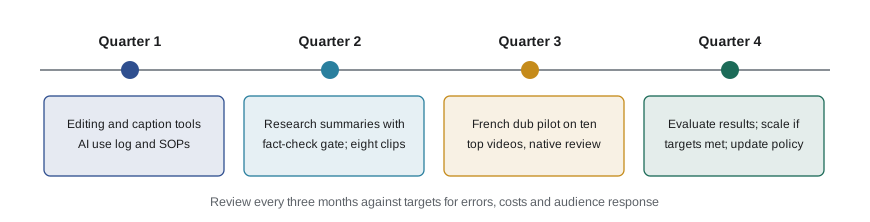
Now build your own plan, for your own channel or a realistic fictional one. Your capstone should include: a workflow map with hours and pain points; a value-risk sorting of at least eight candidate AI uses; cost and savings estimates with at least one ROI calculation; at least three quality gates with owners and targets; consent, data and contract measures; a published-style AI disclosure policy; a risk register with scores and responses; and a four-quarter adoption timeline. Keep it to what you could actually carry out, and plan to review it after three months.
Evaluating the plan after three months
At the three-month review, Priya compares results with her targets. Caption spot checks average 2.4 % WER, below the 3 % target. The fact-check gate caught 41 of 44 errors, a 93 % catch rate, and post-publishing corrections fell to 0.4 per video. Short clips rose to seven a week, slightly below the target of eight, because highlight selection took longer than expected; she adds an hour of editor time and keeps the target. Comment summaries revealed strong interest in a series on climate science, which becomes the next quarter's priority.
She also reviews costs. One subscription went largely unused and is cancelled, saving $35 a month. A sponsor asked about synthetic voices in reads; her contract clause and AI policy answered the question in minutes. Viewer feedback on the AI policy was mostly positive, with a few questions about the French voice clone, which she answers in a community post explaining how it works and how French-speaking reviewers check each dub.
The review ends with three decisions: keep the current gates, extend the French pilot to 20 more videos because it met its targets, and revisit the policy in six months or whenever she adds a new kind of AI use.
Worked problem
Updated catch rate and correction trend
Before the plan, Priya averaged 1.2 corrections per video over 12 videos. After three months, she averages 0.4 over 13 videos. By what percentage did corrections per video fall?
Show solution
- Change: 1.2 − 0.4 = 0.8 corrections per video.
- Percentage fall: 0.8 ÷ 1.2 ≈ 0.667, or about 67 %.
Answer: Corrections per video fell by about two-thirds, the strongest evidence that the fact-check gate works.
Presenting your capstone
When you present your capstone, whether to an instructor, a business partner or your own team, focus on decisions and evidence rather than tools. Explain the goals, the workflow map, why each AI use was placed where it was in the value-risk matrix, the numbers behind your cost and ROI estimates, the gates and targets, and how you will know whether the plan is working. Be honest about uncertainties, such as view estimates for a new language or how an audience might react to a twin. A good plan makes its assumptions visible so they can be tested and revised.
Include your draft disclosure policy as an appendix, written in plain language your audience would understand. Ask someone outside your team to read it and tell you what they think you use AI for; if their answer differs from your intent, revise the wording until it matches.
Common mistakes
MistakeStarting with tools rather than goals.
InsteadBegin with goals and a workflow map, then choose AI uses.
MistakeCounting savings without new review time.
InsteadAdd fact-checking and review hours to every estimate.
MistakeJudging localization on ad revenue alone.
InsteadInclude sponsorships, products and long-term audience growth.
MistakeWriting a vague AI policy.
InsteadState specific uses, prohibited uses, labels, fact-checking and contact details.
MistakeTreating the plan as finished.
InsteadReview results and risks after three months and update the policy.
Summary and key terms
- A capstone AI plan starts with goals and a workflow map with hours and pain points.
- Candidate AI uses are sorted by value and risk into automate, review or avoid.
- Cost estimates include labour saved, new review time and subscriptions.
- Localization pilots should be judged on all revenue sources and native review.
- Quality gates need owners, checklists and measurable targets.
- Consent, data settings and contracts must cover voices, guests, team and sponsors.
- A clear, published disclosure policy and a scored risk register protect trust.
- Workflow map
- A list of production stages with time, owners and pain points.
- Pilot
- A small, time-limited trial before full rollout.
- Net benefit
- Savings or revenue minus costs.
- Disclosure policy
- A public statement of how a creator uses and labels AI.
- Risk register
- A table of risks with likelihood, impact, scores and responses.
- Risk score
- Likelihood multiplied by impact.
- Guest release
- A form in which a guest consents to how their appearance may be used.
- Custom vocabulary
- A list of names and terms added to improve speech recognition.
- Adoption timeline
- A schedule for introducing new tools and processes.
- Correction process
- A defined way to fix and announce errors after publishing.
Practice problems
Work each problem on paper first, then reveal the answer to check.
Editor time falls from 18 to 12 hours a week at $40. Weekly saving?
Show answer
$240.
Annual saving at $240 a week?
Show answer
$12,480.
Tools cost $150 a month. Annual net benefit?
Show answer
$12,480 − $1,800 = $10,680.
A dub pilot costs $1,200 and earns $1,800. ROI?
Show answer
50 %.
A risk has likelihood 4 and impact 3. Score?
Show answer
12.
Name three sections of a disclosure policy.
Show answer
Uses, prohibited uses, labels, fact-checking, contact.
Why add a separate opt-in for guest voice cloning?
Show answer
Cloning is a distinct, sensitive use needing specific consent.
What quality targets did Priya set?
Show answer
WER under 3 %, catch rate above 90 %, fewer than one correction per video.
Why keep subscriptions on a business account?
Show answer
So access and assets stay with the business.
When should a capstone plan be reviewed?
Show answer
After about three months.
Lesson quiz · 5 questions
Score 60% or more to complete this lesson.
Create a free account to save your progress, take quizzes and earn a certificate.