
CRE-410 · Lesson 2 of 12 · 29 min
Research, ideation and scripting with AI
Ideas and scripts are where many creators first try AI. A blank page is intimidating, and a chat assistant will happily produce 20 video ideas, an outline and a draft script in seconds. That speed is real, but so are the risks: generic ideas that hundreds of other creators also received, scripts that sound like no one in particular, and factual errors delivered with total confidence. This lesson shows how to use AI as a research assistant and writing partner while keeping your own voice and protecting your credibility.
Where AI helps in pre-production
Pre-production covers everything before the camera rolls: choosing topics, researching, outlining, scripting, planning shots and preparing questions for interviews. AI can help at each step, but in different ways:
- Ideation: generating long lists of angles, hooks, titles and formats to react to. Quantity is the point; you supply the judgment.
- Research orientation: getting a quick overview of an unfamiliar topic, a list of questions to investigate and the names of key concepts, organizations and experts.
- Source digestion: summarizing long reports, transcripts or papers you provide, and pulling out the passages relevant to your angle.
- Structuring: turning messy notes into an outline, or testing different structures for the same material.
- Drafting and editing: producing a rough draft from your outline, tightening wordy passages, and checking reading level and pacing.
- Interview preparation: suggesting questions, follow-ups and possible objections, based on background material you provide.
What AI should not do is decide what is true, what you believe or what is worth saying. Those remain the creator's job.
Prompting basics
A prompt is the instruction you give an AI tool. Clear prompts get better results, and the principles are much the same as briefing a human assistant. Good prompts usually include:
- Role and audience: who the output is for and what they already know. "Write for first-time home bakers in Canada who have never used a sourdough starter."
- Task: exactly what you want, such as "give 15 title options under 60 characters" rather than "help with titles".
- Context and material: your notes, transcript, brand guidelines or examples of your past work.
- Constraints: length, tone, format, words to avoid, and whether to say "I don't know" when unsure.
- Examples: two or three samples of the style you want, which often work better than describing a style in words.
Iteration matters more than the perfect first prompt. Ask for options, react to them, and refine. Telling a model what you liked and disliked about its last answer usually improves the next one.
| Weak prompt | Stronger prompt |
|---|---|
| Give me video ideas about budgeting. | Give 20 video ideas about budgeting for university students living away from home. Mix formats: tutorials, challenges, myths, interviews. One line each. |
| Write a script about coffee. | Using my outline below, draft an 8-minute script in a friendly, slightly nerdy tone. Keep sentences short for speaking. Mark every factual claim with [CHECK]. |
| Summarize this report. | Summarize the attached report in 10 bullet points for a general audience. Quote page numbers for each point so I can verify them. |
The last example shows a useful trick: ask the tool to mark claims that need checking and to point to where in the source each claim comes from. This makes your fact-checking faster and exposes claims the model cannot support.
Avoiding generic content
Language models are trained to produce likely text, which pulls them toward the average. If you ask for “ten video ideas about travel”, you will get the same ideas the tool gives everyone else. Audiences notice. Search and recommendation systems also tend to reward originality, depth and genuine expertise rather than recycled summaries.
Several habits push AI output away from the generic:
- Start from your own material: your notes, stories, opinions, data and experiences. Ask the tool to organize and challenge your ideas rather than invent them.
- Feed it your style: include transcripts of your best-performing videos and ask it to match the rhythm, humour and vocabulary.
- Ask for the unusual: request contrarian angles, overlooked sub-topics or questions experts disagree about.
- Use AI to critique, not just create: ask it to list weaknesses, missing counter-arguments or confusing passages in your draft.
- Rewrite in your own words: treat the draft as scaffolding. Read it aloud and change anything that does not sound like you.
A fact-checking workflow for AI-assisted scripts
Every script that uses AI for research or drafting needs a deliberate verification step before recording. A simple workflow that scales from solo creators to teams:
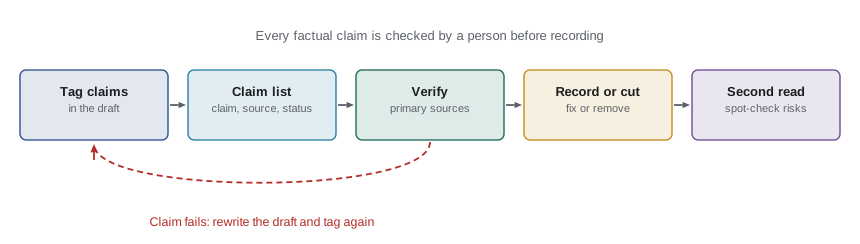
- 1. Tag claims: every statistic, date, name, quotation, scientific statement and legal or health claim gets a marker such as [CHECK] in the draft.
- 2. Extract a claim list: copy the tagged claims into a simple table with columns for the claim, the source and the status.
- 3. Verify against reliable sources: go to primary sources where possible, such as the original study, government data, the official website, court records or the person quoted. Reputable news organizations and reference works are next best. Never accept a citation from an AI tool without opening it and confirming it says what the tool claims.
- 4. Record, correct or cut: note the source link for each claim. Fix claims that are wrong and cut any you cannot confirm.
- 5. Second read: for important or sensitive videos, have someone else read the final script and spot-check the riskiest claims.
Keep the claim list. If a viewer challenges a fact, you can respond quickly with the source, and if you discover an error after publishing, the list shows where it came from.
Worked problem
Measuring an AI tool's error rate
A creator tests an assistant by asking it to draft five research summaries. Across them, they tag 64 factual claims. Checking each one, they find 51 correct, 8 partly wrong or outdated, and 5 completely invented, including two fake study citations. What is the error rate, and what does it imply?
Show solution
- Claims with problems: 8 + 5 = 13.
- Error rate: 13 ÷ 64 ≈ 0.203, or about 20 %.
- Fabrication rate: 5 ÷ 64 ≈ 7.8 %.
Answer: About one claim in five had a problem and nearly one in thirteen was invented. Every claim must be checked, and citations need special care.
Worked problem
Time budget for checking
A 10-minute explainer script contains about 30 checkable claims. Verifying a claim takes an average of 3 minutes, and fixing or replacing a failed claim takes 10 minutes. Using the 20 % error rate above, how long should the creator budget for checking?
Show solution
- Verification: 30 × 3 = 90 minutes.
- Expected failed claims: 30 × 0.20 = 6.
- Fixing: 6 × 10 = 60 minutes.
- Total: 90 + 60 = 150 minutes, or 2.5 hours.
Answer: Budget about two and a half hours. This is part of the true cost of AI-assisted research, and it is still often faster than researching from scratch.
Research tools that cite sources
Some AI tools search the web or a library of documents and show their sources alongside the answer. These research assistants are more useful for fact-finding than a plain chat model, because you can follow the links. But they can still misquote a source, rely on low-quality pages, or blend information from several sources into a claim none of them actually makes. Open the most important sources yourself, and prefer tools that let you restrict searches to trusted domains or upload the documents you want summarized.
When you summarize a document you supply, ask for page or timestamp references, then spot-check a sample. Summaries tend to drop qualifications, so watch for phrases such as “may”, “in some cases” or “preliminary findings” that disappear in the AI version.
Scripting with AI while keeping your voice
A script is not just information; it is performance. Rhythm, jokes, pauses, personal stories and the way you address viewers are what make content recognizably yours. Many experienced creators use AI at the edges of scripting rather than for the whole draft:
- Generating several possible openings or hooks, then writing their own.
- Asking for a clearer explanation of a hard concept, then rephrasing it in their own words.
- Shortening a draft that runs long, or flagging sentences that are hard to say aloud.
- Producing a version for a different audience, such as a simpler cut for younger viewers or a more technical version for experts.
If you publish under your name, you are the author in the eyes of your audience. Sponsors may also expect that the opinions and endorsements in their integrations are genuinely yours. CRE-320 covered the rule that endorsements must reflect the honest opinions of the endorser; an AI-written endorsement you have not actually formed an opinion about can mislead both audience and sponsor.
Confidentiality and what you upload
Be careful what you paste into AI tools. Unreleased sponsor campaigns, contracts, private messages, personal information about other people and unpublished work may be covered by confidentiality clauses or privacy law. Some services may use your inputs to improve their models unless you opt out or use a business plan with stronger terms. Read the data terms, use settings that turn off training on your content where available, and remove names and identifying details when you only need help with structure or wording. Lesson 10 covers the privacy law that applies.
A worked research session
Here is how a careful AI-assisted research session might run for a video on why bread goes stale. The creator starts by asking an assistant for an overview of the science and a list of key terms. The answer mentions starch retrogradation, moisture migration from crumb to crust and the effect of refrigeration. These terms become search queries for reliable sources: food science textbooks, university extension pages and peer-reviewed reviews.
Next, the creator uploads two review articles and asks for a summary with page references. The summary says refrigeration speeds staling; the creator checks the cited page and confirms it, along with the important qualification that freezing slows staling dramatically. The assistant then suggests three possible structures for the video, and the creator picks a myth-busting format built around common kitchen habits.
Finally, the creator drafts the script themselves from their notes, asks the assistant to flag sentences that are hard to say aloud, and tags 22 claims for checking. Two claims turn out to be overstated and are softened. The whole process takes about four hours instead of the eight a fully manual approach might take, and every claim in the final script has a source the creator has personally read.
Worked problem
Comparing research time
A fully manual research and scripting process takes 8 hours. The AI-assisted process takes 1 hour of AI-guided orientation, 1.5 hours of reading sources, 1 hour of drafting and 0.5 hours of claim checking. How much time is saved, as a percentage?
Show solution
- AI-assisted total: 1 + 1.5 + 1 + 0.5 = 4 hours.
- Saving: 8 − 4 = 4 hours.
- Percentage: 4 ÷ 8 = 50 %.
Answer: Half the time is saved, and the reading and checking steps remain fully human.
Common mistakes
MistakePublishing statistics or quotations straight from an AI draft.
InsteadTag every claim and verify it against a primary or reputable source.
MistakeTrusting AI citations without opening them.
InsteadOpen each source and confirm it says what the tool claims.
MistakeUsing vague prompts and accepting the first answer.
InsteadGive role, task, context, constraints and examples, then iterate.
MistakeLetting AI write in a generic voice.
InsteadFeed it your own material and style, and rewrite in your own words.
MistakePasting confidential sponsor or personal information into any tool.
InsteadCheck data terms, turn off training where possible and remove identifying details.
Summary and key terms
- AI helps with ideation, research orientation, summarizing, structuring, drafting and interview preparation.
- Good prompts give role, audience, task, context, constraints and examples, and improve through iteration.
- Language models drift toward generic content, so start from your own material and style.
- A fact-checking loop tags claims, verifies them against reliable sources, records sources and cuts what cannot be confirmed.
- Measuring a tool's error rate on your own topics shows how much checking time to budget.
- Research tools with citations still need their key sources opened and checked.
- Protect confidential and personal information when using AI tools.
- Prompt
- The instruction or input given to an AI tool.
- Iteration
- Refining output through repeated rounds of feedback.
- Pre-production
- Planning work before recording, such as research, scripting and shot planning.
- Primary source
- The original source of information, such as a study, dataset or official record.
- Claim list
- A table of every checkable statement in a script with its source and status.
- Error rate
- The share of claims or outputs that turn out to be wrong.
- Fabrication
- Invented information, such as a fake quote or citation.
- Hook
- The opening moments of a video designed to hold attention.
- Few-shot prompting
- Including a few examples in a prompt to show the style or format wanted.
- Data terms
- The rules a service sets for how it stores and uses what you upload.
Practice problems
Work each problem on paper first, then reveal the answer to check.
Name the five parts of a strong prompt listed in this lesson.
Show answer
Role and audience, task, context and material, constraints, examples.
A tool gets 9 of 60 claims wrong. Error rate?
Show answer
9 ÷ 60 = 15 %.
A script has 40 claims; checking takes 2 minutes each. Verification time?
Show answer
80 minutes.
With a 15 % error rate and 10 minutes per fix, how long to fix the 40-claim script?
Show answer
40 × 0.15 = 6 claims × 10 = 60 minutes.
Why ask a tool to mark claims with [CHECK]?
Show answer
It makes every factual claim visible for verification.
Give two ways to make AI ideas less generic.
Show answer
Use your own material, feed your style, ask for unusual angles, use AI to critique.
What should you do with an AI-supplied citation?
Show answer
Open it and confirm the source exists and supports the claim.
Why keep the claim list after publishing?
Show answer
To answer challenges and trace any errors found later.
What often disappears when AI summarizes research?
Show answer
Qualifications such as "may" or "preliminary".
Why be careful pasting sponsor briefs into AI tools?
Show answer
They may be confidential and the service may store or train on inputs.
Lesson quiz · 5 questions
Score 60% or more to complete this lesson.
Create a free account to save your progress, take quizzes and earn a certificate.