
CRE-410 · Lesson 4 of 12 · 29 min
Thumbnails, graphics and image generation
A thumbnail and title decide whether a viewer clicks. Graphics, lower thirds, channel art and social images shape how professional a creator looks. Image generators and AI design tools now let anyone produce polished visuals quickly, which is both an opportunity and a trap. This lesson covers how creators use AI for visuals, how to test whether AI thumbnails actually perform better, and how to stay on the right side of copyright, trademark, likeness and honesty rules.
Types of AI visual tools
AI visual tools fall into several groups, and many products combine them:
- Text-to-image generators create a new image from a written prompt, often with options for style, aspect ratio and variations.
- Image editing tools remove backgrounds, extend images, replace objects, relight faces, fix eyes or expressions and upscale low-resolution photos.
- Design assistants suggest layouts, colour palettes, fonts and variations for thumbnails, posts and channel art, often from a template.
- Brand-trained generators learn your own style, characters, logo or product from images you supply, so outputs stay on brand.
- Analysis tools predict which thumbnail is likely to get more attention, or check legibility at small sizes.
At the time of writing (October 2026), widely used examples include image features inside general assistants, dedicated generators and the AI features built into established design and photo editing applications. Features and terms change frequently, so check each tool's current licence terms before using its output commercially.
Using AI for thumbnails without losing what works
Effective thumbnails usually share a few features: a clear focal point, readable text of three or four words at most, strong contrast, an expressive face where appropriate, and a promise that matches the video. AI can help generate options, test colour schemes, extend a photo to fit a 16:9 frame, cut out a subject cleanly or create a background that would have been expensive to shoot.
Many creators find that their own face and genuine photos outperform fully generated images, because audiences recognize the creator and trust real moments. A common hybrid approach is to shoot a real photo of the creator or product, then use AI for background replacement, clean-up, lighting adjustments and variations.
Thumbnails must also be honest. A thumbnail that shows something the video does not deliver, such as a dramatic scene that never happens or a product result the creator did not achieve, is clickbait. It can break platform rules on misleading metadata and, if the video is sponsored, advertising law on misleading representations. AI makes it easier to fabricate such images, which makes the honesty test more important, not less.
| Use | Generally acceptable | Needs care or disclosure |
|---|---|---|
| Background replacement | Stylized or obviously designed backgrounds | Implying you were somewhere you were not |
| Facial retouching | Light clean-up of blemishes or glare | Changing body shape or results in beauty or fitness content |
| Product images | Better lighting of the real product | Showing features, colours or results the product does not have |
| Generated scenes | Clearly illustrative or fantastical art | Realistic scenes of events that did not happen |
| Real people | People who agreed to appear | Public figures or private people without consent |
Testing AI thumbnails properly
Platforms increasingly let creators test several thumbnails for the same video and show which one earns more watch time or clicks. Even without a built-in tool, you can compare results carefully. The key metric is click-through rate (CTR): clicks divided by impressions, where an impression is a time the thumbnail was shown to a viewer.
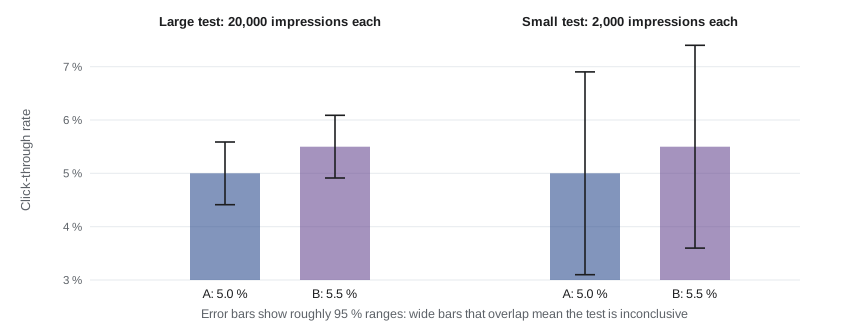
Small differences can easily be due to chance. A simple way to judge whether a difference is real is to calculate the standard error of each CTR and see whether the gap is large compared with the uncertainty. For a proportion \(p\) measured over \(n\) impressions, the standard error is approximately \(\sqrt{p(1-p)/n}\). If two CTRs differ by more than about twice the combined standard error, the difference is unlikely to be pure luck.
Worked problem
Did the AI thumbnail win?
A creator tests two thumbnails. A (real photo) gets 20,000 impressions and 1,000 clicks. B (AI-generated scene) gets 20,000 impressions and 1,100 clicks. Is B's higher CTR likely to be real?
Show solution
- CTR A: 1,000 ÷ 20,000 = 5.0 %. CTR B: 1,100 ÷ 20,000 = 5.5 %.
- Difference: 0.5 percentage points (0.005).
- Standard error of each: \(\sqrt{0.05 \times 0.95 / 20{,}000} \approx 0.00154\) and \(\sqrt{0.055 \times 0.945 / 20{,}000} \approx 0.00161\).
- Combined: \(\sqrt{0.00154^2 + 0.00161^2} \approx 0.00223\).
- Ratio: 0.005 ÷ 0.00223 ≈ 2.2, a little more than 2.
Answer: The difference is probably real but modest. Before switching permanently, check watch time: a thumbnail that wins clicks but disappoints viewers can lose overall.
Worked problem
Too small a test
Another test gives thumbnail A 2,000 impressions and 100 clicks, and B 2,000 impressions and 110 clicks. Is the difference meaningful?
Show solution
- CTRs are again 5.0 % and 5.5 %.
- Standard errors: \(\sqrt{0.05 \times 0.95/2{,}000} \approx 0.0049\) and \(\approx 0.0051\).
- Combined: about 0.0071.
- Ratio: 0.005 ÷ 0.0071 ≈ 0.7, well below 2.
Answer: No. With only 2,000 impressions each, the same gap could easily be chance. Larger samples are needed before drawing conclusions.
CTR is only part of the story. Platforms weigh how long viewers watch and whether they are satisfied. Compare average view duration or total watch time per impression as well. A thumbnail that overpromises may raise CTR while lowering retention and future recommendations.
Brand consistency and style
Audiences recognize channels partly by visual consistency: colours, fonts, framing and character design. AI generators default to their own house styles, which can make many channels look alike. Ways to stay distinctive include creating a style guide with your palette, fonts and composition rules; using reference images of your own past work; training a private style or character model only on images you own; and keeping a human designer or yourself in charge of final layouts.
If you use an AI-generated mascot or character as part of your brand, remember lesson 10: in both Canada and the United States, purely machine-generated images may not be protected by copyright, which can make it harder to stop others from copying them. Adding substantial human creative work, and registering a trademark for a logo or character name where appropriate, gives stronger protection.
Copyright, trademarks and other people's work
Image generators can produce output that closely resembles existing works, especially when prompted with an artist's name, a film title, a famous character or a brand. Using such output in thumbnails, merchandise or advertising can infringe copyright or trademark rights, regardless of whether a machine made it. Practical safeguards include:
- Avoid prompts naming living artists, specific copyrighted characters, franchises or brands unless you have permission.
- Check outputs for recognizable logos, characters, watermarks or signatures and remove or regenerate them.
- Use tools whose terms grant you commercial rights and, where offered, provide some protection against infringement claims, and read the limits of that protection.
- Keep records of prompts, tool versions and edits, which helps show your own creative contribution and good faith.
- Never generate realistic images of real people, including celebrities, in situations they did not take part in, especially implying endorsement.
Representation and bias
Because image models learn from existing images, they can reinforce stereotypes about gender, race, age, disability and body type. Default prompts such as “a scientist” or “a family” may produce a narrow range of people. Review generated images for representation, and write prompts that describe the diversity you intend. For content aimed at young people or on health and body image, be especially careful: idealized AI bodies and faces can contribute to unrealistic expectations, and some platforms and advertising codes restrict heavily altered images in beauty and weight-loss promotions.
Disclosure of AI visuals
Not every AI-assisted image needs a label. Platform rules generally focus on realistic content that could mislead viewers about real people, places or events. A stylized illustration made with AI is unlikely to require disclosure on most platforms, while a realistic generated photo of a real person or a news event usually does. Advertising rules add another layer: if AI significantly alters a product image used to show benefits or results, Canadian and US advertising rules expect the representation to be truthful and may require disclosure. Lesson 9 covers platform labels in detail.
A practical thumbnail workflow with AI
A workflow that combines AI speed with human judgment might look like this. First, the creator writes down the single idea the thumbnail must communicate, such as "this cheap tool beats the expensive one". Second, they ask a design assistant or image tool for 15 to 20 rough concepts, varying composition, colour and text. Third, they pick three promising directions and shoot real photos to match, such as the creator holding both tools with a genuine expression. Fourth, AI tools clean up the photos, cut out the subject and generate or extend backgrounds. Fifth, a designer or the creator finishes the layout, checks legibility on a phone-sized preview and confirms the thumbnail honestly represents the video. Finally, two or three versions are tested.
This approach keeps the trust and recognizability of real photos while using AI where it is strongest: generating options quickly and handling tedious editing. It also creates a record of human creative decisions, which matters for the copyright questions in lesson 10.
Accessibility and legibility
Thumbnails are seen at very small sizes on phones and televisions. Check contrast between text and background, avoid thin fonts, and keep text short. AI tools sometimes produce garbled or misspelled text inside images, so add text in a design tool rather than asking the generator to render it. For graphics inside videos, such as charts and lower thirds, check that colours remain distinguishable for viewers with colour vision deficiency, and that any text is on screen long enough to read.
Worked problem
How long must a test run?
A video receives about 4,000 impressions a day. A creator wants each of two thumbnails to reach at least 20,000 impressions before judging. If impressions are split evenly between them, how many days must the test run?
Show solution
- Impressions needed: 2 × 20,000 = 40,000.
- Days: 40,000 ÷ 4,000 = 10 days.
Answer: About 10 days. Smaller channels may need to accept longer tests or test only on their most-viewed videos.
Licences for stock and generated assets
Many stock libraries now offer AI-generated images alongside photographs, and some generators are trained only on licensed stock collections. Read each licence: some forbid using images in logos or trademarks, some limit print runs for merchandise, and some exclude sensitive uses such as depicting identifiable people in health or political contexts. Keep the licence record with the project files, so you can show your rights if a platform or sponsor asks.
Common mistakes
MistakeDeclaring a thumbnail winner after a small test.
InsteadCheck whether the CTR gap is at least about twice its standard error, and compare watch time.
MistakeGenerating thumbnails that show things the video never delivers.
InsteadMake every thumbnail an honest promise of the content.
MistakePrompting with artists' names, franchises or brands.
InsteadDescribe the style in your own words and avoid protected characters and marks.
MistakeAssuming an AI-generated mascot is fully protected by copyright.
InsteadAdd human creative work and consider trademark registration.
MistakeAccepting default AI images without checking representation.
InsteadReview for stereotypes and prompt for the diversity you intend.
Summary and key terms
- AI visual tools include generators, editors, design assistants, brand-trained models and analysis tools.
- Hybrid thumbnails, real photos enhanced with AI, often keep the trust that real faces earn.
- Thumbnails must honestly represent the content; AI makes fabrication easier, not acceptable.
- CTR equals clicks divided by impressions; compare the gap with its standard error before trusting it.
- Watch time and satisfaction matter as much as clicks.
- Avoid outputs resembling copyrighted works, trademarks or real people without permission.
- Review generated images for bias and disclose realistic synthetic visuals where rules require it.
- Thumbnail
- The preview image that represents a video in feeds and search results.
- Impression
- One instance of a thumbnail being shown to a viewer.
- Click-through rate (CTR)
- Clicks divided by impressions.
- Standard error
- A measure of how much a measured value would vary from sample to sample.
- A/B test
- An experiment comparing two versions to see which performs better.
- Text-to-image
- Generating an image from a written prompt.
- Style guide
- A document setting out colours, fonts and design rules for a brand.
- Clickbait
- Content whose title or thumbnail misrepresents what it delivers.
- Generative fill
- Adding, removing or extending image content with AI.
- Representation bias
- A tendency of models to over- or under-represent certain groups or traits.
Practice problems
Work each problem on paper first, then reveal the answer to check.
8,000 impressions and 480 clicks give what CTR?
Show answer
6 %.
Standard error of a 6 % CTR over 8,000 impressions?
Show answer
√(0.06 × 0.94 ÷ 8,000) ≈ 0.0027.
Two CTRs differ by 0.004 with a combined SE of 0.003. Convincing?
Show answer
No; the ratio is about 1.3, below 2.
Why compare watch time as well as CTR?
Show answer
A thumbnail can win clicks but disappoint viewers and hurt recommendations.
Give one acceptable and one risky use of AI on a product image.
Show answer
Better lighting is fine; showing features it does not have is misleading.
Why avoid prompts naming famous characters?
Show answer
Outputs may infringe copyright or trademark rights.
Name one way to keep AI visuals on brand.
Show answer
Style guide, reference images, private style model, human final layout.
Why might an AI mascot be hard to protect?
Show answer
Purely machine-generated images may lack copyright protection.
What kind of AI image most often needs a platform label?
Show answer
Realistic images of real people, places or events.
Name one bias risk in image generation.
Show answer
Stereotyped portrayals of gender, race, age, disability or body type.
Lesson quiz · 5 questions
Score 60% or more to complete this lesson.
Create a free account to save your progress, take quizzes and earn a certificate.