
CRE-499 · Lesson 1 of 12 · 33 min
The capstone brief, rubric and project charter
This is the last course in the Influencer program, and it works differently from the courses before it. Instead of learning a new body of knowledge, you will plan, launch and run a real content channel for one term, roughly fourteen weeks, and show what you can do with everything you have learned. Each lesson in this course is one stage of that project. You will move from a proposal and a validated niche through branding, a content system and a launch, then into publishing, community, analytics, a small monetization pilot, a media kit and a business plan, and you will finish with a presentation and an honest reflection. The lessons point back to earlier courses rather than re-teaching them, so keep your notes from CRE-202, CRE-301, CRE-302, CRE-310, CRE-320, CRE-330, CRE-350, CRE-410, CRE-440 and the others close at hand.
A capstone is not judged mainly on how many followers you gain in fourteen weeks. A term is a very short time in the life of a channel, and luck, timing and niche size swing the raw numbers widely. What the capstone measures is professional practice: whether you set clear goals, made decisions from evidence, built a repeatable system, published consistently, treated your audience and partners fairly, stayed within the law and platform rules, measured honestly and learned from what happened. A channel that grows slowly but is run like a small, well-managed media business earns a better grade than a lucky spike with no plan behind it.
What you will produce
Over the term you will build a portfolio of deliverables. Each one is due at a set point, and each is assessed against the rubric later in this lesson. Treat these as the documents a manager, sponsor or investor would ask to see before trusting you with a budget.
- A project charter (this lesson): goals, scope, schedule, resources, risks and how success will be measured.
- A proposal and niche validation report (lesson 2) with a scored comparison of at least three niche options and evidence of demand.
- A brand and channel setup checklist (lesson 3), including legal setup, accessibility defaults and channel policies.
- A content strategy and term calendar (lesson 4) based on a realistic capacity calculation.
- A production system document (lesson 5): workflow, checklists, quality bar and an AI use policy.
- A launch plan (lesson 6) covering the first thirty days, cross-promotion and an owned channel such as an email list.
- Published content and a community moderation policy (lesson 7).
- A mid-term analytics review (lesson 8) with at least one completed experiment.
- A monetization pilot report (lesson 9), a media kit and a brand pitch (lesson 10).
- A business plan with a twelve-month financial projection and risk register (lesson 11).
- A final presentation and written reflection (lesson 12).
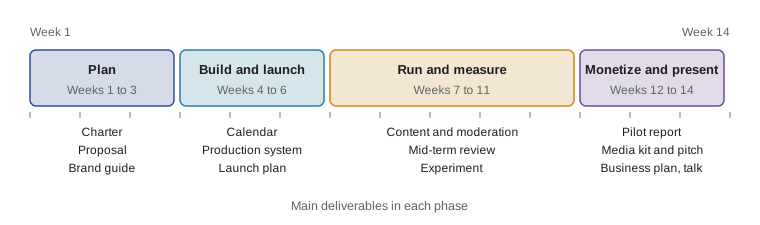
The four phases of the term
The term has four phases. In the planning phase (weeks 1 to 3) you write the charter, test niche ideas and set up your brand. Nothing is published yet except perhaps a channel trailer or a placeholder post. In the build and launch phase (weeks 4 to 6) you set up your production system, bank a buffer of finished content and launch. In the run and measure phase (weeks 7 to 11) you publish on schedule, grow and moderate your community, run experiments and complete a mid-term review. In the final phase (weeks 12 to 14) you pilot one or two revenue streams, build a media kit, write the business plan and present.
The phases overlap a little. You will be editing videos for week 5 while finishing your brand guide, and you will start thinking about monetization long before week 12. But the order matters. Students who try to monetize before they have a consistent publishing habit, or who skip validation and discover in week 9 that nobody searches for their topic, usually run out of time. Plan the work, then work the plan, and adjust deliberately rather than in a panic.
Choosing the scope
Scope is the most common reason capstones fail. A student imagines a daily vlog, a weekly long-form documentary, a podcast and a newsletter, all at studio quality, and by week 6 is exhausted and behind. Your scope should fit the hours you actually have. Most students taking a full course load can give the capstone about eight to twelve hours a week, and some of that time goes to planning, analytics and written deliverables rather than production. Lesson 4 turns this into a capacity calculation, but start now with a rough estimate.
A good capstone scope usually has one primary platform, one main format with a clear cadence (for example one long video a week, or three short videos a week), one secondary distribution channel (repurposed short clips on a second platform, for instance) and one owned channel such as a newsletter or a simple website. That is plenty for one term. You can describe bigger ambitions in your business plan as later stages.
Worked problem
Estimating the weekly hours available
Jordan, a student building a budget bike-repair channel, has four other courses, works ten hours a week at a bike shop and wants to keep two evenings free for rest. After classes, study and work, Jordan estimates 14 free hours on weekdays and 8 on weekends. Jordan decides to give the capstone half of the free time. Planning, analytics and written deliverables are expected to take about 30 % of capstone time. How many hours a week are left for production and publishing?
Show solution
- Total free time: \( 14 + 8 = 22 \) hours a week.
- Capstone allocation: \( 0.5 \times 22 = 11 \) hours a week.
- Planning and deliverables: \( 0.30 \times 11 = 3.3 \) hours.
- Production and publishing: \( 11 - 3.3 = 7.7 \) hours a week.
Answer: About 7.7 hours a week are available for production. That is enough for one carefully made 8-to-10 minute video a week plus a few short clips, but not for daily long-form content. Writing this down early prevents an unrealistic plan.
The project charter
A project charter is a short document, usually one or two pages, that defines the project and gives it authority. In a company, a sponsor signs the charter to say the project is approved and resourced. In the capstone, your instructor plays the sponsor and you are the project manager. The charter is your agreement about what you are trying to achieve, what is in and out of scope, and how you will know whether it worked. Return to it at mid-term and at the end; changing it is allowed, but changes should be written down with reasons.
| Charter section | What it contains | Example for Jordan |
|---|---|---|
| Purpose | Why the channel exists and for whom | Help students and commuters keep cheap bikes running safely |
| Goals | Two or three measurable goals for the term | Publish 6 long videos and 30 shorts; reach 100 hours of watch time a week by week 13; collect 150 email subscribers |
| Scope | Platforms, formats and cadence; what is excluded | YouTube long-form every two weeks, Shorts three a week, newsletter every two weeks; no livestreams this term |
| Schedule | Phases, milestones and due dates | Launch in week 5; mid-term review in week 9; presentation in week 14 |
| Resources | Hours, equipment, budget, help | 8 to 11 hours a week; phone, clip-on microphone, $150 budget; a friend for filming |
| Risks | Main risks and responses | Burnout during exams; weather limits outdoor filming; buffer of three videos |
| Success measures | How results will be judged | Goals above plus rubric criteria for process and professionalism |
| Stakeholders | Who is affected or involved | Instructor, viewers, the bike shop employer, people who appear on camera |
Your goals should mix outputs, which you control, with outcomes, which you influence. Publishing twelve videos is an output; it depends only on your effort. Reaching 25 hours of weekly watch time is an outcome; it depends on your effort and on the audience and the algorithm. Setting only outcome goals can be demoralizing when luck goes against you, and setting only output goals can hide whether the work is reaching anyone. CRE-440 described this as the difference between input and output metrics; a good charter has both.
SMART goals and the north star
Make each goal specific, measurable, achievable, relevant and time-bound. 'Grow the channel' is not a goal. 'Reach 25 hours of watch time a week, averaged over weeks 11 and 12' is. Choose one north star metric that best reflects the value you deliver to viewers. For most educational and entertainment channels this is weekly watch time or weekly engaged viewers rather than subscribers, because watch time reflects whether people actually value the content. Support it with a few input metrics you control, such as uploads per week, and a few health metrics, such as average view duration or returning viewers.
Worked problem
Turning a vague goal into a SMART goal
A student writes the goal: "Become a popular cooking channel this term." Rewrite it as a SMART goal for a 14-week capstone, assuming the student plans one long video a week and has no existing audience.
Show solution
- Specific: name the metric and the audience, for example weekly watch time from viewers interested in budget student cooking.
- Measurable: pick a number that can be read from analytics, such as 20 hours a week.
- Achievable: for a new channel publishing weekly, 20 hours a week by the end of term is ambitious but possible; 2,000 hours would not be.
- Relevant: watch time reflects whether viewers value the recipes, which is the purpose of the channel.
- Time-bound: average over the last two weeks of term to smooth out spikes.
Answer: Reach an average of 20 hours of watch time a week across weeks 13 and 14, while publishing one recipe video every week from week 5. The goal now combines an outcome and an output and can be checked from analytics.
The rubric
The capstone is graded with a rubric that weights process and professionalism more than raw growth. The weights below are typical; your instructor may adjust them, and the version in your course outline is the one that counts. Read the rubric now and plan the evidence you will need for each criterion. Evidence means screenshots of analytics, dated planning documents, checklists, copies of disclosures, experiment logs and similar records. A claim without evidence earns little credit.
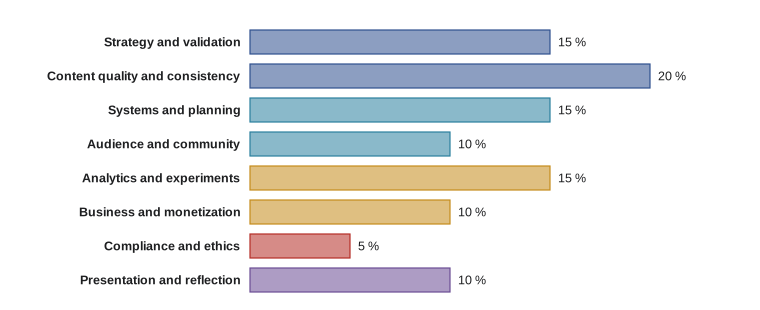
| Criterion | Weight | What earns top marks |
|---|---|---|
| Strategy and validation | 15 % | A clear, evidence-based niche choice and positioning |
| Content quality and consistency | 20 % | A steady cadence met with few misses, improving quality, accessible content |
| Systems and planning | 15 % | A documented, repeatable workflow, realistic calendar and buffer |
| Audience and community | 10 % | Respectful engagement, a moderation policy, an owned channel |
| Analytics and experiments | 15 % | Honest measurement, at least one well-designed experiment, decisions from data |
| Business and monetization | 10 % | A sensible pilot, media kit, pitch and business plan with realistic numbers |
| Compliance and ethics | 5 % | Correct disclosures, permissions, privacy and platform rules followed |
| Presentation and reflection | 10 % | A clear presentation and a candid, specific reflection |
The compliance and ethics criterion carries a small weight but acts as a gate in practice. An undisclosed sponsorship, music used without permission, a video featuring someone who did not consent or content that breaks platform rules can cost far more than five per cent, because your instructor may require it to be removed and will consider it in other criteria too. CRE-320 and CRE-450 are your references here.
Working with others
Many capstones involve other people: a friend who films, a sibling who appears on camera, a classmate in a collaboration, a shop owner whose space you use. Get permission in writing for anyone who appears identifiably, and be especially careful with minors, as CRE-450 explained. If your capstone is a team project, write a short team agreement covering roles, decision-making, how credit and any revenue are shared, who owns the channel and its content after the term, and what happens if someone leaves. Ownership disputes over a channel or its login are common and painful; settling them on day one is much easier.
Some programs allow you to continue an existing channel for the capstone. If yours does, your charter must separate what existed before the term from what you create during it, and your goals should be relative to the starting point. A channel that already has 20,000 subscribers is judged on what changes during the term, not on its starting size.
Keeping a project log
From week 1, keep a dated project log. Each entry can be short: what you did, how long it took, what you decided and why, and anything you learned. A log serves three purposes. It provides evidence for the rubric, it makes the final reflection much easier and more honest, and it gives you real data for capacity planning, because most people badly underestimate how long editing takes until they record it. A shared document, a spreadsheet or a project management tool all work; consistency matters more than the tool.
Worked problem
Using the log to correct an estimate
In weeks 4 and 5, Jordan logged production time for two videos: scripting 1.5 h and 2 h, filming 2 h and 2.5 h, editing 4.5 h and 5 h, thumbnail and upload 1 h each. The plan had assumed 6 hours per video. What is the actual average, and what does it mean for the plan?
Show solution
- Video 1 total: \( 1.5 + 2 + 4.5 + 1 = 9 \) hours.
- Video 2 total: \( 2 + 2.5 + 5 + 1 = 10.5 \) hours.
- Average: \( (9 + 10.5) / 2 = 9.75 \) hours per video.
- Overrun against the plan: \( 9.75 / 6 \approx 1.63 \), about 63 % more than planned.
Answer: Each video takes almost 10 hours, not 6. With about 7.7 production hours a week, a weekly long video would not be sustainable, which confirms the charter's choice of one long video every two weeks. Jordan should also simplify the editing style and use a template, and record the corrected estimate in the log so the calendar in lesson 4 uses real numbers.
How this course connects to the program
Each later lesson begins by naming the earlier courses it draws on. You are expected to apply those ideas, not to re-learn them here. If a concept feels unfamiliar, go back to the original course: niche selection and audience research to CRE-420 and CRE-440; growth and community to CRE-301; monetization to CRE-302; brand deals to CRE-310 and CRE-340; disclosure and advertising law to CRE-320; contracts, money and taxes to CRE-330; wellbeing and safety to CRE-350; team building to CRE-401; AI tools to CRE-410; crisis management to CRE-430; responsible content to CRE-450; and international audiences to CRE-460. The capstone is where these pieces become one working system.
Finally, look after yourself. A term-long public project, with numbers that update every hour, can be stressful. Decide in advance how often you will check analytics (once a day at most, and properly once a week), protect your sleep and other courses, and use the buffer and risk plan you build into the charter. If you are struggling, talk to your instructor early; adjusting scope is a professional decision, not a failure.
Common mistakes
MistakeSetting only follower or subscriber goals.
InsteadCombine an output goal you control with an outcome goal such as watch time, plus a few health metrics.
MistakePlanning a scope that needs more hours than you have.
InsteadEstimate available hours honestly, then fit one main format, one secondary channel and one owned channel into them.
MistakeTreating the charter as a one-time form.
InsteadRevisit it at mid-term and at the end, and record any changes with reasons.
MistakeCollecting evidence only at the end of term.
InsteadKeep a dated project log and save screenshots and documents as you go.
MistakeLeaving team and ownership questions unspoken.
InsteadWrite a short team agreement covering roles, credit, revenue, ownership and exit on day one.
Summary and key terms
- The capstone runs a real channel for one term and assesses professional practice more than raw growth.
- The term has four phases: plan, build and launch, run and measure, and monetize and present.
- Scope must fit the hours actually available; one main format, one secondary channel and one owned channel is plenty.
- A project charter sets purpose, goals, scope, schedule, resources, risks, success measures and stakeholders.
- Good goals are SMART and mix outputs you control with outcomes such as a north star metric.
- The rubric weights strategy, quality, systems, community, analytics, business, compliance and reflection; evidence is essential.
- A dated project log provides evidence, real capacity data and material for the final reflection.
- Capstone
- A final project that integrates the skills of a whole program.
- Project charter
- A short document defining a project's purpose, goals, scope, schedule, resources, risks and success measures.
- Scope
- The boundaries of a project: what is included and what is not.
- Output
- A result fully under your control, such as videos published.
- Outcome
- A result you influence but do not control, such as watch time or subscribers.
- North star metric
- The single measure that best reflects the value a channel delivers.
- SMART goal
- A goal that is specific, measurable, achievable, relevant and time-bound.
- Rubric
- A scoring guide listing criteria, weights and performance levels.
- Project log
- A dated record of work done, time spent, decisions and lessons.
- Stakeholder
- Anyone affected by or involved in a project.
Practice problems
Work each problem on paper first, then reveal the answer to check.
What does the capstone mainly assess?
Show answer
Professional practice: planning, evidence-based decisions, systems, consistency, ethics, honest measurement and learning.
Name the four phases of the term.
Show answer
Plan; build and launch; run and measure; monetize and present.
A student has 20 free hours a week and gives 40 % to the capstone, with 25 % of that on planning and deliverables. How many production hours remain?
Show answer
8 hours on the capstone, 2 on planning, 6 for production.
Give one output goal and one outcome goal.
Show answer
Output: publish 12 videos. Outcome: reach 25 hours of weekly watch time by week 12.
Why is watch time often a better north star than subscribers?
Show answer
It reflects whether viewers actually value and watch the content, not just a one-time click.
List four sections of a project charter.
Show answer
Purpose, goals, scope, schedule, resources, risks, success measures, stakeholders (any four).
Two videos took 8 and 11 hours against a 6-hour plan. What is the average overrun?
Show answer
Average 9.5 hours, about 58 % over plan.
Why does compliance act as a gate even with a small weight?
Show answer
Breaches can force removal of content and affect other criteria and the channel's standing.
What should a team agreement cover?
Show answer
Roles, decisions, credit, revenue sharing, ownership of the channel and content, and what happens if someone leaves.
Give two reasons to keep a project log.
Show answer
Evidence for the rubric, real capacity data and an easier, honest reflection.
Lesson quiz · 5 questions
Score 60% or more to complete this lesson.
Create a free account to save your progress, take quizzes and earn a certificate.