
CRE-499 · Lesson 12 of 12 · 29 min
Final presentation, reflection and next steps
The last stage of the capstone is to show what you did, what happened and what you learned, and to decide responsibly what happens to the channel next. This lesson covers the final presentation, the written reflection, the portfolio you will carry into your career and the choice between continuing, changing or pausing the channel. It draws on everything before it, especially the evidence in your project log. The deliverables are a presentation of ten to fifteen minutes, a written reflection of about 1,500 words and an updated portfolio.
The presentation and reflection carry their own weight in the rubric, but they also affect how every other criterion is judged, because this is where you show your evidence. A strong channel presented vaguely can score lower than a modest channel presented with clear evidence and honest insight.
Structuring the presentation
Tell the story of the project as a sequence of decisions and evidence, not as a list of everything you did. A clear structure helps your audience follow and remember.
- The promise: who the channel serves and why, in one sentence, with a short clip that shows it.
- The plan: goals from the charter, scope and the key choices from validation and strategy.
- The execution: your system, cadence achieved, and one or two pieces of content you are proudest of and why.
- The evidence: north star trend against target, the experiment, cohort or retention insights and the pilot results.
- The business: media kit, pitch, the business plan's scenarios and the main risks.
- The learning: what you would do differently and what you will do next.
Worked problem
Allocating presentation time
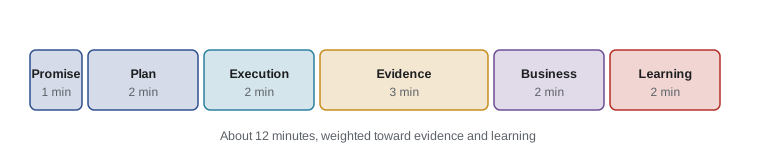
Jordan has 12 minutes. The rubric weights evidence and learning heavily. Jordan allocates time in the ratio 1 : 2 : 2 : 3 : 2 : 2 for promise, plan, execution, evidence, business and learning. How many minutes does each section get?
Show solution
- Total parts: \( 1 + 2 + 2 + 3 + 2 + 2 = 12 \).
- One part is \( 12 / 12 = 1 \) minute.
- Promise 1 min, plan 2, execution 2, evidence 3, business 2, learning 2.
Answer: Evidence gets the most time (3 minutes), matching its weight. Rehearsing with a timer is essential; most first drafts run long, and the learning section, often the most valuable, is the one that gets cut.
Presenting data clearly
Use a few clear charts rather than many screenshots. Each chart should answer one question, such as 'Did watch time reach the target?' or 'Which thumbnail style worked better?', with the answer in the slide title. Label axes and date ranges, show targets as reference lines and include uncertainty where it matters, such as intervals around an experiment result. Avoid reading numbers aloud from cluttered tables. The data visualization principles you used in CRE-202 and CRE-440 apply directly.
Be honest about luck. If one video took off because a large account shared it, say so, and show what the rest of the channel did without it. Your audience will trust everything else you say more.
Writing the reflection
The written reflection is where you show that you can learn from experience, which is the skill employers and partners value most. A useful structure is to describe what happened, analyse why, and decide what you will do differently. Use specific evidence from your log rather than general feelings. 'Editing took 63 % longer than planned in weeks 4 and 5, so I simplified my template and moved to fortnightly long videos, which brought utilization down to 81 % and let me keep the buffer for the rest of term' is far more convincing than 'I learned time management.'
- Goals: which charter goals you met, missed or changed, and why.
- Decisions: two or three key decisions, the evidence behind them and how they turned out.
- Surprises: what you did not expect about the audience, the platform or yourself.
- Ethics and wellbeing: how you handled disclosure, permissions, community issues and your own limits.
- Skills: which program skills you used most and which you need to strengthen.
- Next time: three specific changes you would make if you started again.
Worked problem
Assessing goal attainment
Jordan's goals and results: (a) publish 6 long videos and 30 shorts, achieved 6 and 31; (b) revised target of 85 hours weekly watch time averaged over weeks 13 and 14, achieved 81; (c) revised target of 120 email subscribers, achieved 104. Calculate the attainment percentage for each goal and the average.
Show solution
- (a) Long videos \( 6/6 = 100 \% \); shorts \( 31/30 \approx 103 \% \); treat output goal as met (100 %).
- (b) \( 81 / 85 \approx 95 \% \).
- (c) \( 104 / 120 \approx 87 \% \).
- Average: \( (100 + 95 + 87)/3 \approx 94 \% \).
Answer: Jordan met the output goal and came close on both outcome goals. The reflection should explain the gaps (for example, the newsletter lead magnet launched later than planned) rather than hide them, and connect them to the next-time changes.
A post-mortem method
Many teams use a short post-mortem, sometimes called a retrospective, to structure reflection. Ask three questions: what should we keep doing, what should we stop doing and what should we start doing? Answer each with evidence. For example, keep batching filming because it saved about 45 minutes a week; stop repurposing every long video into three shorts because question shorts performed better; start building the email list from day one with a lead magnet. CRE-430 used a similar after-action review after a crisis; the method works just as well after a successful project.
| Keep | Stop | Start |
|---|---|---|
| Batching filming and thumbnails | Long tool introductions | Lead magnet for the email list from launch |
| Weekly logging of the same metrics | Repurposing every long video into three clips | Two question shorts each week |
| Pre-publish checklist with disclosure and safety items | Checking analytics several times a day | A proper Test & Compare test on each strong video |
| Replying to early comments within a time limit | Planning hero content during exam weeks | Pitching one brand a month with a researched idea |
Building your portfolio
Your capstone is one of the best portfolio pieces you will have when you apply for jobs, internships or partnerships in the creator economy, marketing, media or communications. Assemble a short portfolio page or document with a description of the channel, links to your best two or three pieces, a one-page summary of results with key charts, your media kit, a summary of the experiment and pilot, and a few sentences on what you learned. Remove anything confidential, such as private analytics of collaborators or contract details, and check that you have permission to show any content featuring others.
Write a short case study in the problem, action and result format that employers recognize: the challenge you faced, what you did and what happened, with numbers. For example: 'Launched a budget bike-repair channel with no prior audience; built a fortnightly production system that held utilization near 80 %; ran a packaging experiment that raised click-through rate from 5.0 % to 6.3 %; reached 81 hours of weekly watch time and 104 email subscribers in ten weeks; piloted two revenue streams with full disclosure.'
Continue, change or pause
After the term, you have three broad choices. You can continue the channel as it is, change it based on what you learned, or pause it. Each is legitimate. Decide using your business plan's decision points, your enjoyment, your other commitments and the evidence about whether the channel delivers value to viewers. CRE-440's warning about sunk costs applies: the effort you have already spent is not by itself a reason to continue.
If you continue, carry over the system, buffer and policies, and set the next review date. If you change, write a short plan for the change and tell your audience what to expect. If you pause, do it responsibly. Post a short, honest message so viewers are not left wondering, keep your account secure with two-step verification, keep your handles so no one can impersonate you, honour any obligations to sponsors, buyers or newsletter subscribers (deliver what was promised, process refunds, stop sending email if you will not maintain the list or send a final message with an unsubscribe option), and archive your files and records. Remember the tax and record-keeping obligations from lessons 3 and 11 continue for any income you earned.
If you pause, keep your income and expense records for six years, as the Canada Revenue Agency requires, and report any capstone income on your tax return for the year. If you built an email list, you may keep it for a future restart, but only contact people within the consent they gave under CASL.
Worked problem
Using a decision rule to choose
Jordan's business plan said: continue if the base-case projection breaks even and weekly watch time grew in at least three of the last four weeks; change format if watch time grew but revenue did not; otherwise pause. Watch time grew in three of the last four weeks and the base case shows about $10 profit. What does the rule say?
Show solution
- Condition 1: base case breaks even (about $10 profit) — met.
- Condition 2: watch time grew in three of four weeks — met.
- Both continue conditions are met.
Answer: The rule says continue. Jordan might still reduce the cadence during the next semester's exams, but the decision rests on evidence agreed in advance rather than on a good or bad week.
Looking after yourself at the finish
The end of a capstone can bring a mix of relief, disappointment and pride. Numbers that fell short of your hopes do not mean you failed; they are data, and you now know far more about running a channel than you did fourteen weeks ago. Take a short break before deciding what to do next. If the project affected your wellbeing, use the support options from CRE-350, and if you ever feel in crisis, contact a crisis line such as 9-8-8 in Canada or 988 in the US.
Finally, thank the people who helped: collaborators, friends who filmed or watched drafts, viewers who commented and anyone who gave permission to appear. Generosity builds the relationships your future work will depend on. You finish the Influencer program with a real channel, a documented system, honest evidence and a plan, which is exactly what a professional creator needs.
Answering questions after the presentation
Expect questions after you present, and prepare for the obvious ones: what you would do with more time, why you chose your niche, how confident you are in your experiment result and what the biggest risk to the business plan is. Answer briefly and honestly; 'I do not know, but here is how I would find out' is a strong answer when it is true. Bring your log and spreadsheet in case someone asks for detail.
Common mistakes
MistakePresenting a list of activities instead of decisions and evidence.
InsteadTell the story through the plan, key decisions, evidence and learning.
MistakeHiding the role of luck or a single viral share.
InsteadSay what drove unusual results and show the rest of the channel's performance.
MistakeWriting a reflection of general feelings.
InsteadUse specific evidence from the log and three concrete next-time changes.
MistakeContinuing only because of effort already spent.
InsteadDecide with pre-set decision points and current evidence, ignoring sunk costs.
MistakeAbandoning a channel without notice or loose ends.
InsteadPause responsibly: tell viewers, secure accounts, honour obligations and keep records.
Summary and key terms
- The final stage presents the project, reflects on it, builds a portfolio and decides what happens next.
- A strong presentation follows promise, plan, execution, evidence, business and learning, with time weighted to evidence.
- Clear charts answer one question each, show targets and uncertainty, and acknowledge luck.
- A reflection uses specific evidence to explain goals, decisions, surprises, ethics and next-time changes.
- A keep, stop and start post-mortem turns experience into concrete changes.
- A portfolio and a problem-action-result case study carry the capstone into your career.
- Choose to continue, change or pause using decision rules, and pause responsibly if you stop.
- Final presentation
- A short talk presenting a project's decisions, evidence and learning.
- Reflection
- A structured written analysis of what happened, why and what to change.
- Post-mortem
- A review held after a project to learn what to keep, stop and start.
- Retrospective
- Another name for a structured review of completed work.
- Goal attainment
- Results achieved as a percentage of targets.
- Portfolio
- A collection of work samples and results used to show skills.
- Case study
- A short account of a challenge, the actions taken and the results.
- Sunk cost
- Effort or money already spent that cannot be recovered.
- Decision rule
- A pre-agreed condition that determines which option to choose.
- Responsible pause
- Stopping a channel while informing viewers, securing accounts and honouring obligations.
Practice problems
Work each problem on paper first, then reveal the answer to check.
List the six sections of the suggested presentation.
Show answer
Promise, plan, execution, evidence, business, learning.
15 minutes split 1 : 2 : 3 : 4 : 2 : 3. Minutes for evidence?
Show answer
4 minutes (one part = 1 minute).
Why put the answer in a chart's slide title?
Show answer
It tells the audience the main point immediately.
Goal 150, achieved 120. Attainment?
Show answer
80 %.
Name the three post-mortem questions.
Show answer
What to keep, stop and start doing.
Write a one-sentence problem-action-result statement.
Show answer
For example: launched a channel with no audience, built a weekly system, reached 80 hours of weekly watch time in ten weeks.
What should you remove from a portfolio?
Show answer
Confidential data, private contract details and content you lack permission to show.
Why ignore sunk costs when deciding whether to continue?
Show answer
Past effort cannot be recovered and should not drive future decisions.
List three steps for pausing responsibly.
Show answer
Tell viewers, secure accounts and keep handles, honour obligations, handle the email list properly, keep records.
Why thank collaborators and viewers?
Show answer
It builds relationships that future work depends on.
Lesson quiz · 5 questions
Score 60% or more to complete this lesson.
Create a free account to save your progress, take quizzes and earn a certificate.