
FILM-101 · Lesson 10 of 12 · 27 min
Documentary, animation and experimental film
Most of this course has used narrative fiction films as examples, but cinema includes three other major traditions with their own forms and histories. Documentaries claim to present the real world. Animated films create movement frame by frame from drawings, objects, puppets or computers. Experimental films reject or question the conventions of mainstream cinema, exploring form, perception and personal expression. Canada has made unusually important contributions to all three, largely through the National Film Board. This lesson introduces each tradition, the main types or modes within it, and how to analyze works that do not follow the patterns of fiction.
What makes a film a documentary?
A documentary presents itself as a factual account of real people, places or events. Its makers ask us to believe that what we see existed or happened in some form, rather than being invented. But documentaries are not neutral recordings. Documentary filmmakers select subjects, frame shots, choose interview questions, edit hours of footage into a structure, add music and narration, and sometimes stage or re-enact events. The Scottish filmmaker John Grierson, who coined the term "documentary" in the 1920s, described it as "the creative treatment of actuality." Grierson later became the first commissioner of the National Film Board of Canada when it was founded in 1939.
The key question is not whether a documentary is shaped (all are) but how it is shaped and whether it is honest about its methods. Analysis of documentary uses the same tools as fiction, mise-en-scène, cinematography, editing and sound, plus attention to evidence, argument and ethics.
Documentary modes
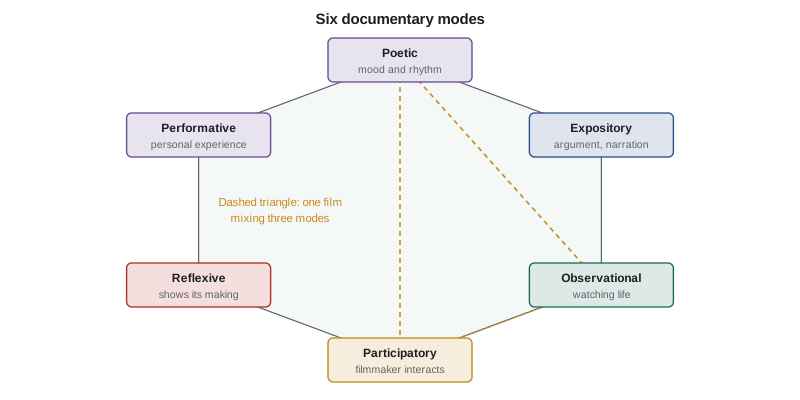
The scholar Bill Nichols proposed six modes of documentary, which many courses use as a framework. Most documentaries mix several modes.
| Mode | Main features | Typical techniques |
|---|---|---|
| Poetic | Emphasizes mood, rhythm and visual association over argument | Lyrical images, music, loose structure |
| Expository | Addresses the viewer directly with an argument | Authoritative voice-over narration, illustrative images |
| Observational | Observes life as it happens with minimal intervention | No narration or interviews, handheld camera, long takes |
| Participatory | The filmmaker interacts with subjects on camera | Interviews, filmmaker presence, encounters |
| Reflexive | Draws attention to how documentaries are made | Showing the crew, questioning representation |
| Performative | Emphasizes subjective, emotional or personal experience | First-person voice, re-enactment, expressive style |
The observational style has strong Canadian roots. In the late 1950s and early 1960s, NFB filmmakers working on the Candid Eye television series, and Quebec filmmakers such as Michel Brault, developed lightweight, synchronized-sound filmmaking that captured everyday life. In the United States, filmmakers such as Robert Drew, D. A. Pennebaker and the Maysles brothers developed the related approach known as direct cinema.
Documentary ethics and evidence
Documentaries raise ethical questions that fiction usually does not.
- Consent: did subjects understand and agree to how they would be shown?
- Representation: are people and communities portrayed fairly, with their own voices, or spoken for by outsiders?
- Manipulation: are staged scenes, re-enactments or misleading edits disclosed?
- Archival material: is old footage used accurately, and is its source acknowledged?
- Harm: could the film endanger vulnerable subjects?
Indigenous filmmakers have been especially important in challenging documentaries made about communities by outsiders, insisting instead on films made by and with those communities.
Alanis Obomsawin, an Abenaki filmmaker who joined the National Film Board in 1967, has made more than fifty films documenting Indigenous lives and struggles. Her Kanehsatake: 270 Years of Resistance (1993) follows the 1990 armed standoff at Kanehsatake and Oka, Quebec, from behind Mohawk lines, giving voice to people mainstream news coverage often ignored. The CBC and many funders require documentaries to follow journalistic standards for accuracy and fairness.
Worked problem
Identifying documentary modes
A described documentary about a fishing village opens with ten minutes of waves, nets and gulls set to music with no words. It then follows a family through a season without narration, interrupted by a few sit-down interviews in which the filmmaker's questions are heard. Which modes does it use?
Show solution
- Opening: mood and rhythm over argument, with music and images, which is the poetic mode.
- Following the family without narration: the observational mode.
- Interviews with the filmmaker's voice audible: the participatory mode.
- There is no authoritative narrator, so the expository mode is absent.
Answer: The film combines poetic, observational and participatory modes, moving from lyrical images to unnarrated observation with occasional interviews that reveal the filmmaker's presence.
Animation
Animation creates the illusion of movement by photographing or generating a series of slightly different images, usually 12 or 24 per second of screen time. Main techniques include:
- Hand-drawn (cel or 2-D) animation, in which artists draw each pose; traditional studio features were made this way for decades.
- Stop-motion, in which physical puppets, clay figures or objects are moved slightly and photographed frame by frame.
- Cut-out animation, using flat pieces of paper or other material.
- Computer-generated (3-D) animation, now dominant in mainstream features.
- Experimental techniques, such as drawing directly on film, animating sand or paint on glass, and pixilation, in which live actors are photographed frame by frame like puppets.
Worked problem
Counting drawings
A described hand-drawn short runs 8 minutes. If it is animated "on twos" (each drawing held for two frames at 24 frames per second), how many drawings does it need? How many if it is animated "on ones"?
Show solution
- Frames in 8 minutes: \( 8 \times 60 \times 24 = 11{,}520 \) frames.
- On twos, each drawing covers two frames: \( 11{,}520 \div 2 = 5{,}760 \) drawings.
- On ones, each frame is a new drawing: 11,520 drawings.
Answer: The short needs about 5,760 drawings on twos or 11,520 on ones, which is why much traditional animation is done on twos except for fast action.
Animation is not a genre but a technique that can serve any genre, from comedy to documentary to horror. Animated documentaries, for example, use animation to represent events that could not be filmed, such as memories or interviews with subjects who must remain anonymous.
The NFB animation studio, founded by Scottish-born animator Norman McLaren in the 1940s, became world-famous for experimental technique. McLaren's Neighbours (1952), an anti-war parable using pixilation, won an Academy Award, and NFB animators such as Caroline Leaf, who animated with sand and paint on glass, and Frédéric Back, whose The Man Who Planted Trees (1987) won an Oscar, extended the studio's reputation.
Experimental and avant-garde film
Experimental (or avant-garde) films set aside mainstream conventions of narrative, continuity and commercial production. They may explore pure form, such as rhythm, colour and light; the materials of film itself, such as scratches and grain; personal diary and poetry; found footage; or perception and duration. Some are abstract, with no recognizable objects; some use narrative fragments; some are installations in galleries rather than films in cinemas.
Analyzing experimental film requires adjusting expectations. Instead of asking what happens next, ask what patterns the film sets up, how it uses repetition and variation, how it affects perception and what it asks of the viewer. Many experimental films are short and reward repeated viewing.
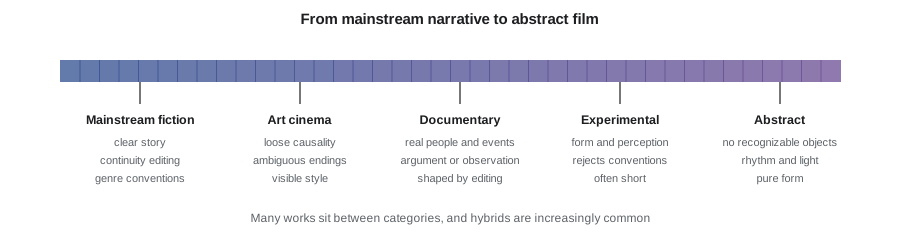
Canadian experimental cinema is internationally respected. Michael Snow's Wavelength (1967), a 45-minute film consisting largely of a slow zoom across a loft toward a photograph on the wall, is often cited as a landmark of structural film, in which the shape of the film itself becomes its subject. Arthur Lipsett's collage films at the NFB, discussed in Lesson 7, also influenced filmmakers worldwide.
Why these traditions matter
Documentary, animation and experimental film show that cinema is not limited to fictional storytelling in the continuity style. They expand the toolkit of form and often influence the mainstream: observational techniques appear in fiction films, animation shapes visual effects, and experimental editing reaches music videos and advertising. Studying them sharpens your awareness of conventions you might otherwise take for granted.
Hybrid forms
The boundaries between documentary, fiction, animation and experimental film are increasingly porous. Docudramas re-enact real events with actors; mockumentaries use documentary techniques for comic fiction; animated documentaries depict real interviews through drawings; and hybrid films mix observational footage with staged scenes, sometimes without telling the audience which is which. These hybrids raise interesting questions about trust and truth. When a film blends forms, analysis asks how it signals what is real, whether its methods are disclosed, and how the mixing affects our response.
Digital technology has made such blending easier. Visual effects can insert impossible images into documentary footage, artificial intelligence can generate realistic voices and faces, and archival footage can be altered or artificially coloured. Many documentary organizations now publish guidelines asking filmmakers to disclose when footage has been generated or significantly altered, so that audiences can judge what they are seeing.
Analyzing a documentary scene
The tools from earlier lessons apply directly to documentary. Ask how the scene is framed: are subjects filmed in close-up during interviews, in long shots as they work, or with a handheld camera following them? How is it edited: does the cutting build an argument, follow chronology, or juxtapose contrasting images? What do we hear: narration, interview voices laid over other images, ambient sound, music? Each choice shapes whether we feel we are observing, being told, or being invited into someone's perspective.
For example, laying an interview voice over images of the speaker's hands at work, rather than showing their face, can feel intimate and respectful, focusing attention on labour rather than personality. Adding a mournful score under footage of an empty factory tells us how to feel about economic change, while presenting the same footage with only ambient sound leaves the interpretation more open. Recognizing these choices helps you read documentaries critically rather than accepting them as transparent windows on reality.
Animation and form
Animation offers complete control over every element of the frame, so analysis of animated films can attend closely to design choices that live-action films inherit from the world: the shape and proportion of characters, the texture of backgrounds, the timing of movement and the use of exaggeration known as squash and stretch. Even the frame rate becomes expressive, with fast action animated on ones for smoothness and quieter moments on twos for a gentler rhythm.
Analyzing animation therefore combines the familiar tools of film form with attention to design. Ask what drawing style the film adopts, how it moves between realism and exaggeration, how colour and texture build its world, and how the soundtrack, often recorded before the animation, shapes timing and performance. Voice performance in animation is recorded separately and then animated to, so the relationship between voice and image is designed with special care.
Studying all three traditions together also reveals shared questions. Documentary asks how films represent reality; animation shows that every image is constructed; and experimental film asks viewers to notice the act of perception itself. Each sharpens the critical habits this course has built: looking closely, naming techniques precisely and asking what each choice does.
Common mistakes
MistakeAssuming documentaries are neutral recordings of reality
InsteadRecognize documentaries as shaped by selection, framing, editing and sound, and analyze how
MistakeCalling animation a genre
InsteadTreat animation as a technique that can serve any genre
MistakeAssigning a documentary to a single mode only
InsteadIdentify the mix of modes and where each appears
MistakeExpecting experimental films to follow narrative logic
InsteadLook for patterns, repetition and effects on perception instead
MistakeIgnoring ethics when analyzing documentary
InsteadConsider consent, representation, disclosure of staging and possible harm
Summary and key terms
- Documentaries present real people and events but are always shaped; Grierson called them the creative treatment of actuality.
- Nichols's six modes are poetic, expository, observational, participatory, reflexive and performative, and films mix them.
- Documentary ethics involve consent, representation, manipulation, archival accuracy and harm.
- Animation creates movement frame by frame through hand-drawn, stop-motion, cut-out, computer and experimental techniques.
- Animation is a technique, not a genre, and can serve fiction, documentary and art.
- Experimental film explores form, materials, perception and personal expression outside mainstream conventions.
- The NFB made Canada a leader in documentary, animation and experimental film.
- Documentary
- A film presenting a factual account of real people, places or events
- Expository mode
- A documentary approach that argues directly to the viewer, often with voice-over
- Observational mode
- A documentary approach that observes events with minimal intervention
- Participatory mode
- A documentary approach in which the filmmaker interacts with subjects on camera
- Direct cinema
- An American observational documentary movement of the late 1950s and 1960s
- Re-enactment
- A staged recreation of past events in a documentary
- Stop-motion
- Animation made by moving physical objects slightly between photographed frames
- Pixilation
- Stop-motion animation of live actors photographed frame by frame
- Structural film
- Experimental film in which the film's overall shape or process becomes the subject
- Avant-garde film
- Experimental film that challenges mainstream conventions of form and production
Practice problems
Work each problem on paper first, then reveal the answer to check.
Who described documentary as the creative treatment of actuality?
Show answer
John Grierson.
Name Nichols's six documentary modes.
Show answer
Poetic, expository, observational, participatory, reflexive and performative.
Which mode uses an authoritative narrator presenting an argument?
Show answer
The expository mode.
Name two ethical questions documentaries raise.
Show answer
Consent and fair representation, also manipulation, archival accuracy and harm.
How many frames are in a one-minute film at 24 frames per second?
Show answer
1,440 frames.
What is pixilation?
Show answer
Stop-motion animation of live actors photographed frame by frame.
Why is animation not a genre?
Show answer
It is a technique that can serve any genre.
What should you look for when analyzing an experimental film?
Show answer
Patterns, repetition, variation and effects on perception rather than plot.
What does "animating on twos" mean?
Show answer
Each drawing is held for two frames.
Give an example of how animation is used in documentary.
Show answer
To show memories or events that could not be filmed, or to protect anonymous subjects.
Lesson quiz · 5 questions
Score 60% or more to complete this lesson.
Create a free account to save your progress, take quizzes and earn a certificate.