
FILM-101 · Lesson 11 of 12 · 25 min
Film in its industry and culture
Films do not appear from nowhere. They are financed, produced, distributed, exhibited, rated, marketed, reviewed, streamed and argued about within industries and cultures. Those systems shape what gets made, who gets to make it, what it looks like, who sees it and how it is understood. This lesson introduces the stages of the film business, the economics of success and failure, national film policies, classification (ratings), the rise of streaming, and questions of representation and diversity. It compares the Canadian and American systems, which are closely linked but very different in scale and policy.
The three stages: production, distribution and exhibition
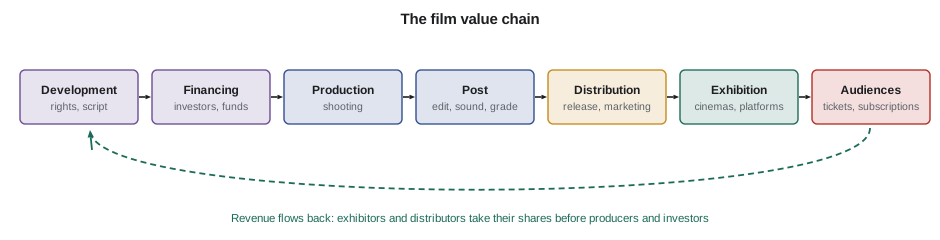
The film industry is traditionally divided into three sectors.
- Production: developing, financing and making the film. Producers assemble rights, scripts, financing, cast and crew; production companies range from huge studios to tiny independents.
- Distribution: acquiring the rights to release a film in particular territories and formats and marketing it. Distributors decide release dates, numbers of screens, advertising and placement on platforms.
- Exhibition: showing films to audiences in cinemas, at festivals, on television and on streaming services.
Each sector takes a share of revenue. In theatrical release, the box office gross is split between the exhibitor and the distributor, and the distributor deducts its fees and marketing costs before money returns to producers and investors.
Budgets, box office and success
Film budgets vary enormously, from a few thousand dollars for a micro-budget independent feature to hundreds of millions for a studio blockbuster. Marketing can add a large share on top of the production budget for wide releases. Because exhibitors keep a substantial share of ticket sales, a film usually needs to gross considerably more than its production budget at the box office to break even theatrically. Industry commentators often cite a rough rule of thumb that a wide release must gross about two and a half times its production budget worldwide to cover costs, though the real figure depends on marketing spending, territories and later revenues from streaming, television and home video.
Worked problem
Box office and budget at awareness level
A described film cost 40 million dollars to produce and grossed 85 million dollars worldwide in cinemas. Using the rough 2.5 times rule of thumb, estimate whether it broke even theatrically, and note what else matters.
Show solution
- Estimate the theatrical break-even: \( 40 \times 2.5 = 100 \) million dollars.
- Compare: 85 million is below 100 million, so on this rough rule the film fell short theatrically.
- Ratio: \( 85 \div 40 \approx 2.1 \) times its budget.
- Other factors: actual marketing costs, how the gross split by territory, and later revenue from streaming licences, television and home video could still make it profitable.
Answer: At about 2.1 times its budget, the film likely fell short of theatrical break-even on the 2.5 times rule of thumb, but its final profit depends on marketing costs and later revenue windows, so the rule gives only a rough indication.
Box office figures reported in the press are usually gross ticket sales, not profit, and comparisons across decades should account for inflation and rising ticket prices.
Hollywood: studios and independents
The American film industry is the largest in the world by revenue and global reach. During the studio era, roughly the 1920s to the late 1940s, a handful of major studios controlled production, distribution and many cinemas. In 1948 the US Supreme Court's Paramount decision forced studios to separate from theatre ownership, helping end the classic studio system; the related consent decrees were terminated by a federal court in 2020. Today the major studios are parts of large media conglomerates, and independent producers and distributors work alongside them, with festivals such as Sundance serving as key markets for independent film.
Hollywood dominates Canadian cinema screens. Films made in Canada typically earn only a small share of the domestic box office in English Canada, while Quebec's French-language films often perform much better in their home market. At the same time, Canada is a major production centre for American films and series, attracted by tax credits, skilled crews and favourable exchange rates; Vancouver, Toronto and Montreal are among the busiest production cities in North America.
National film policies
Many countries support their own film industries to protect cultural expression against the commercial dominance of Hollywood.
Canada has an extensive system of public support for film and television. The National Film Board of Canada (founded 1939) produces and distributes documentaries, animation and interactive works. Telefilm Canada (created in 1967 as the Canadian Film Development Corporation) invests in Canadian feature films and promotes them at home and abroad. Federal and provincial tax credits support productions certified as Canadian; certification by the Canadian Audio-Visual Certification Office (CAVCO) uses a points system that awards points when key creative positions, such as director, screenwriter and lead performers, are held by Canadians, with a minimum number of points required. The Canadian Radio-television and Telecommunications Commission (CRTC) regulates broadcasting, including Canadian content requirements, and the Online Streaming Act of 2023 extended the broadcasting framework to online streaming services, a policy that has remained contested.
Quebec has its own institution, the Société de développement des entreprises culturelles (SODEC), which supports Quebec cinema, and Quebec filmmakers such as Denis Villeneuve, Xavier Dolan and Denys Arcand, whose The Barbarian Invasions (2003) won the Academy Award for Best Foreign Language Film, have achieved international success.
Classification and ratings
Most countries classify films to inform audiences, especially parents, about content such as violence, sexuality and language.
In Canada, film classification for theatrical release is a provincial responsibility. Several provinces have their own classification bodies or rely on another province's ratings. English Canadian ratings commonly use categories such as G, PG, 14A, 18A and R, while Quebec uses its own categories, including G, 13+, 16+ and 18+. Because classification is provincial, the same film can occasionally receive different ratings in different provinces.
Streaming and changing exhibition
Streaming services have transformed the industry. They commission original films and series, license libraries, release films worldwide at once and collect detailed viewing data. Theatrical windows, the period a film plays exclusively in cinemas, have shortened, and some films premiere directly on streaming platforms. Streaming has opened opportunities for filmmakers whose work might not get wide theatrical release, but it also concentrates power in a few global companies and makes viewing data private rather than public. Questions about how streaming services should contribute to national film industries, as with Canada's Online Streaming Act, are among the most active debates in film policy.
Representation and diversity
Who appears on screen, who tells the stories and how communities are portrayed are central questions in film studies and the industry. Researchers track the share of directors, writers and leading roles held by women, racialized people, Indigenous people, people with disabilities and LGBTQ+ people, and many studies have found significant underrepresentation in key creative roles, particularly behind the camera. Representation matters because films shape how audiences see themselves and others, and because access to filmmaking determines whose stories are told.
Analyzing representation means asking whose perspective a film adopts, which characters have complexity and agency, which stereotypes are reinforced or challenged, and who made the film. It also means considering audiences' different responses.
| Area | Canada | United States |
|---|---|---|
| Public production support | NFB, Telefilm Canada, provincial agencies such as SODEC, federal and provincial tax credits | Mostly state tax incentives; NEA and CPB support; foundations |
| Content rules | Canadian content certification (CAVCO points), CRTC broadcasting rules | No national content quotas |
| Ratings | Provincial classification (14A, 18A and others; Quebec 13+, 16+, 18+) | Voluntary industry ratings (G, PG, PG-13, R, NC-17) |
| Market position | Domestic box office dominated by Hollywood; major production centre for US projects | World's largest film industry with global distribution |
| Key festivals | Toronto International Film Festival, Hot Docs, VIFF, Fantasia | Sundance, Tribeca, SXSW, Telluride |
Festivals, awards and critics
Film festivals play a key role in launching films, especially independent, documentary and international work. Festivals select films, attract press and buyers, and award prizes that can lead to distribution deals. Major international festivals include Cannes, Venice and Berlin, along with large North American events. Awards such as the Academy Awards and national prizes influence box office, streaming visibility and careers. Critics and, increasingly, online review aggregators and social media shape a film's reputation, although critical acclaim and commercial success often diverge.
When analyzing a film's place in culture, it can help to trace its path: where it premiered, how it was distributed, how critics and audiences responded, and whether it found a second life on streaming or in classrooms. A film that failed in cinemas may later become a cult classic or be reappraised by critics, while a box office hit may be forgotten within a few years.
Audiences and reception
Film studies also examines audiences: who watches films, where, and how they interpret them. Different audiences can read the same film in very different ways depending on their age, culture, community and experiences. Fan communities create their own meanings through discussion, fan art and online commentary. Researchers study box office data, streaming metrics, surveys and online discussion to understand reception, while recognizing that viewing data held privately by streaming companies is often unavailable to the public.
Questions of access matter too. Captions, described video and accessible cinemas determine whether people with disabilities can enjoy films; distribution decisions determine whether films reach rural communities or smaller countries; and pricing determines who can afford to watch. Canada and the United States both have laws and regulations that require captioning and accessibility for broadcast and some online content, and many cinemas offer captioning devices and described audio.
Labour and working conditions
Behind every film are crews whose working conditions are shaped by unions, guilds and labour law. Unions negotiate pay, hours, safety and residuals, the payments that writers and performers receive when films are reused on other platforms. In 2023, strikes by the Writers Guild of America and SAG-AFTRA in the United States halted much American production for months, with disputes over streaming residuals and the use of artificial intelligence, and the effects were felt by crews in Canada too. Understanding labour helps explain why productions move between cities, why budgets rise and how new technologies are adopted in the industry.
Labour questions also connect to representation. Mentorship programs, training initiatives and funding targets for under-represented groups aim to widen access to crew positions and key creative roles. Telefilm Canada, the Canada Media Fund and several American studios and guilds have introduced programs and data collection to track progress, although researchers continue to debate how effective such measures are and how they should be designed.
For a short analysis exercise, choose a film you know and trace its industrial path: who financed it, which company distributed it, where it premiered, what rating it received and where audiences can watch it today. The answers often explain features of the film itself, from its budget and casting to its length and the way it was marketed.
Common mistakes
MistakeTreating box office gross as profit
InsteadRemember that exhibitors, distributors and marketing take large shares before profit is calculated
MistakeAssuming film ratings work the same everywhere
InsteadDistinguish Canada's provincial government classification from the voluntary US industry system
MistakeTreating national film policy as only about money
InsteadRecognize its cultural goals of protecting local stories and voices
MistakeIgnoring who made a film when discussing representation
InsteadConsider both on-screen portrayal and behind-the-camera access
MistakeComparing box office across decades without adjustment
InsteadAccount for inflation, ticket prices and changes in release patterns
Summary and key terms
- The film industry is organized into production, distribution and exhibition, each taking a share of revenue.
- Box office gross is not profit; a rough rule suggests wide releases need about 2.5 times their budget to break even theatrically.
- The Hollywood studio system was reshaped by the 1948 Paramount decision, and conglomerates and independents now coexist.
- Canada supports film through the NFB, Telefilm, SODEC, tax credits, CAVCO certification and CRTC rules.
- The United States relies mainly on state incentives, nonprofits and voluntary industry ratings.
- Streaming has transformed release patterns and raised new policy debates.
- Representation concerns both who appears on screen and who makes films.
- Production
- The sector that develops, finances and makes films
- Distribution
- The sector that acquires release rights and markets films
- Exhibition
- The sector that shows films to audiences
- Box office gross
- Total ticket sales before shares and costs are deducted
- Theatrical window
- The period a film plays exclusively in cinemas before other release formats
- Telefilm Canada
- The federal Crown corporation that invests in and promotes Canadian feature films
- CAVCO
- The Canadian Audio-Visual Certification Office, which certifies Canadian content for tax credits
- CRTC
- The Canadian Radio-television and Telecommunications Commission, which regulates broadcasting
- MPA rating system
- The voluntary US film industry ratings: G, PG, PG-13, R and NC-17
- Paramount decision
- The 1948 US Supreme Court ruling that separated studios from theatre ownership
Practice problems
Work each problem on paper first, then reveal the answer to check.
Name the three sectors of the film industry.
Show answer
Production, distribution and exhibition.
A film cost 20 million dollars. Using the 2.5 times rule, what must it gross to break even theatrically?
Show answer
About 50 million dollars.
Why is box office gross not profit?
Show answer
Exhibitors, distributors and marketing costs take large shares first.
What did the 1948 Paramount decision do?
Show answer
It forced studios to separate from owning cinemas.
When was the National Film Board of Canada founded?
Show answer
1939.
What does CAVCO do?
Show answer
It certifies productions as Canadian for tax credit purposes using a points system.
Who sets film ratings in the United States?
Show answer
The film industry, through the Motion Picture Association's rating administration.
Who is responsible for film classification in Canada?
Show answer
The provinces.
Name one effect of streaming on film release.
Show answer
Shorter theatrical windows, worldwide simultaneous release or direct-to-streaming premieres.
Give two questions to ask when analyzing representation.
Show answer
Whose perspective the film adopts and which characters have complexity and agency; also who made the film.
Lesson quiz · 5 questions
Score 60% or more to complete this lesson.
Create a free account to save your progress, take quizzes and earn a certificate.