
FILM-101 · Lesson 8 of 12 · 27 min
Sound: dialogue, music, effects, diegetic and non-diegetic sound, and silence
Viewers usually describe films in visual terms, but sound shapes the experience at least as powerfully. It tells us where we are, what is happening offscreen, how to feel and what to pay attention to. A frightening scene with the sound turned off often becomes almost comic; the same images with a different score can seem tragic or triumphant. This lesson introduces the three main types of film sound, the crucial distinction between diegetic and non-diegetic sound, the qualities of sound you can describe, how sound relates to image in space and time, and the expressive power of silence. The sound design and mixing crafts are taught in the film production courses; here the aim is to hear sound analytically.
A short history of film sound
So-called silent films were rarely silent. Screenings were accompanied by live music, from a single pianist to a full orchestra, and sometimes by narrators and sound effects performed in the theatre. Synchronized recorded sound arrived commercially in the late 1920s; The Jazz Singer (1927) is usually cited as the film that popularized synchronized dialogue and song, and within a few years most studios had converted. Early sound technology was cumbersome and briefly restricted camera movement, but techniques quickly developed for recording, re-recording and mixing separate tracks. Later milestones included magnetic stereo sound in the 1950s, Dolby noise reduction and surround sound from the 1970s, digital sound in the 1990s, and object-based immersive formats more recently.
Three types of sound
Film soundtracks are usually built from three broad components, recorded and edited separately and then mixed together.
- Speech: dialogue, voice-over narration and other vocal sounds such as breathing or crowd murmur (walla).
- Music: the score composed for the film, and existing songs or pieces chosen for it.
- Sound effects: all other sounds, from footsteps and doors to explosions and ambient environments. Many everyday sounds are recreated in a studio by Foley artists, named after Jack Foley, a pioneer of the craft at Universal Studios, who perform footsteps, cloth movement and handled objects in sync with the picture.
In mixing, these elements are balanced against one another. Dialogue usually takes priority in mainstream films, so music and effects are lowered (ducked) under speech. Changing that balance, letting music swamp dialogue or letting ambient noise overwhelm a conversation, is an expressive choice.
Worked problem
Breaking a sound mix into layers
A described scene shows a couple arguing quietly in a busy restaurant kitchen during service. List the likely layers of the soundtrack and suggest how the mix might change at the emotional peak.
Show solution
- Speech: the couple's dialogue; background walla from other staff and diners.
- Effects: ambience of the kitchen (extractor fans, sizzling, clattering plates), specific sounds such as a knife on a board, Foley for their movements.
- Music: perhaps none at first, or a faint radio playing in the kitchen.
- Peak: the mixer might fade the kitchen ambience and walla down until only their voices and one small sound remain, isolating the couple as if the world has fallen away.
Answer: The mix layers dialogue, walla, kitchen ambience, Foley and perhaps diegetic radio; at the peak, reducing everything but the voices and one detail focuses attention on the argument and expresses the couple's emotional isolation.
Diegetic and non-diegetic sound
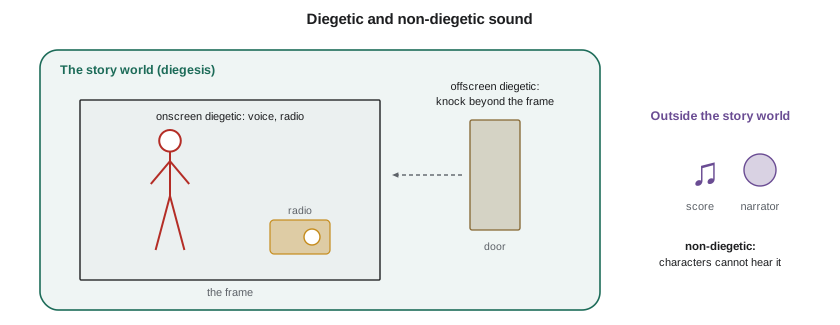
The most important distinction in film sound analysis is between diegetic and non-diegetic sound. The diegesis is the world of the story.
- Diegetic sound has a source in the story world: characters' voices, a radio playing, footsteps, traffic. Characters could, in principle, hear it.
- Non-diegetic sound comes from outside the story world: the orchestral score, a narrator who is not a character, added sound effects for comic emphasis. Characters cannot hear it.
| Type | Source | Examples | Typical function |
|---|---|---|---|
| Diegetic onscreen | Visible source in the story world | Dialogue of characters we see; a guitar being played | Realism, information, performance |
| Diegetic offscreen | Source in the story world but outside the frame | A siren outside; a voice from another room | Enlarges space, creates suspense |
| Internal diegetic | A character's thoughts heard by us | Inner monologue as voice-over | Subjective depth |
| Non-diegetic | Outside the story world | Orchestral score; a non-character narrator | Mood, guidance, commentary |
The boundary can be crossed for effect. A piece of music may begin as a song on a car radio (diegetic) and swell into the score (non-diegetic). A score may suddenly be revealed as an orchestra playing on screen, a joke some comedies enjoy. Analysis notes where such shifts happen and what they do.
Describing sound qualities
To analyze sound precisely, describe its acoustic qualities.
- Loudness (volume): loud sounds command attention; sudden changes startle.
- Pitch: high or low frequency; low rumbles can create unease, high sustained tones tension.
- Timbre: the tone colour or texture of a sound, what makes a violin sound different from a flute playing the same note, or a voice warm or harsh.
- Rhythm: patterns of sound over time, which interact with editing rhythm.
- Perspective: whether a sound seems near or far, through volume, reverberation and clarity. Close-miked whispers feel intimate; distant, echoing voices feel remote.
- Fidelity: whether a sound matches its apparent source. A deliberately mismatched sound, such as a squeaky toy noise for a punch, creates comedy or strangeness.
Sound and image in space and time
Sound can relate to the image in several ways.
- Synchronous sound matches the image in time: lips move as we hear the words.
- Asynchronous sound is out of step, through technical error or deliberate effect.
- A sound bridge carries sound from one scene into the next, or begins the next scene's sound before the cut, smoothing the transition or linking ideas. For example, a phone rings at the end of one scene and continues into the next, where someone answers it far away.
- Sound can also be displaced in time: we hear a voice from the past over images of the present, suggesting memory or haunting.
- Offscreen sound expands space and builds suspense, because we imagine the unseen source.
Worked problem
Identifying a sound bridge
In a described film, a teacher says "Tomorrow, we begin" in a classroom. Before the image cuts, we hear the roar of a crowd; the next shot shows a stadium the following day. Classify the sound technique and its effect.
Show solution
- Identify the timing: the stadium sound begins before the cut, overlapping the end of the classroom scene.
- Classify: this is a sound bridge, with sound from the next scene leading in.
- Interpret: it links the teacher's words to the coming event and creates anticipation, while smoothing a jump in time and place.
Answer: The crowd roar is a sound bridge that pre-laps the next scene, tying the promise of "tomorrow" to the stadium event and making the transition feel driven by anticipation.
Music and its functions
Film music can do many jobs at once.
- Mood: establishing emotional tone, from dread to joy.
- Emotional guidance: telling us how to feel, sometimes heavily.
- Continuity: smoothing cuts and holding a sequence together.
- Leitmotifs: recurring musical themes linked to characters, places or ideas, a technique borrowed from opera; a famous two-note shark motif from a 1975 American thriller is a classic example.
- Counterpoint: music that contrasts with the image, such as cheerful music over violence, creating irony or unease.
- Period and place: songs and instruments signal era, culture or location.
Many composers and critics distinguish between a score that underlines what we already see and one that adds a layer of meaning the images do not contain. Analysis asks which the film does at each key moment.
Silence and sound design
Silence is one of the most powerful sounds in cinema. Because films are almost never truly silent, a sudden drop to near silence, or the removal of score from a scene where we expect it, draws intense attention. Silence can express shock, awe, death, deafness or the aftermath of violence. Some films withhold music entirely to create a documentary feel.
The term sound designer is often credited to Walter Murch for his work on Apocalypse Now (1979), signalling that the whole soundtrack can be designed with the same care as the image. Modern sound design blends recorded, edited and synthesized sounds into environments that can be realistic, heightened or completely imaginary.
Canadian films and filmmakers have contributed notably to sound innovation. The NFB pioneered experiments in hand-drawn and animated sound; Norman McLaren drew and printed patterns directly onto the soundtrack area of film to create synthetic music for works such as Synchromy (1971), in which the images show the very patterns producing the sound. Canada's broadcast regulator, the CRTC, also regulates loudness of commercials on television.
Listening exercises
Sound analysis improves with deliberate listening. Try three exercises. First, watch a scene with your eyes closed and describe what you hear: how many layers of sound, where they seem to be in space, which are diegetic and which are not. Then watch the same scene normally and notice which sounds you had not consciously registered. Second, watch a scene with the sound muted and note what is lost: often the emotional tone, the sense of space beyond the frame and much of the rhythm. Third, compare two films in the same genre, such as two thrillers, and describe how each uses music: constantly, sparingly, or not at all.
As you listen, pay attention to room tone and ambience, the quiet background sound of a space. Every room has its own sound, and sound editors carefully match ambience across shots so that cuts do not reveal changes in microphone position. When ambience suddenly changes or disappears, the film may be signalling a shift in a character's perception, a dream or a moment of shock.
Sound also shapes how we read performance. A whisper recorded close to the microphone can feel intimate even in a wide shot, while a voice drowned by wind or traffic can make a character seem overwhelmed by their surroundings. Dialogue that is partly inaudible may frustrate viewers but can also feel realistic, as conversation often is in life.
Sound and genre
Genres develop recognizable sound conventions. Horror films rely on low drones, sudden loud stings and long silences before a shock. Westerns often use sweeping orchestral or guitar scores and the wind of open landscapes. Science fiction uses synthesized textures to suggest the unfamiliar, while musicals foreground song as the main expressive channel. Recognizing these conventions helps you notice when a film follows or breaks them, for example a horror film that refuses jump scares or a war film that drops music entirely.
Common mistakes
MistakeAssuming all music in a film is non-diegetic
InsteadCheck whether the music has a source in the story world, such as a radio or performer
MistakeIgnoring sound when analyzing a scene
InsteadDescribe dialogue, music, effects, silence and the mix as part of the evidence
MistakeDescribing sound only as loud or quiet
InsteadUse pitch, timbre, rhythm, perspective and fidelity for precise description
MistakeTreating silence as the absence of design
InsteadRecognize silence and score removal as deliberate expressive choices
MistakeMissing sound bridges at scene transitions
InsteadListen for sound that begins before or continues after a cut and ask what it connects
Summary and key terms
- Silent cinema used live music; synchronized sound spread from the late 1920s.
- Soundtracks combine speech, music and effects, often with Foley and careful mixing.
- Diegetic sound comes from the story world; non-diegetic sound comes from outside it, and films can cross the boundary.
- Loudness, pitch, timbre, rhythm, perspective and fidelity describe sound precisely.
- Synchronous sound, sound bridges and offscreen sound shape space and time.
- Music sets mood, guides emotion, links scenes and uses leitmotifs or counterpoint.
- Silence and sound design are powerful expressive tools.
- Diegesis
- The world of the story in which characters live
- Diegetic sound
- Sound whose source exists in the story world
- Non-diegetic sound
- Sound from outside the story world, such as the score or a non-character narrator
- Foley
- Studio-recorded everyday sounds such as footsteps and cloth, performed in sync with the picture
- Walla
- Background crowd murmur recorded to suggest unspecific voices
- Sound bridge
- Sound that carries over or begins before a cut, linking two scenes
- Leitmotif
- A recurring musical theme associated with a character, place or idea
- Counterpoint
- Music or sound that contrasts with the image to create irony or tension
- Timbre
- The tone colour or texture that distinguishes one sound from another
- Sound perspective
- The apparent distance of a sound, created by volume and reverberation
Practice problems
Work each problem on paper first, then reveal the answer to check.
Name the three main components of a soundtrack.
Show answer
Speech, music and sound effects.
What is the difference between diegetic and non-diegetic sound?
Show answer
Diegetic sound has a source in the story world; non-diegetic sound does not.
Give an example of offscreen diegetic sound.
Show answer
A siren heard outside the window that we do not see.
What do Foley artists do?
Show answer
Recreate everyday sounds in a studio in sync with the picture.
What is a sound bridge?
Show answer
Sound that overlaps a cut, linking one scene to the next.
What is a leitmotif?
Show answer
A recurring musical theme linked to a character, place or idea.
What effect can cheerful music over violence create?
Show answer
Irony or unease through counterpoint.
Which film is often cited for popularizing synchronized dialogue?
Show answer
The Jazz Singer (1927).
Name three qualities used to describe sound.
Show answer
Loudness, pitch and timbre, also rhythm, perspective and fidelity.
Why can sudden silence be so powerful?
Show answer
Because films are rarely silent, its arrival draws intense attention.
Lesson quiz · 5 questions
Score 60% or more to complete this lesson.
Create a free account to save your progress, take quizzes and earn a certificate.