
FILM-310 · Lesson 1 of 12 · 29 min
How sound tells the story
Audiences say they go to the cinema to see a film, but much of what they feel comes through their ears. A door that closes a little too loudly, a room that suddenly goes quiet, a distant siren under a conversation, a music cue that arrives a beat late: each of these is a decision someone made. This course follows those decisions from the set to the final mix. It is written from the point of view of the people who make film sound for a living, the production sound mixer and boom operator on set, and the dialogue editor, sound effects editor, sound designer, Foley team, music editor and re-recording mixer in post-production. Earlier courses introduced the basics: FILM-101 lesson 8 covered how to analyze film sound as a viewer, CINE-101 lesson 8 taught how to record usable sound on a small shoot, and FILM-220 lesson 9 showed how a picture editor prepares sound for handover. Here we go further, into the craft and the workflows of the sound department itself.
Sound as the second half of the image
Picture tells the audience what is in front of the camera. Sound tells them what surrounds it, what came before it and what they should feel about it. Sound can extend the frame beyond its edges: we never see the train, but we hear it pass and know where we are. It can compress or stretch time, carry a scene across a cut, and tell us what a character is paying attention to. The director Walter Murch, who edited and mixed sound for many celebrated films, described the sound track as working on the audience in a way they rarely notice, which is precisely what makes it powerful. When sound is working, most viewers believe they are responding to the picture.
For the practitioner, this means that every sound in the final mix should have a job. Dialogue carries the story and must be understood. Effects give physical reality and scale. Backgrounds, also called ambiences, place the audience in a space and a time of day. Foley gives intimacy and texture to human movement. Music shapes emotion and pace. Silence, used deliberately, can be the loudest moment in a film. The sound team's craft is in choosing, shaping and balancing these elements so that the audience hears what the story needs at each moment and nothing that distracts from it.
A useful habit is to describe sound in terms of intention rather than objects. Instead of "add rain", ask what the rain should do: isolate the characters, create pressure, wash away an earlier argument, or mark the passage of time. The same rain recording can serve any of these jobs depending on its level, its distance, its frequency content and how it enters and leaves the scene. Directors often communicate in emotional language, and the sound team translates that language into technical choices.
The sound department and who does what
Film sound is divided into production sound, recorded while the picture is shot, and post-production sound, built after the edit. On larger productions these are separate teams who may never meet; on a micro-budget short, one person may do everything. Knowing the roles helps you understand the workflow even when you wear several hats.
| Role | When | Main responsibilities |
|---|---|---|
| Production sound mixer | Production | Chooses microphones, sets levels, records and logs every take, protects dialogue |
| Boom operator | Production | Places the boom microphone for each shot, rehearses moves, watches frame lines |
| Sound utility (sound assistant) | Production | Fits lavaliers, manages wireless, cables, batteries, timecode and second boom |
| Supervising sound editor | Post | Leads the post sound team, schedule and budget; main contact for director and producer |
| Dialogue editor | Post | Selects and assembles production dialogue, removes noise and smooths edits |
| ADR supervisor and editor | Post | Plans and edits replacement dialogue and group voices |
| Sound effects editor and sound designer | Post | Cuts hard effects and backgrounds; creates designed and unusual sounds |
| Foley artist and Foley mixer | Post | Perform and record footsteps, cloth and props in sync with picture |
| Music editor | Post | Cuts temp and final music, works with composer and supervisor |
| Re-recording mixer | Post | Balances all elements into the final mix, stems and deliverables |
Two further roles sit near the sound department. The music supervisor finds and licenses existing music and coordinates the composer's work with the production's budget and rights. The post-production supervisor runs the overall schedule and deliverables across picture and sound. On many independent films, the supervising sound editor and the re-recording mixer are the same person, and the dialogue, effects and Foley may be edited by a small team of two or three.
The path from set to screen
The workflow begins in pre-production, when the production sound mixer reads the script, scouts locations for noise and discusses with the director whether scenes will be recorded with booms, lavaliers or both. During production, the mixer records multitrack files with timecode and metadata, sends a mixed track to the camera or editorial, and writes a sound report. The picture editor syncs and cuts using the mix track. When the picture is locked or close to locked, editorial exports the audio as an AAF or OMF file with handles, the extra audio beyond each edit that lets sound editors extend or replace a cut, plus a reference video with burned-in timecode.
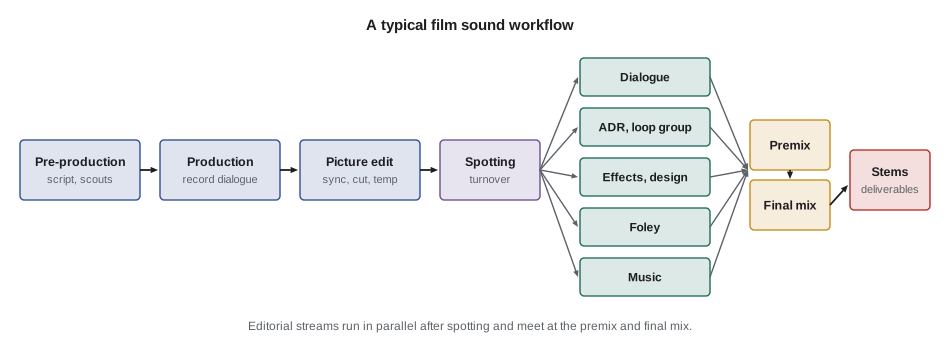
Post-production sound then starts with a spotting session, in which the director, picture editor, supervising sound editor and often the composer watch the film together and decide, scene by scene, what each moment needs: which lines may need replacement, where effects must be built from scratch, where music begins and ends, and where silence should be left alone. The editorial teams work in parallel, then hand their tracks to the re-recording mixers for premixing, where each element is cleaned and balanced on its own, and the final mix, where everything is balanced together in the room where the film was designed to be heard. The final stage creates stems, versions and deliverables for theatres, streamers, broadcasters and foreign-language dubbing.
Worked problem
Planning a post sound schedule
A 90-minute independent feature has six weeks between picture lock and delivery. Allocate the time to the main stages so that the final mix is not squeezed.
Show solution
- Week 1: spotting session, turnover, ADR list, effects and backgrounds gathering; dialogue editing begins.
- Weeks 1 to 3: dialogue editing; ADR recorded in week 2 once the actors are available; Foley recorded in week 2 or 3.
- Weeks 2 to 4: effects editing, sound design and backgrounds; music editing as the score arrives.
- Week 4 to 5: premixes of dialogue, effects, Foley and music, then the final mix with the director (typically 5 to 8 days for a modest feature).
- Week 6: fixes, stems, music and effects version, loudness and quality control, deliverables.
Answer: About three weeks of editorial, one to two weeks of mixing and one week of deliverables. If picture changes after lock, the schedule must absorb conforming every track, so protect the lock date.
Spotting: turning story into a sound plan
A good spotting session produces written notes for each department. For dialogue, the notes flag lines that are noisy, off-microphone, or need changes to performance or wording. For effects, they identify sounds that must be designed, such as a creature, a futuristic device or a stylized dream sequence, and moments where real-world accuracy matters, such as the specific engine of a period car. For music, they mark the start and end of each cue and its purpose. A spotting sheet records the scene, the timecode range, the element and the note.
| Scene and timecode | Element | Note |
|---|---|---|
| Sc 12, 00:14:02:10 to 00:15:40:00 | Dialogue | Fridge hum under both takes; check alt takes, otherwise ADR for Mara lines 3 to 5 |
| Sc 12 | Backgrounds | Late-night apartment, distant highway, occasional footsteps upstairs |
| Sc 13, 00:15:40:00 | Effects | Hard cut to street: loud bus pass to jolt audience, then thin out |
| Sc 13 | Music | Cue 2M1 starts on Mara's exit, ends under bus pass |
| Sc 18 | Design | Memory flash: muffle all diegetic sound, add tonal rise |
Directors vary greatly in how they talk about sound. Some arrive with exact references; others say only that a scene "feels flat". The supervising sound editor's job in spotting is to ask questions that turn feelings into a plan: whose point of view are we in, what should the audience notice first, what is happening off screen, and should this moment feel real, heightened or subjective.
Realism, heightened realism and subjectivity
Most narrative films use heightened realism: sounds that feel natural but are cleaner, larger and more selective than real life. A punch in a film rarely sounds like a real punch, which would be disappointingly dull; it is built from layers that give weight and impact. Footsteps are recorded on a Foley stage rather than on set, because production recordings prioritize dialogue. Backgrounds are composed so that each element supports the scene rather than competes with dialogue.
Subjective sound takes us inside a character's experience. Common techniques include filtering or muffling the outside world when a character is in shock, raising the level of a small sound a character is focused on, such as a ticking clock, and introducing tonal elements that blur the line between effects and music. These choices are powerful precisely because the audience is used to realism; when the sound track changes its rules, viewers feel the shift even if they cannot name it.
Documentary and unscripted work follows different expectations. Viewers assume that sound recorded on location reflects what happened. Adding effects or backgrounds is common, but fabricating sounds that change the meaning of a real event raises ethical questions similar to those in photojournalism. Many documentary sound teams follow a simple rule: enhance clarity and continuity, but do not invent events.
Budgets and the economics of sound
Sound is often budgeted late and cut first, yet poor sound is one of the most common reasons festivals and distributors reject low-budget films. A reasonable rule of thumb in independent production is to reserve a meaningful share of the post-production budget, often cited as somewhere between 5 and 10 per cent of the total budget for audio across production and post, though this varies widely. More important than the percentage is protecting time: rushed dialogue editing and a compressed mix are false economies.
In Canada, production and post-production sound work on larger productions is often covered by collective agreements with unions such as IATSE locals and Unifor-affiliated unions, depending on the province and the production. Public funding through Telefilm Canada, the Canada Media Fund and provincial agencies frequently requires deliverables, including stems and a music and effects version, that must be budgeted from the start (see FILM-410).
This course is not legal or employment advice. Rates, union jurisdiction and deliverable requirements change; always check the current agreement and the distributor's specification.
Listening as a professional skill
The most important tool in film sound is a trained ear. Professional listening means hearing a sound as a set of qualities: its level, its frequency balance from low rumble to high air, its distance and the space it sits in, its envelope (how it starts, sustains and decays), and its relationship to the picture. Practise by watching scenes from films you admire with the picture off, then with the sound off, and writing down what each element contributes. Try to separate dialogue, Foley, hard effects, backgrounds and music; you will be surprised how much is going on.
Listening conditions matter. A calibrated room, good headphones and a consistent playback level let you make decisions that will translate to other systems. Laptop speakers and earbuds are useful for checking how a mix survives on small devices, but they cannot reveal low-frequency problems or subtle noise. Later lessons cover calibration and monitoring in detail.
Worked problem
Describing a scene's sound by intention
A short-film scene shows a teenager waiting alone in a hospital corridor for news. Write a sound plan by intention rather than by object.
Show solution
- Isolation: thin, distant backgrounds (ventilation, a far-off trolley) with no other voices close by.
- Pressure: a slowly rising tonal element blended into the ventilation hum as the wait drags on.
- Focus: the squeak of the teenager's trainers and the click of a vending machine played closer and drier than real life.
- Release: when the doctor appears, cut the tone suddenly and let the corridor return to normal level.
Answer: The plan names what each sound must do for the story. The specific recordings can then be chosen to serve those jobs.
How this course is organized
Lessons 2 and 3 build the technical foundation: the physics of sound and acoustics, and microphones and recording technology. Lessons 4 and 5 cover production sound on set and the recording, timecode and synchronization workflows that connect set and post. Lessons 6 to 10 follow the post-production editorial streams: dialogue editing, ADR and loop group, sound effects and design, Foley, and music. Lesson 11 brings everything together in the mix and deliverables, and lesson 12 is a capstone in which you plan, build and mix the sound for a short scene.
Common mistakes
MistakeTreating sound as something to fix after the picture is finished
InsteadPlan sound from pre-production, protect dialogue on set and schedule post sound properly.
MistakeAdding sounds because they are visible on screen
InsteadGive every sound a story job and leave out what distracts.
MistakeSkipping the spotting session to save time
InsteadSpot the film with the director so every department knows the plan.
MistakeMaking every scene equally dense and loud
InsteadUse contrast and silence; heightened realism is selective.
MistakeFabricating sounds that change the meaning of real events in documentary
InsteadEnhance clarity and continuity without inventing events.
Summary and key terms
- Sound extends the frame, shapes time and tells the audience what to feel and notice.
- Production sound records dialogue on set; post-production builds dialogue, ADR, effects, Foley, music and the mix.
- Editorial exports an AAF or OMF with handles and a timecoded reference video at turnover.
- Spotting turns the director's intentions into written notes for each department.
- Most fiction uses heightened realism; subjective sound changes the rules to place us inside a character.
- Budget and schedule protection matter as much as equipment; stems and an M and E version are standard deliverables.
- Professional listening means hearing level, frequency, distance, space, envelope and relationship to picture.
- Production sound
- Sound recorded on set during filming, mainly dialogue.
- Post-production sound
- All sound work done after the edit, from editing to the final mix.
- Turnover
- The handover of locked picture, audio files and reference video to the sound team.
- Handles
- Extra audio beyond each edit point that lets sound editors extend or adjust cuts.
- Spotting session
- A meeting to decide, scene by scene, what sound and music each moment needs.
- Heightened realism
- Sound that feels natural but is cleaner, larger and more selective than real life.
- Backgrounds
- Ambient recordings that establish place and time, also called ambiences.
- Re-recording mixer
- The engineer who balances all sound elements into the final mix.
- Supervising sound editor
- The leader of the post-production sound team.
- Music and effects (M and E)
- A version of the mix without dialogue, used for foreign-language dubbing.
Practice problems
Work each problem on paper first, then reveal the answer to check.
Name the four main components of a film sound track apart from silence.
Show answer
Dialogue, effects (including Foley and backgrounds), music, and ambiences or backgrounds as a distinct layer.
What does the boom operator do?
Show answer
Places and moves the boom microphone for each shot while keeping it out of frame.
What is turnover?
Show answer
The handover of locked picture, AAF or OMF audio with handles and a reference video to the sound team.
What happens in a spotting session?
Show answer
The director and sound team decide scene by scene what each moment needs.
Why is Foley usually recorded on a stage rather than on set?
Show answer
Production recording prioritizes dialogue, so movement sounds are performed and recorded separately.
What is heightened realism?
Show answer
Sound that feels natural but is cleaner, larger and more selective than real life.
Give one technique for subjective sound.
Show answer
Muffling the outside world, or raising a small sound the character is focused on.
What ethical rule do many documentary sound teams follow?
Show answer
Enhance clarity and continuity but do not invent events.
Why protect the picture lock date?
Show answer
Picture changes after lock force every sound track to be conformed, costing time and money.
What qualities do professionals listen for in a sound?
Show answer
Level, frequency balance, distance, space, envelope and relationship to the picture.
Lesson quiz · 5 questions
Score 60% or more to complete this lesson.
Create a free account to save your progress, take quizzes and earn a certificate.