
FILM-310 · Lesson 3 of 12 · 27 min
Microphones and recording technology
A production sound mixer's kit is a chain: microphone, cable or wireless link, preamplifier, analogue-to-digital converter, recorder and storage. Each link can add noise, distortion or failure, and each has specifications that tell you what it will do in the field. This lesson explains how microphones work, how to read their specifications, how polar patterns behave, and how digital recording turns voltage into numbers. CINE-101 lesson 8 introduced microphone types for small shoots; here we look inside the equipment so you can choose and use it like a professional.
How microphones turn sound into voltage
A microphone is a transducer: it converts the pressure changes of sound into an electrical signal. The two designs that dominate film sound are dynamic and condenser microphones, with ribbon microphones as a specialist third.
In a dynamic microphone, a thin diaphragm is attached to a coil of wire sitting in a magnetic field. Sound moves the diaphragm and coil, generating a small voltage. Dynamic microphones are rugged, need no power and handle very loud sounds, which makes them common for live events, loud effects recording and handheld interviews in noisy places. They are less sensitive and less detailed in the highs than condensers, so they are rarely used for film dialogue.
In a condenser microphone, the diaphragm forms one plate of a capacitor next to a fixed backplate. Movement of the diaphragm changes the capacitance and produces a signal that a built-in amplifier boosts. Condensers need power, usually phantom power at 48 volts supplied through the microphone cable from the recorder, or a battery. They are sensitive, detailed and quiet, which is why nearly all boom and lavalier microphones for film are condensers. Their sensitivity makes them more vulnerable to wind, handling noise and humidity.
Ribbon microphones use a thin corrugated metal ribbon suspended in a magnetic field. They have a natural, smooth sound and a figure-of-eight pattern, and are prized for Foley, music and voice-over, but they are fragile and easily damaged by wind or phantom power applied incorrectly to older models.
| Type | Power | Strengths | Limitations | Typical film uses |
|---|---|---|---|---|
| Dynamic | None | Rugged, handles very high levels | Less sensitive, less detail | Loud effects, live events, noisy vox pops |
| Small-diaphragm condenser | Phantom or battery | Detailed, accurate, light | Sensitive to wind and handling | Boom shotguns and hypercardioids, Foley |
| Large-diaphragm condenser | Phantom | Low noise, warm close sound | Bulky, picks up room | Voice-over, ADR in studios |
| Lavalier condenser | Bias voltage from transmitter | Tiny, hideable | Clothing noise, chest resonance | Body-worn dialogue |
| Ribbon | None (some active models need phantom) | Smooth, natural | Fragile | Foley, voice-over, music |
Reading a microphone specification
Five numbers on a datasheet tell you most of what matters. Sensitivity is the output voltage for a given sound pressure, usually stated in millivolts per pascal (mV/Pa); 1 pascal is 94 dB SPL. A boom condenser might produce 25 to 50 mV/Pa, a dynamic microphone 1 to 3 mV/Pa. Higher sensitivity means less preamplifier gain is needed and therefore less preamplifier noise. Self-noise is the noise the microphone itself produces, expressed as an equivalent sound level in dBA; good boom microphones are around 10 to 15 dBA, lavaliers often 25 to 35 dBA. Maximum SPL is the level at which distortion reaches a stated amount, often 0.5 or 1 per cent. Frequency response shows how evenly the microphone responds across frequencies; dialogue microphones often have a gentle presence rise and a low-frequency roll-off. Polar pattern describes directionality.
Self-noise matters most when recording quiet scenes and backgrounds. A lavalier with 30 dBA self-noise recording a whisper at 40 dB SPL leaves only about 10 dB of signal over its own hiss. A boom microphone with 12 dBA self-noise leaves almost 30 dB, if it can get close enough. For loud effects, maximum SPL matters instead: a gunshot at close range can exceed 140 dB SPL and will overload many microphones and preamplifiers.
Polar patterns and the mathematics of directivity
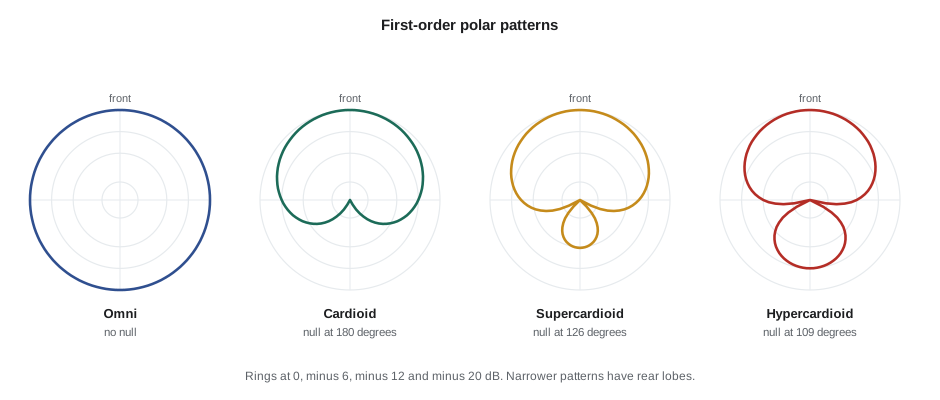
Directional microphones work by letting sound reach both the front and the back of the diaphragm, with the paths arranged so that sound from the rear partly cancels. The basic patterns form a family that can be described by a simple formula, in which \( \theta \) is the angle from the front of the microphone:
An omnidirectional microphone has \( A = 1 \): equal sensitivity in all directions. A cardioid has \( A = 0.5 \), giving zero sensitivity directly behind. A supercardioid has \( A \approx 0.37 \) and a hypercardioid \( A = 0.25 \), narrowing the front pickup at the cost of a small lobe at the rear. A figure-of-eight has \( A = 0 \), equally sensitive front and back and dead at the sides. Expressed in decibels, the rejection at an angle is \( 20\log_{10}|S(\theta)| \).
import math
patterns = {'omni': 1.0, 'cardioid': 0.5, 'supercardioid': 0.37, 'hypercardioid': 0.25, 'figure-8': 0.0}
angles = [0, 45, 90, 135, 180]
print('pattern        ' + ''.join(f'{a:>8d}' for a in angles))
for name, A in patterns.items():
    row = []
    for a in angles:
        s = abs(A + (1 - A) * math.cos(math.radians(a)))
        row.append('   -inf' if s < 1e-6 else f'{20 * math.log10(s):7.1f}')
print(f'{name:14s} ' + ' '.join(row))pattern 0 45 90 135 180 omni 0.0 0.0 0.0 0.0 0.0 cardioid 0.0 -1.4 -6.0 -16.7 -inf supercardioid 0.0 -1.8 -8.6 -22.4 -11.7 hypercardioid 0.0 -2.2 -12.0 -11.0 -6.0 figure-8 0.0 -3.0 -inf -3.0 0.0
The table produced by the code shows the trade-offs. A cardioid is 6 dB down at 90 degrees and rejects sound directly behind. A hypercardioid is about 6 dB down at 60 degrees and 12 dB down at 90, which helps in a reflective room, but its rear lobe is only 6 dB down at 180 degrees, so a noise source directly behind the boom is not rejected well. When booming indoors from above, a hypercardioid's null points (around 110 degrees) can be aimed at the floor or a noisy wall.
Shotgun microphones add an interference tube in front of a supercardioid or hypercardioid capsule. Slots along the tube let off-axis sound arrive at slightly different times so it partly cancels. The tube only works at frequencies whose wavelengths are shorter than the tube, so a 25 cm shotgun is highly directional in the upper mids and highs but behaves like its underlying capsule at low frequencies. Indoors, reflections arrive from every direction and a long shotgun's off-axis sound becomes coloured and phasey, which is why many mixers prefer hypercardioids indoors and keep shotguns for exteriors.
Lavaliers and plant microphones
Lavaliers are tiny omnidirectional or directional condensers worn on the body. Their great advantage is distance: close to the mouth, they deliver strong dialogue regardless of the boom's access. Their disadvantages are clothing rustle, the chest's effect on tone, which adds a boomy resonance around 700 Hz and loses some high frequencies because the microphone is below and off-axis to the mouth, and the need to hide them in costume. Many lavaliers have changeable caps that add a high-frequency boost to compensate.
Plant microphones are hidden in the set, behind a sun visor in a car, inside a lamp or under a table edge, to cover lines the boom cannot reach. They are especially useful in cars, where boom access is impossible. Boundary microphones placed on a flat surface use the surface to reinforce the sound and avoid comb filtering from a nearby reflection.
Cables, balanced lines and wireless
Professional microphones use balanced connections, normally three-pin XLR. The signal travels on two conductors with opposite polarity plus a shield; at the input, the difference between the two conductors is amplified, so interference picked up equally on both cancels. This is what allows long cable runs on set without hum.
Wireless systems replace the cable with a radio link. Analogue UHF systems compress the signal before transmission and expand it at the receiver, a process called companding, which can add subtle pumping artefacts. Digital systems transmit the audio as data with low latency and no companding artefacts, and many can record a backup copy inside the transmitter. All wireless systems need a clear frequency plan so that multiple transmitters do not interfere with each other or with television broadcasts; lesson 4 covers the frequency rules in Canada and the United States.
From voltage to numbers: sampling and bit depth
A recorder's preamplifier raises the tiny microphone voltage to a level the analogue-to-digital converter can use. The converter then measures the signal many thousands of times per second (the sample rate) and stores each measurement as a number with a certain precision (the bit depth).
The sampling theorem, associated with Harry Nyquist and Claude Shannon, says that to capture frequencies up to \( f_{\max} \) the sample rate must be more than twice \( f_{\max} \). Film and television use 48 kHz as the standard sample rate, which captures frequencies up to 24 kHz, comfortably above human hearing. Higher rates such as 96 kHz or 192 kHz are used when sound effects will be slowed down or pitched down, because the extra high-frequency content becomes audible after processing.
Bit depth sets the dynamic range: the ratio between the loudest signal the format can represent and its noise floor. Each bit adds about 6 dB. For fixed-point formats, the theoretical dynamic range is:
For 16-bit audio, about 98 dB; for 24-bit, about 146 dB, far more than any microphone or preamplifier can deliver. In practice, 24-bit fixed-point recording means you can leave generous headroom and still have a noise floor well below the microphone's own self-noise. Recorders that capture 32-bit floating point go further: their effective range is so large that a signal that appears to clip on the meter can usually be lowered in post without distortion, provided the analogue stages and converter did not overload. Many current field recorders use dual converters to make the most of 32-bit float.
| Format | Dynamic range or behaviour | Typical use |
|---|---|---|
| 16-bit, 44.1 kHz | About 98 dB | Music CDs; rarely used in film production |
| 24-bit, 48 kHz | About 146 dB theoretical | Standard for production sound and post |
| 24-bit, 96 kHz | As above, with content to 48 kHz | Sound effects for pitch shifting, some Foley |
| 32-bit float, 48 kHz | Very large range, resists clipping in post | Field recording with unpredictable levels |
| Broadcast WAV (BWF) | Container with metadata and timecode | Production sound files, effects libraries |
Levels, gain staging and reference levels
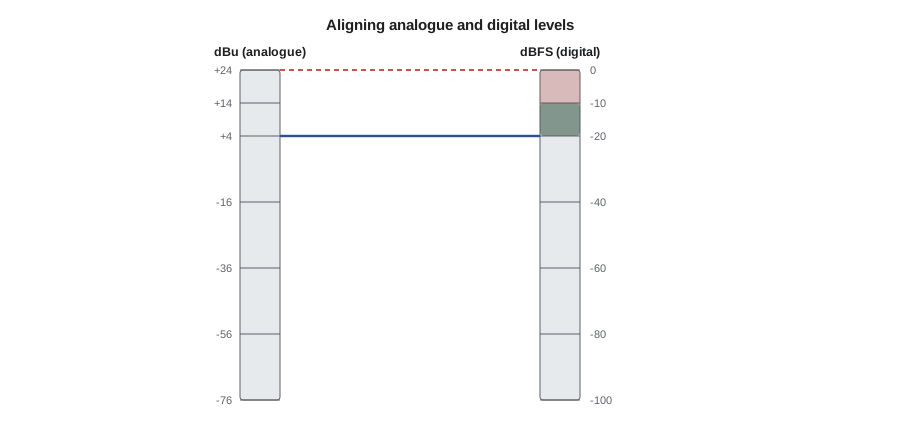
Gain staging means setting the level at each stage of the chain so the signal stays well above noise and well below distortion. In analogue equipment, levels are measured in dBu, decibels relative to 0.775 volts. Professional line level is +4 dBu. In digital equipment, levels are measured in dBFS, decibels below full scale, where 0 dBFS is the maximum. To connect the two worlds, studios and productions agree on a reference alignment: in North American film and television, a 1 kHz tone at +4 dBu typically equals −20 dBFS, leaving 20 dB of headroom above the reference. European broadcasters commonly use −18 dBFS as the reference.
Worked problem
Gain staging a boom into a recorder
A boom microphone with 35 mV/Pa sensitivity picks up dialogue peaking at 80 dB SPL. How much preamplifier gain brings those peaks to about −12 dBFS on a recorder aligned so that +4 dBu equals −20 dBFS?
Show solution
- 80 dB SPL is 14 dB below 94 dB SPL (1 Pa), so the pressure is \( 10^{-14/20} \approx 0.20 \) Pa and the output is about \( 35 \times 0.20 = 7.0 \) mV.
- In dBu: \( 20\log_{10}(0.0070 / 0.775) \approx -40.9 \) dBu.
- Target: −12 dBFS is 8 dB above the −20 dBFS reference, so +12 dBu.
- Required gain: \( 12 - (-40.9) \approx 53 \) dB.
Answer: About 53 dB of preamplifier gain. With a quieter or more distant source the gain rises further, which is why sensitive, low-noise microphones and quiet preamplifiers matter for quiet scenes.
import math
def mic_dbu(spl, sens_mv_pa):
    pa = 10 ** ((spl - 94) / 20)
    volts = sens_mv_pa / 1000 * pa
    return 20 * math.log10(volts / 0.775)
ref_dbu, ref_dbfs, target_dbfs = 4, -20, -12
target_dbu = ref_dbu + (target_dbfs - ref_dbfs)
for name, sens in [('boom condenser', 35), ('lavalier', 8), ('dynamic', 2)]:
    for spl in (60, 80):
        out = mic_dbu(spl, sens)
print(f'{name:15s} {spl} dB SPL -> {out:6.1f} dBu, gain needed {target_dbu - out:5.1f} dB')boom condenser 60 dB SPL -> -60.9 dBu, gain needed 72.9 dB boom condenser 80 dB SPL -> -40.9 dBu, gain needed 52.9 dB lavalier 60 dB SPL -> -73.7 dBu, gain needed 85.7 dB lavalier 80 dB SPL -> -53.7 dBu, gain needed 65.7 dB dynamic 60 dB SPL -> -85.8 dBu, gain needed 97.8 dB dynamic 80 dB SPL -> -65.8 dBu, gain needed 77.8 dB
Recorders and their features
Professional production recorders combine several preamplifiers, converters, a timecode generator, and recording to two cards simultaneously for redundancy. Features that matter on set include isolated tracks for each microphone with a separate mix track, pre-record buffers that capture a few seconds before the record button is pressed, metadata entry for scene, take and track names, limiters on each channel to catch unexpected peaks, and the ability to send separate mixes to camera, to the director's headphones and to the video village. Smaller recorders and some cameras offer 32-bit float with fewer channels, which suits documentary and small crews.
Limiters deserve a note of caution. A limiter prevents overloads by quickly reducing gain when the signal approaches a threshold, but heavy limiting on dialogue sounds squashed and cannot be undone. Mixers set limiters to catch only rare peaks, ride the faders by hand for performance, and use safety tracks or 32-bit float to protect against shouts.
Common mistakes
MistakeUsing a long shotgun indoors in a reflective room
InsteadUse a hypercardioid indoors and aim its null away from noise and reflections.
MistakeReading self-noise and sensitivity as unimportant details
InsteadCheck self-noise for quiet scenes and maximum SPL for loud effects.
MistakePushing the preamplifier hard to compensate for a distant microphone
InsteadMove the microphone closer; gain raises noise as well as signal.
MistakeTreating 32-bit float as permission to ignore levels
InsteadSet sensible gain; analogue stages and microphones can still overload.
MistakeConfusing dBu, dBFS and dB SPL
InsteadKnow which reference each scale uses and align them with a reference tone.
Summary and key terms
- Dynamic microphones are rugged and handle loud sources; condensers are sensitive and detailed and dominate film dialogue.
- Sensitivity, self-noise, maximum SPL, frequency response and polar pattern describe a microphone's behaviour.
- First-order patterns follow S equals A plus (1 minus A) cos theta; narrower patterns have rear lobes and different nulls.
- Shotgun tubes add directivity only at high frequencies and colour off-axis sound indoors.
- The sample rate must exceed twice the highest frequency; 48 kHz is the film standard.
- Each bit adds about 6 dB of dynamic range; 24-bit and 32-bit float give ample headroom.
- Film and television commonly align +4 dBu to −20 dBFS, leaving 20 dB of headroom.
- Transducer
- A device that converts energy from one form to another, such as sound to voltage.
- Phantom power
- A DC supply, usually 48 V, sent through microphone cables to power condensers.
- Sensitivity
- A microphone's output voltage for a given sound pressure, usually in mV/Pa.
- Self-noise
- The noise a microphone produces on its own, expressed as an equivalent level in dBA.
- Interference tube
- The slotted tube on a shotgun microphone that increases directivity at high frequencies.
- Balanced line
- A connection using two opposite-polarity conductors so that interference cancels.
- Sample rate
- The number of measurements of an audio signal per second.
- Bit depth
- The number of bits used for each sample, setting the dynamic range.
- dBu
- Decibels relative to 0.775 volts, used for analogue levels.
- Headroom
- The margin between the normal operating level and the maximum level before clipping.
Practice problems
Work each problem on paper first, then reveal the answer to check.
Why are condensers preferred for film dialogue?
Show answer
They are more sensitive, detailed and quiet than dynamic microphones.
What voltage is standard phantom power?
Show answer
48 volts.
What is the rejection of a cardioid at 90 degrees?
Show answer
About 6 dB.
Where is a cardioid's null?
Show answer
Directly behind, at 180 degrees.
Why does a shotgun's interference tube not help at low frequencies?
Show answer
Low-frequency wavelengths are longer than the tube, so the cancellation does not work.
What sample rate is standard for film?
Show answer
48 kHz.
What is the theoretical dynamic range of 24-bit audio?
Show answer
About 146 dB.
What digital level corresponds to +4 dBu in common North American film alignment?
Show answer
−20 dBFS.
Why are balanced XLR cables used on set?
Show answer
Interference picked up on both conductors cancels, allowing long runs without hum.
What sound do lavaliers often lose because of placement on the chest?
Show answer
High frequencies, and they gain a chest resonance in the low mids.
Lesson quiz · 5 questions
Score 60% or more to complete this lesson.
Create a free account to save your progress, take quizzes and earn a certificate.