
FILM-310 · Lesson 2 of 12 · 31 min
Acoustics and the physics of sound
Every decision in film sound, from where to put a boom to why a mix sounds muddy in one room and clear in another, rests on a handful of physical ideas. This lesson gives you the working physics a sound professional uses every day: what sound is, how it travels and spreads, how decibels work, and how rooms change what we hear. The aim is not to turn you into an acoustician but to give you the numbers that explain the practical rules you will meet on set and in the studio.
What sound is
Sound is a travelling pressure wave. A vibrating source, such as vocal cords, a door slamming or a loudspeaker cone, pushes and pulls on the air, creating tiny regions of higher and lower pressure that move outward. In air at about 20 °C, sound travels at roughly 343 metres per second, about a million times slower than light. That difference is why you see lightning before you hear thunder, and why on a large set a distant actor's lips can appear slightly ahead of their voice.
Two properties describe a simple tone. Frequency, measured in hertz (Hz), is the number of pressure cycles per second and corresponds to pitch. Human hearing spans roughly 20 Hz to 20,000 Hz (20 kHz) in young adults, with the upper limit falling with age and noise exposure. Amplitude, the size of the pressure changes, corresponds to loudness. Real sounds combine many frequencies at once; the balance of those frequencies gives each sound its timbre, which is why a cello and a voice playing the same note sound different.
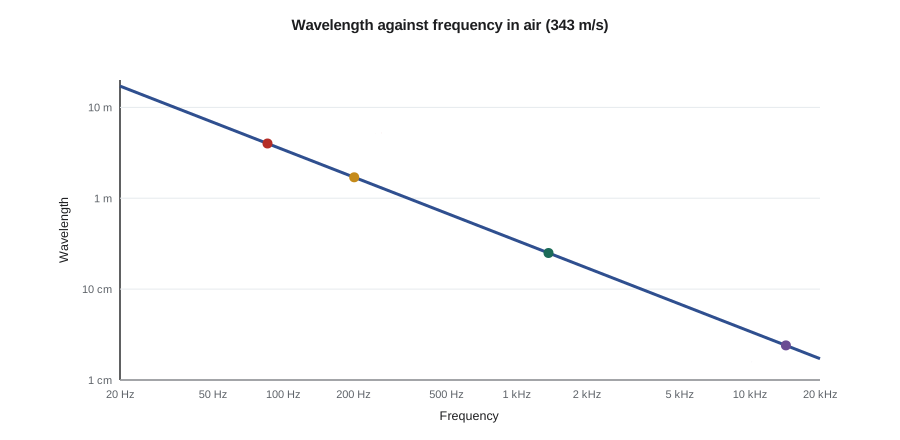
Wavelength is the physical length of one cycle in the air. It links frequency to the size of objects and rooms, and explains much of acoustics.
Here \( \lambda \) is wavelength in metres, \( c \) is the speed of sound (343 m/s) and \( f \) is frequency in hertz. At 100 Hz the wavelength is about 3.4 m; at 1 kHz about 34 cm; at 10 kHz about 3.4 cm. Low frequencies have wavelengths comparable to rooms and walls, so they bend around obstacles and pass through thin barriers; high frequencies are short, travel more like beams and are easily blocked or absorbed. This is why you hear the bass from a party next door but not the vocals, and why a sound blanket on a set reduces hiss and clatter far more than traffic rumble.
| Range | Approximate frequencies | Typical content | Common issues |
|---|---|---|---|
| Sub-bass | 20 to 60 Hz | Explosions, rumble, low-frequency effects channel | Wind and traffic rumble, handling noise |
| Bass | 60 to 250 Hz | Body of voices, engines, music bass | Boominess, room modes, mud |
| Low mids | 250 Hz to 2 kHz | Fundamental of speech, most instruments | Boxiness, honk |
| Upper mids | 2 to 6 kHz | Speech intelligibility, presence | Harshness, sibilance build-up |
| Highs | 6 to 20 kHz | Air, detail, cloth and Foley texture | Hiss, sibilance, lost with distance |
Decibels: the language of level
Sound pressures that humans can hear cover an enormous range, from the faintest whisper to sounds that cause pain, a ratio of about a million to one in pressure. Instead of using such large numbers, sound professionals use the decibel (dB), a logarithmic unit that compares a level with a reference. For sound pressure level (SPL), the reference is 20 micropascals, roughly the threshold of hearing.
Because the scale is logarithmic, equal steps in decibels are equal ratios. A 6 dB rise doubles the sound pressure; a 20 dB rise multiplies it by ten. Perceived loudness is different again: listeners judge a rise of about 10 dB as roughly twice as loud. A quiet room might sit at 30 dB SPL, normal conversation at about 60 dB at 1 m, a busy street at 70 to 80 dB, and a film mix in a cinema peaks around 105 dB per channel at the loudest moments. Occupational safety rules limit exposure to loud sound; in Canada most jurisdictions use 85 dBA averaged over eight hours as the exposure limit, and in the United States OSHA uses 90 dBA with an action level of 85 dBA (see HSE courses on noise).
Decibels for different quantities use different references, which is a frequent source of confusion. dB SPL describes sound in air. dBFS describes digital levels relative to full scale, the largest number a digital system can represent. dBu and dBV describe analogue voltages. LUFS (also written LKFS) describes measured programme loudness. Lesson 3 and lesson 11 return to these scales.
The inverse square law
A small source in open space spreads its energy over the surface of an expanding sphere. Because the surface area grows with the square of distance, the intensity falls with the square of distance, and the sound pressure level drops by about 6 dB every time the distance doubles.
This one rule explains most production sound practice. An actor's voice that reaches the microphone at 70 dB from 30 cm will arrive at only 58 dB from 1.2 m, while the air conditioning, traffic and room reverberation stay about the same. The ratio of direct voice to everything else, which determines clarity, depends far more on microphone distance than on microphone price. Booms get as close as the frame allows, and lavaliers sit a hand's width below the chin, because every halving of distance buys another 6 dB of dialogue over noise.
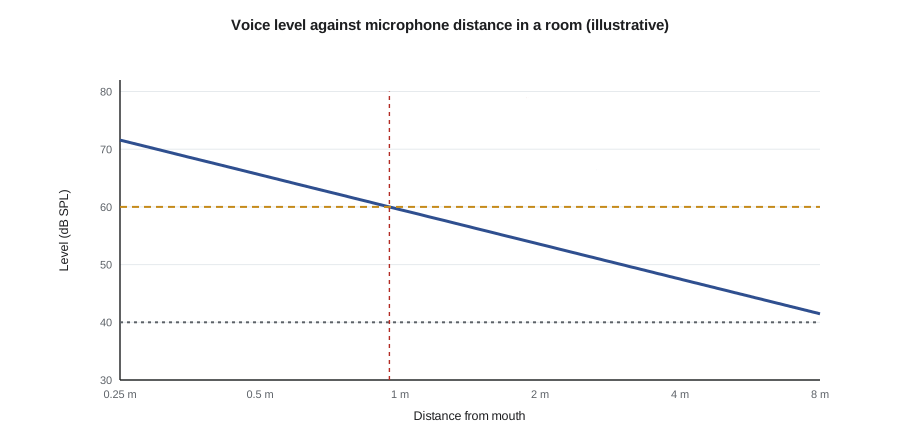
Indoors the law holds only close to the source. Further away, reflected sound from walls, floor and ceiling builds up into a reverberant field that is roughly the same level everywhere in the room. The distance at which direct and reverberant sound are equal is the critical distance. Inside it, the voice sounds close and clear; beyond it, the voice sounds distant and washed out no matter how much gain you add. In a typical untreated living room the critical distance for a speaking voice is often only about a metre, which is why on-camera microphones at three metres sound so hollow.
Adding decibels
Decibels do not add like ordinary numbers. When two sounds with no fixed relationship, such as two air conditioners or a voice and traffic, combine, their powers add. Two equal uncorrelated sources together are 3 dB louder than one; ten equal sources are 10 dB louder. A sound 10 dB quieter than another adds less than 0.5 dB to the total.
This explains why finding and switching off the single loudest noise source on set matters more than anything else: removing a fridge at 45 dB when the room tone is 40 dB from everything else drops the total by about 5 dB, while removing a quieter source changes almost nothing. In mixing, it explains why adding many quiet background layers gradually raises the noise floor and muddies the mix.
import math
c = 343.0
for f in [50, 100, 250, 1000, 4000, 10000]:
    print(f'{f:6d} Hz  wavelength {c / f:6.3f} m')
voice_30cm = 70.0
for d in [0.3, 0.6, 1.2, 2.4]:
    print(f'voice at {d:3.1f} m: {voice_30cm - 20 * math.log10(d / 0.3):5.1f} dB SPL')
def add_db(levels):
    return 10 * math.log10(sum(10 ** (L / 10) for L in levels))
room = [45, 40, 38]   # fridge, ventilation, traffic
print(f'room tone with fridge: {add_db(room):.1f} dB; without fridge: {add_db(room[1:]):.1f} dB')50 Hz wavelength 6.860 m 100 Hz wavelength 3.430 m 250 Hz wavelength 1.372 m 1000 Hz wavelength 0.343 m 4000 Hz wavelength 0.086 m 10000 Hz wavelength 0.034 m voice at 0.3 m: 70.0 dB SPL voice at 0.6 m: 64.0 dB SPL voice at 1.2 m: 58.0 dB SPL voice at 2.4 m: 51.9 dB SPL room tone with fridge: 46.8 dB; without fridge: 42.1 dB
Reflection, absorption and diffusion
When sound meets a surface, part is reflected, part is absorbed and part passes through. Hard, smooth surfaces such as glass, concrete and tile reflect most sound; soft, porous materials such as heavy curtains, carpet, upholstered furniture and acoustic panels absorb mid and high frequencies. Absorption of low frequencies requires thick or specially designed treatment, because the wavelengths are long. Irregular surfaces such as bookshelves scatter sound in many directions; this diffusion makes a room sound lively without strong echoes.
The absorption coefficient of a material, from 0 (perfect reflector) to 1 (perfect absorber), varies with frequency. Painted concrete might absorb 2 per cent of sound at 1 kHz; a heavy curtain 50 per cent; a 100 mm mineral wool panel over 90 per cent. Production sound teams carry sound blankets, also called furniture pads, to hang out of frame on hard walls, which can noticeably reduce flutter echoes between parallel surfaces.
Reverberation time
Reverberation time, RT60, is the time a sound takes to decay by 60 dB after the source stops. Large halls have long reverberation times of two seconds or more; a well-treated voice booth may have under 0.3 s. Wallace Sabine, who founded architectural acoustics around 1900, found a simple relationship between room volume, absorption and reverberation time.
Here \( V \) is the room volume in cubic metres and \( A \) is the total absorption in square metre sabins, the sum of each surface area \( S_i \) multiplied by its absorption coefficient \( \alpha_i \). The formula works best for fairly absorbent, evenly treated rooms, but it is accurate enough to predict whether a location will be usable for dialogue and how much treatment would help.
Worked problem
Will this room work for dialogue?
A location kitchen measures 5 m by 4 m by 2.6 m. The walls and ceiling (about 59 m²) absorb about 5 per cent at mid frequencies and the tiled floor (20 m²) about 2 per cent. Estimate RT60, then estimate it again after hanging 12 m² of sound blankets that absorb 60 per cent.
Show solution
- Volume \( V = 5 \times 4 \times 2.6 = 52 \) m³.
- Absorption before: \( 59 \times 0.05 + 20 \times 0.02 = 2.95 + 0.40 = 3.35 \) sabins, so \( RT_{60} \approx 0.161 \times 52 / 3.35 \approx 2.5 \) s.
- The blankets cover 12 m² of wall, replacing \( 12 \times 0.05 = 0.6 \) with \( 12 \times 0.6 = 7.2 \), so \( A \approx 3.35 - 0.6 + 7.2 = 9.95 \) sabins.
- After: \( RT_{60} \approx 0.161 \times 52 / 9.95 \approx 0.84 \) s.
Answer: The bare kitchen would ring for about 2.5 s, far too live for clean dialogue. Twelve square metres of blankets cut that to under a second, a large improvement; closer miking and soft furnishings would bring it nearer the 0.4 to 0.6 s range that suits dialogue.
Furniture and people add absorption too, which is why an empty location scouted on a weekday may sound very different once it is dressed and filled with crew.
Room modes and small rooms
In small rooms, low frequencies behave differently. Between two parallel walls, sound at certain frequencies reflects back and forth in step, creating standing waves called room modes. At those frequencies the bass is much louder in some places and almost absent in others. The axial modes between two parallel surfaces a distance \( L \) apart occur at:
In a 4 m room, the first axial mode is \( 343 / 8 \approx 43 \) Hz, with further modes at 86, 129 and 172 Hz. Rooms with dimensions that are equal or simple multiples of each other stack modes at the same frequencies and sound especially uneven. Room modes matter in two places. In mix rooms and edit suites, they make bass decisions unreliable, which is why rooms are treated with bass traps and why mixers check on headphones and other systems. On location, small rooms colour dialogue with boominess that is hard to remove later.
import math
L, W, H = 4.2, 3.4, 2.7      # room dimensions in m
V = L * W * H
surfaces = {'walls': (2 * (L + W) * H, 0.25), 'ceiling': (L * W, 0.60), 'floor': (L * W, 0.30)}
A = sum(area * alpha for area, alpha in surfaces.values())
print(f'volume {V:.1f} m3, absorption {A:.1f} sabins, RT60 about {0.161 * V / A:.2f} s')
for name, dim in [('length', L), ('width', W), ('height', H)]:
    modes = [round(n * 343 / (2 * dim)) for n in (1, 2, 3)]
print(f'{name:6s} {dim} m: axial modes {modes} Hz')volume 38.6 m3, absorption 23.1 sabins, RT60 about 0.27 s length 4.2 m: axial modes [41, 82, 122] Hz width 3.4 m: axial modes [50, 101, 151] Hz height 2.7 m: axial modes [64, 127, 191] Hz
Hearing, masking and the ear
The ear is not equally sensitive at all frequencies. It is most sensitive between about 2 and 5 kHz, the region that carries the consonants of speech, and much less sensitive to low frequencies at quiet levels. This is why sound level meters use weighting curves: A-weighting approximates the ear's sensitivity at moderate levels and is used for noise and safety measurements, while C-weighting is flatter and is used for calibrating loud playback such as cinema monitoring.
Masking occurs when one sound makes another harder to hear, especially when they share frequencies. A rumbling truck masks the low end of a voice; a hissing steam pipe masks consonants. Mixers manage masking by carving space in the frequency spectrum for dialogue, lowering competing elements during lines and choosing effects that sit around speech rather than on top of it. Understanding masking also explains why a busy mix can make dialogue unintelligible even when the dialogue is technically loud enough.
Protect your hearing. Your ears are your instrument, and hearing damage is permanent. Keep headphone levels moderate, take breaks during long sessions, use earplugs at loud events and on set near effects such as gunfire, and get your hearing tested regularly.
Phase and comb filtering
When the same sound reaches a microphone by two paths of different length, such as directly and by reflection from a table, or when two microphones pick up the same voice at different distances, the delayed copy combines with the original. At some frequencies the two are in step and reinforce; at others they are out of step and cancel. The result, comb filtering, gives a hollow, phasey sound. A path difference of 34 cm, for example, delays the copy by 1 ms and causes the first cancellation at 500 Hz. Production mixers avoid comb filtering by keeping microphones away from hard reflective surfaces, by avoiding two open microphones on the same voice at similar levels, and by checking how booms and lavaliers sum together in the mix.
Worked problem
Two microphones on one voice
A boom 60 cm from an actor and a lavalier 20 cm from the actor's mouth are both open. How large is the time difference, and what happens if both are mixed at similar levels?
Show solution
- Path difference \( 0.60 - 0.20 = 0.40 \) m.
- Delay \( 0.40 / 343 \approx 1.17 \) ms.
- First cancellation at \( 1 / (2 \times 0.00117) \approx 430 \) Hz, then at about 1.3 kHz, 2.1 kHz and so on.
Answer: Mixing both at similar levels would create comb filtering with notches through the speech range. Record them on separate tracks, choose one as the primary in post, or align them in time before blending.
Common mistakes
MistakeAssuming a more expensive microphone will fix distant dialogue
InsteadGet the microphone closer; each halving of distance gains about 6 dB over noise.
MistakeAdding decibels like ordinary numbers
InsteadTwo equal uncorrelated sources add 3 dB, not double the decibels.
MistakeExpecting thin blankets to stop traffic rumble
InsteadBlankets absorb mid and high frequencies; low frequencies need mass or distance.
MistakeJudging bass in an untreated small room
InsteadRoom modes make bass unreliable; treat the room and check on headphones and other systems.
MistakeLeaving two open microphones on one voice at similar levels
InsteadRecord separately and choose or time-align to avoid comb filtering.
Summary and key terms
- Sound travels at about 343 m/s in air; wavelength equals speed divided by frequency.
- Low frequencies have long wavelengths that bend around and pass through barriers; highs are easily blocked or absorbed.
- A 6 dB change doubles or halves sound pressure; about 10 dB sounds twice or half as loud.
- Direct sound falls about 6 dB per doubling of distance until the reverberant field takes over beyond the critical distance.
- Uncorrelated sources add on a power basis: two equal sources make 3 dB more.
- Sabine's formula estimates reverberation time from volume and absorption; dialogue rooms want short RT60.
- Room modes, masking and comb filtering explain many problems with bass, intelligibility and hollow sound.
- Frequency
- The number of pressure cycles per second, measured in hertz, perceived as pitch.
- Wavelength
- The physical length of one cycle of a sound wave in air.
- Decibel (dB)
- A logarithmic unit comparing a level with a reference.
- Inverse square law
- Intensity falls with the square of distance, about 6 dB per doubling for sound pressure level.
- Critical distance
- The distance at which direct and reverberant sound are equal in level.
- Absorption coefficient
- The fraction of sound energy a surface absorbs at a given frequency.
- RT60
- The time for sound in a room to decay by 60 dB after the source stops.
- Room mode
- A standing wave at a frequency set by room dimensions, causing uneven bass.
- Masking
- One sound making another harder to hear, especially when they share frequencies.
- Comb filtering
- Cancellations and reinforcements caused by combining a sound with a delayed copy of itself.
Practice problems
Work each problem on paper first, then reveal the answer to check.
What is the wavelength of a 343 Hz tone in air?
Show answer
1 m.
How much does the level drop from 0.5 m to 2 m in open space?
Show answer
About 12 dB.
Two equal uncorrelated noise sources each measure 50 dB. What is the total?
Show answer
About 53 dB.
Why does music from the next apartment come through a wall as mostly bass?
Show answer
Long low-frequency wavelengths pass through and around barriers more easily than highs.
State Sabine's formula.
Show answer
RT60 is about 0.161 times room volume divided by total absorption in sabins.
What is the first axial mode between walls 5 m apart?
Show answer
About 34 Hz.
What does A-weighting approximate?
Show answer
The ear's sensitivity at moderate listening levels.
Why do mixers lower competing elements during lines?
Show answer
To reduce masking so dialogue stays intelligible.
What causes comb filtering?
Show answer
Combining a sound with a delayed copy, such as two microphones at different distances.
What is the critical distance?
Show answer
The distance where direct and reverberant sound are equal; beyond it the voice sounds distant.
Lesson quiz · 5 questions
Score 60% or more to complete this lesson.
Create a free account to save your progress, take quizzes and earn a certificate.