
FILM-410 · Lesson 1 of 12 · 28 min
The producer's role
Every film that reaches an audience has passed through the hands of a producer. Directors are credited with a film's vision, and actors with its face, but the producer is the person who makes it possible for the film to exist at all: who finds or develops the material, assembles the money, hires the key people, protects the schedule and the budget, and carries the finished work into the market. On a small independent feature the producer may also drive the van, cater lunch and sign the loan papers. On a large studio or streaming production, the producing function is spread across a team with distinct titles and responsibilities. This course is about that function, from the first spark of an idea to the moment a finished film is delivered and sold.
Earlier courses in the Film and Cinematography streams cover much of the surrounding territory. FILM-210 teaches screenwriting and the breakdowns that turn a script into a shot list. FILM-320 covers directing, including the director's partnership with the first assistant director. CINE-340 covers set safety and hours of work from the camera department's side. FILM-220 and FILM-310 cover picture and sound post-production. FILM-420 covers media law, copyright, releases and contracts in depth, so this course keeps legal detail light and points forward to it. CRE-330 and PHOT-410 cover the business side of creator and photography work, which share some ideas with producing but operate at a very different scale. Here we look at filmmaking as a business and a logistics problem: money, people, time and risk.
Throughout the course we follow one invented project, Stillwater Road, a contemporary drama set in a small river town. Its screenplay runs 94 pages, it needs about 20 shooting days, three main locations and a cast of eleven speaking roles. The numbers attached to it are illustrative, chosen to be realistic for a low-budget independent feature in 2026, not taken from any real production.
What a producer actually does
Ask producers to describe their job and most will describe a sequence of problems. Before production, the producer's problem is whether the film can be made: is there a script worth making, can rights be secured, will talent attach, and will anyone pay for it? During production, the problem becomes whether the film can be made on time and on budget without anyone getting hurt. After production, the problem is whether the finished film can be completed, delivered and sold for enough to repay the people who financed it.
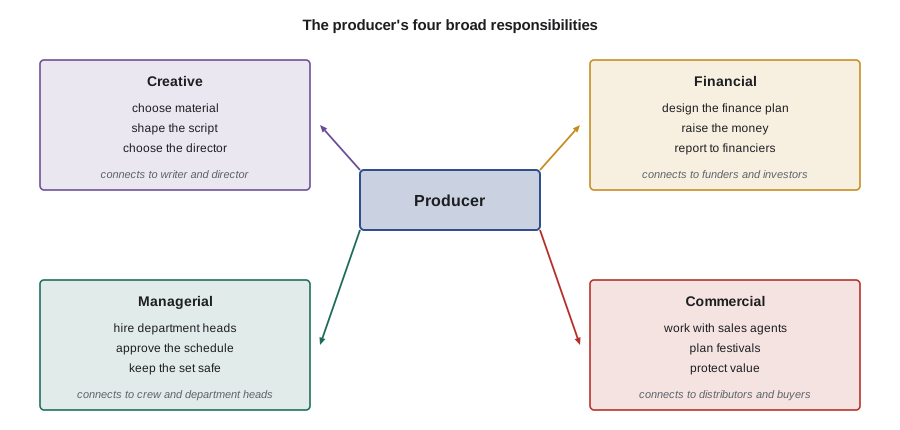
These problems map onto four broad responsibilities. The first is creative: choosing material, shaping the script with the writer, choosing the director, and protecting the film's creative integrity when money and time are short. The second is financial: designing a finance plan, raising money, controlling spending and reporting to financiers. The third is managerial: hiring the department heads, approving the schedule, solving problems on set and keeping the production legal and safe. The fourth is commercial: understanding the market, working with sales agents and distributors, choosing festivals and protecting the film's value after release.
Different producers weight these responsibilities differently. Some are primarily creative producers who develop projects with writers and directors over years. Others are primarily physical producers who run the machinery of production. Many independent producers do both, at least until a project is large enough to justify a bigger team.
| Credit | Usual responsibility | When it appears |
|---|---|---|
| Producer | Overall responsibility for the film from development to delivery | Every production |
| Executive producer | Financing, a major rights or talent contribution, or senior oversight on behalf of a company or financier | Often several per film |
| Co-producer | A significant producing contribution, often a partner company or a co-production partner | Partnerships and treaty co-productions |
| Line producer | Day-to-day control of the budget, schedule and crew during prep and production | Most independent features |
| Unit production manager (UPM) or production manager | Runs the physical production: crew, equipment, locations, paperwork | Most productions |
| Associate producer | A meaningful contribution below producer level; sometimes an honorary credit | Varies widely |
| Showrunner | The lead writer-producer who runs a television series creatively | Series television |
Credits matter because they are a currency in the industry. A producer credit on a festival film can open doors to financing for the next one. Because credits are valuable, they are negotiated carefully and sometimes inflated. Industry bodies have tried to give them meaning.
In Canada, the Canadian Media Producers Association (CMPA) represents independent producers in English-language production, and the Association québécoise de la production médiatique (AQPM) does so in Quebec. Producer credits also matter for public funding and tax credits: to qualify as a Canadian production, the key producer roles must be held by Canadians, and the producer must keep control of the production. Telefilm Canada, the Canada Media Fund (CMF) and the Canadian Audio-Visual Certification Office (CAVCO) all check who the producers are and what they control. Lesson 4 returns to these rules.
Independent, studio and streamer productions
Producing looks different depending on who owns the film. In an independent production, the producer usually owns the copyright, at least at first, and raises money from many sources: public funds, tax credits, private equity, pre-sales to distributors and loans. The producer carries the risk and, if the film succeeds, shares in the upside. In a studio production, the studio owns the film, puts up most or all of the money, and hires producers to deliver it. In a streamer production, a streaming service commissions the film or series, usually paying the full cost plus a premium in exchange for owning or licensing the rights worldwide for a long period.
These models create very different jobs. The independent producer's central skill is assembling a finance plan from many parts and keeping all the financiers satisfied. The studio or streamer producer's central skill is delivering what the buyer wants, on a schedule and budget the buyer has approved, while protecting the creative work. Many producers work across all three models, perhaps making independent features while producing commissioned series for a streamer.
| Feature | Independent | Studio | Streamer commission |
|---|---|---|---|
| Who owns the copyright | Producer, at least initially | Studio | Streamer or producer under licence, depending on the deal |
| Who carries the financial risk | Producer and financiers | Studio | Streamer, mostly |
| Typical producer income | Fees in the budget plus a share of profits | Fees, sometimes bonuses | Fees plus a premium on cost; little back end |
| Creative control | Shared among producer, director and financiers | Studio has final approvals | Streamer has strong approvals |
| Producer's key skill | Raising and combining money | Managing studio relationships | Delivering to the buyer's specifications |
The streamer model changed the economics of production through the 2010s and early 2020s. Producers who once hoped to own valuable libraries often accepted a cost-plus fee instead, giving up the chance of a large back end in exchange for certainty. Some independent producers have resisted that trade, preferring to keep rights in territories or windows that a streamer does not need. Lesson 11 returns to these choices when it looks at distribution.
Worked problem
Choosing a production model for Stillwater Road
The producer of Stillwater Road has two offers. A streamer will commission the film for its full budget plus a 10 per cent premium and own worldwide rights for 25 years. Alternatively, the producer can finance it independently with public funds, tax credits, a domestic distributor and private equity, keeping ownership. Which should the producer choose?
Show solution
- List what each route secures: the streamer route gives certainty of financing and a guaranteed fee, but no ownership and little upside.
- The independent route keeps ownership and potential profits, and lets the producer sell rights territory by territory, but carries financing risk and takes longer to close.
- Consider the producer's goals: building a library and long-term value favours the independent route; paying the company's bills and building a relationship with the streamer favours the commission.
- Consider the director's goals: a theatrical and festival release may be more likely on the independent route.
Answer: Neither answer is always right. A producer who needs certainty and wants the relationship may take the commission; one who wants ownership and a festival life may choose independence, accepting more risk and a longer path to production.
The phases of a production
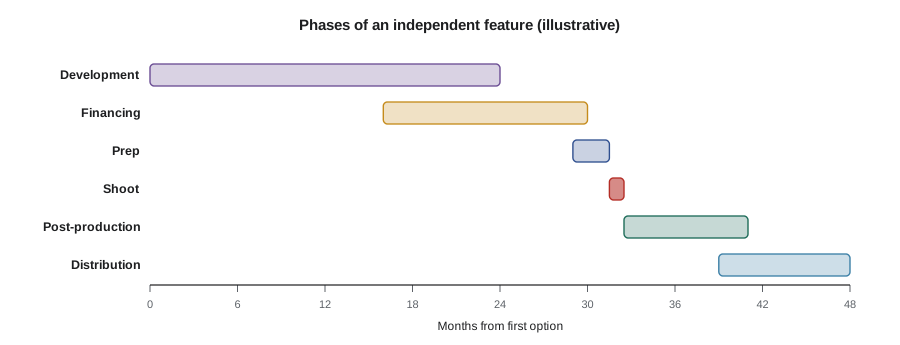
Producers organize work into phases. Development turns an idea into a script and a package that can be financed. Financing assembles the money. Pre-production, or prep, hires the crew, finds locations, casts the film and plans the shoot. Production, or principal photography, shoots the film. Post-production edits the picture, builds the sound, adds visual effects and music, and creates the deliverables. Distribution and exploitation take the film to audiences and earn back its costs.
The phases overlap. Financing often continues into prep, and a producer may still be closing a gap loan while the crew is being hired. Marketing begins long before release; a festival strategy is shaped while the film is still being edited. Development of the next project usually begins while the current one is in post-production, because a producer with only one project is a producer between jobs.
Time is unevenly distributed. Development can take years. Financing can take months or more. Prep for a low-budget feature might be six to ten weeks, the shoot itself three to five weeks, and post-production six months to a year. A producer who thinks of the shoot as the main event misunderstands the job: the shoot is the most expensive and visible part, but most of the producer's decisions are made before and after it.
phases = [
    # name, months of producer effort, share of the cash budget
    ("Development", 24, 0.03),
    ("Financing", 8, 0.02),
    ("Pre-production", 2.5, 0.15),
    ("Production", 1, 0.55),
    ("Post-production", 8, 0.20),
    ("Delivery and sales", 6, 0.05),
]
total_months = sum(m for _, m, _ in phases)
print(f"{'Phase':<20}{'Months':>8}{'Time %':>9}{'Money %':>9}")
for name, months, money in phases:
    print(f"{name:<20}{months:>8.1f}{months / total_months * 100:>8.1f}%{money * 100:>8.1f}%")
prod = [p for p in phases if p[0] == "Production"][0]
ratio = (prod[2]) / (prod[1] / total_months)
print(f"Production uses {prod[1] / total_months * 100:.1f}% of the time but {prod[2] * 100:.0f}% of the money,")
print(f"so each month of shooting costs about {ratio:.0f} times the average month.")Phase Months Time % Money % Development 24.0 48.5% 3.0% Financing 8.0 16.2% 2.0% Pre-production 2.5 5.1% 15.0% Production 1.0 2.0% 55.0% Post-production 8.0 16.2% 20.0% Delivery and sales 6.0 12.1% 5.0% Production uses 2.0% of the time but 55% of the money, so each month of shooting costs about 27 times the average month.
The numbers are illustrative, but the pattern holds for most independent films: the shoot uses a small share of the producer's time and most of the money. This is why preparation is so valuable. A day saved in prep costs little; a day lost on set costs a large share of the budget.
Skills and qualities of a good producer
Producing rewards a strange mixture of skills. A producer must read scripts with a creative eye and a budget in mind at the same time, seeing both what a scene could become and what it will cost. A producer must be able to negotiate firmly without damaging relationships that will matter for decades. A producer must understand enough accounting and law to read a cost report and a contract, and enough about every craft to know when a department head is right.
Above all, producers make decisions under uncertainty. Will this actor's attachment help raise money? Is this location worth its cost? Should the production add a day or cut a scene? Few of these decisions have obviously right answers, and the producer must make them quickly, explain them clearly and live with the results.
| Skill | What it involves | Lessons |
|---|---|---|
| Story judgement | Choosing material and shaping scripts | 2 |
| Financial design | Building finance plans and recoupment schedules | 3, 4, 11 |
| Budgeting | Translating a script into costs | 5, 6 |
| Scheduling | Turning pages into days | 7 |
| Management | Hiring, leading and protecting a crew | 8 |
| Cost control | Tracking spending against the budget | 9 |
| Post supervision | Completing the film and its deliverables | 10 |
| Market sense | Festivals, sales and distribution | 11 |
Ethics and responsibility
Producers hold power over people's livelihoods and safety. They decide who is hired, how long people work, how money is spent and whether concerns are taken seriously. Industry reckonings about harassment, unsafe sets and exploitative working conditions have made it clear that these responsibilities cannot be delegated away. A producer who pushes a crew into excessive hours, cuts safety corners or ignores complaints is not just making a bad business decision; they may be breaking the law and harming people.
Good practice now includes respectful-workplace policies with real reporting channels, safety planning led by qualified people, reasonable hours with proper turnaround between days, fair pay and prompt payment, and honest dealing with financiers and crew. CINE-340 covers set safety in detail, and FILM-320 lesson 8 covers safety culture from the director's side. In this course, the producer's role is to fund and protect those practices: to put money in the budget for safety, to schedule realistically, and to back the people who raise concerns.
Producers also owe honesty to financiers. A finance plan, cost report or sales projection is a representation that others rely on. Misstating costs to qualify for funding, or hiding overruns from a bond company, can expose a producer to legal action and ends careers. FILM-420 covers the legal side; here the principle is simple: report accurately, early and in writing.
Common mistakes
MistakeTreating the producer as only the person who raises money
InsteadSee producing as creative, financial, managerial and commercial work across every phase.
MistakeAssuming every producer credit means the same thing
InsteadCheck what each credit holder actually did; certification and funding rules give credits meaning.
MistakeTreating the shoot as the main event of producing
InsteadRecognize that most producing decisions are made in development, prep and post-production.
MistakeChoosing a production model without considering ownership and risk
InsteadCompare who owns the film, who carries the risk and what each route secures before choosing.
MistakeLeaving safety and respectful-workplace practice to others
InsteadBudget, schedule and back safety and fair treatment as part of the producer's own job.
Summary and key terms
- The producer is responsible for making a film possible, from development to delivery and sale.
- Producing combines creative, financial, managerial and commercial responsibilities.
- Producer credits are negotiated and valuable; industry bodies and funding rules give them meaning.
- Independent, studio and streamer productions differ in ownership, risk and the producer's key skills.
- Productions move through development, financing, prep, production, post-production and distribution, with heavy overlap.
- The shoot uses little of the producer's time but most of the money, so preparation is valuable.
- Producers hold responsibility for safety, fair treatment and honest reporting to financiers.
- Producer
- The person with overall responsibility for making a film, from development to delivery.
- Executive producer
- A credit usually given for financing, rights, talent or senior oversight contributions.
- Line producer
- The producer who controls the budget, schedule and crew day to day during prep and production.
- Unit production manager
- The manager who runs the physical production: crew, equipment, locations and paperwork.
- Independent production
- A production owned and financed by its producer from several sources.
- Commission
- An arrangement in which a buyer such as a streamer pays for a production in exchange for rights.
- Cost-plus deal
- A commission paying the budget plus a premium, usually with little back-end profit.
- Back end
- Profit participation after a film's costs are recouped.
- Principal photography
- The main shooting period of a production.
- Development
- The phase in which an idea becomes a script and a financeable package.
Practice problems
Work each problem on paper first, then reveal the answer to check.
Name the four broad responsibilities of a producer.
Show answer
Creative, financial, managerial and commercial.
What does a line producer usually control?
Show answer
The budget, schedule and crew day to day during prep and production.
Who usually owns the copyright in an independent production?
Show answer
The producer, at least initially.
What does a producer usually give up in a cost-plus streamer commission?
Show answer
Ownership and most of the back-end upside.
Why do producer credits need certification or rules?
Show answer
Because credits are valuable and can be inflated or given for little work.
Which phase usually takes the longest: development, prep or production?
Show answer
Development, often lasting years.
Why is a day saved in prep valuable?
Show answer
Prep days are cheap, while lost shooting days cost a large share of the budget.
Give one ethical responsibility of a producer toward the crew.
Show answer
For example: safe working conditions, reasonable hours, fair and prompt pay or acting on complaints.
Why must cost reports be accurate?
Show answer
Financiers and bond companies rely on them; misstating them can lead to legal action.
What course covers contracts and copyright in depth?
Show answer
FILM-420.
Lesson quiz · 5 questions
Score 60% or more to complete this lesson.
Create a free account to save your progress, take quizzes and earn a certificate.