
FILM-410 · Lesson 9 of 12 · 25 min
Production accounting and cost control
A budget is a plan; production accounting is how the producer finds out whether the plan is working. From the first day of prep, money flows out of the production in hundreds of transactions: payroll, purchase orders, rentals, petty cash, location fees, catering and more. The production accountant records every transaction against the budget, and each week the accounting team produces a cost report showing what has been spent, what is committed and what the film is now expected to cost. That forecast, not the amount spent so far, is the number that matters most.
This lesson covers the production accountant's role, the systems that control spending, the weekly cost report and estimated final cost, hot costs, cash flow and the audits that tax credits and funders require. CON-310 covers cost control and earned value management in construction, where the same ideas, budgets, commitments, forecasts and variances, are applied to buildings rather than films. Readers who have taken that course will recognize the logic.
The production accountant
The production accountant, often with assistants for payroll and payables, manages the production's money. They set up the bank accounts and accounting system, code every cost to the correct budget account, process payroll with the payroll service, pay vendors, manage petty cash, reconcile accounts, and prepare cost reports for the producer, financiers and completion guarantor. On a tax credit production, they also keep the records that the audit will require.
A good production accountant is a safeguard as much as a record-keeper. They question purchases that have not been approved, spot costs coded to the wrong account, and warn the producer when a department is trending over budget. Producers should hire an experienced production accountant early in prep, not halfway through the shoot when problems have already accumulated.
Controlling spending
Production accounting relies on a few simple controls. Purchase orders authorize spending before it happens: a department head requests a purchase or rental, the production manager or line producer approves it against the budget, and the purchase order number goes on the vendor's invoice. Check requests and payment approvals ensure that someone with authority signs off before money leaves the account. Petty cash floats give departments small amounts of cash for minor purchases, which they must account for with receipts before receiving more.
These controls exist to make spending visible before it becomes a surprise. A department that rents extra equipment without a purchase order may not appear in the accounts until the invoice arrives weeks later, by which time the money is gone. Requiring purchase orders for all but trivial purchases lets the accountant record commitments as soon as they are made.
| Control | How it works | What it prevents |
|---|---|---|
| Purchase order | Spending approved against the budget before it happens | Unapproved commitments discovered late |
| Check request or payment approval | Authorized signature before payment | Payments without authority |
| Petty cash with receipts | Small floats replenished only against receipts | Untracked cash spending |
| Weekly reconciliation | Bank and card statements matched to records | Errors and fraud going unnoticed |
| Approval limits | Larger purchases need more senior approval | Large commitments by junior staff |
Spent, committed and estimated final cost
A cost report compares three things for every budget account. The first is the budget, the amount originally allowed. The second is the cost to date: money actually spent, plus commitments, which are amounts the production has agreed to pay through purchase orders, deal memos and contracts but has not yet paid. The third is the estimate to complete: what the accountant and department heads expect still to spend on that account. Cost to date plus estimate to complete gives the estimated final cost, or EFC. The difference between the EFC and the budget is the variance.
The estimate to complete is the hardest number and the most important. It requires judgement: if the camera department has spent 70 per cent of its budget with 40 per cent of the shoot remaining, simply subtracting will produce a misleading figure. The accountant must talk to department heads, look at the schedule ahead and forecast realistically. A cost report that assumes every remaining dollar will be spent exactly as budgeted is not a forecast; it is a hope.
accounts = [
    # account, budget, spent, committed, estimate to complete
    ("Production staff", 98000, 52000, 18000, 30000),
    ("Camera", 64000, 30000, 14000, 24000),
    ("Grip and electric", 58000, 27000, 12000, 22000),
    ("Art and set dressing", 72000, 61000, 6000, 13000),
    ("Locations", 60000, 38000, 15000, 15000),
    ("Transport", 38000, 18000, 7000, 15000),
    ("Catering and craft", 30000, 14000, 2000, 15500),
    ("Fringes", 80000, 41000, 0, 43000),
]
print(f"{'Account':<22}{'Budget':>9}{'To date':>9}{'To go':>9}{'EFC':>9}{'Var':>8}")
tb = tefc = 0
for name, budget, spent, committed, etc in accounts:
    to_date = spent + committed
    efc = to_date + etc
    var = budget - efc
    tb += budget; tefc += efc
    flag = "  over" if var < 0 else ""
    print(f"{name:<22}{budget:>9,}{to_date:>9,}{etc:>9,}{efc:>9,}{var:>8,}{flag}")
print(f"{'Total':<22}{tb:>9,}{'':>9}{'':>9}{tefc:>9,}{tb - tefc:>8,}")
contingency = 77100
print(f"Contingency remaining after these variances: {contingency + (tb - tefc):,}")Account Budget To date To go EFC Var Production staff 98,000 70,000 30,000 100,000 -2,000 over Camera 64,000 44,000 24,000 68,000 -4,000 over Grip and electric 58,000 39,000 22,000 61,000 -3,000 over Art and set dressing 72,000 67,000 13,000 80,000 -8,000 over Locations 60,000 53,000 15,000 68,000 -8,000 over Transport 38,000 25,000 15,000 40,000 -2,000 over Catering and craft 30,000 16,000 15,500 31,500 -1,500 over Fringes 80,000 41,000 43,000 84,000 -4,000 over Total 500,000 532,500 -32,500 Contingency remaining after these variances: 44,600
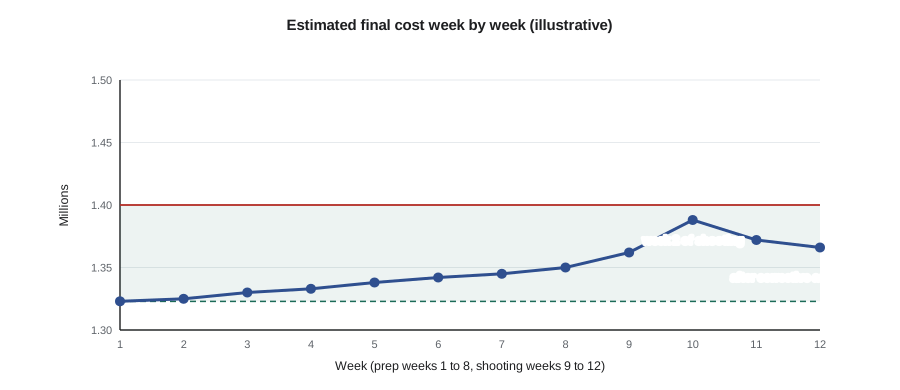
The report shows several accounts trending over budget, with the largest variances in art and locations, and fringes rising with overtime. Together they consume part of the contingency. The producer's question is not only how much is over, but why, and whether the causes will continue. Art may have been a one-time cost of building the marina office set; overtime-driven fringes will keep growing if the long days continue.
Hot costs and the daily view
On many productions, the accountant or production manager also prepares a hot cost report each day of the shoot. It compares the day's actual labour hours, overtime, meal penalties and other variable costs with what the budget allowed for that day. Hot costs give the producer a near-real-time view of the most volatile costs, especially overtime, long before the weekly cost report.
Hot costs are useful because they connect money to decisions. A day that ran two hours over with a late meal shows up as an extra cost the next morning, so the producer and first assistant director can discuss what happened and how to avoid it. Over a 20-day shoot, a habit of running 30 minutes over each day can cost more than a full extra day.
Worked problem
Reading a hot cost report
Day 9 of Stillwater Road ran 1.5 hours over the planned 11-hour day, with a meal 45 minutes late. With 34 crew on an average straight-time rate of about 38 per hour, overtime at time and a half, fringes at 22 per cent and a meal penalty of 25 per person (all illustrative), what did the overage cost?
Show solution
- Overtime hours: 1.5 hours times 34 crew equals 51 person-hours.
- Overtime cost: 51 times 38 times 1.5 equals 2,907.
- Fringes on overtime: 22 per cent of 2,907 equals about 640.
- Meal penalties: 34 times 25 equals 850.
- Total: about 2,907 plus 640 plus 850, or roughly 4,400 for the day.
Answer: The overage cost about 4,400. Repeated across the shoot, similar days would consume a large share of the contingency, which is why the producer and first assistant director review the causes the next morning.
Cash flow
A production can be on budget and still run out of cash. Cash flow tracks when money comes in and when it must go out. Financing arrives in instalments, often tied to milestones such as the start of principal photography or delivery, and some sources, such as tax credits, arrive only after the film is finished. Payroll, meanwhile, is due every week, and vendors expect payment on their terms.
The production accountant prepares a cash flow schedule, matching expected receipts against expected payments week by week, and updates it as the production progresses. If a funder's instalment is late, the producer must know in advance whether there is enough cash to meet payroll, and if not, arrange a bridge or delay non-essential payments. Missing payroll is not an option: it breaks trust, may break the law and can stop a production.
| Period | Cash in | Cash out | Balance |
|---|---|---|---|
| Prep weeks 1 to 4 | 350 | 140 | 210 |
| Prep weeks 5 to 8 | 200 | 230 | 180 |
| Shoot weeks 1 to 2 | 300 | 360 | 120 |
| Shoot weeks 3 to 4 | 100 | 210 | 10 |
| Post-production | 81 | 430 | -339 |
| Tax credits received after audit | 369 | 30 | 0 |
The table shows a common problem: the budget balances overall, but there is a large cash shortfall in post-production before the tax credits arrive. The interim financing described in lesson 3 exists to fill exactly this gap. The producer plans it during financing, not when the bank balance is already negative.
Reporting to financiers and the guarantor
Financiers and the completion guarantor receive regular cost reports, often weekly during production and monthly in post-production, along with production reports and notices of significant problems. Financing agreements usually define what counts as a significant overrun and when the producer must notify. On bonded films, the guarantor watches these reports closely; a forecast that exceeds the budget plus contingency may lead the guarantor to intervene, first by requiring a plan and, in serious cases, by taking control.
Honest, timely reporting protects the producer. A guarantor who learns about a problem early can help solve it; one who discovers it late will assume the worst. Cost reports should explain variances in plain language, distinguish one-time costs from trends, and set out the corrective actions the producer is taking.
Audits and closing the books
Tax credit programs and many funders require an audit of the production's final costs by an independent accountant. The audit checks that costs were incurred, paid and correctly classified, that residency and labour rules were met, and that the final cost report matches the accounts. Productions that keep clean records from the start pass audits faster and receive their credits sooner, which reduces interest on interim loans. Productions with messy records face delays, reduced credits and higher costs.
Closing the books means finishing all payments, collecting deposits, returning equipment, settling disputes, issuing tax slips, preparing the final cost report and archiving records. Producers often underestimate this work and the time it takes. Records must be kept for the period required by tax law and funders, which can be several years.
Fraud prevention and segregation of duties
Small productions are vulnerable to error and fraud because a few people handle a lot of money quickly. Simple practices reduce the risk: the person who approves a payment should not be the same person who makes it; bank and card statements should be reconciled weekly by someone other than the card holder; vendor details should be verified before the first payment; and changes to banking information should be confirmed by phone with a known contact. These controls protect honest staff as well as the production's money.
Common mistakes
MistakeReporting only what has been spent
InsteadReport cost to date, commitments, estimate to complete and estimated final cost for each account.
MistakeAssuming every account will finish on budget
InsteadForecast estimates to complete with department heads and the schedule ahead.
MistakeAllowing purchases without purchase orders
InsteadRequire purchase orders so commitments are recorded before invoices arrive.
MistakeWatching the budget but not the cash
InsteadMaintain a weekly cash flow schedule and plan interim financing early.
MistakeDelaying bad news to the guarantor
InsteadReport variances early with explanations and corrective actions.
Summary and key terms
- Production accounting records every transaction against the budget and forecasts the final cost.
- Purchase orders, payment approvals, petty cash rules and reconciliations make spending visible early.
- Cost to date plus estimate to complete equals the estimated final cost; the variance is its difference from the budget.
- Realistic estimates to complete are the most important and difficult part of a cost report.
- Hot costs give a daily view of overtime and other volatile costs.
- Cash flow can fail even when the budget is on track, so receipts and payments are scheduled weekly.
- Timely, honest reporting and clean records protect the producer with financiers, guarantors and auditors.
- Production accountant
- The person who manages a production's money, records and cost reports.
- Purchase order
- An authorization to spend, approved against the budget before the purchase.
- Commitment
- An amount the production has agreed to pay but not yet paid.
- Cost to date
- Money spent plus commitments.
- Estimate to complete
- The forecast of remaining spending on an account.
- Estimated final cost
- Cost to date plus estimate to complete.
- Variance
- The difference between the budget and the estimated final cost.
- Hot cost report
- A daily report of actual labour and variable costs compared with the budget.
- Cash flow schedule
- A week-by-week plan of expected receipts and payments.
- Audit
- An independent check of a production's costs, required by tax credit programs and funders.
Practice problems
Work each problem on paper first, then reveal the answer to check.
What does a production accountant do?
Show answer
Manages the production's money, records transactions and prepares cost reports.
Why are purchase orders important?
Show answer
They record commitments before invoices arrive.
How is estimated final cost calculated?
Show answer
Cost to date plus estimate to complete.
Why is the estimate to complete the hardest number?
Show answer
It requires realistic judgement about future spending.
What does a hot cost report show?
Show answer
The day's actual labour and variable costs compared with the budget.
How can a production be on budget but out of cash?
Show answer
Money may arrive later than payments are due.
When must payroll be met?
Show answer
Every pay period; missing it is not an option.
Why report variances to the guarantor early?
Show answer
Early reporting allows solutions; late discovery causes intervention.
What does a tax credit audit check?
Show answer
That costs were incurred, paid and correctly classified, and that program rules were met.
Why do clean records reduce costs?
Show answer
Faster audits mean faster credits and less interest on interim loans.
Lesson quiz · 5 questions
Score 60% or more to complete this lesson.
Create a free account to save your progress, take quizzes and earn a certificate.