
FILM-410 · Lesson 7 of 12 · 25 min
Scheduling and breakdown
The schedule is the backbone of a production. It decides how many days the film will shoot, in what order, where the crew will be each day, which actors are needed when, and how long each person is employed. Because so many costs depend on it, the schedule and the budget are built together, and a change to one almost always changes the other. A producer who understands scheduling can see the cost of a creative decision before it is made.
Scheduling is usually led by the first assistant director, often with the line producer or production manager, using the director's plan for each scene. FILM-210 lesson 10 introduces breakdowns from the writer's side, and FILM-320 lesson 3 explains how directors estimate shooting time with the first assistant director. This lesson looks at scheduling from the producer's side: how the breakdown is made, how scenes are ordered, how cast schedules are built, and what the producer should check before approving a schedule.
The script breakdown
The breakdown begins by dividing the script into scenes and measuring each scene's length in pages and eighths of a page. A standard screenplay page is divided into eight parts, so a scene that runs one and a half pages is written as 1 4/8. Page counts give a rough measure of how much screen time and shooting time each scene needs, although a page of dialogue in one room shoots far faster than a page describing a chase.
For each scene, the breakdown records every element needed: the set or location, interior or exterior, day or night, the cast members by number, background performers, stunts, vehicles, animals, special effects, props, wardrobe, makeup, special equipment and anything else that costs money or needs planning. These details are entered on breakdown sheets, traditionally colour-coded, and in scheduling software they become the data from which the schedule is built.
| Element | Example | Why it matters |
|---|---|---|
| Scene and pages | Scene 34, 2 3/8 pages | Measures workload |
| Set and location | Ext. marina dock | Groups scenes by place |
| Day or night | Night | Night work needs lighting, crew rest and premiums |
| Cast | 1 (Nora), 4 (Eli) | Drives cast days and holds |
| Background | 6 boaters | Background costs and wardrobe |
| Vehicles and boats | One working outboard boat | Rental, marine safety and permits |
| Special effects | Rain towers | Equipment, water and safety |
| Props | Ledger, flashlight | Department preparation |
Building the stripboard
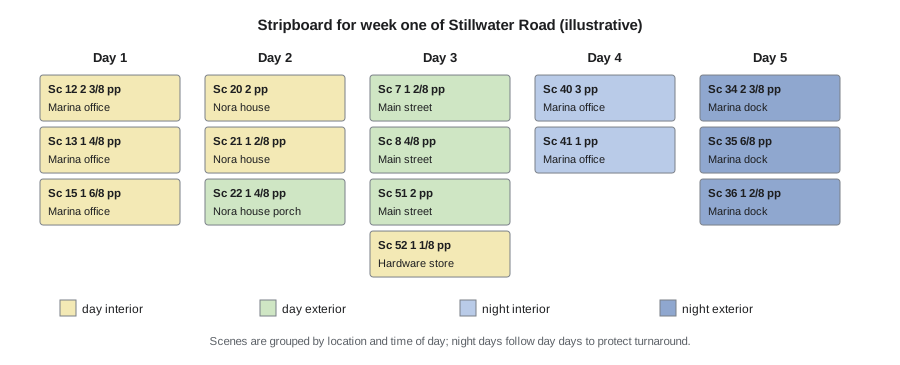
Once every scene is broken down, the scenes are arranged into shooting days on a stripboard, now usually a digital one. Each scene is a strip showing its key data. Scenes are grouped so that the crew shoots everything at one location before moving on, regardless of story order. Within a location, scenes are often grouped by day and night, by interior and exterior, and by cast, so that actors are not held for days between their scenes.
Many considerations compete. Location availability may fix certain days. An actor may be available only for one week. Exterior scenes need weather cover: an interior set or location that can be used if rain stops exterior work. Night work requires rest periods that push the next day's call later. Children and animals have limited hours. Complex scenes are often scheduled early in the day when everyone is fresh, and emotionally demanding scenes may be placed where the actors can prepare. Some directors prefer to shoot roughly in story order when it helps performances, if the budget allows.
The number of pages a production can shoot in a day depends on the script, the director's approach and the budget. Low-budget features often shoot four to six pages a day; larger productions may shoot two or three. A schedule that assumes eight pages a day for a dramatic feature is almost certainly unrealistic.
from fractions import Fraction

def pages(s):
    """Convert '2 3/8' or '5/8' into a number of pages."""
    total = Fraction(0)
    for part in s.split():
        total += Fraction(part)
    return total

scenes = [
    # scene, location, day/night, pages, complexity factor
    (12, "Marina office", "D", "2 3/8", 1.0),
    (13, "Marina office", "D", "1 4/8", 1.0),
    (40, "Marina office", "N", "3", 1.1),
    (34, "Marina dock", "N", "2 3/8", 1.6),
    (35, "Marina dock", "N", "6/8", 1.4),
    (7, "Main street", "D", "1 2/8", 1.3),
    (8, "Main street", "D", "4/8", 1.2),
    (51, "Main street", "D", "2", 1.0),
]
pages_per_day = 5      # target for straightforward dialogue scenes
by_location = {}
for sc, loc, dn, pg, cx in scenes:
    by_location.setdefault((loc, dn), []).append((sc, pages(pg), cx))
total_days = 0
for (loc, dn), items in by_location.items():
    raw = sum(p for _, p, _ in items)
    weighted = sum(p * cx for _, p, cx in items)
    days = float(weighted) / pages_per_day
    total_days += days
    print(f"{loc:<14}{dn}  scenes {[s for s, _, _ in items]}  pages {float(raw):>5.3f}  weighted {float(weighted):>5.2f}  days {days:.2f}")
print(f"Estimated shooting days for these scenes: {total_days:.2f}")Marina office D scenes [12, 13] pages 3.875 weighted 3.88 days 0.78 Marina office N scenes [40] pages 3.000 weighted 3.30 days 0.66 Marina dock N scenes [34, 35] pages 3.125 weighted 4.85 days 0.97 Main street D scenes [7, 8, 51] pages 3.750 weighted 4.22 days 0.84 Estimated shooting days for these scenes: 3.25
The complexity factor is a rough way to account for scenes that take longer than their page count suggests, such as the night dock scenes with a boat. Real schedules are built scene by scene with the director and first assistant director, but simple calculations like this help a producer test whether a schedule is plausible.
Cast schedules and day-out-of-days
A day-out-of-days report shows, for each actor, which days they work, travel, are held and are on rest. It drives cast costs, because actors under weekly deals are paid for the weeks they are engaged, actors under daily deals are paid per day worked, and holds between working days may have to be paid. A schedule that brings an expensive actor in for one day in week one and one day in week four may cost far more than one that groups their scenes together.
Unions set rules about how performers may be engaged: when daily performers can be dropped and picked up again, what must be paid for holds, and how weekly performers' guarantees work. The first assistant director and production manager build the day-out-of-days to keep cast costs within the budget while respecting these rules.
schedule = {
    1: [1, 2], 2: [1, 2, 4], 3: [1, 4], 4: [1, 3], 5: [1, 3, 5],
    6: [1, 2, 5], 7: [1, 4], 8: [1, 2], 9: [1, 5], 10: [1, 2, 4],
}
cast = {1: "Nora", 2: "Jim", 3: "Ruth", 4: "Eli", 5: "Sam"}
days = sorted(schedule)
print("Actor  " + " ".join(f"{d:>2}" for d in days) + "   work  span")
for num, name in cast.items():
    worked = [d for d in days if num in schedule[d]]
    first, last = worked[0], worked[-1]
    row = []
    for d in days:
        if d in worked:
            row.append(" W")
        elif first < d < last:
            row.append(" H")      # held between working days
        else:
            row.append(" .")
    print(f"{name:<6} " + " ".join(row) + f"   {len(worked):>4}  {last - first + 1:>4}")
print("W = work, H = hold between first and last work days")Actor 1 2 3 4 5 6 7 8 9 10 work span Nora W W W W W W W W W W 10 10 Jim W W H H H W H W H W 5 10 Ruth . . . W W . . . . . 2 2 Eli . W W H H H W H H W 4 9 Sam . . . . W W H H W . 3 5 W = work, H = hold between first and last work days
The report shows that Jim works only five days but spans the full ten-day schedule, while Eli's four days are spread across nine. If either is on a weekly deal or must be held, the producer may ask the first assistant director to group their scenes more tightly. Reordering one day can save thousands.
Company moves and travel
A company move is a change of location during the working day. Moving a crew, equipment and cast can take two hours or more, during which no filming happens. Low-budget schedules avoid company moves wherever possible by grouping scenes at each location and choosing locations close together. When a move is unavoidable, it is usually placed at a natural break, such as lunch, and planned in detail.
Travel also affects the schedule. Distant locations mean travel days, accommodation and per diems. Some union agreements define a zone around a production centre; work outside it triggers travel time and additional costs. Producers choose locations with these zones in mind, and a location that looks cheap may be expensive once travel is added.
Worked problem
Removing a company move from Stillwater Road
Day 7 of Stillwater Road's draft schedule begins at the marina dock, moves to the main street for two short scenes, and returns to the marina for a night scene. The move costs about two hours each way. How might the schedule be improved?
Show solution
- Identify why the day was built this way: the two street scenes involve an actor available only that day.
- Look for alternatives: can the street scenes move to day 9, when the crew is already on the main street, by asking the actor's agent about availability?
- If not, can the street scenes be rewritten to take place at the marina, which the director accepts because they are transitional?
- Replace the gap with additional marina scenes, freeing a half day elsewhere.
Answer: Moving the street scenes to the marina with a small rewrite removes two company moves and frees about half a day, which reduces overtime across the week.
Approving the schedule
Before approving a schedule, the producer checks that it is realistic and consistent with the budget. Are the pages per day achievable for this director and this script? Are night shoots followed by proper turnaround? Are children's hours and other legal limits respected? Is there weather cover for exterior days? Are company moves minimized? Do cast holds match the budget? Are there buffer days, or at least lighter days that could absorb overruns?
The producer should also check the schedule against risk. A schedule that puts all the difficult scenes in the final days leaves no room for recovery. A schedule that depends on a single location for many days is exposed if that location falls through. Experienced producers ask the first assistant director to walk them through the schedule day by day, looking for the days most likely to go wrong.
| Question | What a good answer shows |
|---|---|
| How many pages per day, and why? | A pace matched to the script and director |
| Where are the riskiest days? | Hard scenes spread out with recovery options |
| What happens if it rains? | Weather cover is planned for exterior days |
| How long are the days and turnarounds? | Hours are realistic and legal |
| Which actors are held, and for how long? | Cast costs match the budget |
| How many company moves are there? | Moves are minimized and placed sensibly |
Common mistakes
MistakeScheduling in story order by default
InsteadGroup scenes by location, time of day and cast unless story order is worth its cost.
MistakeAssuming every page shoots in the same time
InsteadWeight pages by complexity, such as action, night work and effects.
MistakeIgnoring day-out-of-days until the end
InsteadCheck cast holds early, because spreading an actor's scenes can be expensive.
MistakePlanning several company moves a day
InsteadGroup scenes by location and place unavoidable moves at natural breaks.
MistakeApproving a schedule without weather cover
InsteadPlan interior cover for exterior days.
Summary and key terms
- The schedule determines shooting days, order, locations, cast days and therefore much of the budget.
- The breakdown measures each scene in pages and eighths and lists every element it needs.
- Scenes are grouped on a stripboard by location, time of day and cast rather than story order.
- Pages per day depend on the script and director; low-budget features often shoot four to six pages a day.
- Day-out-of-days reports drive cast costs, including holds between working days.
- Company moves and distant locations consume time and money.
- Producers approve schedules only after checking pace, rest, weather cover, cast holds and risk.
- Breakdown
- A scene-by-scene list of the elements a script needs.
- Eighths
- The units into which a script page is divided for scheduling.
- Stripboard
- A board or digital tool showing scenes as strips grouped into shooting days.
- Day-out-of-days
- A report showing each actor's work, travel, hold and rest days.
- Hold
- A day between an actor's working days that may have to be paid.
- Company move
- A change of location during a shooting day.
- Weather cover
- An interior scene or location scheduled as a backup for exterior work.
- Zone
- The area around a production centre beyond which travel rules apply.
- First assistant director
- The crew member who builds and runs the shooting schedule.
- Pages per day
- The amount of script a production plans to shoot each day.
Practice problems
Work each problem on paper first, then reveal the answer to check.
How is a scene of one and three-quarter pages written in eighths?
Show answer
1 6/8.
Name four elements recorded on a breakdown sheet.
Show answer
For example, location, day or night, cast, props, vehicles or special effects.
Why are scenes shot out of story order?
Show answer
To group work by location, time of day and cast.
What does a day-out-of-days report show?
Show answer
Each actor's work, travel, hold and rest days.
Why can holds be expensive?
Show answer
Actors may need to be paid for days between their working days.
How long might a company move take?
Show answer
Often two hours or more.
What is weather cover?
Show answer
An interior scene or location that can be shot if weather stops exterior work.
Why should difficult scenes not all be scheduled at the end?
Show answer
There would be no room to recover from overruns.
What pace do low-budget features often aim for?
Show answer
About four to six pages a day.
Who usually builds the schedule?
Show answer
The first assistant director, with the line producer or production manager.
Lesson quiz · 5 questions
Score 60% or more to complete this lesson.
Create a free account to save your progress, take quizzes and earn a certificate.