
HSE-103 · Lesson 2 of 12 · 25 min
Legal duties to assess and control hazards in Canada
In Canada, occupational health and safety law is mainly provincial and territorial, with a separate federal system for federally regulated workplaces. Every jurisdiction requires employers to protect the health and safety of workers, and most now set out, in one form or another, an explicit duty to identify, assess and control hazards. The details differ, so this lesson describes the common principles and gives examples from several jurisdictions. Always check the law that applies where you work.
The internal responsibility system
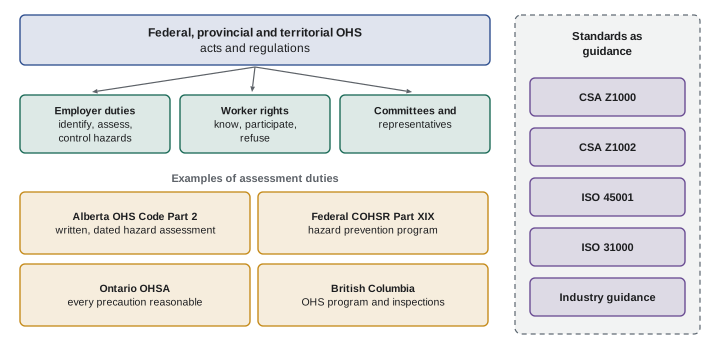
Canadian occupational health and safety law is built on the internal responsibility system: the idea that everyone in the workplace, including employers, supervisors and workers, shares responsibility for health and safety according to their authority and ability. Employers carry the primary responsibility because they control the workplace, the equipment and the organization of work. Workers have three basic rights, the right to know about hazards, the right to participate in health and safety, and the right to refuse unsafe work, and duties to work safely, use required equipment and report hazards. Government inspectors enforce the law but are not meant to be the main source of safety; the system depends on the workplace parties identifying and controlling hazards themselves. Hazard assessment is the practical engine of the internal responsibility system.
Explicit hazard assessment duties
Several jurisdictions spell out hazard assessment requirements in detail. In Alberta, Part 2 of the Occupational Health and Safety Code requires employers to assess a work site and identify existing and potential hazards before work begins, to prepare a written and dated hazard assessment that states how each hazard will be eliminated or controlled, and to repeat the assessment at reasonably practicable intervals, when a new work process is introduced, when a process or operation changes, and before the construction of significant additions or alterations to a work site. Workers must be involved in the assessment and control of hazards where reasonably practicable and informed of the hazards and controls. Federally, Part XIX of the Canada Occupational Health and Safety Regulations requires a hazard prevention program developed in consultation with the policy committee, workplace committee or health and safety representative, including a hazard identification and assessment methodology, a hazard record, preventive measures, employee training and evaluation of the program at least every three years. Other provinces combine general duties with specific requirements for health and safety programs, workplace violence and harassment risk assessments, and particular hazards.
General duties and "every precaution reasonable"
Even where the law does not use the words "hazard assessment", general duties require it in practice. Ontario's Occupational Health and Safety Act, for example, requires employers to take every precaution reasonable in the circumstances for the protection of a worker, to provide information, instruction and supervision, and, where more than five workers are regularly employed, to prepare a written health and safety policy and maintain a program to implement it. Supervisors must advise workers of any potential or actual danger of which the supervisor is aware. Ontario also requires employers to assess the risks of workplace violence and to reassess them as often as necessary. British Columbia's Occupational Health and Safety Regulation requires an occupational health and safety program that includes regular inspections to prevent the development of unsafe conditions, and specific risk assessments for hazards such as violence, working alone and musculoskeletal injury. It is difficult to show that every reasonable precaution was taken, or that a program is effective, without a systematic way of finding and controlling hazards.
Due diligence
In Canadian occupational health and safety prosecutions, most offences are strict liability offences. Once the prosecution proves that a violation occurred, the employer, supervisor or other accused can avoid conviction by showing due diligence: that they took every reasonable precaution in the circumstances to prevent the violation. The Supreme Court of Canada set out this framework in R. v. Sault Ste. Marie (1978). Courts consider whether hazards were foreseeable, whether the accused had identified them, whether reasonable controls, training and supervision were in place, and whether the system was enforced. A current, specific, well-documented hazard assessment, with evidence that controls were implemented and checked, is among the strongest evidence of due diligence. Conversely, a generic assessment that ignored an obvious hazard can undermine a defence. Since 2004, the Criminal Code (Westray amendments) also imposes a legal duty on anyone who directs how work is done to take reasonable steps to prevent bodily harm, and serious negligence can lead to criminal charges.
Standards and management systems
Beyond the law, voluntary standards describe good practice for hazard assessment and occupational health and safety management. They are often referenced by regulators, courts, insurers and clients as benchmarks of what a reasonable organization does.
| Standard | Scope |
|---|---|
| CSA Z1000 | Occupational health and safety management systems |
| CSA Z1002 | Hazard identification and elimination and risk assessment and control |
| CSA Z1003 | Psychological health and safety in the workplace |
| ISO 45001 | International OHS management system standard |
| ISO 31000 | Risk management principles and guidelines |
| IEC 31010 | Risk assessment techniques |
ISO 45001, published in 2018, requires organizations to establish processes for ongoing, proactive hazard identification that take into account routine and non-routine activities, human factors, the design of work areas and equipment, past incidents, emergencies and changes, and to assess and control risks using the hierarchy of controls. ISO 31000 provides general principles for risk management in any field. Neither replaces the law, but both are widely used to design effective systems.
Duties of supervisors and workers
Supervisors are in a special position because they direct work. Provincial laws generally require supervisors to ensure that workers work in compliance with the law and safe procedures, use required equipment, and are advised of potential or actual hazards the supervisor knows about. In many jurisdictions, supervisors must be competent: knowledgeable about the work, the hazards and the law. Workers must work safely, use required protective equipment, report hazards and contraventions, and refrain from removing guards or disabling safety devices. Workers have the right to refuse work they have reasonable grounds to believe is dangerous, following the procedure set out in their jurisdiction's law, and are protected from reprisal for exercising their rights.
Worked problem
Linking an assessment to legal duties
A small Alberta landscaping company starts a new service: trimming trees near roads using a bucket truck. What does the OHS Code require before the work starts?
Show solution
- Because this is a new work process, the employer must complete a hazard assessment before work begins (Part 2).
- The assessment must be written and dated, identify hazards such as overhead power lines, traffic, falls, chainsaw cuts and falling limbs, and state how each will be eliminated or controlled.
- Workers who will do the work must be involved where reasonably practicable, and informed of the hazards and controls.
- Specific Code parts also apply, such as those on powered mobile equipment, fall protection, power line clearances and traffic control, and the assessment must be repeated if the work changes.
Answer: A written, dated hazard assessment, with worker involvement, completed before the new work begins and repeated when it changes, plus compliance with the specific Code parts.
What the law expects in practice
Across both countries, regulators and courts expect broadly the same things: that employers identify the hazards of their work, including foreseeable non-routine work; that they assess the risks and control them using effective measures, preferring elimination and engineering controls; that they involve and inform workers; that they train and supervise; that they keep reasonable records; and that they review and update their approach when conditions change or incidents occur. The rest of this course explains how to do these things well.
Due diligence in practice
Due diligence means taking every precaution reasonable in the circumstances to prevent injury, and it must be shown with evidence. In a prosecution, the employer must prove on a balance of probabilities that it took all reasonable care, which courts assess by looking at what a reasonable employer in the same industry would have done. Evidence typically includes written hazard assessments that are specific to the work, records of the controls chosen and why, training records showing what was taught and how competence was checked, inspection reports and corrective actions, maintenance records for safety-critical equipment, records of supervision and enforcement of safe work rules, minutes of joint committee meetings, and investigation reports showing that the employer learned from incidents. A thick binder of generic policies does not establish due diligence if the workplace does not follow them.
Due diligence has three broad parts, sometimes described as foreseeability, preventability and control. Was the hazard foreseeable, given what was known in the industry and in this workplace? Could the harm have been prevented with reasonable measures? Did the employer have the authority and means to control the hazard? Hazard assessment addresses all three: it identifies foreseeable hazards, chooses reasonable controls and assigns responsibility for implementing them. Supervisors have their own duties under provincial laws, such as Ontario's requirement that supervisors take every precaution reasonable for the protection of workers and advise workers of hazards they know about, and supervisors can be prosecuted personally.
Standards that support the law
Voluntary standards do not carry the force of law unless a regulation or contract adopts them, but they describe recognized good practice and are often used by regulators, courts and auditors to judge whether an employer acted reasonably. ISO 45001, the international standard for occupational health and safety management systems, requires organizations to establish processes for ongoing, proactive hazard identification and for assessing and controlling risks, taking into account routine and non-routine activities, people and organizational factors, past incidents and emergencies. ISO 31000 provides general guidance on risk management that applies to any kind of risk, including safety, and describes risk assessment as identification, analysis and evaluation, followed by treatment, monitoring and communication. Knowing these standards helps when working for clients or parent companies that require them, and when building a program that will hold up under scrutiny.
Workers' rights that support assessment
Canadian OHS laws are built on three basic worker rights: the right to know about hazards in the workplace, the right to participate in identifying and resolving health and safety concerns, and the right to refuse unsafe work. Each right supports hazard assessment. The right to know means that the results of assessments must be shared with the workers affected. The right to participate means that workers, through committees, representatives and direct involvement, help identify hazards and choose controls; Alberta's OHS Code, for example, requires the employer to involve affected workers in the hazard assessment and the control or elimination of hazards. The right to refuse acts as a last safeguard when assessment and control have failed. Most jurisdictions also protect workers from reprisal for exercising these rights, and workers who face reprisal can file complaints with the regulator or labour board.
Employers should also remember that hazard assessment duties apply to everyone at the work site. Prime contractors and owners in many provinces must coordinate health and safety where several employers work at the same site, and host employers must share hazard information with contractors.
In practice, regulators in every Canadian jurisdiction expect to see a written hazard assessment when they visit, whether or not the law uses those exact words, and inspectors commonly ask workers whether they took part in it and know its results.
Keeping these records organized and easy to retrieve is part of due diligence, because evidence that cannot be found when an inspector or court asks for it offers little protection.
Common mistakes
MistakeAssuming no assessment is needed because the law does not use the word.
InsteadGeneral duties require hazards to be identified and controlled.
MistakeKeeping assessments that are generic and out of date.
InsteadKeep assessments specific, current and documented.
MistakeTreating voluntary standards as law.
InsteadUse standards as good practice alongside legal requirements.
MistakeLeaving workers out of assessments.
InsteadInvolve and inform the workers who do the work.
MistakeForgetting supervisors' duties.
InsteadMake sure supervisors know and control the hazards of their work.
Summary and key terms
- Canadian OHS law is mainly provincial and territorial, with a federal system for federally regulated work.
- The internal responsibility system shares duties among all workplace parties.
- Alberta and the federal regulations set explicit hazard assessment requirements.
- General duties such as "every precaution reasonable" require assessment in practice.
- Due diligence is the main defence to strict liability OHS offences.
- Voluntary standards such as ISO 45001 and ISO 31000 describe good practice.
- Supervisors and workers also have duties and rights.
- Occupational health and safety law
- Law governing safety at work.
- General duty
- Broad legal duty to protect workers.
- Internal responsibility system
- Shared responsibility of workplace parties (Canada).
- General Duty Clause
- OSH Act Section 5(a)(1) on recognized serious hazards (US).
- Due diligence
- Taking every reasonable precaution to prevent a violation.
- State plan
- OSHA-approved state occupational safety program.
- Hazard prevention program
- Federal Canadian program under COHSR Part XIX.
- Process hazard analysis
- Systematic analysis required under OSHA PSM.
- ISO 45001
- International OHS management system standard.
- Right to refuse
- Worker right to refuse dangerous work under defined conditions.
Practice problems
Work each problem on paper first, then reveal the answer to check.
What is the internal responsibility system?
Show answer
Shared responsibility for safety among employers, supervisors and workers.
When must an Alberta hazard assessment be repeated?
Show answer
At reasonable intervals, for new processes, changes, and before significant site alterations.
How often must a federal hazard prevention program be evaluated?
Show answer
At least every three years.
What is the due diligence defence?
Show answer
Proof that every reasonable precaution was taken.
Which case set out strict liability and due diligence?
Show answer
R. v. Sault Ste. Marie (1978).
Name two voluntary standards for risk management.
Show answer
ISO 45001, ISO 31000, CSA Z1002, ANSI/ASSP Z10.
What does ISO 45001 require hazard identification to consider?
Show answer
Routine and non-routine work, human factors, design, incidents, emergencies and changes.
Name a duty of supervisors.
Show answer
Ensure safe work and advise workers of known hazards.
Name a worker duty.
Show answer
Work safely, use protective equipment, report hazards.
What do regulators expect across both countries?
Show answer
Identify, assess and control hazards, involve workers, train, record and review.
Lesson quiz · 5 questions
Score 60% or more to complete this lesson.
Create a free account to save your progress, take quizzes and earn a certificate.