
HSE-103 · Lesson 5 of 12 · 25 min
Job hazard analysis
Job hazard analysis, also called job safety analysis (JSA), task hazard analysis or task risk assessment, is the most widely used structured method for assessing the hazards of a specific job or task. It breaks a task into steps, identifies the hazards of each step, and sets out the controls that will be used. Job hazard analyses are used to develop safe work procedures, to train new workers, to plan non-routine work, and to support permits and pre-job briefings. This lesson explains when to use a JHA, how to select and prioritize jobs, how to break a job into steps, how to identify hazards and controls for each step, how to involve workers and write clear results, and how JHAs relate to safe work procedures, field-level hazard assessments and permits.
What a job hazard analysis is
A job is a sequence of tasks that a worker carries out to achieve a goal, such as changing a conveyor belt, cleaning a tank, loading a truck or replacing a light fixture. A job hazard analysis examines that sequence step by step and asks, for each step, what could go wrong and how it will be prevented. The result is usually a table with three main columns: the job steps, the hazards associated with each step, and the controls or safe work practices for each hazard. Many organizations add columns for risk ratings before and after controls, responsible persons, and required PPE, permits and training.
| Job step | Hazards | Controls |
|---|---|---|
| 1. Position the ladder | Ladder slipping; contact with overhead lines | Inspect ladder; 4:1 angle; level footing; check for overhead lines |
| 2. Climb with tools | Falling; dropping tools | Three points of contact; tool belt or hoist; barricade below |
| 3. Remove the fixture | Electric shock | Lock out the circuit and test for absence of voltage |
| 4. Install new fixture | Overreaching; eye injury from debris | Move the ladder rather than overreach; safety glasses |
| 5. Restore power and test | Shock; arc flash if wiring is faulty | Qualified person; check wiring before energizing |
When to use a JHA
A JHA is useful whenever a task has significant hazards and a defined sequence of steps. Priorities for analysis include:
- Jobs with the highest injury or near miss rates.
- Jobs with the potential for serious injury or fatality, even if no incident has occurred, such as work at height, lifting operations, confined space entry, energized work and work near mobile equipment.
- Jobs where a simple human error could cause serious harm.
- New jobs, or jobs that have changed because of new equipment, processes or materials.
- Jobs done rarely, such as annual maintenance or emergency shutdowns, where people have little recent experience.
- Complex jobs that require written instructions.
Simple, low-risk tasks may not justify a full JHA, but the same thinking applies informally. For non-routine and changing field work, a quicker field-level hazard assessment, covered in HSE-230, is completed at the start of each job.
Step 1: Select and prepare
Choose the job, define where it starts and ends, and gather information: existing procedures, manufacturers' instructions, incident reports, safety data sheets and relevant regulations. Assemble a small team that includes workers who do the job regularly, a supervisor, and, for complex hazards, a specialist. Explain that the purpose is to improve the job, not to evaluate individual workers. Where possible, plan to observe the job being done, ideally more than once, or to walk through it at the workplace.
Step 2: Break the job into steps
List the basic steps of the job in the order they are performed. Each step should describe what is done, starting with an action verb, such as "position", "lift", "connect" or "remove", without detail about how. A good rule is that most jobs can be described in about 5 to 15 steps: too few, and hazards are hidden inside broad steps such as "do the repair"; too many, and the analysis becomes a detailed procedure that is hard to use. Include preparation, such as getting tools and isolating equipment, and finishing steps, such as clean-up, restoring guards and returning equipment to service, because many incidents happen at the start and end of jobs.
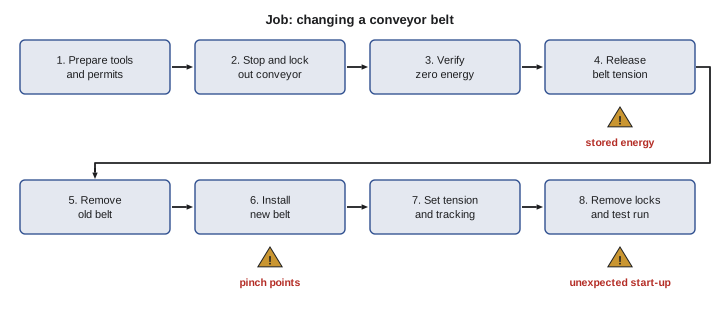
Step 3: Identify the hazards of each step
For each step, ask what could go wrong. Useful prompts include:
- Could the worker be struck by, struck against, caught in, on or between anything?
- Could the worker fall, slip or trip, or could something fall on them?
- Is there contact with electricity, heat, cold, chemicals, sharp edges or moving parts?
- Is there stored or hazardous energy that could be released?
- Does the step involve lifting, pushing, awkward postures or repetition?
- Could there be exposure to noise, dust, fumes, vapours, radiation or biological agents?
- What happens if equipment fails, something unexpected occurs, or the step is done out of order?
- Who else could be affected, such as co-workers, contractors or the public?
Use the energy wheel from Lesson 4 as an additional check. Record each hazard specifically, for example "hand caught between belt and pulley during tensioning" rather than "pinch point".
Step 4: Determine controls
For each hazard, decide how it will be eliminated or controlled, using the hierarchy of controls: eliminate the hazard if possible; substitute a less hazardous process or material; use engineering controls such as guards, isolation and ventilation; then administrative controls such as procedures, permits, training and supervision; and finally personal protective equipment. Lesson 7 explains the hierarchy in detail. Controls should be specific and practical: "wear gloves" is less useful than "wear cut-resistant gloves rated for handling sheet metal edges", and "be careful" is not a control at all. Where existing controls are inadequate, the JHA should lead to improvements, such as a new guard, a lifting device or a redesigned workstation, rather than accepting a high-risk task with only PPE and caution.
Step 5: Rate and review the risk
Many organizations rate the risk of each hazard before and after controls, using a risk matrix (Lesson 6), to show which hazards remain significant and to prioritize improvements. After the JHA is drafted, review it with the workers who do the job and with supervisors, test it against the actual job, and revise it. Finally, have it approved according to the organization's procedures, communicate it, and use it to train workers and to write or update the safe work procedure.
Worked problem
A JHA step with before and after risk
In a JHA for cleaning a meat slicer in a grocery store, the step "remove and clean the blade guard" has the hazard "cut from contact with the blade". Using a 5 × 5 matrix where risk = likelihood × severity, the team rates the current method at likelihood 4 and severity 4. What controls might reduce the risk, and what might the residual rating be?
Show solution
- Initial risk: 4 × 4 = 16, which is high on the organization's matrix.
- Engineering: unplug the slicer and set the blade to the zero (closed) position before cleaning; use a blade cover or guard designed for cleaning.
- Administrative: written procedure, training and supervision; only trained workers aged 18 or older may clean slicers, consistent with laws restricting young workers from such equipment.
- PPE: cut-resistant gloves worn under protective gloves for cleaning.
- Residual risk: likelihood reduced to 2, severity remains 4 if a cut occurs; 2 × 4 = 8, medium.
Answer: Isolating power, closing the blade, a cleaning guard, training and cut-resistant gloves reduce the risk from 16 to about 8, with further reduction possible through slicer designs that allow safer cleaning.
Writing clear JHAs
A JHA is useful only if people can understand and use it. Write in plain language and short sentences. Use the words workers use for equipment and tasks. Keep the format consistent across the organization. Include photographs or diagrams of key steps, isolation points and hazards. Make JHAs available where the work is done, on paper at the job or on tablets. Translate them or provide verbal explanations for workers with limited English or French. Avoid vague controls such as "use caution", "be aware" or "follow procedures" without saying which procedures.
JHAs, safe work procedures and permits
Job hazard analyses are closely related to other tools. A safe work procedure, or standard operating procedure, is a step-by-step instruction for carrying out a task safely; the JHA provides the analysis on which the procedure is based. A field-level hazard assessment (FLHA), or point-of-work risk assessment, is a short assessment completed by workers at the start of each job or when conditions change, especially in construction and field work, to capture site-specific hazards that a general JHA cannot anticipate. Work permits, such as hot work, confined space entry and lockout permits, control high-risk activities by requiring specific checks, authorizations and conditions before work starts; the JHA identifies when a permit is needed. Pre-job briefings or toolbox talks communicate the hazards and controls to the crew. Together, these tools form a layered system: general analysis, specific procedures, daily checks and authorization for high-risk work.
| Tool | Purpose | When |
|---|---|---|
| Job hazard analysis | Analyse hazards of a job step by step | Before a job is standardized or changed |
| Safe work procedure | Instruct how to do the job safely | Training and daily reference |
| Field-level hazard assessment | Capture conditions on the day | Start of each job or change |
| Work permit | Authorize high-risk work under conditions | Before hot work, confined spaces, etc. |
| Pre-job briefing | Communicate hazards and controls | Start of shift or job |
Keeping JHAs current
JHAs should be reviewed when the job changes, when new equipment or materials are introduced, after incidents or near misses involving the job, when workers raise concerns, and periodically, for example every one to three years depending on risk. A JHA that no longer matches the job is worse than none, because it gives false assurance. Lessons 10 and 12 cover management of change and review.
Choosing which jobs to analyse first
Few workplaces can analyse every task at once, so priorities are needed. Jobs to analyse first include those with the highest injury or illness rates; jobs that have caused serious injuries, fatalities or significant near misses, here or elsewhere in the industry; jobs with the potential for serious harm even if no incident has occurred, such as work with hazardous energy, heights, confined spaces or toxic chemicals; new jobs and jobs that have changed; jobs done infrequently, where workers may lack recent experience; and jobs that are complex enough to need written instructions. A simple prioritization table that scores each job for injury history, potential severity and frequency helps organize the work and explains the choices to managers and the committee.
Common weaknesses in JHAs
Reviews of job hazard analyses often find the same weaknesses. Steps are too broad, such as "perform maintenance", hiding the hazards within them, or too detailed, listing every hand movement. Hazards are described vaguely, such as "be careful" or "safety hazard", rather than naming the energy, the body part and how harm occurs. Controls rely almost entirely on PPE and instructions, even when engineering solutions are practical. Controls are written as hopes, such as "watch out for moving parts", rather than specific actions. The analysis was written in an office without watching the job or talking to the workers. And once written, it is filed and never reviewed, even after equipment or procedures change. Avoiding these weaknesses makes JHAs useful as training tools and as the basis for written procedures.
Once a JHA is complete, it can be turned into a written safe work procedure, used for training new workers, posted at the workstation, and reviewed at toolbox talks. Each use is an opportunity to check whether the analysis still matches the job, and to invite workers to suggest improvements based on their experience.
A well-written JHA is short enough to be read at the start of a shift and specific enough that a new worker could use it to understand what can go wrong at each step of the job.
Common mistakes
MistakeWriting steps that are too broad, such as "do the repair".
InsteadBreak the job into about 5–15 action steps.
MistakeListing vague controls such as "be careful".
InsteadSpecify concrete controls using the hierarchy.
MistakeSkipping preparation and clean-up steps.
InsteadInclude start and finish steps where incidents often occur.
MistakeWriting JHAs without workers who do the job.
InsteadInvolve experienced workers and observe the job.
MistakeNever updating JHAs.
InsteadReview after changes, incidents and periodically.
Summary and key terms
- A JHA breaks a job into steps, identifies hazards and sets controls.
- Prioritize jobs with high injury rates, serious potential, change or rarity.
- Steps should be actions, about 5 to 15 per job, including start and finish.
- Identify hazards with structured prompts and the energy wheel.
- Choose specific controls using the hierarchy of controls.
- Rate risk before and after controls and review with workers.
- JHAs support procedures, field assessments, permits and briefings.
- Job hazard analysis
- Step-by-step analysis of a job's hazards and controls.
- Job safety analysis
- Another name for job hazard analysis.
- Job step
- An action in the sequence of a job.
- Safe work procedure
- Written instructions for doing a task safely.
- Field-level hazard assessment
- Quick assessment at the start of field work.
- Work permit
- Authorization for high-risk work under set conditions.
- Pre-job briefing
- Discussion of hazards and controls before work.
- Initial risk
- Risk before additional controls.
- Residual risk
- Risk remaining after controls.
- Non-routine task
- Task performed infrequently or under unusual conditions.
Practice problems
Work each problem on paper first, then reveal the answer to check.
What are the three main columns of a JHA?
Show answer
Job steps, hazards, controls.
Name three priorities for JHAs.
Show answer
High injury rates, serious potential, new or changed jobs, rare jobs.
How many steps does a typical JHA have?
Show answer
About 5 to 15.
How should each step begin?
Show answer
With an action verb.
Name three hazard prompts.
Show answer
Struck by, caught between, fall, contact, stored energy, lifting.
Why is "be careful" not a control?
Show answer
It does not change the hazard or exposure.
Initial risk 4 × 5 reduced to 2 × 5: what are the scores?
Show answer
20 before, 10 after.
What is the difference between a JHA and a safe work procedure?
Show answer
The JHA analyses hazards; the procedure instructs how to work.
What is a field-level hazard assessment for?
Show answer
Capturing conditions at the start of each job.
When should JHAs be reviewed?
Show answer
After changes, incidents, concerns and periodically.
Lesson quiz · 5 questions
Score 60% or more to complete this lesson.
Create a free account to save your progress, take quizzes and earn a certificate.