
HSE-103 · Lesson 8 of 12 · 26 min
Selecting, implementing and verifying controls
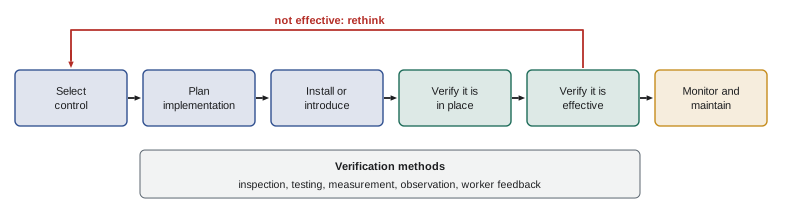
Choosing a control in an assessment is not the same as controlling a hazard. Controls must be selected carefully, designed or specified properly, installed, explained to the people affected, and then checked to make sure they work and keep working. Many serious incidents happen in workplaces where the right controls were listed on paper but were missing, bypassed, poorly maintained or misunderstood in practice. This lesson covers criteria for selecting controls, critical controls for serious hazards, implementation planning, verification and effectiveness checks, monitoring and maintenance, avoiding new hazards created by controls, and closing the loop with documentation and follow-up.
Criteria for selecting controls
When comparing possible controls, consider:
- Effectiveness: how much does it reduce likelihood or severity, and for whom? Where does it sit in the hierarchy?
- Reliability: will it keep working under real conditions, including time pressure, fatigue, weather and wear? Can it be bypassed or defeated?
- Coverage: does it protect everyone exposed, including other workers, contractors and the public, or only the wearer?
- Practicality: can it be used in the way the work is actually done, without making the job much harder?
- New hazards: could it create other hazards, such as heat stress from PPE, trip hazards from barriers, or new chemical hazards from a substitute?
- Cost and time: what are the costs of purchase, installation, maintenance and training, compared with the risk reduction?
- Legal requirements: does a regulation or standard require a specific control?
- Worker acceptance: have the people who do the work been consulted, and do they think it will work?
Decisions should be recorded, including why higher-level controls were not chosen where they were not.
Critical controls
For hazards that could cause fatalities or catastrophic events, many organizations identify critical controls: the controls that, on their own, are crucial to preventing the event or reducing its consequences, and whose absence or failure would significantly increase the risk. Examples include lockout and verification of zero energy before entering machinery, gas testing before confined space entry, an anchor point and fall arrest system for work at height, exclusion zones under suspended loads, and interlocks that stop a press when a guard is opened. Critical control management, promoted by mining and resources industry bodies after major disasters, involves identifying these controls, defining performance requirements for each, assigning owners, and verifying them frequently in the field, often with short checklists used by supervisors and managers. The idea is to focus attention on the few controls that matter most for the worst outcomes.
| Serious hazard | Example critical controls | Verification question |
|---|---|---|
| Hazardous energy | Isolation, lockout, zero-energy verification | Is every energy source isolated and verified before work? |
| Work at height | Guardrails or fall arrest, rescue plan | Is the fall protection in place, inspected and used? |
| Confined space | Atmospheric testing, ventilation, attendant | Has the atmosphere been tested and is it monitored? |
| Suspended loads | Lift plan, exclusion zone, rigging inspection | Is anyone under the load or inside the zone? |
| Mobile equipment | Separation of pedestrians, spotters, alarms | Are pedestrians physically separated from vehicles? |
Planning implementation
Once controls are chosen, they need an implementation plan: what will be done, by whom, by when, and with what resources. Temporary measures may be needed to protect workers while permanent controls are installed; for example, restricting access to an area or using additional PPE until a guard is fabricated. For significant changes, management of change procedures apply (Lesson 10). Implementation includes purchasing and installing equipment, writing or updating procedures, training workers and supervisors, communicating changes, and updating the hazard assessment and related documents.
Verification: does the control exist and work?
Verification answers two questions: is the control in place as intended, and is it effective? A newly installed local exhaust hood should be tested to confirm that it captures contaminants at the required airflow, often with smoke tubes, air velocity measurements and air sampling. A new guard should be checked to confirm that it prevents reaching hazardous parts, using reach-distance criteria from machinery safety standards, and that its interlock stops motion before access. A new procedure should be observed in practice to confirm that workers can follow it and that it achieves its purpose. Training effectiveness should be checked by demonstration or assessment, not just attendance. Verification should involve the people who do the work, since they can say whether the control works in practice.
Worked problem
Verifying a ventilation control
A furniture shop installs a local exhaust hood over a spray finishing bench to reduce solvent vapour exposure. How should the control be verified?
Show solution
- Confirm installation matches the design: hood position, duct, fan and filters as specified by the designer or supplier.
- Measure capture or face velocity at the hood with an anemometer and compare with the design value; check airflow visually with smoke tubes.
- Have an occupational hygienist sample workers' breathing-zone air during typical spraying and compare results with exposure limits.
- Observe how workers actually spray: are they working within the capture zone, or are large items forcing them outside it?
- Set up a schedule for checking airflow and changing filters, and record results.
Answer: Check installation, measure airflow, sample exposure during real work, observe work practices and set up ongoing checks and maintenance.
Monitoring and maintaining controls
Controls degrade over time. Guards are removed for maintenance and not replaced; ventilation filters clog; interlocks are bypassed with tape or wire; training is forgotten; procedures drift as people find shortcuts; PPE wears out. Ongoing monitoring keeps controls effective. Methods include scheduled inspections and testing of engineering controls; preventive maintenance programs for safety-critical equipment; periodic exposure monitoring; observations of work practices; audits of permits and procedures; refresher training; and tracking leading indicators such as the percentage of critical controls verified each month. When monitoring finds a control is not working, treat it as seriously as a near miss: correct it promptly and ask why it failed.
Watching for new hazards
Every control changes the work, and changes can create new hazards. Barriers can create trip hazards or block emergency exits; enclosures can trap heat; automated equipment can introduce new maintenance hazards and complacency; PPE can cause heat stress, reduce dexterity, vision or hearing, and give a false sense of security; substitutes can introduce new chemical hazards; procedures that are too complex can encourage shortcuts. After implementing controls, review the task again to identify any new hazards and adjust as needed, as Alberta's OHS Code, for example, explicitly requires when new controls are put in place.
Bypassing and defeating controls
People bypass controls for understandable reasons: a guard makes a task slow or awkward, an interlock trips repeatedly, PPE is uncomfortable, or a procedure seems unnecessary for a quick job. Bypassing is a sign that the control does not fit the work. The response should include investigating why it was bypassed, redesigning the control or the task to remove the incentive, involving workers in the solution, and making it clear that safety-critical controls must not be defeated. Some machinery safety standards require that guards and interlocks be designed so that they cannot easily be defeated, and that maintenance and troubleshooting tasks can be done safely with guards in place or through alternative safe methods.
Documentation and closing the loop
Document each control decision and its status: the hazard, the control chosen, the person responsible, the target date, the date completed, verification results, and residual risk. Use a tracking system, such as a corrective action log, so that actions do not get lost. Report progress to the joint health and safety committee or representative and to management. When actions are complete and verified, update the hazard assessment, procedures and training materials, and inform workers. Closing the loop builds trust: workers who see hazards fixed are more likely to keep reporting.
Interim controls
Permanent controls, especially engineering controls, can take weeks or months to design, buy and install. In the meantime, workers still face the hazard, so interim controls are needed. Examples include restricting access to a machine until a guard is fitted, limiting the time workers spend in a noisy area until an enclosure is built, adding a second worker or spotter, slowing a process, using rented equipment, or providing respirators while ventilation is redesigned. Interim controls should be documented with an expected end date and checked regularly, because temporary arrangements have a way of becoming permanent. If the risk is very high and no adequate interim control exists, the work should stop until a suitable control is in place.
Contractors, purchasing and design
Many controls are decided long before work begins. Purchasing decisions determine whether new equipment arrives with good guarding, low noise and safe access for maintenance. Design decisions determine whether buildings have safe roof access, adequate ventilation and separated traffic routes. Contractor selection determines whether those doing high-risk work on site have competent people and sound safety programs. Building safety requirements into specifications, purchase orders, design reviews and contract prequalification is one of the most effective ways to control hazards, because changes on paper cost far less than changes after installation. This approach, often called prevention through design, is described in ANSI/ASSP Z590.3 and in CSA guidance on safe design of machinery and workplaces.
Engaging workers in verification
Workers who use a control every day are the best judges of whether it works in practice. A guard may meet the standard but block the operator's view, encouraging removal. A procedure may be technically correct but impossible to complete in the time allowed. A respirator may fit well in the fit test but slip during physical work. Asking workers for feedback after a new control has been in place for a few weeks, observing work without judgement, and acting on what they report makes controls more effective and builds trust. Committee members can help organize this feedback and include it in inspections.
A simple control action plan
A control action plan turns the decisions in an assessment into work that gets done. For each hazard, it lists the control, the hierarchy level, the person responsible, the target date, the resources needed, any interim measures, the verification method and the date verified. Reviewing the plan at regular meetings, such as monthly management or committee meetings, keeps it moving. Overdue items should be escalated, and any item that cannot be completed should be re-examined to find an alternative control, rather than quietly dropped. The table below shows a short example for a woodworking shop.
| Hazard | Control | Owner | Due | Verification |
|---|---|---|---|---|
| Table saw kickback | Riving knife and anti-kickback pawls fitted | Shop supervisor | 2 weeks | Inspection and operator feedback |
| Wood dust | Dust collector connected to all machines | Maintenance lead | 6 weeks | Airflow check and dust sampling |
| Noise | Quieter blades; hearing protection in interim | Shop supervisor | 4 weeks | Noise survey |
| Manual handling of sheets | Panel cart and vacuum lifter | Purchasing | 8 weeks | Observation and discomfort survey |
Each entry in the plan should be specific enough that someone else could check whether it was done. "Improve ventilation" cannot be verified; "connect the planer to the dust collector and confirm an airflow of at least the design value at the hood" can.
Controls in the field: a supervisor's checklist
Supervisors are often the people best placed to confirm that controls are working day to day. A short checklist, used at the start of a shift or during a walk-through, might ask: Are guards and interlocks in place and working? Are isolation and lockout devices available and used? Is ventilation running, and are hoods positioned correctly? Are barriers and exclusion zones set up and respected? Is the required PPE available, in good condition and worn correctly? Do workers know the procedure for the task and the hazards at each step? Have conditions changed since the assessment, for example weather, staffing or equipment? Any "no" answer should lead to immediate correction or stopping the task, and a record so that the underlying cause can be addressed. Over time, the pattern of answers shows which controls are fragile and need redesign.
Verification results should be shared with the workers concerned, so they know the control has been tested and can trust it, or know what is being done if it fell short.
Common mistakes
MistakeListing controls without assigning responsibility and dates.
InsteadPlan implementation with owners and deadlines.
MistakeAssuming installed controls work.
InsteadVerify with inspection, testing and measurement.
MistakeTreating training attendance as proof of competence.
InsteadCheck that workers can apply the training.
MistakeIgnoring bypassed guards and interlocks.
InsteadFind out why and redesign the control or task.
MistakeForgetting that controls create new hazards.
InsteadReview the task again after introducing controls.
Summary and key terms
- Select controls by effectiveness, reliability, coverage, practicality and new hazards.
- Critical controls are crucial for preventing fatal and catastrophic events.
- Implementation needs a plan, temporary measures and communication.
- Verification checks that controls are in place and effective.
- Controls degrade, so monitor and maintain them.
- Controls can create new hazards and may be bypassed if impractical.
- Document, track and close the loop on every control.
- Control selection
- Choosing among possible controls using criteria.
- Critical control
- Control crucial to preventing a serious event.
- Implementation plan
- Plan for putting controls in place.
- Interim control
- Temporary measure until permanent controls are installed.
- Verification
- Checking that a control is in place and effective.
- Capture velocity
- Air speed needed to draw contaminants into a hood.
- Preventive maintenance
- Scheduled maintenance to keep equipment working.
- Bypassing
- Defeating or removing a control.
- Corrective action log
- Record tracking actions to completion.
- Closing the loop
- Completing, verifying and communicating actions.
Practice problems
Work each problem on paper first, then reveal the answer to check.
Name four criteria for selecting controls.
Show answer
Effectiveness, reliability, coverage, practicality, new hazards, cost, law, acceptance.
What is a critical control?
Show answer
A control crucial to preventing a serious or fatal event.
Give a critical control for confined spaces.
Show answer
Atmospheric testing and monitoring.
Why might interim controls be needed?
Show answer
To protect workers until permanent controls are installed.
What two questions does verification answer?
Show answer
Is the control in place, and is it effective?
How can a ventilation hood be verified?
Show answer
Airflow measurement, smoke tubes and exposure sampling.
Name three ways controls degrade.
Show answer
Guards removed, filters clog, interlocks bypassed, training forgotten.
Give an example of a new hazard created by a control.
Show answer
Heat stress from PPE or trips from barriers.
What does bypassing a control often indicate?
Show answer
The control does not fit the work.
What should a corrective action log record?
Show answer
Hazard, control, owner, dates, verification and residual risk.
Lesson quiz · 5 questions
Score 60% or more to complete this lesson.
Create a free account to save your progress, take quizzes and earn a certificate.