
HSE-382 · Lesson 1 of 12 · 19 min
How kitchen fires start
▶ Video coming soon A video version of this lesson is on the way.
At 8:40 on a Friday night in February, a tray of fatty burger patties went onto the charbroiler at Juniper Street Kitchen and Bar. The grease that dripped into the burners flared, as it does dozens of times a night, but this time the flames reached the baffle filters in the hood above. The filters had not been washed for three weeks because the kitchen was short a dishwasher, and the grease on them caught. Within seconds, fire was licking up behind the filters. Hana Kim saw it, shouted, and pulled the hood system's manual station by the back door. The wet chemical system discharged, the gas to the cooking line shut off, the fire alarm sounded, and Olivia Brooks began moving 140 guests out the front door. Nobody was hurt. The kitchen lost a night and a half of business, the suppression system had to be recharged, and the whole hood and duct had to be professionally cleaned before the fire department would let the line run again.
This course follows that fire and the work that came after it. It is the third course in the food service safety track, after HSE-380 (restaurant and commercial kitchen safety) and HSE-381 (food safety), and it uses the same restaurant: Juniper Street, a full-service restaurant with a bar and a patio, about 60 workers and one busy cooking line under one hood. This first lesson asks a simple question. What has to come together for a kitchen fire to start, and where in a real kitchen do those things meet?
Why kitchens burn
Restaurants combine three things that most workplaces keep apart: open flames and very hot surfaces, large amounts of fat and oil, and air that is constantly being pulled past both by a powerful exhaust fan. Add a fast pace, a crowded line, staff who are often young or new, and late nights, and it is easy to see why cooking is the leading cause of fires in eating and drinking places in both countries.
In British Columbia, the Office of the Fire Commissioner reported about 700 fires in commercial kitchens over a ten-year period in the 1990s, causing about 24 million dollars in damage and 60 injuries. That report led the province to require older kitchen fire suppression systems to be upgraded to modern standards, a story Lesson 5 picks up. Fire departments across Canada still respond to restaurant kitchen fires every week, and most begin at the cooking line.
The good news is that kitchen fires follow a small number of patterns. Once you know them, you can see a developing fire risk on any line long before anything ignites.
The fire tetrahedron
Every fire needs four things at once: fuel to burn, heat to raise the fuel to its ignition temperature, oxygen from the air, and an uninterrupted chemical chain reaction in the flames. Fire training often draws these as a triangle of heat, fuel and oxygen, with the chain reaction in the middle, or as a four-sided tetrahedron. Every method of fighting a fire removes one side. Water cools away the heat. A lid or a foam blanket shuts out the oxygen. Turning off the gas removes the fuel for a gas fire. Dry chemical and wet chemical agents also interrupt the chain reaction.
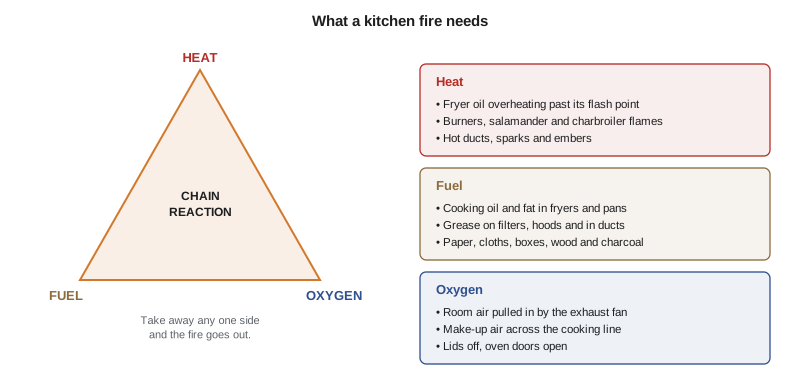
In a kitchen, heat and oxygen are always present. The cooking line exists to make heat, and the exhaust system exists to move air. That leaves fuel as the side that cooks and managers control most directly: how much oil is in a pan, how much grease has built up on a filter or inside a duct, and whether paper, cloths and cardboard are kept away from the flames.
Cooking oil: the main fuel
Cooking oil is hard to ignite at normal frying temperatures. That is exactly why it is safe to fry with. The trouble starts when the oil gets hotter than it should, and there are three temperatures worth knowing. The smoke point is the temperature at which oil starts to break down and give off visible smoke. The flash point is higher: at that temperature the oil gives off enough flammable vapour that a flame or spark above the surface will ignite it. The autoignition temperature is higher again, and at that point the oil can burst into flame on its own with no spark at all.
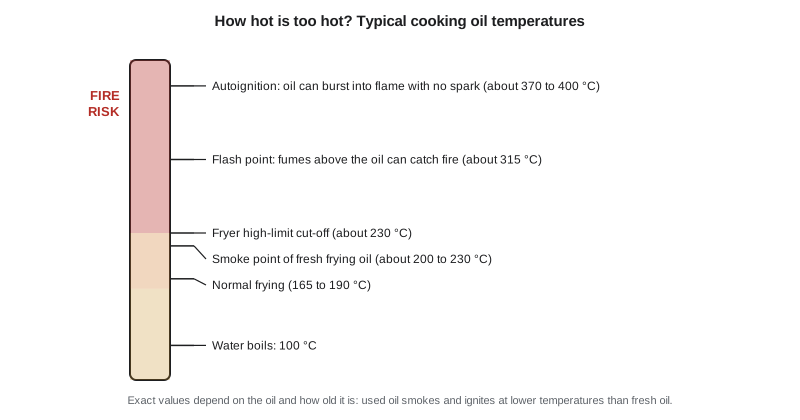
Juniper's floor fryers run at about 175 to 180 °C (350 °F), well below the flash point. A commercial fryer has two thermostats. The operating thermostat holds the temperature the cook sets. A separate high-limit control shuts off the burners if the oil ever gets too hot, usually at around 230 °C (450 °F). Fryer fires happen when that protection fails or is defeated, or when the oil itself changes. The common causes are:
- A failed operating thermostat, so the burners keep firing, combined with a high-limit control that is faulty or has been bypassed.
- A low oil level, so the heating tubes or the temperature probe are exposed and the oil that is left overheats quickly.
- Old, dark oil that has broken down. Its smoke point and flash point drop with every day of use, and food crumbs in the bottom can char and smoulder.
- A fryer left on high with no food in it during a slow period, or forgotten at closing.
- Water or ice going into hot oil, which does not start a fire by itself but can throw burning or very hot oil out of the fryer onto the burners or a person.
Pans on the range follow the same rules on a smaller scale. A pan of oil heating for a stir-fry or a sear can go from shimmering to smoking to burning in a couple of minutes on a high flame, especially if the cook is called away. The single best habit is simple: a pan with oil in it on a lit burner always has someone watching it.
Grease: the hidden fuel
Every time food is fried, grilled or seared, tiny droplets of fat go up with the hot air. Most of them are caught by the filters in the hood, and some condense on the hood surfaces. The rest travel into the duct and up to the roof fan, coating every surface on the way. Over weeks this builds into a sticky, then hard, layer of grease that will burn fiercely once it ignites.
A hood or duct fire is far more dangerous than a fire in a pan. The fuel is spread over a long, hidden surface. The fan pulls air along it like a chimney draft. The duct can get hot enough to ignite wood, insulation or roofing near it, which is why grease ducts are built of welded steel and run inside fire-rated shafts. Fire can travel the full length of a dirty duct to the roof in seconds, and it is hard for firefighters to reach. Much of this course is about the systems that stop a fire at the line from getting into the duct: filters that are cleaned on schedule (Lessons 3 and 4), a suppression system with nozzles in the duct and plenum (Lesson 5), and a professional cleaning program that keeps the fuel load low.
Juniper's February fire is a textbook case. The charbroiler throws more grease into the air than any other appliance on the line and produces open flames that leap upward when fat drips onto them. The filters above it were overdue for washing. Fuel, heat and oxygen met in the one place on the line where the kitchen had let the fuel build up.
Other ways kitchen fires start
Most kitchen fires begin with oil and grease, but not all of them. Aisha Rahman, Juniper's sous chef and safety lead, keeps a log of every fire, flare-up and near miss, however small. Over the past two years it includes:
- Side towels left on the edge of the range that caught when a burner was turned up.
- A paper ticket that drifted onto the salamander and burned.
- A sheet pan of bacon fat that ignited in the oven when it boiled over.
- A smoking motor on the floor mixer, traced to flour dust packed into the vents.
- A frayed cord behind the coffee machine that sparked when the machine was pulled out for cleaning.
- A bag of oily cleaning rags that became hot to the touch overnight in the laundry bin.
- A smouldering cigarette butt in the planter by the back door, beside the stack of broken-down boxes waiting for recycling.
The last two deserve a word. Cloths soaked in cooking oil or in some finishes can heat up by themselves as the oil reacts with oxygen. In a pile or in a tumble dryer, where the heat cannot escape, this spontaneous heating can start a fire hours after the cloths were put away. Laundry companies that serve restaurants wash greasy towels with special detergents and cool them fully before folding, and kitchens should keep soiled towels in a closed metal container rather than a heap. Cardboard, paper and food waste stored against an outside wall can be set alight by a dropped cigarette or by arson, and the fire can spread into the building through the wall or a door.
The human side
Nearly every entry in Aisha's log has a human story behind it. Kitchens catch fire when people are rushed, distracted, tired or new, and when safety devices are seen as obstacles. The patterns are familiar to anyone who has worked a line:
- Cleaning slips when the kitchen is short-staffed, which is exactly what happened to the hood filters in February.
- A fryer is topped up with cold oil from the jug instead of being filtered and checked, and the low-oil alarm is ignored because it goes off every night.
- A high-limit or a gas valve is bypassed to keep an appliance running when it keeps shutting off, instead of having it repaired.
- Combustible storage creeps toward the heat: a box of takeout containers on the shelf above the range, a stack of menus by the salamander.
- Nobody is sure where the manual pull station is, or who is allowed to pull it.
That last point is worth stressing because Juniper got it right. Hana did not hesitate, did not try to throw water at the flames, and did not wait for a manager. She knew where the pull station was because Aisha had walked every cook to it during orientation, and she knew she was allowed to use it.
Reading the fire log
A log is only useful if someone reads it for patterns. The program below summarizes Aisha's log of 24 entries from the past two years by cause and by location. The causes are grouped into the categories used in this lesson. The same program works for both countries because the data contains no units.
# Summarize Juniper's two-year fire and flare-up log by cause and by location.
from collections import Counter

log = [
    ("charbroiler flare-up reached filters", "line", "grease"),
    ("charbroiler flare-up", "line", "grease"),
    ("charbroiler flare-up", "line", "grease"),
    ("griddle grease caught", "line", "grease"),
    ("fryer oil smoking, high-limit tripped", "line", "oil"),
    ("fryer low oil level alarm ignored", "line", "oil"),
    ("saute pan oil ignited", "line", "oil"),
    ("saute pan oil ignited", "line", "oil"),
    ("bacon fat boiled over in oven", "line", "oil"),
    ("side towel on range caught", "line", "combustibles"),
    ("side towel on range caught", "line", "combustibles"),
    ("paper ticket on salamander", "line", "combustibles"),
    ("menus stored by salamander", "line", "combustibles"),
    ("mixer motor smoking", "prep", "electrical"),
    ("coffee machine cord sparked", "bar", "electrical"),
    ("toaster crumbs smoking", "prep", "electrical"),
    ("oily rags hot in laundry bin", "dish pit", "spontaneous heating"),
    ("oily rags hot in laundry bin", "dish pit", "spontaneous heating"),
    ("cigarette in planter by boxes", "outside", "smoking"),
    ("cigarette in dumpster enclosure", "outside", "smoking"),
    ("candle tipped on patio table", "patio", "open flame"),
    ("chafing fuel can flared at refill", "dining", "open flame"),
    ("chafing fuel can flared at refill", "dining", "open flame"),
    ("charbroiler flare-up", "line", "grease"),
]

by_cause = Counter(cause for _, _, cause in log)
by_place = Counter(place for _, place, _ in log)
print(f"{len(log)} entries")
print("By cause:")
for cause, n in by_cause.most_common():
    print(f"  {cause:20s} {n:2d} {'#' * n}")
print("By location:")
for place, n in by_place.most_common():
    print(f"  {place:20s} {n:2d} {'#' * n}")
line_share = by_place["line"] / len(log)
print(f"Cooking line: {by_place['line']} of {len(log)} entries, about {round(line_share * 10)} in 10")24 entries By cause: grease 5 ##### oil 5 ##### combustibles 4 #### electrical 3 ### open flame 3 ### spontaneous heating 2 ## smoking 2 ## By location: line 14 ############## prep 2 ## dish pit 2 ## outside 2 ## dining 2 ## bar 1 # patio 1 # Cooking line: 14 of 24 entries, about 6 in 10
The output confirms what the national figures say. Most of the entries come from the cooking line, and grease and oil together account for more than half of everything in the log. Aisha used it to make the case for three changes after February: washing the filters over the charbroiler and fryers every night instead of weekly, adding fryer oil checks to the opening and mid-shift checklists, and moving the soiled-towel bin into a lidded metal can. The rest of the course explains the systems behind each of those changes.
What this course covers
The lessons that follow move from the rules to the equipment to the response. Lesson 2 sets out the fire, building, gas and electrical codes that apply to a commercial kitchen and who enforces them. Lessons 3 to 6 cover the hood and duct, grease cleaning schedules, the wet chemical suppression system and portable extinguishers. Lessons 7 to 9 turn to gas appliances, gas leaks and carbon monoxide, and electrical hazards in wet kitchens. Lesson 10 looks at wood-fired and other specialty cooking, Lesson 11 at emergency shut-offs and evacuation, and Lesson 12 brings it all together in a full fire safety walk of Juniper Street.
Summary and key terms
- Cooking is the leading cause of fires in restaurants, and most kitchen fires start at the cooking line.
- Every fire needs fuel, heat, oxygen and a chain reaction; in a kitchen, the fuel is the side cooks and managers control most directly.
- Cooking oil becomes dangerous above its normal frying range: it smokes, then reaches its flash point, then can ignite on its own at its autoignition temperature.
- Grease that builds up on filters, hoods and ducts is a hidden fuel load; a fire that reaches the duct is far harder to control than one in a pan.
- Towels, paper, cardboard, oily rags, electrical faults and smoking materials cause many of the remaining fires, and rushed or bypassed routines lie behind most of them.
- Fire tetrahedron
- The four things a fire needs: fuel, heat, oxygen and an uninterrupted chemical chain reaction.
- Smoke point
- The temperature at which cooking oil starts to break down and give off visible smoke.
- Flash point
- The lowest temperature at which a liquid gives off enough vapour to be ignited by a flame or spark.
- Autoignition temperature
- The temperature at which a substance ignites by itself, with no flame or spark.
- High-limit control
- A safety device on a fryer that shuts off the heat if the oil gets too hot, separate from the operating thermostat.
- Spontaneous heating
- Heat produced as oils on cloths react with oxygen; in a pile or a dryer it can build up until the cloths ignite.
Common mistakes
MistakeFryer oil is too hard to ignite to be a real fire risk.
InsteadOil is safe at frying temperature, but a failed thermostat, a low oil level or old oil can take it past its flash point and autoignition temperature.
MistakeThe hood filters only need washing when they look dirty.
InsteadGrease builds up long before it looks bad; filters are washed on a fixed schedule set by how much grease the appliances below them produce.
MistakeOnly a manager should decide whether to pull the hood system.
InsteadEvery cook should know where the manual pull station is and be allowed to use it the moment a fire starts.
Practice problems
Work each problem on paper first, then reveal the answer to check.
A fryer keeps shutting off during the dinner rush and a cook suggests taping down the reset button. What is the risk, and what should happen instead?
Show answer
The shut-off is probably the high-limit control doing its job; defeating it removes the protection against oil reaching its flash point. Take the fryer out of service and have it repaired.
Which side of the fire tetrahedron does a lid placed on a burning pan remove?
Show answer
Oxygen: the lid seals the burning surface off from the air, and the burner should also be turned off to remove the heat.
Why is a fire in a grease duct more dangerous than a fire in a pan?
Show answer
The fuel is spread along a long, hidden surface, the fan draws air through it like a chimney, it can ignite nearby building materials, and it is hard to reach and put out.
Lesson quiz · 5 questions
Score 60% or more to complete this lesson.
Create a free account to save your progress, take quizzes and earn a certificate.