
HSE-382 · Lesson 3 of 12 · 17 min
Hoods, filters and ducts
▶ Video coming soon A video version of this lesson is on the way.
Stand under the hood at Juniper Street at 7 p.m. on a Saturday and you can feel the exhaust system working. The air moves steadily upward from the cooking line, the heat from six burners, two fryers, a griddle and a charbroiler rises into the stainless steel canopy, and the smoke from a pan of searing duck disappears instead of drifting into the dining room. The system is easy to take for granted until it stops working, or until it catches fire. This lesson takes the system apart, piece by piece, so that cooks and supervisors understand what each part does and what can go wrong with it.
What the exhaust system does
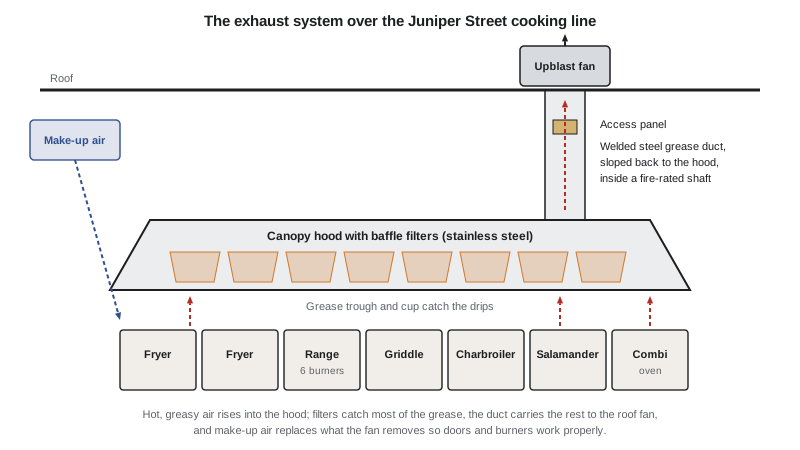
A commercial kitchen exhaust system has three jobs. It captures the heat, smoke, steam and grease-laden vapours that rise from cooking equipment so that the kitchen stays breathable and cool enough to work in. It removes grease from that air before it reaches the duct, so that the fuel load inside the system stays low. And it carries what is left safely out of the building, through a duct built to contain a fire if one starts inside it.
The hood
The hood is the canopy over the cooking line. Hoods over appliances that produce grease, such as fryers, griddles, ranges and charbroilers, are grease hoods: they are built of steel with liquid-tight welded or sealed seams, they hold grease filters, and they are connected to a grease duct. Hoods over equipment that produces only heat and steam, such as a dish machine or some ovens, are simpler and do not need grease filters. Juniper has a grease hood over the whole cooking line and a separate condensate hood over the dish machine. Most new grease hoods in Canada are factory-built and listed to ULC-S646, and come with the manufacturer's installation rules.
Juniper's line hood is a wall-mounted canopy about 4.9 m (16 ft) long. A hood only works if it is big enough and close enough to the appliances to catch the plume of hot air rising from them. That is why the canopy overhangs the front of the appliances, why appliances must stay under the hood even when they are pulled out for cleaning, and why adding a new appliance at the end of the line, outside the hood, is never allowed. Heat and smoke that escape the hood are not just unpleasant. They mean grease is condensing on walls and ceilings outside the protected area, where there are no filters and no suppression nozzles.
The filters
Grease filters are the first and most important line of defence against duct fires. They sit at an angle in the hood, in front of the opening to the duct, so that all of the exhaust air must pass through them. Each filter is a set of interlocking vertical baffles. As the air zigzags between the baffles, the heavier grease droplets cannot turn fast enough, hit the metal, and run down into a trough that drains into a removable grease cup.
Only listed grease filters, normally steel or aluminum baffle filters, are allowed in a grease hood. Mesh filters, like the ones in a home range hood, trap grease in a fine web that burns readily and are not permitted. The filters are also part of the fire protection: baffles act as a flame barrier that helps stop a fire at the line from being drawn into the duct, and the space behind them, called the plenum, has its own suppression nozzles. A gap in the row of filters, or a filter left out after washing, lets flames and grease straight into the plenum and the duct. Filters must always be in place when the appliances are on, and they must fit the openings exactly.
NFPA 96 also sets a minimum distance between the lowest edge of a grease filter and the cooking surface below it, usually 457 mm (18 in), with larger distances above appliances that produce exposed flames and the largest above charcoal and similar charbroilers. The distance gives the grease in the air a chance to cool and keeps flames from reaching the filters during normal cooking. This is one reason a cook must never place a sheet pan or a stack of pans on top of a charbroiler or a salamander, where it can deflect flames upward toward the filters.
Washing the filters
Filters are the part of the system the restaurant cleans itself, and how often depends on what is cooked below them. Before February, Juniper washed all eight filters once a week, on Sunday night. After the fire, Aisha set a new routine based on the appliances under each filter:
- The three filters over the charbroiler and the two fryers are washed every night at closing.
- The other five filters are washed twice a week, on Wednesday and Sunday.
- Any filter that is visibly coated, or that drips, is washed the same night regardless of the schedule.
- The grease cups at the ends of the trough are emptied into the used-oil caddy every night.
The filters go through the dish machine on their own, with nothing else in the racks, or into a soak tank of hot water and degreaser for stubborn buildup. They are rinsed, allowed to drain, and put back in the hood the same night, with the baffles facing the right way. Filters are heavy and their edges can be sharp, and the hood above the line can still be hot at closing, so the closing cook waits until the line has cooled for at least half an hour, wears cut-resistant gloves and uses a step stool with a platform rather than climbing on the range. Filter washing is not a job for young workers at Juniper: nobody under 18 removes filters from above the line.
The duct
Behind the filters, the exhaust air enters the grease duct. Grease ducts are very different from the ducts that carry heating and cooling air around a building. They are made of heavy-gauge carbon steel or stainless steel with every seam welded so that they are liquid-tight. They slope back toward the hood or toward a drain so that liquid grease does not pool. They have no screws or seams that penetrate into the airstream, where grease would catch. They keep a set distance from wood framing, drywall and other combustible materials, or are wrapped in a listed fire-resistant insulation. Where they pass through floors and ceilings, they run inside a fire-rated shaft. And they have access panels at intervals and at every change of direction so that cleaners can reach the whole interior.
These features exist for one reason: a grease duct is expected to have a fire in it someday. The duct is designed to contain that fire, to keep it from spreading to the building, and to let firefighters get at it. Anything that compromises the duct, such as a hole cut for a new pipe, a missing access panel cover or a section of duct replaced by an unlicensed contractor with ordinary sheet metal, breaks that protection. Any change to the duct is work for the original hood installer or a qualified mechanical contractor, with a permit.
The fan
At Juniper the duct ends at an upblast fan on the roof. The fan pulls air through the whole system and throws it upward, away from the roof surface. Upblast fans for grease exhaust are hinged so that they can be tilted back for cleaning, and they have a grease containment system that catches the grease that drips from the fan housing so that it does not soak into the roof, where it would be a fire hazard and would damage the roofing. The fan belt, motor and bearings are checked by the mechanical service contractor, and a fan that is noisy, vibrating or slow is reported at once, because a weak fan lets smoke and grease build up in the kitchen and the duct.
The fan must run whenever the appliances are on. Some codes require an interlock that prevents the cooking equipment from operating unless the fan is running, and some newer hood systems start the fan automatically when they sense heat. During a suppression system discharge, the exhaust fan is normally left running to help remove smoke, as Lesson 5 explains.
Make-up air
Every cubic metre of air the exhaust fan pulls out of the kitchen has to be replaced. If it is not, the kitchen goes into negative pressure: doors become hard to open and slam shut, cold drafts pour in under the back door, the hood stops capturing smoke properly, and gas appliances and water heaters can have their flue gases pulled back into the room, which is a carbon monoxide hazard covered in Lesson 8. A make-up air unit brings in outside air, usually tempered in winter, and supplies most of what the exhaust removes. The rest comes in from the dining room, which keeps kitchen smells from drifting the other way.
Make-up air needs to be delivered gently. If it blows straight across the cooking line, it can push the plume of smoke out from under the hood and disturb burner flames. At Juniper, the make-up air enters through a perforated ceiling panel in front of the hood, aimed downward, which the installer set up after the original diffusers blew smoke into the pass.
How much air the hood needs
Hood designers size the exhaust airflow by the length of the hood and the heaviest-duty appliance under it. A hood with a charbroiler under it is treated as heavy duty along its whole length, because the charbroiler produces the largest and hottest plume. The program below estimates the exhaust and make-up air for Juniper's hood using typical design values for a wall-mounted canopy. The real figures come from the hood manufacturer's listing and the mechanical engineer's design; this calculation simply shows why adding a charbroiler to a light-duty hood is not a small change.
# Estimate exhaust and make-up air for a wall-mounted canopy hood.
# Typical design rates in litres per second per metre of hood length.
RATE = {"light": 310, "medium": 460, "heavy": 620}
DUTY_ORDER = ["light", "medium", "heavy"]

hood_length_m = 4.9
appliances = {
    "fryer 1": "medium", "fryer 2": "medium", "range": "medium",
    "griddle": "medium", "charbroiler": "heavy", "salamander": "medium",
    "combi oven": "light",
}

duty = max(appliances.values(), key=DUTY_ORDER.index)
exhaust = RATE[duty] * hood_length_m
make_up = 0.85 * exhaust
print(f"Heaviest duty under the hood: {duty}")
print(f"Exhaust airflow: about {exhaust:,.0f} L/s")
print(f"Make-up air at 85 parts in 100: about {make_up:,.0f} L/s")

without = max((d for a, d in appliances.items() if a != "charbroiler"), key=DUTY_ORDER.index)
print(f"Without the charbroiler the hood would be {without} duty: about {RATE[without] * hood_length_m:,.0f} L/s")Heaviest duty under the hood: heavy Exhaust airflow: about 3,038 L/s Make-up air at 85 parts in 100: about 2,582 L/s Without the charbroiler the hood would be medium duty: about 2,254 L/s
The charbroiler alone raises the required exhaust by about a third. When Tomás Reyes, the executive chef, once suggested adding a second charbroiler at the end of the line for summer, the mechanical contractor explained that the hood, the fan, the make-up air unit and the suppression system would all have to be checked and probably changed. The idea was dropped.
Daily checks on the exhaust system
The cook who opens the line at Juniper runs through a short check before lighting anything:
- The exhaust fan is on and the air is moving: a strip of paper held near the filters is drawn toward them.
- All eight filters are in place, seated properly, with no gaps.
- The grease cups are in place and not full.
- The suppression system nozzles have their blow-off caps on, and nothing is stacked on or hanging from the hood.
- Every appliance is in its marked position under the hood, with nothing blocking the space between the appliances and the filters.
If any check fails, the line does not light until it is fixed. That rule took some getting used to, but after February nobody argues with it.
Summary and key terms
- The kitchen exhaust system captures heat, smoke and grease, removes grease from the air, and carries the rest safely out of the building.
- Grease hoods are built of welded steel, hold listed baffle filters and must cover every grease-producing appliance; appliances never sit outside the hood.
- Baffle filters trap grease and act as a flame barrier; they must always be in place, fit exactly, and be washed on a schedule set by the appliances below them.
- Grease ducts are welded, sloped, separated from combustibles and accessible for cleaning because they are designed to contain a fire; any change needs a qualified contractor and a permit.
- The exhaust fan must run whenever appliances are on, and make-up air replaces the exhausted air without blowing smoke out of the hood.
- Grease hood
- A steel canopy with sealed seams and grease filters over appliances that produce grease-laden vapours.
- Baffle filter
- A grease filter of interlocking metal baffles that makes the exhaust air change direction so grease droplets hit the metal and drain away.
- Plenum
- The space behind the filters where the exhaust air collects before entering the duct.
- Grease duct
- A welded, liquid-tight steel duct that carries kitchen exhaust from the hood to the fan and is built to contain a fire.
- Make-up air
- Outside air brought into the kitchen to replace the air removed by the exhaust fan.
Common mistakes
MistakeRunning the line with one filter out for washing is fine for an hour.
InsteadA missing filter lets flames and grease straight into the plenum and duct; filters must all be in place whenever the appliances are on.
MistakeA new appliance can go at the end of the line, just past the hood, if there is no room underneath.
InsteadEvery grease-producing appliance must sit fully under the hood and be covered by the suppression system.
MistakeTurning off the exhaust fan on a cold night keeps the kitchen warmer.
InsteadThe fan must run whenever appliances are on; without it smoke, grease and carbon monoxide build up.
Practice problems
Work each problem on paper first, then reveal the answer to check.
Why are mesh filters not allowed in a grease hood?
Show answer
They trap grease in a fine web that burns readily and do not act as a flame barrier the way listed baffle filters do.
The back door slams shut on its own every evening and is hard to open. What might be wrong with the exhaust system?
Show answer
The kitchen is probably in negative pressure because the make-up air unit is off, undersized or faulty; it should be checked, since negative pressure also affects hood capture and gas appliance venting.
A contractor wants to cut a hole in the grease duct shaft to run a new water line. What should the manager say?
Show answer
No; the duct and its shaft are fire separations, and any change must be designed and done by a qualified contractor with a permit and approval.
Lesson quiz · 5 questions
Score 60% or more to complete this lesson.
Create a free account to save your progress, take quizzes and earn a certificate.