
HSE-391 · Lesson 10 of 12 · 25 min
Patient handling in home and community care
▶ Video coming soon A video version of this lesson is on the way.
Everything in this course so far has taken place in a building designed for care: a hospital with ceiling lifts, an equipment pool, biomedical engineering down the hall, and colleagues a call bell away. A growing share of patient handling happens somewhere else entirely. Northbridge Home Care's 42 nurses, personal support workers and therapists see about 310 clients in their own homes, in apartments, farmhouses, basement suites and seniors' buildings across the city and the rural area around it. Group homes, adult day programs and supportive housing add more. In each of these places, the worker arrives alone or in a pair, the home was not built for lifts, the equipment is whatever the client has, and the client and family decide much of what happens.
Home care workers have some of the highest injury rates of any group of health workers, and handling clients is the leading cause. This lesson covers why home care handling is different, how Northbridge Home Care assesses homes and clients, the equipment that makes home handling safe, working with families and with clients who refuse equipment, transfers in and out of cars, and how a home care program plans visits so that no worker is left to lift alone.
Why home care is different
Nadia Rahman, a home care RN who drives about 180 km a week, lists the differences she sees every day:
- The space. Bedrooms are small and crowded with furniture. Beds are low, soft and pushed against the wall so the worker can reach only one side. Bathrooms are narrow, with a tub instead of a shower, and doorways are too tight for a wheelchair. Carpet, rugs and steps make it hard to roll equipment.
- The equipment. There may be no lift, or a lift but no spare sling, or a sling that has never been inspected. The bed may be a double bed the client shares with a spouse. A hospital bed or lift has to be ordered and delivered, which takes days.
- Working alone. Most visits are by one worker, so a move that needs two people in hospital has no second person. The nearest colleague may be 30 minutes away by car.
- The client and family are in charge. It is their home. Clients can refuse equipment, decline to move the bed or furniture, or ask the worker to do things the way they always have. Family members may help, or may get in the way.
- Time. Visits are short and tightly scheduled, and a worker running late feels pressure to hurry the next one.
- The trip. Workers drive in all weather, carry supplies from the car, and in winter walk on icy steps and driveways. Home care staff carry ice cleats from November to April.
The law still applies. Under the OHSA, the home care employer is responsible for its workers' safety even in a client's home: it must assess the hazards of each home, provide information, instruction and supervision, and take every precaution reasonable in the circumstances. A worker who believes a move is likely to endanger them can refuse, using the process in Lesson 2. Ontario Health atHome care coordinators arrange home care services for many clients, and their assessments and care plans are one source of information about a client's mobility.
Assessing the home and the client
Northbridge Home Care does a home safety and handling assessment before or at the first visit for every new client who needs help to move, and repeats it when the client's condition changes, after a hospital stay, or when a worker reports a problem. The assessment is usually done by a nurse or an occupational therapist, and covers three things.
- The client. The same mobility assessment used in hospital (Lesson 3), adapted for home: can the client sit up, bear weight, stand and step, follow instructions? What is their weight? Do they have pain, confusion, dizziness or behaviours that make moves unpredictable? What can they do at their best and at their worst, for example first thing in the morning?
- The environment. Room sizes, bed height and access to both sides, floor surfaces, steps, doorways, the bathroom layout, lighting, pets and clutter. The assessor sketches the bedroom and bathroom and measures the clear space beside the bed.
- The people and equipment. Who lives in the home and can help, what equipment is already there, and its condition, rating and service history.
The result is a handling plan for the home that says, for each task (getting up, toileting, bathing, repositioning in bed, transfers to a chair or car), which method and equipment to use, how many workers are needed, and what to do if the equipment is not working. The plan is kept in the client's file and in a folder in the home, so that any worker who visits can follow it.
Equipment in the home
The same principle applies at home as in hospital: equipment does the lifting, not the worker. Because equipment takes time to arrive, the handling plan includes what to do in the meantime, which may mean extra workers, a different schedule, or a short stay somewhere with equipment rather than a manual lift.
The most common items in home handling are:
- A hospital bed. A height-adjustable bed is the single most useful item. It lets the worker raise the bed to hip height for care and lower it for the client to get out safely, and it can usually be placed away from the wall.
- A floor lift or portable ceiling lift. Floor lifts work in homes with hard floors and enough space; carpet makes them hard to push. Some homes have a freestanding gantry lift, a frame that stands over the bed without fixing to the ceiling. Permanent ceiling track can be installed in homes for clients with long-term needs.
- Sit-to-stand aids, transfer boards and slide sheets, as in hospital.
- Bathroom aids such as raised toilet seats, toilet frames, grab bars, bath boards and tub transfer benches. Bathing is one of the riskiest home tasks, and many plans switch to a sponge bath at the bedside, or a bath at a day program with a lift, rather than lifting a client in and out of a tub.
- Mobility aids such as walkers and wheelchairs, which the client uses between visits.
Equipment is paid for in several ways. In Ontario, home care can arrange some equipment and supplies for clients, the Assistive Devices Program helps pay for some mobility devices, and vendors and charitable loan programs rent or lend others. Clients may also have private insurance or buy equipment themselves. The handling plan notes who owns each item and who maintains it.
Equipment in homes is often owned by the client or a vendor, not by the employer, which creates gaps. Northbridge Home Care asks its workers to do a quick visual check of a lift and sling before each use, the same check taught in Lessons 4 and 5, and to report any damage to the office, which contacts the vendor or family. A lift that fails the check is not used, and the visit plan changes until it is repaired.
When the client or family says no
The hardest home care situations are not about equipment but about choices. A client may refuse a lift because it feels undignified, because it reminds them they are getting worse, or because they do not want a hospital bed in their bedroom. A spouse may insist that the worker help their partner up the way they always have. A family may refuse to move a sofa or remove a rug.
Clients have the right to make choices about their own care and their own home, including choices that carry risk for themselves. This is sometimes called the dignity of risk. But they do not have the right to require a worker to do something that is likely to injure the worker. Northbridge Home Care's approach is:
- Listen and explain. Find out why the client is refusing and explain why the equipment is needed, for them as well as the worker. Many clients accept a lift once they see that it is more comfortable and less frightening than being hauled up by two people. A trial with an occupational therapist often helps.
- Offer choices. There are often several safe options: a sit-to-stand aid instead of a full lift, a different time of day when the client is stronger, a hospital bed in the living room instead of the bedroom.
- Agree on what workers will and will not do. The plan states clearly which tasks workers can do safely without the equipment and which they cannot. Workers do not perform a manual lift because the client asks.
- Escalate and document. If no safe plan can be agreed, the nurse and the supervisor meet with the client and family, and the care coordinator is involved. In the end, the employer may have to limit or change the service, for example to tasks that do not involve transfers, while making sure the client is not left without care.
Family caregivers deserve attention too. They often do most of the handling between visits, without training, and are themselves at risk of injury. Showing a spouse how to use a slide sheet or how to let a client sit back down safely protects both of them, and many back injuries in home care happen when a worker and an untrained family member lift together.
Cars, stairs and the community
Some of the most dangerous moves in community care happen outside: helping a client into or out of a car for an appointment, up or down steps at the front door, or after a fall in the driveway. These moves are often unplanned and done in a hurry.
- Car transfers. The safest approach uses the client's own ability with aids: the seat pushed back and reclined slightly, a swivel cushion or transfer board on the seat, a handle that fits in the door latch for the client to push on, and the client sitting first and then lifting their legs in. Workers do not lift clients into cars. A client who cannot do this with aids needs accessible transport.
- Stairs. Clients who cannot manage steps with a rail and supervision need a ramp, a stair lift or an evacuation chair; workers do not carry clients up or down stairs. For emergencies, the plan says how the client will leave the home, usually with paramedics.
- Falls outside. The rules from Lesson 8 apply everywhere: stay, call for help, assess, and do not lift from the ground by hand. In winter, keep the client warm while help comes.
Workers also handle the equipment itself: a folding wheelchair, a commode or a portable lift into and out of a car trunk. Portable lifts split into pieces of a manageable weight, and workers lift them one piece at a time, close to the body, rather than all at once.
Planning visits so no one lifts alone
Because most visits are by one worker, the scheduling office has a key safety role. Every client's handling plan has a risk level and says whether tasks need one or two workers. Grace worked with the home care manager to make sure the schedule matched the plans, using a short script on a week's visit list.
# Check one week's home care schedule against each client's handling plan.
# need: workers required for the transfer tasks in the plan
clients = {
    "C-114": {"need": 2, "visits": [("Mon", 2), ("Tue", 1), ("Wed", 2), ("Thu", 2), ("Fri", 1)]},
    "C-207": {"need": 1, "visits": [("Mon", 1), ("Wed", 1), ("Fri", 1)]},
    "C-231": {"need": 2, "visits": [("Mon", 2), ("Tue", 2), ("Wed", 2), ("Thu", 2), ("Fri", 2)]},
    "C-305": {"need": 2, "visits": [("Tue", 1), ("Thu", 1), ("Sat", 2)]},
    "C-318": {"need": 1, "visits": [("Mon", 1), ("Thu", 1)]},
}
total = gaps = 0
for cid, c in clients.items():
    for day, booked in c["visits"]:
        total += 1
        if booked < c["need"]:
            gaps += 1
            print(f"{cid} {day}: plan needs {c['need']} workers, schedule has {booked}")
print(f"\n{gaps} of {total} visits are short-staffed for their handling plan")C-114 Tue: plan needs 2 workers, schedule has 1 C-114 Fri: plan needs 2 workers, schedule has 1 C-305 Tue: plan needs 2 workers, schedule has 1 C-305 Thu: plan needs 2 workers, schedule has 1 4 of 18 visits are short-staffed for their handling plan
Four visits out of eighteen were booked with one worker although the client's plan needed two. Two of them were for C-305, a man whose plan had changed to two workers after a hospital stay, but whose schedule had not been updated. The fix was to make the scheduling system check the plan automatically, so a visit that needs two workers cannot be booked with one. Where a second worker is not available, the visit is moved, or the tasks are changed to ones a single worker can do safely, and the nurse is told.
Worked problem
Mrs. Lindqvist and the double bed
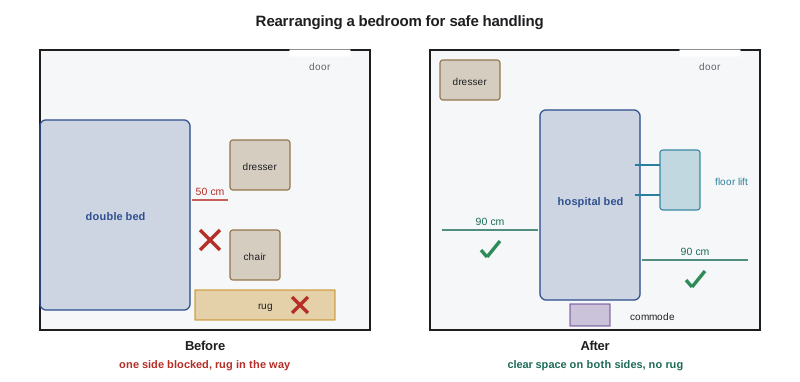
Mrs. Lindqvist, 84, has returned home after a hip fracture. She weighs about 70 kg (155 lb), can bear weight on one leg with a walker, and tires quickly in the evening. She sleeps in a low double bed against the wall, shared with her husband, and the bedroom has a thick rug. Her husband has been helping her up by pulling on her arms. The plan from the hospital says sit-to-stand aid with one worker. On her first evening visit, the personal support worker finds she cannot stand at all. What should happen?
Show solution
- Stop and do not lift. The plan was written for her at her best. In the evening she cannot bear weight, so a manual lift would mean holding far more than the guideline. The personal support worker helps her stay comfortable in bed, does the care that can be done there, and calls Nadia.
- Reassess. Nadia visits the next morning with the occupational therapist. They find that Mrs. Lindqvist can use the sit-to-stand aid in the morning but needs a full lift in the evening. The low, soft double bed against the wall makes both moves harder.
- Change the environment. With the couple's agreement, a hospital bed is placed in the bedroom with space on both sides, and the rug is removed. Mr. Lindqvist keeps the double bed in the same room so they can still sleep side by side.
- Equipment and plan. A floor lift with a sized sling is delivered through the equipment program. The plan now says sit-to-stand aid in the morning, floor lift with two workers in the evening, and the schedule is changed to two workers for evening visits.
- Family. The personal support worker shows Mr. Lindqvist how to help her shift in bed with a slide sheet and asks him not to pull on her arms, which hurts her shoulder and his back.
Answer: Do not lift; reassess her at her best and worst, rearrange the room with a hospital bed and no rug, add a floor lift and two workers for evenings, update the schedule, and teach her husband safer ways to help.
Common mistakes
MistakeFollowing a hospital discharge plan without checking the client at home.
InsteadReassess at the first visit and whenever the client changes, including at their worst time of day.
MistakeLifting a client by hand because the client or family asks.
InsteadExplain, offer safe choices and escalate; workers do not perform manual lifts on request.
MistakeUsing a client-owned lift without checking it.
InsteadDo a visual check of the lift and sling before each use and report damage.
MistakeLifting a client into a car or carrying them up stairs.
InsteadUse transfer aids for cars, ramps or stair lifts for steps, and accessible transport or paramedics when needed.
MistakeBooking a two-worker client with one worker when the schedule is tight.
InsteadMatch the schedule to the handling plan; move the visit or change the tasks instead.
Summary and key terms
- Home care handling happens in spaces not built for it, often by one worker, with equipment the client owns and a client and family who make many decisions.
- The employer is still responsible for workers' safety in clients' homes and must assess each home.
- A home handling assessment covers the client, the environment and the people and equipment, and produces a written handling plan kept in the home.
- A hospital bed with clear space, a suitable lift and transfer aids make most home handling safe; bathing in a tub is often replaced with safer options.
- Clients may accept risks for themselves but cannot require workers to lift by hand; listen, offer choices, agree limits and escalate.
- Car transfers, stairs and falls outside need aids, accessible transport or paramedics, not lifting.
- Scheduling must match the handling plan so that no worker is sent alone to a two-worker task.
- Home handling assessment
- An assessment of the client, home and equipment that produces a handling plan for home visits.
- Handling plan
- A written statement of the method, equipment and number of workers for each task.
- Dignity of risk
- The right of a person to make choices about their own life that carry some risk to themselves.
- Gantry lift
- A freestanding frame with a lift motor that stands over a bed without fixing to the ceiling.
- Family caregiver
- A relative or friend who provides unpaid care to a client.
Practice problems
Work each problem on paper first, then reveal the answer to check.
Give four ways home care handling differs from hospital handling.
Show answer
Any four of: small or crowded spaces, low beds against walls, missing or unchecked equipment, working alone, clients and families deciding, tight schedules, travel and outdoor hazards.
What three things does a home handling assessment cover?
Show answer
The client, the environment and the people and equipment in the home.
Why is a hospital bed often the most useful item in a home?
Show answer
It adjusts in height for care and for getting out of bed, and can be placed with space on both sides.
A client refuses a lift and asks the worker to pull her up by the arms. What should the worker do?
Show answer
Decline the manual lift, explain and offer safe options, report to the nurse or supervisor, and follow the plan until it is changed.
How should a client who cannot step up be helped into a car?
Show answer
They should not be lifted; use a swivel cushion, board or door handle if they can do it with aids, otherwise accessible transport.
In the schedule script, what was the main cause of the short-staffed visits, and what was the fix?
Show answer
Schedules not updated when plans changed; the scheduling system now checks the plan so a two-worker visit cannot be booked with one.
Lesson quiz · 5 questions
Score 60% or more to complete this lesson.
Create a free account to save your progress, take quizzes and earn a certificate.