
HSE-391 · Lesson 7 of 12 · 24 min
Lateral transfers and repositioning
▶ Video coming soon A video version of this lesson is on the way.
Lesson 1 showed that the task causing the most patient handling injuries at Northbridge is not lifting patients into chairs. It is moving them in bed: sliding them back up the bed when they have slumped down, turning them onto their side for care or to relieve pressure, and pulling them across from one bed or stretcher to another. These tasks look less dramatic than a lift, and they are done so often that staff stop noticing them. A patient on 4 West at risk of pressure injuries is turned every two hours, day and night, which is twelve turns a day. A resident at Maple Court who slides down in bed may need to be boosted up three or four times a shift.
This lesson covers the physics of why these tasks are hard, and the equipment and methods that make them easier: friction-reducing slide sheets, air-assisted devices, transfer boards, the bed itself, and ceiling lifts with repositioning slings. It also covers lateral transfers between beds, stretchers and tables, which are the bread and butter of porters, imaging staff and the emergency department.
Why moving a patient in bed is hard
When a patient lies on a bed, their weight presses them into the mattress, and friction between their body or sheet and the mattress resists any sideways movement. To slide a patient, staff must pull or push with a force that overcomes the friction. The force needed depends on two things: the patient's weight and how slippery the surfaces are, described by a number called the coefficient of friction. A patient on an ordinary cotton sheet on a hospital mattress is not very slippery at all.
Three more things make the task worse:
- Reach. The patient is in the middle of the bed, so the worker reaches across it, often with a bent back and arms extended. The force is applied far from the body, which multiplies the load on the spine and shoulders.
- Soft mattresses. Pressure-redistributing mattresses, which protect patients' skin, let the patient sink in, so that staff are in effect pulling the patient uphill out of a hollow.
- Drag on the skin. Pulling a patient across a sheet drags their skin and the tissue under it, which causes shear and friction injuries, the starting point of many pressure injuries, and can tear fragile skin.
The same physics applies to a lateral transfer from a bed to a stretcher or table, with the added problem of a gap between the two surfaces and, often, a difference in height.
Friction-reducing devices
A friction-reducing device, usually a slide sheet, is a sheet of very slippery fabric placed under the patient. Slide sheets are often tubular, or used in pairs, so that the fabric slides against itself rather than against the patient. They can reduce the force needed to move a patient by several times, and they protect the skin from drag.
Slide sheets are used for boosting a patient up the bed, turning them, moving them across the bed, and short lateral transfers between surfaces at the same height. The basic steps for boosting a patient up the bed with two staff are:
- Prepare. Explain the move. Raise the bed to about hip height, put the brakes on and lower the head of the bed flat if the patient can tolerate it. If the bed can tilt head down slightly, that helps gravity do some of the work. Set a pressure-redistributing mattress to its firm or maximum inflate setting if it has one.
- Insert the sheet. Roll the patient slightly to one side, tuck the folded slide sheet under them, roll them back the other way and unfold it, so that it runs from the shoulders to below the hips. Some slide sheets can be inserted by unrolling them under the patient without turning.
- Move. With one worker on each side, feet apart and facing the head of the bed, both take hold of the top layer of the sheet close to the patient's body. On a count, they shift their weight from the back foot to the front foot, moving the patient up the bed in one smooth glide. The movement comes from the legs and body weight, not from the arms and back. If the patient can help by bending their knees and pushing, they should.
- Remove. Take the slide sheet out by pulling the bottom layer out from under the patient, low and flat. Slide sheets must not be left under a patient unless they are a type designed to stay in place, because the patient can slide right off the bed.
Slide sheets make moves easier, but they do not remove the load altogether. For a heavy patient, a patient who cannot help at all, or a task that is done many times a day, a ceiling lift with a repositioning sling is better. On units with ceiling lifts, Northbridge's policy is to use the lift for boosting and turning any level 1 patient over about 90 kg (200 lb).
Air-assisted devices
An air-assisted lateral transfer device is an inflatable mattress placed under the patient. A small blower inflates it, and air escaping through tiny holes in the underside makes it float on a thin cushion of air, like a hovercraft. The patient can then be slid across to a stretcher or table, or up the bed, with a small fraction of the force needed on a sheet. Some types stay under the patient for the whole hospital stay, so that they can be used whenever a move is needed.
Air-assisted devices are most useful where lateral transfers of heavy or dependent patients are frequent: the emergency department, imaging, the operating rooms, the intensive care unit and the bariatric equipment pool. Kevin Tran keeps one on his stretcher for every transfer request marked level 1 or level 2.
How much force?
Grace uses a short script in training to show how much each method reduces the force staff have to apply. The coefficients of friction are typical values for illustration; real values depend on the sheet, mattress and patient.
# Force each worker must apply to start sliding a 90 kg patient across a bed
# (friction force = coefficient x weight; weight in newtons = kg x 9.81)
G = 9.81
patient_kg = 90
workers = 2

methods = [
    ("cotton draw sheet on mattress", 0.45),
    ("slide sheet (two layers)", 0.12),
    ("air-assisted device", 0.02),
]

for name, mu in methods:
    total_n = mu * patient_kg * G
    each_n = total_n / workers
    each_kgf = each_n / G          # in kilograms-force, which people find easier to picture
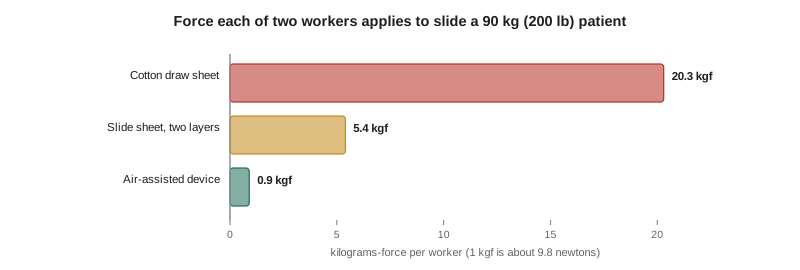
print(f"{name:32} total {total_n:5.0f} N, each worker {each_n:4.0f} N (about {each_kgf:4.1f} kgf)")cotton draw sheet on mattress total 397 N, each worker 199 N (about 20.2 kgf) slide sheet (two layers) total 106 N, each worker 53 N (about 5.4 kgf) air-assisted device total 18 N, each worker 9 N (about 0.9 kgf)
With an ordinary draw sheet, each of two workers must pull with a force equivalent to lifting about 20 kg (45 lb), while reaching across the bed, which is a heavy pull in a bad posture. A slide sheet cuts that to about 5 kg (12 lb) each, and an air-assisted device to under 1 kg (2 lb). These are the forces to start the patient moving; in practice there are extra forces from the mattress sinking, the patient's body bending and the gap between surfaces. The comparison is still the point: slippery surfaces turn a hard pull into an easy one.
Lateral transfers between surfaces
A lateral transfer moves a lying patient sideways from one surface to another: bed to stretcher, stretcher to imaging table, operating table to bed. The steps are the same everywhere:
- Plan. Check the mobility plan, the patient's weight and any lines, drains or precautions. Decide on the device: a slide sheet for lighter patients who can help, an air-assisted device or a ceiling lift for heavier or dependent ones. Get enough staff: at least two, often more for heavy patients, with one at the head to protect the airway and lines if needed.
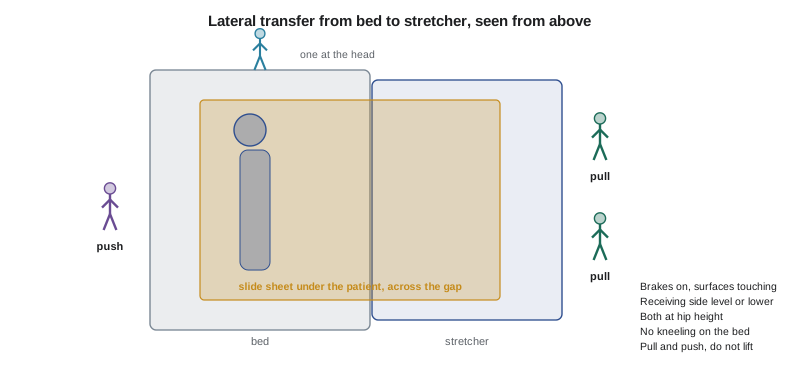
- Line up. Put the two surfaces side by side, touching, with the brakes on both. Adjust the heights so the receiving surface is level with or slightly lower than the one the patient is on, so the move goes slightly downhill. Raise both to about hip height for the staff. Bridge any gap with a transfer board under the slide sheet if needed.
- Insert the device. Roll the patient slightly and place the slide sheet or air device under them.
- Move. Staff on the receiving side pull, using the handles of the device or the top layer of the sheet, while staff on the sending side push. Nobody kneels on the bed or stretcher, and nobody lifts. The move is a smooth glide on a count.
- Finish. Remove the device unless it stays in place, centre the patient, raise the side rails and release the brakes only when everyone is ready.
Imaging rooms are a special problem. Scanning tables in CT and X-ray are narrow, often higher than a stretcher, cannot always be lowered far, and cannot be pushed against the stretcher because of the scanner. At Northbridge, the CT and MRI rooms have ceiling lifts, and the X-ray rooms use air-assisted devices and height-adjustable stretchers. Imaging staff and porters plan transfers together using the transfer request form described in Lesson 3. HSE-394 covers the radiation and magnet hazards in those rooms.
Transfer boards for seated transfers
A transfer board, also called a slide board, is a smooth, rigid board that bridges the gap between two seated surfaces, such as a bed and a wheelchair or a wheelchair and a car seat. The patient sits on the board and slides across it in small shifts, using their arms. Transfer boards are for patients with good sitting balance and upper body strength, such as many people with spinal cord injuries, and are often part of the independence they work on in rehabilitation. They are not for patients who cannot help, because staff would end up dragging them across.
Turning and positioning
Turning a patient onto their side for care, for a bed change or to relieve pressure is the other half of repositioning. With a slide sheet, two staff can turn a patient by first sliding them towards one side of the bed, then rolling them towards the opposite side, keeping their own backs straight and using their body weight rather than their arms. Pillows or wedges then hold the patient in position.
For patients who are turned many times a day and cannot help, the better choice is a ceiling lift with a repositioning sling. The sling stays under the patient or is inserted for each turn. The lift raises one side of the sling, rolling the patient gently, and staff place the pillows. Many beds also have features that help: lateral rotation, a turn-assist function that inflates one side of the mattress, and a chair position that lets patients sit up without being lifted.
Patients who slide down in a chair are another common task. The safe methods are a lift with a repositioning sling, a tilt-in-space chair that can be tilted back so the patient slides back into the seat, or helping a patient who can stand to stand up and sit down again further back, with a standing aid if needed. Pulling a patient up in a chair from behind, under the arms, is a high-risk manual lift and harms patients' shoulders, and it is not allowed under the new policy.
Worked problem
A heavy patient in CT
The emergency department sends a request: a man of 130 kg (285 lb) with a suspected spinal injury needs a CT scan of his neck and back. He is on a spine board with a collar, conscious, in pain. How should Kevin and the CT technologist move him?
Show solution
- He is a lateral transfer of a heavy patient with a suspected spinal injury, so he must be moved flat, in line, with no lifting and no twisting. The transfer form tells Kevin in advance, so he brings a wide stretcher with an air-assisted device already under the patient from the emergency department.
- In CT, the technologist lowers the table as far as it goes and the team lines the stretcher up beside it, touching, with the stretcher slightly higher and the brakes on both. A transfer board bridges the small gap.
- The team is four: one at the head to hold the neck in line and lead the count, two on the table side to pull, and one on the stretcher side to push. The air device is inflated and the patient glides across on the count.
- The air device stays under the patient so that he can be moved back to the stretcher after the scan the same way, and staff do not need to roll him. The 130 kg weight is within the table's rated load, which the technologist checks on the scanner's label before the move.
Answer: Move him flat on an air-assisted device left under him, with surfaces lined up and braked, a board across the gap, four staff (one at the head leading) and no lifting; check the table's rated load.
Common mistakes
MistakePulling a patient up the bed on a cotton draw sheet.
InsteadUse a slide sheet, an air-assisted device or a ceiling lift with a repositioning sling.
MistakeLeaving an ordinary slide sheet under a patient.
InsteadRemove it after the move; only devices designed to stay in place may be left.
MistakeKneeling on the bed to reach a patient.
InsteadRaise the bed to hip height, line surfaces up and use a device so nobody needs to kneel or reach far.
MistakeTransferring uphill onto a higher surface.
InsteadSet the receiving surface level with or slightly lower than the sending one.
MistakePulling a patient up in a chair from behind under the arms.
InsteadUse a lift with a repositioning sling, a tilt-in-space chair, or a stand and sit with an aid.
Summary and key terms
- Repositioning in bed and lateral transfers cause more patient handling injuries at Northbridge than any other tasks.
- The force to slide a patient depends on weight and friction; reaching across a bed and soft mattresses make it worse.
- Slide sheets cut the force by several times and protect skin; they are removed after use unless designed to stay.
- Air-assisted devices float the patient on air and cut the force to a small fraction; they suit frequent transfers of heavy or dependent patients.
- Lateral transfers need surfaces side by side, braked, at hip height, with the receiving surface level or slightly lower, and no lifting.
- Transfer boards are for seated transfers by patients with good sitting balance and arm strength.
- Ceiling lifts with repositioning slings are best for patients turned or boosted many times a day.
- Repositioning
- Moving a patient within a bed or chair, such as boosting, turning or centring.
- Lateral transfer
- Moving a lying patient sideways from one surface to another, such as from bed to stretcher.
- Friction-reducing device
- A slippery sheet or tube placed under a patient so they slide with less force.
- Air-assisted device
- An inflatable mattress that floats the patient on a thin layer of air for transfers and repositioning.
- Shear
- Damaging force when skin is held by friction while the tissue under it is pulled in another direction.
- Transfer board
- A smooth board that bridges two seated surfaces for a patient to slide across.
Practice problems
Work each problem on paper first, then reveal the answer to check.
Name three things that make moving a patient in bed harder than the patient's weight suggests.
Show answer
Reaching across the bed, soft pressure-redistributing mattresses and friction on the sheet.
Using the coefficients in the script, about how much does each of two workers pull to slide a 90 kg patient on a slide sheet?
Show answer
About 53 newtons each, roughly equivalent to lifting 5 kg.
How should two surfaces be set for a lateral transfer?
Show answer
Side by side and touching, brakes on, both at about hip height, with the receiving surface level or slightly lower.
Why must an ordinary slide sheet be removed after a move?
Show answer
It is so slippery that the patient can slide off the bed.
Who is a transfer board for?
Show answer
Patients with good sitting balance and upper body strength who can slide themselves between seated surfaces.
Name two safe ways to move a patient who has slid down in a chair.
Show answer
Any two of: a lift with a repositioning sling, tilting a tilt-in-space chair back, or a stand and sit with an aid for a patient who can stand.
Lesson quiz · 5 questions
Score 60% or more to complete this lesson.
Create a free account to save your progress, take quizzes and earn a certificate.