
ITIL-120 · Lesson 2 of 12 · 29 min
Focus on value
The first guiding principle is the one the others serve. Everything an organization does should link back, directly or indirectly, to value for itself, its customers and other stakeholders. That sounds obvious, yet a surprising amount of work in most organizations cannot be traced to anyone's benefit: reports nobody reads, approval steps nobody remembers the reason for, features nobody uses. This lesson explains what focusing on value means in practice, how to find out what consumers actually value, and how the principle applies at every level, from a single support ticket to an investment decision.
What the principle asks
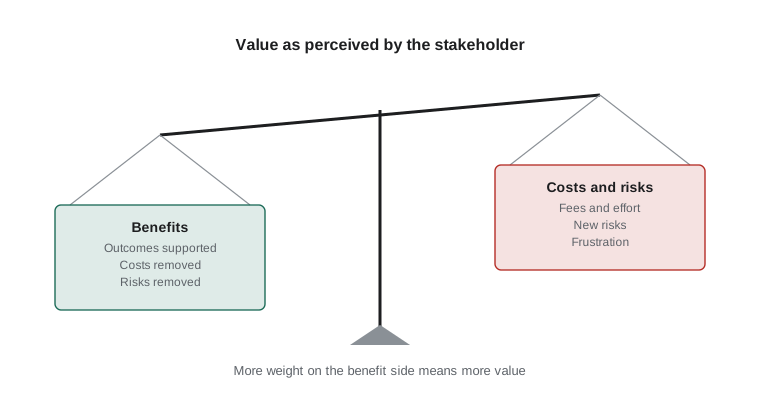
ITIL-110 defined value as the perceived benefits, usefulness and importance of something. Two words in that definition matter here. "Perceived" means value is judged by stakeholders, not declared by the provider. "Importance" means value depends on what matters to the stakeholder at that moment. Focusing on value therefore starts with knowing who the stakeholders are and what they consider valuable, and then checking that each activity contributes to it.
Applying the principle involves four steps:
- Know who the service consumer is, and who the other stakeholders are for this piece of work.
- Understand what the consumer values: why they use the service, what it helps them do, and how it affects their costs and risks.
- Understand the consumer experience, including how it feels to use the service, not only whether it works.
- Focus on value during normal operations as well as during improvement initiatives, so that everyday work also links to value.
Who receives value
Value flows to many stakeholders, and an activity can create value for some while destroying it for others. A new automated billing process may cut the provider's costs (value for the organization), confuse customers who receive unfamiliar invoices (lost value for consumers) and reduce workload for the finance team (value for employees). Focusing on value means seeing all of these effects and deciding consciously which trade-offs are acceptable.
| Stakeholder | Typical forms of value | Typical forms of lost value |
|---|---|---|
| Consumers (customers, users, sponsors) | Outcomes achieved, costs and risks removed, good experience | Delays, errors, new costs or risks imposed |
| The provider organization | Revenue, reputation, efficiency, learning | Rework, complaints, lost customers |
| Employees | Meaningful work, manageable workload, skills | Frustration, burnout, pointless tasks |
| Partners and suppliers | Fair business, long-term relationships | Unclear requirements, late payment |
| Society and regulators | Compliance, safety, sustainability | Harm, breaches, environmental cost |
Finding out what consumers value
Providers often assume they know what consumers value, and are often wrong. Common ways to find out include:
- Talking to consumers directly: interviews, workshops and joint reviews.
- Observing the service in use: watching how people actually complete tasks.
- Analyzing data: usage logs, abandoned transactions, repeat contacts and complaints.
- Asking about outcomes, not features: "what are you trying to achieve?" rather than "what features do you want?"
The last point deserves emphasis. Consumers asked for features tend to list everything they can imagine. Consumers asked about outcomes reveal what actually matters. A clinic asking for "more reports" from its booking system may really need to reduce no-shows; a reminder message might achieve that better than any report.
Value also changes over time. A feature that delighted users two years ago may now be taken for granted, and a slow response that was tolerated in a quiet period may be unacceptable during a peak season. Focusing on value is therefore continuous, not a one-off requirements exercise.
Value and experience
ITIL places growing weight on experience. Two services can deliver identical outcomes while one feels smooth and the other frustrating. The frustrating one delivers less value, because frustration is a cost to the consumer and damages the relationship. ITIL (Version 5) gives experience even more prominence across the product and service life cycle. In practice, focusing on value includes asking how it feels to request help, wait for a fix or use a self-service portal, and treating those feelings as part of what the service delivers.
Worked problem
Outcomes versus features
A university department asks IT for "a dashboard showing every ticket in real time". Use the focus on value principle to decide how to respond.
Show solution
- Ask what outcome the department wants. In discussion, the department head explains that students complain about waiting days for lab software to be installed.
- The real outcome is faster lab software installation for students, not a dashboard.
- Options that deliver that outcome include pre-installing common software, a self-service software catalogue and a target for lab requests.
- A simple weekly report on lab request times may still help the department monitor progress, but a real-time dashboard of every ticket adds cost without adding value.
Answer: Respond to the outcome, not the requested feature. A software catalogue and a weekly report deliver more value than a costly dashboard.
Value in everyday operations
The principle is not reserved for big projects. Every interaction is a chance to create or destroy value. A service desk agent who closes a ticket quickly but leaves the user unable to work has met a time target while failing on value. An agent who spends two extra minutes confirming the fix creates more value even if the average handling time rises. Measures that reward speed alone can push people away from value, a problem lesson 11 returns to.
Worked problem
Weighing an everyday trade-off
A service desk handles 6,000 incidents a month. Adding a 90-second confirmation step with the user would cut reopened incidents from 12 % to 5 %. Each reopened incident costs about 40 minutes of combined agent and user time. Is the extra step worth it in time alone?
Show solution
- Extra time added: 6,000 × 1.5 minutes = 9,000 minutes a month.
- Reopens before: 12 % × 6,000 = 720. Reopens after: 5 % × 6,000 = 300. Reopens avoided: 420.
- Time saved: 420 × 40 minutes = 16,800 minutes a month.
- Net saving: 16,800 − 9,000 = 7,800 minutes, or 130 hours a month.
Answer: Yes. The confirmation step saves about 130 hours a month, before counting the better experience for users.
Value in investment decisions
At the strategic level, focusing on value means choosing investments by the value they enable, not by technical appeal. A useful approach is to state the expected value in measurable terms before work starts, then check afterwards whether it was achieved. This links to the benefits realization ideas in ITIL-150 and to the continual improvement model in lesson 11.
Worked problem
Comparing two investments by value
An organization has budget for one of two projects. Project A, a new monitoring tool, costs $120,000 and is expected to avoid 30 hours of outage a year, each hour costing about $8,000 in lost business. Project B, a redesigned employee portal, costs $90,000 and is expected to save 5,000 hours of employee time a year at $45 per hour. Compare the first-year net benefit.
Show solution
- Project A benefit: 30 × $8,000 = $240,000. Net: $240,000 − $120,000 = $120,000.
- Project B benefit: 5,000 × $45 = $225,000. Net: $225,000 − $90,000 = $135,000.
- Project B has the higher first-year net benefit, though the difference is small and both estimates are uncertain.
- Focus on value also asks about value that is hard to quantify: outages may damage reputation, and the portal may improve employee experience.
Answer: Project B shows about $15,000 more first-year net benefit, but the decision should also weigh the uncertainty of each estimate and the unquantified value.
When the principle is ignored
Organizations that lose sight of value show recognizable symptoms. Teams measure activity (tickets closed, changes deployed) instead of outcomes. Projects are judged on delivery to schedule rather than on benefits. Processes accumulate steps that once had a purpose but now exist only because nobody removed them. Consumers describe the provider as bureaucratic. Staff cannot explain why they do parts of their job. The remedy is to ask, persistently and at every level, "who gets value from this, and how do we know?"
One test that works well in practice is to follow a single request from start to finish and ask, at each step, whether the consumer would be willing to pay for that step if they could see it. Steps that pass the test add value. Steps that fail are candidates for removal, simplification or automation. The test is borrowed from Lean, and it connects focus on value directly to keep it simple and practical (lesson 7).
Value for different kinds of organization
In the Canadian public sector, the Treasury Board Policy on Service and Digital asks departments to design services around client needs and to measure client satisfaction and service standards. Focusing on value there means asking what outcomes Canadians need from a service, such as a passport or a benefit payment, and designing to deliver them reliably. In a private company, value may be measured more in revenue, retention and cost. The principle applies to both; only the measures of value differ.
Focus on value in exam scenarios
Scenario questions about this principle usually describe a provider doing something that looks efficient or impressive but does not help anyone. The best answer is normally the option that goes back to the consumer: find out what outcome they need, check how they experience the service, or remove work that cannot be linked to value. Distractors often sound sensible, such as adding a new report, buying a tool or tightening a target, but none of them starts from what the stakeholder values. When two options both mention consumers, prefer the one about outcomes over the one about features or requests.
A second pattern describes a trade-off between stakeholders. A change may cut costs for the provider while adding effort for users. The principle does not say the provider must always lose, nor that users always win. It asks that all affected stakeholders be identified and the trade-off made consciously and openly, which also draws on collaborate and promote visibility.
Key point to remember
If you remember one idea from this lesson, make it this: value is decided by the people who receive it. A provider can make a service faster, cheaper or more feature-rich and still fail to create value if those changes do not matter to its stakeholders. Every other principle in this course is a way of delivering value more effectively.
Common mistakes
MistakeAssuming the provider knows what consumers value.
InsteadAsk consumers about the outcomes they need and observe how they use the service.
MistakeTreating requested features as the definition of value.
InsteadLook behind feature requests to the outcomes they are meant to achieve.
MistakeFocusing on value only during projects.
InsteadLink everyday operational work to value as well.
MistakeConsidering only the paying customer.
InsteadConsider value and lost value for users, sponsors, employees, partners and society.
MistakeRewarding speed alone in support work.
InsteadBalance speed with measures of whether the consumer's problem was actually solved.
Summary and key terms
- Everything an organization does should link back, directly or indirectly, to value for stakeholders.
- Value is perceived by stakeholders, so providers must find out what consumers value rather than assume.
- Applying the principle means knowing the consumer, understanding what they value and how they experience the service.
- Ask about outcomes, not features, to uncover real value.
- Experience is part of value; frustration is a cost to consumers.
- The principle applies to everyday operations and to investment decisions.
- Activities that cannot be linked to value are candidates for removal or redesign.
- Value
- The perceived benefits, usefulness and importance of something.
- Stakeholder
- A person or organization that has an interest or involvement in an organization, product, service, practice or other entity.
- Outcome
- A result for a stakeholder enabled by one or more outputs.
- Consumer experience
- How it feels to interact with a provider and use its services across all touchpoints.
- Lost value
- A reduction in benefit for a stakeholder, such as added cost, delay, risk or frustration.
- Reopened incident
- An incident marked resolved that returns because the problem was not actually fixed.
- Net benefit
- Total benefit minus total cost over a stated period.
- Willingness-to-pay test
- A Lean test asking whether the consumer would pay for a step if they could see it.
- Vanity measure
- A measure that looks impressive but does not reflect value for stakeholders.
- Service standard
- A published commitment about the level of service consumers can expect, common in the public sector.
Practice problems
Work each problem on paper first, then reveal the answer to check.
Why does the word "perceived" matter in the definition of value?
Show answer
Value is judged by stakeholders, so providers must find out what stakeholders value rather than declare it.
List the four steps for applying focus on value.
Show answer
Know the consumer and stakeholders; understand what the consumer values; understand the consumer experience; focus on value in operations and improvement.
Why ask about outcomes rather than features?
Show answer
Outcome questions reveal what matters; feature lists tend to include everything imaginable.
Give an example of an activity that creates value for one stakeholder and loses it for another.
Show answer
Automated billing that cuts provider costs but confuses customers with unfamiliar invoices.
A step adds 1 minute to 5,000 tickets and avoids 200 reopens of 30 minutes each. What is the net time saved?
Show answer
Added 5,000 minutes; saved 6,000 minutes; net saving 1,000 minutes.
How does experience relate to value?
Show answer
Frustration is a cost, so a poor experience reduces the value a service delivers.
What is the willingness-to-pay test?
Show answer
Ask at each step whether the consumer would pay for it if they could see it; steps that fail are candidates for removal.
Name two symptoms of an organization that has lost focus on value.
Show answer
Measuring activity instead of outcomes; processes with steps nobody can explain.
Project costs $50,000 and saves 1,500 hours at $40 per hour. What is the first-year net benefit?
Show answer
1,500 × $40 = $60,000; net $10,000.
Does value stay the same over time?
Show answer
No. Expectations change, so focusing on value is continuous.
Lesson quiz · 5 questions
Score 60% or more to complete this lesson.
Create a free account to save your progress, take quizzes and earn a certificate.