
ITIL-141 · Lesson 12 of 12 · 31 min
Capstone: improving service delivery for an organization
This final lesson brings the course together. You will diagnose service delivery problems at Larchmont Logistics across all the practices you have studied, build a prioritized improvement plan, quantify its business case, set baselines and targets, and plan how to keep improving. The lesson ends with a strategy for Foundation exam questions on these practices, including a summary of each practice's purpose.
The situation
It is October 2026. Larchmont Logistics, headquartered in Winnipeg, is preparing for peak season and plans to open two new distribution centres, in Regina and Thunder Bay, next spring. The new chief operating officer has asked LTS for an honest assessment of service delivery and a 12-month improvement plan. She has heard complaints from dispatchers, seen an audit report about software licensing and been surprised by a network outage at the Brandon centre that took most of a day to fix. LTS has 95 staff and an annual budget of about $21 million.
The service management team gathers evidence from each practice. The findings below use the invented figures from earlier lessons, brought together into one picture.
Diagnosis by practice
| Practice | Finding | Evidence |
|---|---|---|
| Service level management | Watermelon reporting on the shipment portal | All targets green; satisfaction fell from 78 % to 62 %; most morning searches miss 2 s |
| Service configuration management | CMDB not trusted | 14.5 % sample discrepancy rate; 23 live servers unrecorded; supplier circuit IDs missing |
| IT asset management | Licence shortfalls and waste | Office suite 130 users over entitlement; database 8 cores short; 160 inactive accounts |
| Release management | Large, poorly communicated releases | One recent release doubled incidents in the following week; another raised them by 30 % |
| Deployment management | Manual deployments at night | Portal deployments manual; 4 % deployment failure rate; no canary or automated verification |
| Relationship management | Late involvement with operations | Relationship health score weakest for operations; new centres announced to IT six weeks before go-live last time |
| Supplier management | Declining carrier performance | Carrier score down 9 points in three quarters; restore time 5.4 h against 4 h target; renewal notice due soon |
| Information security management | Long tail of unpatched critical findings | 10 % of critical findings open more than 30 days; 61 leaver accounts still active |
| Continual improvement | Register full but stalled | 120 open ideas; median 70 days from capture to decision; benefits measured for 70 % of completed items |
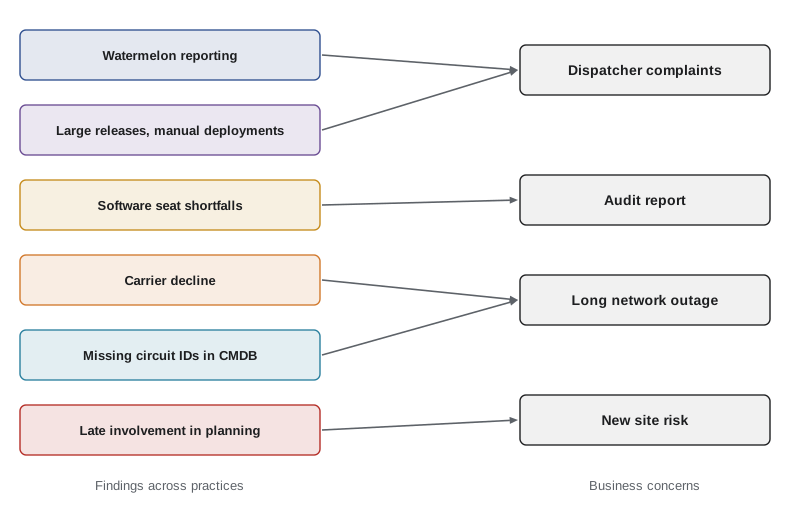
Look at how the findings interact. The long network outage was partly the carrier's slow restore process and partly LTS's fault: without circuit IDs in the CMDB, the service desk took over an hour to raise the fault with the right details. The dispatcher complaints come from poor measurement and from large releases that disrupted the portal. Late involvement in operations planning threatens the new distribution centres, which will need network circuits, scanners, licences and support from day one. A plan that treats each practice separately would miss these connections.
Building the improvement register
The team converts the findings into improvement ideas, each with an owner, an expected benefit and a rough size, and scores them using WSJF from lesson 1. They run the scoring as a workshop with the BRM for operations and the finance lead, so the business view shapes the priorities.
# Larchmont improvement register: WSJF ranking and a capacity-constrained 12-month plan
ideas = [
    # name, value, time criticality, risk reduction, size (relative), practice
    ("Add circuit IDs and supplier links to CMDB", 5, 8, 8, 2, "configuration"),
    ("Carrier improvement plan before renewal notice", 8, 13, 8, 3, "supplier"),
    ("End-to-end portal SLIs and morning window", 8, 8, 5, 3, "service level"),
    ("Reclaim inactive seats, fix database count", 5, 8, 8, 2, "asset"),
    ("Automate leaver access removal via HR feed", 3, 5, 13, 5, "security"),
    ("Pipeline with canary and auto-verification", 8, 5, 8, 8, "deployment"),
    ("Phased releases with readiness checklist", 8, 5, 5, 3, "release"),
    ("BRM joins operations planning; new-site playbook", 13, 13, 8, 3, "relationship"),
    ("Discovery for all networks and cloud accounts", 5, 3, 8, 5, "configuration"),
    ("Monthly triage to clear stalled register", 3, 3, 3, 1, "improvement"),
    ("Patch plan or risk acceptance for long tail", 3, 5, 13, 3, "security"),
]
capacity_per_quarter = 12     # relative size units LTS can deliver per quarter alongside operations
ranked = sorted(ideas, key=lambda x: -(x[1] + x[2] + x[3]) / x[4])
quarter, used, plan = 1, 0, {}
for name, v, t, r, size, prac in ranked:
    while used + size > capacity_per_quarter:
        quarter, used = quarter + 1, 0
    plan.setdefault(quarter, []).append((name, round((v + t + r) / size, 1)))
    used += size
for q, items in plan.items():
    print(f"Quarter {q}:")
    for name, w in items:
print(f" WSJF {w:>5} {name}")Quarter 1: WSJF 11.3 BRM joins operations planning; new-site playbook WSJF 10.5 Add circuit IDs and supplier links to CMDB WSJF 10.5 Reclaim inactive seats, fix database count WSJF 9.7 Carrier improvement plan before renewal notice WSJF 9.0 Monthly triage to clear stalled register Quarter 2: WSJF 7.0 End-to-end portal SLIs and morning window WSJF 7.0 Patch plan or risk acceptance for long tail WSJF 6.0 Phased releases with readiness checklist Quarter 3: WSJF 4.2 Automate leaver access removal via HR feed WSJF 3.2 Discovery for all networks and cloud accounts Quarter 4: WSJF 2.6 Pipeline with canary and auto-verification
The ranking puts the operations relationship, the CMDB circuit data, the carrier improvement plan, licence reclamation and register triage first. These are small, urgent and high in value. The deployment pipeline is valuable but large, so it falls later; the team may split it into smaller steps, such as automated verification first and canary releases second, and re-score them. The plan is a starting point for discussion with the chief operating officer, not a final answer.
Quantifying the business case
Executives need to see what the plan is worth. The team estimates benefits for the main improvements using conservative assumptions, clearly labelled. Some benefits are cash savings, such as reclaimed licences. Others are avoided losses, such as fewer hours of disrupted warehouse operations, which the operations finance lead values at an agreed cost per hour. Some benefits, such as better relationships, are described qualitatively rather than forced into numbers.
# Conservative annual benefit estimates for the main improvements (invented assumptions)
cost_per_outage_hour = 4_500        # agreed with operations finance: lost throughput and overtime
benefits = {}
# 1. Faster network restores: CMDB data cuts 1 h of diagnosis; carrier plan cuts restore from 5.4 h to 4.0 h
faults_per_year = 14
benefits["network restores"] = faults_per_year * ((5.4 - 4.0) + 1.0) * cost_per_outage_hour * 0.5   # half of sites affected
# 2. Software seat actions: reclaim 160 office suite accounts, avoid buying 130; database fixed by reconfiguration
benefits["seat reclamation"] = 130 * 300
# 3. Safer releases and deployments: avoid two disruptive releases a year, each costing about 6 outage-equivalent hours
benefits["fewer disruptive releases"] = 2 * 6 * cost_per_outage_hour
# 4. Portal SLIs and tuning: dispatchers save 4 min per day each through faster searches
dispatchers, minutes, workdays, loaded_rate = 180, 4, 240, 38.0
benefits["dispatcher time"] = dispatchers * minutes / 60 * workdays * loaded_rate
one_off_costs = {"pipeline tooling and effort": 85_000, "discovery expansion": 30_000, "training and readiness": 15_000}
total_b, total_c = sum(benefits.values()), sum(one_off_costs.values())
for k, v in benefits.items():
    print(f"{k:<28} {v:>12,.0f} per year")
print(f"{'total annual benefit':<28} {total_b:>12,.0f}")
print(f"{'one-off costs':<28} {total_c:>12,.0f}")
print(f"simple payback: {total_c / total_b * 12:.1f} months")network restores 75,600 per year seat reclamation 39,000 per year fewer disruptive releases 54,000 per year dispatcher time 109,440 per year total annual benefit 278,040 one-off costs 130,000 simple payback: 5.6 months
The estimate shows a payback of well under a year, even before counting benefits that are hard to quantify, such as reduced audit risk, better readiness for the new distribution centres and improved trust. The team presents the assumptions openly so the chief operating officer can challenge them; a business case that hides its assumptions invites suspicion.
Baselines, targets and measures
Each improvement needs a baseline and a target so that "did we get there?" can be answered honestly. The team chooses a small set of measures that the chief operating officer will see each quarter, balanced across outcomes, quality and relationships.
| Measure | Baseline (October 2026) | 12-month target |
|---|---|---|
| Morning searches within 2 s | About 13 % | At least 90 % |
| Portal satisfaction (quarterly survey) | 62 % | At least 75 % |
| CMDB sample discrepancy rate | 14.5 % | Below 5 % |
| Licence position for top 5 products | 2 shortfalls | No shortfalls; surplus under 5 % |
| Week-after-release incident uplift | Up to about 100 % | Below 15 % for every release |
| Deployment failure rate | 4.0 % | Below 2 % |
| Carrier mean time to restore | 5.4 h | Below 4 h for two consecutive months |
| Critical findings open over 30 days | 10 % | Below 2 %, rest under formal risk acceptance |
| Operations relationship health | Lowest of all groups | Involved at site selection for both new centres |
| Register median time to decision | 70 days | Below 21 days |
Protecting peak season and the new centres
Two business events shape the timing. During peak season, from mid-November to the end of December, the team will avoid releases that change dispatcher or warehouse workflows, use the change schedule from ITIL-140 to enforce a freeze on high-risk changes, and focus on improvements that do not disturb operations, such as CMDB data, licence reclamation and the carrier improvement plan. For the new distribution centres, the BRM and operations will build a new-site playbook: a standard release covering network circuits ordered through the carrier with agreed lead times, scanners deployed in a phased rollout, licences checked before go-live, CMDB records created as part of the build, service levels agreed with the site managers and support briefings for the service desk.
Worked problem
Lead times for a new site
The new distribution centre opens on 1 May. The carrier needs 90 days to install a circuit, scanner deployment takes 3 weeks including a pilot, and testing and readiness need 2 weeks after the network is live. When must the circuit be ordered at the latest, and when should scanner deployment begin?
Show solution
- Readiness must finish by 1 May, so the network must be live and tested by about 17 April (2 weeks before).
- Scanner deployment of 3 weeks must also finish by 17 April, so it should start by about 27 March, after the network is installed.
- The circuit must be live by 27 March at the latest so scanners can connect; 90 days before 27 March is about 27 December.
Answer: Order the circuit by about 27 December, during peak season, which is why LTS must be involved in site planning well before then. A late decision would push opening back or force temporary connectivity.
Keeping the momentum
The final question of the continual improvement model is how to keep the momentum going. The team proposes several mechanisms: a monthly improvement review chaired by the chief information officer, where practice owners report progress against the targets; quarterly service reviews with each major stakeholder group; quarterly supplier reviews for strategic and tactical suppliers; a published dashboard of the ten measures; recognition for teams that complete improvements and measure benefits; and an annual reassessment of practice maturity. Most importantly, 10 % of each team's capacity is protected for improvement work, even during busy periods, because improvement that only happens when there is spare time never happens.
Reflecting on the practices together
The capstone illustrates a theme that runs through ITIL: practices are not departments, and they create value only in combination. The network outage needed configuration data, supplier management and incident management to work together. The dispatcher complaints needed service level management, release management, deployment management and relationship management. The audit finding needed IT asset management, supplier contracts and information security. When you study practices separately for the exam, remember that real improvement almost always crosses practice boundaries.
Foundation exam strategy for these practices
The ITIL 4 Foundation exam tests the purpose of each of the 15 practices it covers at recall level and requires more detailed understanding of seven of them; continual improvement, service level management and change enablement are among those studied in more detail. ITIL-140 covered the support practices; the table below summarizes the purposes of the practices in this course in plain words. Exam questions use official wording, which you should study from the current official materials; the plain-language versions here help you understand and recognize them.
| Practice | Purpose in plain words | Key words to recognize |
|---|---|---|
| Continual improvement | Align practices and services with changing business needs through ongoing improvement | align, changing business needs, ongoing improvement |
| Service level management | Set clear business-based targets and manage delivery against them | business-based targets, assessed, monitored, managed |
| Service configuration management | Ensure accurate, reliable information about services and CIs is available when and where needed | accurate and reliable, configuration, relationships |
| IT asset management | Plan and manage the full lifecycle of IT assets for value, cost, risk and compliance | full lifecycle, maximize value, control costs |
| Release management | Make new and changed services and features available for use | available for use |
| Deployment management | Move new or changed components to live and other environments | move, live environments |
| Relationship management | Establish and nurture links with stakeholders at strategic and tactical levels | establish and nurture, stakeholders |
| Supplier management | Ensure suppliers and their performance are managed to support seamless provision | suppliers, seamless provision |
| Information security management | Protect the information needed to conduct business | protect information, confidentiality, integrity, availability |
Many wrong options in practice questions are purposes of other practices. If a question asks for the purpose of release management and one option says "move new or changed components to live environments", recognize that as deployment management. If an option says "set clear business-based targets", that is service level management, not supplier management. Learning to pair each purpose with its practice removes many distractors quickly.
| Easily confused pair | How to tell them apart |
|---|---|
| Release vs deployment | Release makes available for use; deployment moves components into environments |
| Service configuration vs IT asset management | Configuration focuses on CIs and relationships for service delivery; assets focus on financial value and lifecycle |
| Service level vs supplier management | Service levels are agreed with customers; supplier management manages the suppliers that support them |
| Relationship vs service level management | Relationship management nurtures links with stakeholders broadly; service level management sets and manages service targets |
| Continual improvement vs problem management | Continual improvement improves anything; problem management reduces incidents by addressing causes |
| Information security vs incident management | Security protects information; incident management restores service, handing security incidents to security response |
Worked problem
Working through a practice question
Which practice ensures that accurate information about how a database server supports the shipment booking service is available when needed? Options: A) IT asset management; B) service configuration management; C) deployment management; D) service level management.
Show solution
- The key words are accurate information, supports a service and available when needed.
- IT asset management tracks financial and lifecycle data, not how components support services, so A is a distractor.
- Deployment management moves components; it does not maintain information about relationships, so C is wrong.
- Service level management sets targets, so D is wrong.
Answer: B, service configuration management.
Other tips from ITIL-101 still apply: read every option before choosing; watch for absolute words such as always and never, which are often wrong in ITIL because the framework favours adapting practices to context; and when two options seem right, choose the one that best matches the practice's purpose as ITIL defines it rather than common workplace usage.
Where to go next
With ITIL-140 and this course complete, you have studied all the practices covered by the ITIL 4 Foundation exam. ITIL-150 looks at digital products, AI and transformation, and ITIL-160 focuses on Foundation exam strategy and full practice exams. For deeper security knowledge, the CISSP courses build on lesson 11. For project and procurement skills that support supplier and release management, the PMP courses are a natural next step.
Common mistakes
MistakeImproving each practice separately.
InsteadLook for connections between findings; most business problems cross practice boundaries.
MistakePresenting a plan without baselines and targets.
InsteadSet measurable baselines and targets so success can be shown.
MistakeHiding assumptions in the business case.
InsteadState assumptions openly and keep them conservative.
MistakeScheduling disruptive improvements during peak season.
InsteadAlign the plan with business calendars and protect critical periods.
MistakeConfusing release with deployment or configuration with asset management in exam answers.
InsteadPair each purpose with its practice using the key words.
Summary and key terms
- Diagnosis across all practices revealed connected problems behind each business concern.
- Improvement ideas were scored with WSJF in a workshop including business stakeholders.
- A conservative, transparent business case showed payback within a year.
- Baselines and targets for a small, balanced set of measures make results visible.
- Peak season was protected, and a new-site playbook brings IT into planning early.
- Momentum is kept through regular reviews, dashboards, recognition and protected improvement capacity.
- For the exam, learn each practice's purpose and the key words that distinguish easily confused practices.
- Capstone
- A final exercise that applies the knowledge of a whole course to a realistic case.
- New-site playbook
- A standard plan for bringing IT services to a new location.
- Business case
- A justification for an investment, setting out benefits, costs, risks and assumptions.
- Payback period
- The time it takes for benefits to repay an investment.
- Protected capacity
- A share of team time reserved for improvement work.
- Distractor
- A plausible but incorrect option in a multiple-choice question.
- Recall level
- Exam level requiring recognition of definitions and purposes.
- Avoided loss
- A benefit measured as harm that no longer occurs.
- Practice maturity
- How well a practice is defined, measured and improved.
- Peak season freeze
- A period when high-risk changes are avoided to protect critical business activity.
Practice problems
Work each problem on paper first, then reveal the answer to check.
Why did the network outage need several practices to fix?
Show answer
It involved the carrier's restore process (supplier management), missing circuit data (configuration management) and incident handling.
Why was the deployment pipeline ranked later despite high value?
Show answer
Its large size gave it a lower WSJF; splitting it into smaller steps could raise its priority.
Why should business case assumptions be shown openly?
Show answer
So decision makers can challenge them and trust the result.
Name three measures from the capstone dashboard.
Show answer
Any three from the table, such as morning searches within 2 s, CMDB discrepancy rate and carrier restore time.
How does the plan protect peak season?
Show answer
It avoids workflow-changing releases, freezes high-risk changes and focuses on non-disruptive improvements.
A circuit needs 90 days and must be live by 1 March. When should it be ordered?
Show answer
By about 1 December.
Which practice's purpose includes "available for use"?
Show answer
Release management.
Which practice's purpose includes "seamless provision"?
Show answer
Supplier management.
How do service configuration management and IT asset management differ?
Show answer
Configuration focuses on CIs and relationships for service delivery; asset management on financial value and lifecycle.
Why are absolute words often wrong in ITIL exam options?
Show answer
ITIL favours adapting practices to context rather than fixed rules.
Lesson quiz · 5 questions
Score 60% or more to complete this lesson.
Create a free account to save your progress, take quizzes and earn a certificate.