
LES-105 · Lesson 1 of 12 · 21 min
Why ethics matters in policing: authority, power and the public trust
▶ Video coming soon A video version of this lesson is on the way.
On the first day of Ethics and Professionalism, Professor Ray Desjardins writes a single sentence on the board: A police officer is a citizen in uniform who has been lent extraordinary powers by everyone else. He asks the class what those powers are. Amara Okafor lists arrest. Marco DiSanto adds the use of force, up to and including deadly force. Priya Sandhu mentions searching people, cars and homes. Jesse Morningstar says officers can stop someone on the street and demand answers. Linh Tran adds a quieter one: officers decide what goes into a report, and a court may later treat that report as the truth. Desjardins nods. Every one of those powers, he says, can be used well or badly, and no supervisor, camera or court can watch every use. That gap between what officers are able to do and what anyone can check is the reason this course exists.
Power that no one else holds
Most people never hold legal power over another person. A teacher can give a detention and an employer can fire someone, but only the state can take away liberty, and in daily life the state is usually represented by a patrol officer. Under the Criminal Code, the Charter and provincial statutes such as Ontario's Community Safety and Policing Act, officers can detain, arrest, search, seize property, enter places and apply force. These powers are hedged with conditions: reasonable grounds, warrants, necessity and proportionality. But the conditions are applied first by the officer, alone, in the moment, often at night and often with no witness who is not either a suspect or a victim. The law draws the outer boundary. Ethics governs everything an officer does inside it.
Desjardins illustrates the point with a call he handled as a young officer. A teenager was caught shoplifting a phone charger worth a few dollars. The law allowed an arrest and a charge. It also allowed a warning, a call to the parents or a referral to an extrajudicial measures program under the Youth Criminal Justice Act. Every option was lawful. What separated them was judgment: what was fair to the store, what was likely to keep the teenager out of further trouble, and what the community would accept as reasonable if it learned the details. That is an ethical decision dressed in a legal uniform, and patrol officers make dozens of them every week.
Legitimacy: why people cooperate
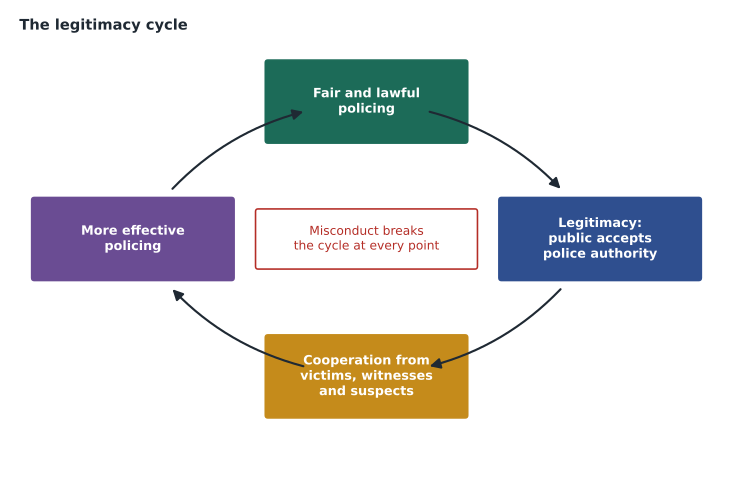
Police depend on public cooperation for almost everything they accomplish. Most crimes come to police attention because a victim or witness calls. Most cases are solved because someone talks. Most arrests end peacefully because the person arrested accepts, however grudgingly, that the officer has the right to make it. Researchers call this acceptance legitimacy: the belief that the police are entitled to exercise authority and that people ought to comply even when they disagree with a particular decision. Tom Tyler's studies, beginning in the late 1980s, found that legitimacy depends less on whether people get the outcome they want than on whether they feel they were treated fairly. People who are listened to, treated with dignity and given reasons for decisions are more likely to obey the law and cooperate with police, even after receiving a ticket.
Tyler's work became the basis of what is now called procedural justice, which has four elements that recur throughout this course: voice, meaning people get to tell their side; neutrality, meaning decisions are based on facts and rules rather than prejudice; respect, meaning people are treated with dignity; and trustworthy motives, meaning people believe the officer is trying to do the right thing. Each element is an ethical commitment as much as a technique. An officer can recite the right words while plainly not listening, and people notice. Desjardins tells the class that the officers he most admired were not the ones with the best arrest numbers but the ones whom people in the toughest neighbourhoods asked for by name.
The asymmetry of trust
Trust is built slowly and lost quickly. Wesley Skogan's research on police contacts found an asymmetry: a bad experience with police lowers a person's confidence much more than a good experience raises it. One rude stop can undo the effect of several courteous ones. The effect also spreads, because people tell others, and today they post video. Port Ardent's 2025 community survey, which the class first saw in LES-101, showed 68 out of every 100 residents trusting the police overall, but only 61 out of 100 among people who had a recent contact with officers, compared with 71 out of 100 among people who had none. Desjardins asks the class what that gap means. Linh suggests that some contacts are going badly. Priya points out that people who have contact with police are often victims or suspects having a bad day already. Both explanations may be partly true, and the code below shows why the gap matters even so.
The Python example uses the survey's published counts to estimate trust among residents with and without recent contact, and then imagines a year in which more residents have contact. If contacts continue to lower trust at the same rate, overall trust drifts down even though nothing else changes. The arithmetic is simple, but it makes a serious point: each individual encounter is a small deposit into or withdrawal from an account the whole service shares.
# Port Ardent 2025 survey: trust by recent police contact (counts from the survey report)
groups = {
    "recent contact": {"n": 420, "trust": 256},
    "no recent contact": {"n": 780, "trust": 554},
}
total_n = sum(g["n"] for g in groups.values())
total_trust = sum(g["trust"] for g in groups.values())
for name, g in groups.items():
    print(f"{name:18s} {g['trust'] / g['n']:.3f}")
print(f"{'overall':18s} {total_trust / total_n:.3f}")

# What if the share of residents with recent contact grows and contact keeps lowering trust?
p_contact = groups["recent contact"]["trust"] / groups["recent contact"]["n"]
p_none = groups["no recent contact"]["trust"] / groups["no recent contact"]["n"]
for share in (0.35, 0.45, 0.55):
    overall = share * p_contact + (1 - share) * p_none
print(f"share with contact {share:.2f} -> overall trust {overall:.3f}")recent contact 0.610 no recent contact 0.710 overall 0.675 share with contact 0.35 -> overall trust 0.675 share with contact 0.45 -> overall trust 0.665 share with contact 0.55 -> overall trust 0.655
The output shows overall trust near 0.68 today and drifting to about 0.66 if more than half of residents had a contact that went the way recent contacts are going now. The point is not the third decimal place. It is that the quality of ordinary encounters, multiplied across 54,300 calls a year, shapes how much help the service will get when it needs it.
Ethics, law and policy are not the same thing
Students often assume that if something is legal it is ethical, and if it is against policy it is unethical. Desjardins draws three overlapping circles on the board. Law sets the minimum that the whole society enforces through courts. Policy is the service's own rules, written by the chief and approved by the police service board and enforced through discipline. Ethics is the set of principles about right conduct that a professional carries everywhere, including into situations no law or policy anticipated. Most of the time the three agree. Sometimes they do not. A legal action can be cruel, as when an officer uses every lawful power against a person simply because the officer is annoyed. A policy can be out of date. And ethics sometimes asks more than either, such as staying with a frightened child until a relative arrives even though the call has been cleared.
The overlap matters most where the law leaves room for choice, which is most of the time. Officers choose whom to stop, whom to question, whether to search when consent might be obtained, whether to arrest or release, how to word a report and whether to report a colleague. These choices are where careers are made and broken, and where the public experiences the police as fair or unfair. Professionalism, in the sense this course uses the word, means making those choices consistently well, for reasons the officer could explain to a reasonable member of the public.
| Question | Law | Policy | Ethics |
|---|---|---|---|
| Who writes it? | Legislatures and courts | The police service | The profession and the individual |
| How is it enforced? | Prosecution, exclusion of evidence, lawsuits | Supervision and discipline | Conscience, peers and reputation |
| What does it cover? | Minimum standards for everyone | How this service wants things done | Right conduct in every situation |
| Example | Grounds needed for an arrest | When to activate a body camera | Treating an angry person with patience |
What the public expects of a professional
Policing in Canada is not a licensed profession in quite the way medicine or law is, but it increasingly behaves like one. Officers complete required training, swear an oath, are bound by a statutory code of conduct, can lose their appointment for serious misconduct and are expected to keep their knowledge current. The public expects of officers what it expects of any profession: competence, honesty, fairness, confidentiality and putting the interests of the people served ahead of personal convenience. The difference is that police professionals wear a weapon and can compel compliance, so the consequences of falling short are more immediate and more visible.
Jesse raises his hand. In his community, he says, trust in police is not starting from zero; it is starting from below zero, because of a history that includes the enforcement of the pass system and the removal of children to residential schools. Desjardins agrees and says that history is part of why ethics cannot be treated as a matter of personal good intentions alone. Officers inherit the reputation of the institution, and they repair it, or damage it further, one contact at a time. Later lessons return to this theme when they look at bias, community trust and accountability.
Every new officer makes a formal commitment before taking up these powers. In Ontario, officers swear or affirm an oath of office and an oath of secrecy, promising to discharge their duties loyally, faithfully and impartially and to keep confidential what they learn on the job. Desjardins says most officers remember the ceremony and few remember the words. He asks the class to read the oath aloud and pick out its key promises. Amara picks out impartiality. Marco picks out faithfulness. Priya notices that confidentiality is a promise to the public, not to colleagues. Those promises, Desjardins says, are the yardstick against which every later lesson measures conduct.
How this course works
The rest of the course moves from theory to practice. Lessons 2 and 3 introduce the main ethical frameworks and a practical decision-making model. Lessons 4 and 5 look at codes of conduct and discretion. Lessons 6 and 7 examine how good officers go wrong, through noble cause corruption, gratuities and the slippery slope. Lesson 8 covers honesty in notes, reports and testimony. Lesson 9 deals with bias and fair treatment. Lesson 10 addresses the code of silence and the duty to intervene. Lesson 11 explains how officers are held accountable, and the capstone asks each student to build an ethics case portfolio. Each lesson uses Port Ardent cases, and each includes a short program that shows how data can reveal patterns that individual cases hide.
Worked problem
A small decision with large effects
Constable Dev Malhotra stops a driver for rolling through a stop sign at 2 a.m. on an empty street. The driver, a nurse heading home from a twelve-hour shift, is polite and apologetic and has a clean record. The fine is substantial. Malhotra is behind on his ticket numbers for the month, and his sergeant has hinted that the platoon's numbers are low.
Show solution
- Identify the lawful options: a ticket, a warning recorded in the system, or an informal warning.
- Identify what pushes toward each option: the safety purpose of the stop sign, the driver's record and attitude, the time and traffic, and the pressure of ticket numbers.
- Ask which considerations are legitimate. Safety and the driver's record are. Monthly numbers are not a reason to penalize a particular person.
- Consider how the decision would look if explained in public: a recorded warning to a careful driver at an empty intersection is easy to defend; a ticket issued to meet a quota is not.
- Act consistently: the same facts with a different driver should produce the same decision.
Answer: A recorded warning fits the purpose of the law and the facts. Issuing the ticket would be lawful, but issuing it because of numbers would make the decision about the officer rather than the driver. The example shows that ethics lives inside lawful discretion.
Common mistakes
MistakeIf an action is legal, it is ethical.
InsteadThe law sets minimum standards. Many lawful actions can still be unfair, disrespectful or harmful, and ethics governs the choices the law leaves open.
MistakeEthics is just about not taking bribes.
InsteadCorruption is one part. Ethics also covers fairness, honesty in reports, respect, the use of discretion, bias and how officers treat colleagues and the public every day.
MistakePublic trust depends mainly on crime rates.
InsteadResearch on procedural justice shows that how people are treated matters as much as or more than outcomes for whether they see police as legitimate.
MistakeOne bad encounter does not matter if most are good.
InsteadTrust is asymmetric: negative experiences lower confidence far more than positive ones raise it, and they spread through word of mouth and video.
Summary and key terms
- Police hold powers no other citizens hold, and most uses of those powers happen where no one else can check them.
- Legitimacy, the belief that police have the right to exercise authority, depends heavily on fair treatment.
- Procedural justice has four elements: voice, neutrality, respect and trustworthy motives.
- Trust is asymmetric and shared: each encounter adds to or draws from the reputation of the whole service.
- Law, policy and ethics overlap but differ, and ethics matters most where the law leaves room for choice.
- Professionalism means making discretionary choices consistently well, for reasons that could be explained in public.
- Legitimacy
- The public belief that police have the right to exercise authority and should be obeyed, even when people disagree with a particular decision.
- Procedural justice
- Fair process in police encounters: giving people voice, acting neutrally, treating them with respect and showing trustworthy motives.
- Discretion
- The freedom to choose among lawful options, such as warning, ticketing or arresting.
- Ethics
- Principles of right conduct that guide choices, including those no law or policy addresses.
- Professionalism
- Competent, honest and fair conduct that puts the interests of the public ahead of personal convenience.
- Asymmetry of trust
- The finding that negative police contacts lower confidence more than positive contacts raise it.
Practice problems
Work each problem on paper first, then reveal the answer to check.
Name the four elements of procedural justice.
Show answer
Voice, neutrality, respect and trustworthy motives.
Why is ethics especially important for patrol officers?
Show answer
Because they exercise wide discretion alone, often without witnesses or supervisors, so their own judgment is the main safeguard.
In the Port Ardent survey, trust was 61 out of 100 among people with recent contact and 71 out of 100 among people with none. Give two possible explanations.
Show answer
Some contacts may be going badly, and people who have contact are often victims or suspects already having a difficult experience.
Give an example of an action that is legal but unethical.
Show answer
Using every lawful power against a person out of irritation, such as issuing several tickets for minor issues because the driver was rude.
Lesson quiz · 5 questions
Score 60% or more to complete this lesson.
Create a free account to save your progress, take quizzes and earn a certificate.