
LES-105 · Lesson 7 of 12 · 20 min
Misconduct and corruption: gratuities, the slippery slope and abuse of authority
▶ Video coming soon A video version of this lesson is on the way.
Desjardins begins with a cup of coffee. He places it on the desk at the front of the room and asks whether a police officer should accept it free from the owner of a café on the officer's beat. The class splits. Amara says it is a kind gesture and refusing would be rude. Priya says the owner is buying goodwill and expects something back. Marco says it depends on whether the owner gives free coffee to everyone. Jesse says that in his community, refusing food offered by an elder would be an insult. Desjardins says all four answers contain something true, which is exactly why the free coffee has been argued about in police ethics for more than fifty years. This lesson moves from that small question to the large ones: the kinds of police corruption, how officers slide into it and what services do to prevent it.
Types of police misconduct and corruption
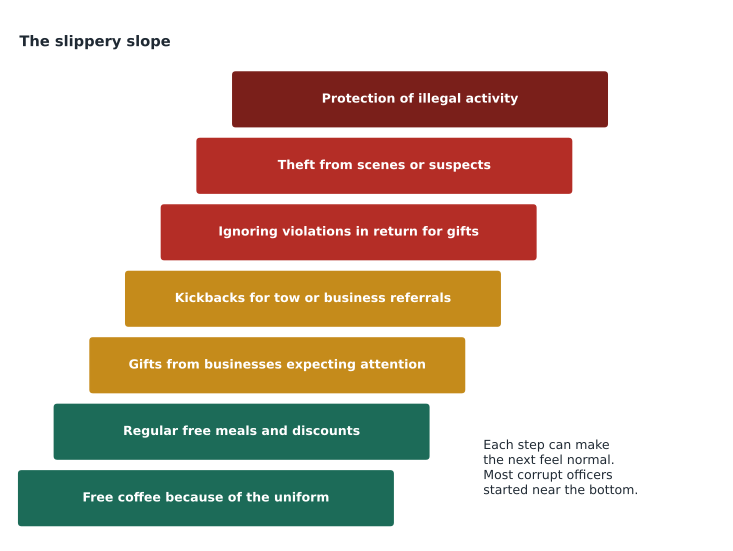
Misconduct is any breach of law or the code of conduct. Corruption is a narrower category: misuse of police authority for personal or organizational gain. Julian Roebuck and Thomas Barker published a widely used typology in 1974 that sorted corruption into kinds, from least to most serious: corruption of authority, such as accepting free meals and discounts because of the uniform; kickbacks, such as payment for referring business to tow trucks or lawyers; opportunistic theft from suspects, victims or crime scenes; shakedowns, demanding money not to enforce the law; protection of illegal activities such as gambling or drug dealing; the fix, making tickets or cases disappear; direct criminal activities, such as officers committing robberies or selling drugs; and internal payoffs, such as paying for preferred assignments. Later researchers added categories such as sexual misconduct, in which officers use their authority to exploit people, which research suggests is far more common than official records show.
Abuse of authority is a related category that does not always involve gain. It includes using force to punish or humiliate, making arrests to settle personal scores, harassing people the officer dislikes and using police databases to spy on former partners or neighbours. Desjardins notes that misuse of databases is one of the most common reasons officers are disciplined in many services today, because every query is logged and audits catch officers who look up people for personal reasons.
The gratuities debate
Gratuities are small gifts or discounts given to officers because of their role. Supporters argue that they are harmless expressions of appreciation, that they build relationships with businesses and that banning them insults both officers and the public. Critics argue that they create a sense of entitlement and obligation, that businesses expect better service in return, such as faster response or overlooked violations, and that they start officers on a slippery slope toward more serious corruption. Lawrence Sherman described the slope in 1985: officers who accept small benefits gradually redefine what is acceptable until larger benefits feel normal. The evidence for an automatic slope is mixed, and many officers accept a coffee their whole careers without ever taking a bribe. But nearly every corrupt officer studied by commissions of inquiry started small.
Services take different approaches. Some ban all gratuities. Others allow token items of minimal value offered to everyone, such as coffee at a community event, while prohibiting anything that is offered only because of the uniform or that could create an obligation. Most require gifts above a small value to be declared or refused. Port Ardent's policy bans gratuities offered because of police status, allows food and drink at community events open to the public, and requires officers to report any offer of a gift worth more than a token amount. Jesse's point about cultural protocols is handled by allowing officers to accept hospitality offered as part of ceremonies or community gatherings and to note it, rather than refuse in a way that would give offence.
| Test | Question to ask | Free coffee at a community event | Regular free meals at one restaurant |
|---|---|---|---|
| Who receives it? | Is it offered to everyone or only to police? | Everyone attending | Only uniformed officers |
| Why is it offered? | Is there an expectation, even unspoken? | Hospitality | Owner hopes for extra attention |
| How often? | Is it occasional or routine? | Occasional | Every shift |
| Would you disclose it? | Would you be comfortable telling your supervisor or the public? | Yes | Probably not |
| Does it affect duty? | Could it influence how you respond to the giver? | No | Possibly |
Lessons from the great inquiries
Major corruption scandals have been studied by commissions whose findings still shape policy. The Knapp Commission in New York, which reported in 1972 after testimony by officer Frank Serpico, distinguished grass-eaters, who passively accepted small payments as part of the culture, from meat-eaters, who actively sought out corrupt opportunities. It found that the grass-eaters were the heart of the problem, because their acceptance created the silence that protected the meat-eaters. In Canada, inquiries into wrongful convictions and police conduct, such as the Marshall inquiry in Nova Scotia and later reviews of drug squad investigations in several cities, have pointed to the same pattern: misconduct thrives where supervision is weak, records are poor and colleagues stay quiet.
Researchers describe three levels of explanation. The rotten apple theory says corruption comes from a few bad individuals, and the solution is better screening and removal. The rotten barrel theory says corruption comes from the culture and opportunities of particular units, such as drug or vice squads, and the solution is better supervision and rotation. The rotten orchard theory says the whole system, including political pressure, resources and laws, creates the conditions for corruption. The inquiries generally found that all three levels mattered, and that services which blamed only individuals tended to suffer the same problems again a decade later.
Sexual misconduct: the hidden form of abuse
One form of abuse of authority deserves separate attention because it is serious, under-reported and preventable. Police sexual misconduct ranges from inappropriate comments and unwanted contact with colleagues to officers using their power to pressure or coerce members of the public into sexual contact. Research by Philip Stinson and colleagues on arrests of officers in the United States found sex-related crimes among the most common offences for which officers are arrested, and studies in several countries have found that victims are disproportionately people with the least power to complain: young people, people in custody, people who sell sex, people who use drugs, undocumented migrants and victims of domestic violence who depend on police for protection. The power imbalance is the core of the harm. A person stopped late at night, or a victim who needs an officer's help, may feel unable to refuse.
Services reduce this risk with specific measures: clear policies prohibiting any sexual or romantic contact with people encountered in the course of duty, rules requiring that officers report the start and end mileage or time when transporting a person alone, GPS and body camera audits, care with assignments that involve vulnerable people such as youth programs, and complaint processes that people can use safely, including through advocates. Desjardins tells the class that most officers find such misconduct as abhorrent as the public does, and that the strongest protection is colleagues who notice warning signs, such as an officer making unnecessary repeat visits to a vulnerable complainant, and who act on them.
Why officers cross the line
Opportunity is the most consistent factor. Officers often work alone or in pairs, at night, around cash, drugs and vulnerable people, with wide discretion and little direct supervision. Units that handle seized money and drugs, or that work with informants, face the greatest temptations. The second factor is culture: when colleagues tolerate small lapses, officers learn that the real rule is different from the written one. The third is rationalization, from Lesson 3: they would have spent the money on drugs anyway, the business owner is getting value from my presence, the city underpays us. The fourth is personal pressure: debt, addiction, divorce and stress have been present in many cases of officer theft. None of these excuses misconduct, but understanding them helps services design prevention and helps officers recognize when they are at risk.
A benefit register
Many services now require officers to declare gifts, hospitality and secondary employment in a register that supervisors review. The register protects officers who declare honestly and helps detect patterns that no single declaration would reveal. The code below analyses a year of entries from a fictional Port Ardent register. It totals the value of declared benefits by giver, flags any giver whose total for the year exceeds a threshold and shows how often each giver appears, because frequency can matter as much as value.
# Port Ardent benefit register 2025 (fictional entries): officer, giver, value
from collections import defaultdict
entries = [
    ("Malhotra", "Lakeview Cafe", 4), ("Malhotra", "Community festival", 12), ("Haddad", "Rotary dinner", 45),
    ("Officer K", "Bayside Towing", 60), ("Officer K", "Bayside Towing", 80), ("Officer K", "Bayside Towing", 120),
    ("Officer R", "Lakeview Cafe", 4), ("Officer R", "Lakeview Cafe", 4), ("Officer R", "Lakeview Cafe", 4),
    ("Officer K", "Bayside Towing", 150), ("Haddad", "Youth soccer league", 20), ("Officer R", "Lakeview Cafe", 4),
]
THRESHOLD = 100
by_giver = defaultdict(lambda: {"total": 0, "count": 0, "officers": set()})
for officer, giver, value in entries:
    g = by_giver[giver]
    g["total"] += value
    g["count"] += 1
    g["officers"].add(officer)
for giver, g in sorted(by_giver.items(), key=lambda kv: -kv[1]["total"]):
    flag = "  <- review" if g["total"] > THRESHOLD or (g["count"] >= 4 and len(g["officers"]) == 1) else ""
print(f"{giver:20s} total {g['total']:4d} entries {g['count']} officers {len(g['officers'])}{flag}")Bayside Towing total 410 entries 4 officers 1 <- review Rotary dinner total 45 entries 1 officers 1 Lakeview Cafe total 20 entries 5 officers 2 Youth soccer league total 20 entries 1 officers 1 Community festival total 12 entries 1 officers 1
Two patterns stand out. Bayside Towing's gifts to a single officer total far more than the threshold and are increasing, which is a classic warning sign of a kickback arrangement in which an officer steers tow calls to a company. The café's gifts are tiny, but they go repeatedly to one officer, which suggests a routine rather than occasional hospitality. Neither pattern proves wrongdoing, and the officer who declared the café coffees was being honest. But both deserve a conversation with a supervisor, and the towing pattern would justify an audit of which tow companies that officer called.
Prevention
Services use a combination of measures to prevent corruption. Careful hiring, including background checks and integrity questions, screens out some high-risk candidates. Clear policies on gratuities, conflicts and secondary employment remove ambiguity. Close supervision, especially in high-risk units, and rotation of officers out of such units after a set period reduce opportunity. Audits of seized property, informant payments and database queries detect misconduct. Early intervention systems, described in Lesson 10, identify officers whose patterns suggest trouble. Integrity testing, in which officers are presented with staged opportunities, is used by some services and is controversial. And a culture in which reporting misconduct is expected and protected, rather than punished, is probably the most important measure of all.
Worked problem
The tow truck referral
Malhotra's new partner, an officer with fifteen years of service, tells him that whenever they attend a collision where the driver has no preference, they should call Bayside Towing, whose owner is generous at Christmas. The rotation list in the dispatch system shows that a different company is next in line.
Show solution
- Recognize the issue: steering tow calls for gifts is a kickback, one of the corruption types in the Roebuck and Barker typology, and it disadvantages other companies and possibly drivers.
- Check the rules: Port Ardent policy requires officers to use the dispatch rotation list when drivers have no preference, and to declare gifts.
- Identify options: follow the rotation and say nothing; follow the rotation and tell the partner why; report the arrangement to a supervisor; or a combination.
- Test the options: following the rotation is required. Saying nothing about an apparent kickback arrangement allows it to continue and fails the precedent and publicity tests.
- Act: use the rotation list, explain to the partner that he will follow policy, and report the arrangement, because a pattern of benefits tied to referrals is exactly what the code of conduct and benefit register exist to catch.
Answer: Malhotra should use the rotation list and report the arrangement. The partner's seniority makes this harder, which is why Lesson 10 discusses the code of silence and the protections available to officers who report.
Common mistakes
MistakeAccepting a free coffee is always corruption.
InsteadContext matters: hospitality offered to everyone at a community event differs from routine benefits offered only to officers. Clear policies help.
MistakeCorruption is caused by a few bad apples.
InsteadInquiries found that unit culture, opportunity, weak supervision and system pressures also matter, and that blaming individuals alone allows problems to recur.
MistakeDatabase lookups are harmless if nothing is done with the information.
InsteadPersonal queries breach confidentiality and privacy, are logged and audited, and are a common cause of discipline.
MistakeDeclaring a gift means admitting wrongdoing.
InsteadDeclaring is what honest officers do. Registers protect those who declare and help supervisors spot patterns.
Summary and key terms
- Corruption is the misuse of police authority for personal or organizational gain; misconduct is broader.
- Roebuck and Barker's typology runs from corruption of authority and kickbacks to protection of illegal activity and direct criminal acts.
- Gratuities are debated because of the risk of obligation and the slippery slope; services range from total bans to limited allowances with declaration.
- The Knapp Commission found that passive grass-eaters created the silence that protected active meat-eaters.
- Opportunity, culture, rationalization and personal pressure explain why officers cross the line.
- Prevention combines hiring, clear policy, supervision, rotation, audits, benefit registers, early intervention and a culture of reporting.
- Corruption
- Misuse of police authority for personal or organizational gain.
- Gratuity
- A gift or discount given to an officer because of the officer's role.
- Slippery slope
- The process by which small benefits gradually make larger ones seem acceptable.
- Kickback
- A payment or benefit received for steering business, such as tow referrals, to a particular company.
- Grass-eaters and meat-eaters
- The Knapp Commission's terms for officers who passively accept corrupt benefits and those who actively seek them.
- Benefit register
- A record in which officers declare gifts, hospitality and secondary employment for supervisory review.
Practice problems
Work each problem on paper first, then reveal the answer to check.
Name four types of corruption in Roebuck and Barker's typology.
Show answer
Corruption of authority, kickbacks, opportunistic theft, shakedowns (also protection of illegal activities, the fix, direct criminal activities, internal payoffs).
What did the Knapp Commission mean by grass-eaters, and why did it see them as the heart of the problem?
Show answer
Officers who passively accepted small corrupt benefits; their acceptance created the culture of silence that protected officers who actively sought corruption.
In the register example, why is Bayside Towing flagged?
Show answer
Its gifts to one officer total far more than the threshold and are increasing, suggesting a kickback for tow referrals.
Give three measures services use to prevent corruption.
Show answer
Clear gratuity and conflict policies, close supervision and rotation in high-risk units, and audits of property, informant payments and database queries.
Lesson quiz · 5 questions
Score 60% or more to complete this lesson.
Create a free account to save your progress, take quizzes and earn a certificate.