
LES-115 · Lesson 1 of 12 · 21 min
Victimology: the study of victims and their place in criminal justice
▶ Video coming soon A video version of this lesson is on the way.
Professor Ray Desjardins begins this course differently from the others. Instead of a statute or a case, he puts a single photograph on the screen: the front window of Lakeshore Hardware on Harbour Street, boarded with plywood the morning after the break-in the class has followed since LES-104. 'In every course so far, you have studied this file from the police side,' he says. 'Alarm times, the broadcast, the arrest, the search warrant, the release decision. Today I want you to think about the person who unlocked that door at 03:30 and found her shop of twenty-two years broken open.' Ruth Lindqvist, he reminds them, was a name on page one of the report and a signature on a property loss form. She was also the person most affected by everything that happened that night, and the person the system spoke to least.
He introduces his co-instructor for the course, Nadia Brooks, the executive director of Victim Services Port Ardent, the community agency that works alongside the police service to support victims from the first call. Brooks has spent sixteen years in victim services, first on a crisis line, then answering police call-outs at two in the morning, and now running a team of staff and volunteers. 'Police officers are often the first people a victim meets after the worst moment of their life,' she tells the class. 'What you do in the first ten minutes can shape how that person copes for months. My job is to help you do it well, and to know when to hand someone on to people like me.'
What victimology studies
Victimology is the scientific study of victims of crime: who they are, how they come to be victimized, how crime affects them, how they are treated by the justice system and by the people around them, and what helps them recover. It sits alongside criminology, which the class studied in LES-102 and which asks mainly about offenders and crime. Victimology asks the mirror questions. Why are some people and places victimized again and again? Why do most victims never call the police? What does a burglary, an assault or a fraud do to a person's sense of safety? Which forms of support actually make a difference?
Brooks distinguishes three strands of the field. Theoretical victimology tries to explain patterns of victimization, using ideas such as lifestyle, routine activities and vulnerability, which the class will study in Lesson 2. Applied victimology, sometimes called assistance-oriented victimology, studies the needs of victims and the services that respond to them, from crisis support to compensation. Critical victimology asks who gets recognized as a victim at all, whose harm is counted, and how power, race, gender, poverty and colonialism shape the answers. All three matter to police officers, she says, because officers decide in practice who is treated as a victim, whose report is taken seriously and who is offered help.
Early victimology: victim precipitation and its critics
The first victimologists, writing in the 1940s and 1950s, were mainly interested in the victim's role in the crime. Hans von Hentig's 1948 book The Criminal and His Victim argued that some people are more prone to victimization because of characteristics such as age, mental illness or isolation. Benjamin Mendelsohn, a lawyer who is often credited with coining the word victimology, classified victims by how much responsibility he thought they bore, from completely innocent to more guilty than the offender. In 1958 Marvin Wolfgang's study of homicides in Philadelphia found that in about a quarter of cases the person who died had been the first to use force, and he called these cases victim-precipitated.
Desjardins asks the class what is wrong with this approach. Amara Okafor answers first: it can slide from explaining a pattern to blaming a person. The clearest example came in 1971, when Menachem Amir applied the idea of victim precipitation to rape and suggested that some victims had contributed to their own assaults through their behaviour, their clothing or their reputation. The study was strongly criticized for relying on police files that reflected the officers' own assumptions, and for treating myths about sexual violence as findings. Brooks tells the class that the damage outlived the study. For decades, victims of sexual assault were questioned about what they wore, how much they drank and why they did not fight back, as though those questions explained the crime. Much of the modern law on sexual offences, which the class will meet in LES-212, was written to stop that.
The lesson for officers, Brooks says, is not that victims never do anything risky. People walk home late, leave doors unlocked and trust people who turn out to be dangerous. The lesson is that understanding risk is for prevention, and that responsibility for a crime belongs to the person who committed it. An officer can tell a victim how to reduce the risk of a repeat burglary without suggesting that the first burglary was their fault.
The victims' movement
From the late 1960s onward, victimology changed direction. Feminist activists opened the first rape crisis centres and shelters for women leaving abusive partners, usually with almost no money and in the face of police and courts that often did not take their work seriously. Parents of murdered children formed support and advocacy groups. Researchers began to document how badly victims were treated: kept uninformed, made to wait for hours in courthouse hallways beside the accused, called to testify and then never told the outcome. In 1980 the psychiatrist Martin Symonds described the cold or blaming responses of police and others as a second injury, a harm added to the harm of the crime itself. Today the term secondary victimization is used for the same idea, and Lesson 5 is devoted to avoiding it.
The reforms came in waves. New Zealand created the first state compensation scheme for victims of violent crime in 1963, following a campaign by the English penal reformer Margery Fry, and Britain followed in 1964. Saskatchewan created the first Canadian scheme in 1967, and every province eventually followed. In 1985 the United Nations adopted the Declaration of Basic Principles of Justice for Victims of Crime and Abuse of Power, which set out four basic entitlements: access to justice and fair treatment, restitution from offenders, compensation from the state where restitution is not available, and assistance. In 1988 the federal, provincial and territorial governments of Canada agreed on a Canadian Statement of Basic Principles of Justice for Victims of Crime, updated in 2003, and provinces passed their own victims' rights laws, including Ontario's Victims' Bill of Rights in 1995. The Office of the Federal Ombudsman for Victims of Crime opened in 2007, now called the Office of the Federal Ombudsperson for Victims of Crime, and the Canadian Victims Bill of Rights came into force in 2015.
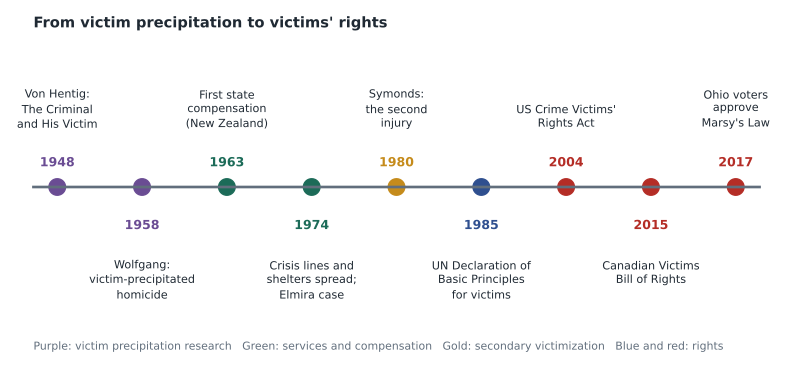
Who counts as a victim
Brooks asks the class to define a victim. Priya Sandhu suggests the person a crime was committed against. Brooks agrees that this is the core, but points out that the legal definitions are wider. The Canadian Victims Bill of Rights defines a victim as an individual who has suffered physical or emotional harm, property damage or economic loss as the result of the commission or alleged commission of an offence. When the victim has died or cannot act, a spouse, common-law partner, relative or dependant may exercise the victim's rights. The words alleged commission matter: a person is a victim from the moment they report, long before anyone is convicted, and their rights do not wait for the outcome of the trial.
Victimologists also use wider terms. Co-victims or survivors of homicide are the family and close friends of a person who was killed. Indirect victims include witnesses, children who live with violence at home, and communities affected by a hate crime or a mass shooting. Some victims are businesses, like Lakeshore Hardware, though the harm always lands on people in the end: an owner who loses sleep, staff who no longer feel safe closing up at night. Jesse Morningstar adds that whole communities can be harmed by crimes that the system has not always counted as crimes at all, and Brooks agrees that this is exactly the question critical victimology asks.
Many people who have been harmed prefer the word survivor, especially after sexual or family violence, because it emphasizes strength rather than injury. Others prefer victim, because it names the wrong that was done to them, and some use neither. Brooks's advice is simple: in legal documents use the legal term, and in conversation listen to the words a person uses about themselves and use them back.
Victims and the police
Desjardins closes the first half of the lesson by connecting victimology to everyday police work. Most calls for service begin with a victim or a witness, and most crimes are solved because a victim reports promptly, describes what happened and stays involved until the case is over. Research on procedural justice, which the class studied in LES-101, shows that victims judge the police less by whether an arrest is made than by how they were treated: whether the officer listened, explained what would happen next, kept them informed and treated them with respect. A victim who feels dismissed may not report next time, and may tell everyone they know not to bother.
Officers also carry legal duties to victims. Under the Canadian Victims Bill of Rights and provincial laws, police must give victims information about the investigation, the services available and the complaint process, and Ontario police services refer victims to local victim services agencies. Brooks tells the class that the most common complaint she hears is not that police were rude. It is that nobody called back.
The police service keeps track of how often officers connect victims with support. The program below shows the kind of summary Sergeant Lisa Haddad reviews each quarter: the number of victims referred to victim services from different types of calls, and how many of them accepted contact.
# Port Ardent: referrals to victim services in one quarter, by call type
referrals = {
    "assault": (212, 151),
    "intimate partner violence": (188, 160),
    "break and enter": (96, 41),
    "robbery": (34, 27),
    "fraud": (58, 22),
    "sudden death": (19, 17),
}
total_ref = sum(r for r, a in referrals.values())
total_acc = sum(a for r, a in referrals.values())
print("referrals:", total_ref, "accepted:", total_acc, "share:", round(total_acc / total_ref, 2))
for kind, (r, a) in sorted(referrals.items(), key=lambda kv: kv[1][1] / kv[1][0]):
print(f"{kind:27} {r:4} {a:4} {a / r:.2f}")referrals: 607 accepted: 418 share: 0.69 fraud 58 22 0.38 break and enter 96 41 0.43 assault 212 151 0.71 robbery 34 27 0.79 intimate partner violence 188 160 0.85 sudden death 19 17 0.89
Victims of property crime and fraud accepted contact far less often than victims of violence. Brooks says that is partly reasonable, since many people want only a case number for their insurer. But she has also seen what sits behind some of those refusals: an older fraud victim too ashamed to talk, a shop owner who assumed services were only for people who were hurt. Part of the officer's job is to explain what services can offer, and to make the referral in a way that makes saying yes easy. Lesson 8 covers how to do that.
Following three victims through the course
The class will follow three Port Ardent victims through the course. The first is Ruth Lindqvist, the owner of Lakeshore Hardware, whose shop was broken into on the night of March 14, 2026. The second is Grace Whitford, a 79-year-old retired schoolteacher who lost 18,400 dollars to a telephone fraud in which a caller pretended to be her grandson in trouble with the police. The third is Daniel Ferreira, a 24-year-old line cook who moved to Port Ardent from Brazil two years ago and was assaulted and robbed of his phone and wallet while walking home from a late shift; he was injured and needed surgery to his jaw. None of them had ever been a victim of crime before, and each needed something different from the police and the people around them.
Desjardins asks the class to keep a simple question in mind for each of them, in every lesson that follows: what did this person need at this moment, and who was responsible for making sure they got it?
Worked problem
Recognizing a victim's needs at first contact
Officer Malhotra arrives at Lakeshore Hardware at 03:35 to stay with Ruth Lindqvist while the scene is examined. She is shaking, keeps apologizing for the mess, and says she should have installed a better alarm. Using the ideas in this lesson, what does she need from him in the next half hour?
Show solution
- Safety and reassurance: tell her the suspect is in custody and that the shop is secure, so she is not left wondering whether someone is still nearby.
- Avoid any suggestion of blame: when she criticizes her alarm, respond that the break-in is the responsibility of the person who did it, and offer prevention advice later rather than now.
- Information: explain what officers are doing in the shop, roughly how long it will take, and what she can and cannot touch.
- Rights and services: give her the victim information card with the file number, the investigating officer's name and the number for Victim Services Port Ardent, and ask whether she would like a call from them.
- A next step: tell her when and how someone will contact her, and make sure it happens.
Answer: She needs safety, freedom from blame, clear information about what is happening, her rights and a referral, and a reliable promise about what happens next.
Common mistakes
MistakeVictimology is mainly about how victims cause crimes.
InsteadModern victimology studies patterns of victimization, the effects of crime, victims' treatment and recovery; explaining risk is not blaming.
MistakeA person is only a victim once someone is convicted.
InsteadLegal definitions protect people harmed by an offence or alleged offence from the moment they report.
MistakeVictims judge the police mainly by whether an arrest was made.
InsteadResearch shows victims weigh how they were treated and kept informed at least as heavily as the outcome.
MistakeBusinesses are not real victims.
InsteadBusinesses can be victims, and the harm falls on owners and staff.
Summary and key terms
- Victimology studies who is victimized, the effects of crime, how victims are treated and what helps them recover.
- Early ideas of victim precipitation were criticized for sliding into victim blaming, especially in Amir's study of rape.
- The victims' movement produced crisis centres, shelters, compensation schemes, the 1985 UN Declaration and national rights laws.
- Legal definitions of a victim include people harmed by an alleged offence and, in some cases, family members.
- Victims judge police by how they are treated, informed and followed up, and police have legal duties to inform and refer them.
- Victimology
- The scientific study of victims, victimization, its effects and responses to it.
- Victim precipitation
- The idea that a victim's own actions started or contributed to the crime; now used with great caution.
- Secondary victimization
- Further harm caused to a victim by the response of officials, institutions or other people.
- Co-victim
- A family member or close friend of a person who was killed.
- Critical victimology
- The strand of victimology that asks whose harm is recognized and how power shapes the answer.
- Survivor
- A term many people prefer to victim, emphasizing strength and recovery.
Practice problems
Work each problem on paper first, then reveal the answer to check.
Name the three strands of victimology Brooks describes.
Show answer
Theoretical, applied or assistance-oriented, and critical victimology.
What did Symonds mean by the second injury?
Show answer
The added harm caused when police and others respond to a victim with coldness or blame.
In the code example, which call type had the lowest share of referrals accepted?
Show answer
Fraud, 22 of 58, about 0.38.
Why do the words alleged commission matter in the definition of a victim?
Show answer
Because a person has victims' rights from the time they report, not only after a conviction.
Lesson quiz · 5 questions
Score 60% or more to complete this lesson.
Create a free account to save your progress, take quizzes and earn a certificate.