
LES-115 · Lesson 7 of 12 · 19 min
Victims in the court process: information, protection and impact statements
▶ Video coming soon A video version of this lesson is on the way.
Three weeks after the assault on Front Street, detectives identified the man who attacked Daniel Ferreira. Video from a convenience store showed him using Daniel's bank card at 01:40, and the phone that had been taken was traced to his apartment. Corey Vance, 27, was arrested and charged with robbery and assault causing bodily harm. For Daniel, the arrest was a relief, and the start of a process he did not understand. 'I thought the police had finished,' he told Brooks later. 'Then I found out it was just beginning, and that it would take most of a year.' This lesson follows a victim through that process and looks at the information, protection and participation the law provides at each stage.
The stages of a criminal case
Margaret Liu returns to walk the class through the stages, from the victim's point of view. After a charge is laid, the accused either is released by police or appears before a justice for a bail hearing. The case then moves through a series of appearances in the Ontario Court of Justice, where disclosure is provided, the Crown and defence discuss resolution, and dates are set. For serious indictable offences, the accused may elect a trial in the Superior Court of Justice and may have a preliminary inquiry. The case ends in a plea, a trial, a withdrawal or a stay. If there is a conviction, the court sentences the offender, and the victim's role continues into corrections and parole. At almost every stage, a decision can affect the victim's safety or their chance to participate, and most victims do not know the stages exist.
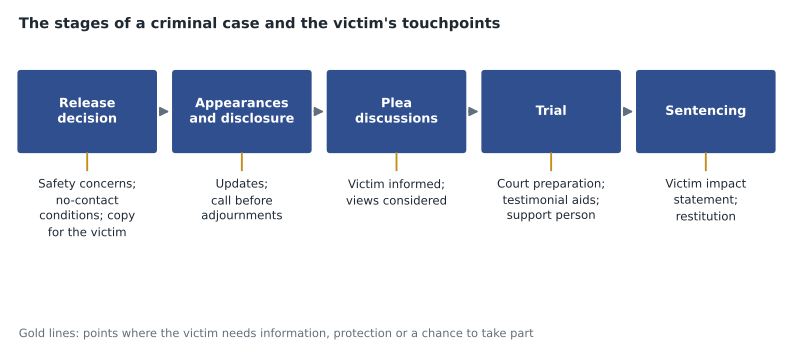
Safety at the release stage
The first decision that matters to most victims is whether the accused will be released, and on what conditions. Section 515(13) of the Criminal Code requires a justice who makes a release order to state that they considered the safety and security of every victim, and section 515(4.2) allows conditions such as no contact with the victim and staying away from places they frequent. The victim is entitled on request to a copy of the release order. Police and Crown should tell the justice about any safety concerns the victim has raised. Vance was ordered to have no contact with Daniel and to stay away from Front Street and the restaurant where he worked. Daniel learned the conditions from a phone call from the detective the same afternoon, and Brooks gave him a copy to keep with him.
Brooks explains why the copy matters. If Vance had approached Daniel, Daniel could show the order to the first officer he saw, and the officer could confirm it and arrest for the breach. A victim who knows the conditions is safer than one who has only been told that conditions exist.
Information and court preparation
Between the charge and the outcome, cases often take many months, with appearances that seem to accomplish nothing and dates that move without warning. Victims who are not kept informed fill the silence with worry. In Ontario, the Victim/Witness Assistance Program, run by the Ministry of the Attorney General and staffed by workers based at courthouses, contacts victims in many cases after charges are laid. Workers explain the process, provide updates on dates and outcomes, pass the victim's views to the Crown, arrange court tours, and help victims prepare to testify. Court preparation does not mean telling the victim what to say. It means explaining where to go, who will be in the room, what the lawyers will do, how cross-examination works, and that it is fine to say 'I don't know' or 'I don't remember.' Liu tells the class that well-prepared witnesses are calmer, clearer and more accurate.
The program below summarizes how long Daniel's case took and how much of that time was spent waiting.
# Daniel's case: court events from arrest to sentence
from datetime import date
events = [
    (date(2026, 4, 23), "arrest and release on conditions", False),
    (date(2026, 5, 12), "first appearance", False),
    (date(2026, 6, 16), "appearance adjourned for disclosure", True),
    (date(2026, 7, 21), "appearance adjourned, lawyer not ready", True),
    (date(2026, 9, 8), "pretrial conference", False),
    (date(2026, 11, 3), "trial date set", False),
    (date(2027, 1, 19), "guilty plea to robbery", False),
    (date(2027, 3, 2), "sentencing hearing", False),
]
start, end = events[0][0], events[-1][0]
adjourned = sum(1 for d, what, adj in events if adj)
print("days from arrest to sentence:", (end - start).days)
print("court events:", len(events) - 1, "adjournments:", adjourned)
gaps = [(events[i + 1][0] - events[i][0]).days for i in range(len(events) - 1)]
print("longest wait between events:", max(gaps), "days")days from arrest to sentence: 313 court events: 7 adjournments: 2 longest wait between events: 77 days
The case took more than ten months, with seven court events and two adjournments, and the longest wait between events was 77 days. Liu tells the class that this was a fairly ordinary pace for a serious assault, well within the limits set by the Supreme Court in R. v. Jordan. To Daniel it felt endless. Each adjournment meant a phone call he dreaded, and each new date meant arranging time off work. Brooks says the simple fix is to call the victim before they hear about a delay any other way, and to tell them why it happened.
Privacy and the media
Victims often worry about who will learn what happened to them. Court proceedings are generally public, and victims' names can appear in court documents and news reports. The law offers some protection. Publication bans can prohibit publishing information that could identify a victim or witness, and are mandatory on request in sexual offence cases and for witnesses under 18 in many cases. The Canadian Victims Bill of Rights gives victims the right to request that their identity be protected from public disclosure. Brooks adds that police have their own role. News releases should give the information the public needs without identifying victims unnecessarily, and officers should never share details of a victim's experience on social media or in casual conversation. Grace Whitford asked specifically that her name not appear in any media release about the fraud, because she was afraid her former students would find out. The service's release described her only as an older resident.
Testifying: aids and protections
For many victims the most frightening part of the process is testifying in front of the accused. The law provides a range of measures to make this easier and to help victims give their best evidence. The Criminal Code allows a support person to sit near a witness while they testify under section 486.1; a screen or closed-circuit television so the witness does not have to see the accused under section 486.2; an order preventing a self-represented accused from personally cross-examining the witness under section 486.3, with a lawyer appointed to do it instead; and orders protecting the witness's identity under sections 486.31 and 486.5, and in sexual offence cases a mandatory publication ban on request under section 486.4. For witnesses under 18 and witnesses with disabilities that make communication difficult, the support person and testimonial aids are generally granted on application unless they would interfere with the proper administration of justice, and a video-recorded statement made soon after the offence can be admitted as evidence under section 715.1 if the witness adopts it in court.
Brooks adds the practical supports that matter as much as the legal ones: a separate waiting room so the victim does not sit in the hallway beside the accused's family, a chance to see the courtroom beforehand, an interpreter booked in advance, and someone to explain what happened afterward. Daniel was scheduled to testify through a Portuguese interpreter and had toured the courtroom twice before the trial date. In the end he did not have to testify.
Pleas and the victim's voice
Most criminal cases end in guilty pleas, often to fewer or less serious charges than were originally laid. For victims, a plea can bring relief, because they do not have to testify, or anger, because the outcome seems to minimize what happened. The law tries to make sure victims are informed and their views are considered. Section 606(4.1) of the Criminal Code requires a judge accepting a plea agreement for murder or a serious personal injury offence to ask the Crown whether reasonable steps were taken to inform the victim of the agreement, and for other offences carrying five years or more if the victim has asked to be informed. The judge is not required to reject a plea if the victim was not informed, but the question makes it much less likely to be forgotten. Vance pleaded guilty to robbery three weeks before trial, in exchange for the withdrawal of the second charge and a joint position on sentence. Liu called Daniel the week before to explain the offer and ask for his views. He was disappointed that the second charge would be dropped, but said that not having to testify mattered more to him. Liu put his views on the record.
Victim impact statements
After a conviction, the victim can tell the court how the crime affected them. Section 722 of the Criminal Code requires the court to consider a victim impact statement, prepared in the form set out in the Code, that describes the physical or emotional harm, property damage or economic loss suffered. The victim can read the statement aloud, present it in another way the court permits, such as by video, and can include a photograph of themselves or, in some cases, of a victim who has died. The statement must not include comments about the offender or the offence that are unrelated to the harm, allegations that have not been proved, or, unless the court allows it, a recommendation about the sentence. Section 722.2 allows a community impact statement describing harm to a community.
Research on impact statements is mixed but useful. They rarely change sentences much, and some victims who expected their statement to bring a longer sentence have been disappointed. But many victims say that being able to tell the court, and the offender, what the crime did to them was one of the most important parts of the process. Brooks tells victims to write the statement for themselves, not for the sentence. Daniel read his statement through an interpreter. He described the surgery, the months of soft food, the shifts he could not work, and walking home a different way every night. He ended by saying that he had come to Canada to build a life and that he would not let one night take it from him. Liu told the class it was one of the most effective statements she had heard.
Worked problem
Helping a victim prepare an impact statement
Ruth Lindqvist wants to submit an impact statement at Kyle Brandt's sentencing. Her draft says he is a lazy thief who should be locked up for years, and lists the break-in at the bicycle shop as well as hers. How should Brooks help her?
Show solution
- Explain the purpose: the statement is her chance to describe how the crime affected her, and the court must consider it.
- Explain the limits: it should describe harm and loss, not insult the offender, and should not mention other offences unless he was convicted of them; a sentence recommendation is limited.
- Help her focus on effects: the financial loss, the days the shop was closed, her fear when locking up and her lost sleep.
- Offer choices: she can read it aloud, have someone else read it, or simply file it in writing.
- Prepare her for the outcome: the statement matters, but the sentence will depend on many factors, and she should not measure its value by the length of the sentence.
Answer: Brooks helps Ruth turn the draft into a description of her own harm and losses, explains the rules and choices, and prepares her for the sentencing decision.
Common mistakes
MistakeThe victim's role ends when the police lay a charge.
InsteadVictims have rights at release, during the court process, at pleas and sentencing, and afterward.
MistakeCourt preparation means coaching the victim's evidence.
InsteadIt means explaining the process and the courtroom, never telling the victim what to say.
MistakeA victim impact statement can say anything the victim wants.
InsteadIt must describe harm and loss and follow limits on comments about the offender, unproved allegations and sentence recommendations.
MistakeIf a victim is not consulted, a plea must be rejected.
InsteadCourts must ask whether the victim was informed, but the decision remains with the prosecutor and the court.
Summary and key terms
- Victims meet the justice process at release, court appearances, pleas, trial and sentencing.
- Release decisions must consider victim safety, and no-contact conditions are common; victims should have a copy.
- The Victim/Witness Assistance Program informs and prepares victims for court.
- Testimonial aids and other protections help victims give their best evidence.
- Victims must be informed about pleas in serious cases and their views considered.
- Victim impact statements describe harm and loss, and many victims value them whatever the sentence.
- Release order
- An order releasing an accused before trial, often with conditions.
- Victim/Witness Assistance Program
- Ontario's court-based program that informs and supports victims and witnesses.
- Testimonial aid
- A screen, closed-circuit television or support person that helps a witness testify.
- Plea agreement
- An agreement in which the accused pleads guilty, often to reduced charges or a joint sentence position.
- Victim impact statement
- A statement describing the harm and loss a victim suffered, considered at sentencing.
- Community impact statement
- A statement describing harm to a community, under section 722.2.
Practice problems
Work each problem on paper first, then reveal the answer to check.
Why should a victim carry a copy of release conditions?
Show answer
So they can show an officer the conditions if the accused breaches them.
What does court preparation include?
Show answer
Explaining the process, the courtroom and cross-examination, without telling the victim what to say.
In the code example, how many days passed from arrest to sentence?
Show answer
313 days.
Why do many victims value impact statements even when they do not change the sentence?
Show answer
Because they can tell the court and the offender what the crime did to them.
Lesson quiz · 5 questions
Score 60% or more to complete this lesson.
Create a free account to save your progress, take quizzes and earn a certificate.