
MATH-101 · Lesson 3 of 5 · 44 min
Centroids and moments
Where does a plate balance? Where does the resultant of a distributed load act? Where is the neutral axis of a beam, and how stiff is the beam in bending? These questions all come down to moments: integrals that weight each small piece of an object by its distance from an axis.
This lesson develops first moments, which locate centroids and centres of mass, and second moments of area, which measure how a cross-section resists bending. Both are among the most-used integrals in structural and mechanical engineering, and the methods you learn here are exactly the ones in your mechanics of solids and design courses.
Moments and balance
Picture a light rod with masses \(m_1, m_2, \ldots\) at positions \(x_1, x_2, \ldots\). Each mass has a moment \(m_i x_i\) about the origin: its tendency to turn the rod. The rod balances at the point \(\bar{x}\) where the total moment equals the total mass placed there:
This is a weighted average of the positions. A heavy mass pulls the balance point toward itself.
For a continuous object, replace the sum with an integral. If a rod lying along \([a, b]\) has density \(\rho(x)\) (mass per unit length), a short piece of length \(dx\) has mass \(\rho(x)\,dx\) and moment \(x\,\rho(x)\,dx\):
Worked problem
A tapered rod
A 3 m rod gets heavier toward one end: its density is \(\rho(x) = 2 + x\) kg/m. Find its mass and centre of mass.
Show solution
- Mass: \(\int_0^3 (2 + x)\,dx = 6 + 4.5 = 10.5\) kg.
- Moment: \(\int_0^3 x(2 + x)\,dx = \left[x^2 + \tfrac13x^3\right]_0^3 = 9 + 9 = 18\) kg·m.
- \(\bar{x} = 18/10.5 \approx 1.71\) m.
Answer: Mass 10.5 kg, centre of mass 1.71 m from the light end, past the 1.5 m midpoint as expected
Centroids of plane regions
For a flat plate of uniform thickness and material, the centre of mass depends only on the shape. This geometric balance point is the centroid. Engineers need centroids constantly, because:
- a uniformly distributed load acts as a single force through the centroid of the load diagram;
- the neutral axis of a beam in bending passes through the centroid of its cross-section;
- the resultant of water pressure on a surface is found from moments of the pressure distribution.
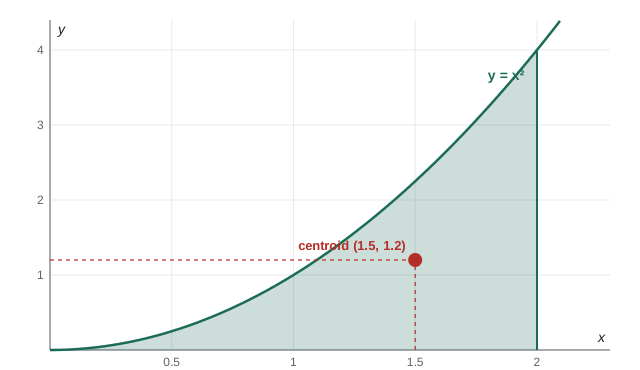
For the region under \(y = f(x)\) from \(a\) to \(b\), a vertical strip has area \(f(x)\,dx\), its own centroid at \(\big(x, \tfrac12 f(x)\big)\), and therefore moments \(x f(x)\,dx\) about the y-axis and \(\tfrac12 f(x)\cdot f(x)\,dx\) about the x-axis:
The integrals \(\int x\,dA\) and \(\int y\,dA\) are called the first moments of area, written \(Q_y\) and \(Q_x\). The first moment \(Q\) reappears in beam theory, where it determines the shear stress at each level of a cross-section.
Worked problem
Centroid under a parabola
Find the centroid of the region under \(y = x^2\) from \(x = 0\) to \(x = 2\).
Show solution
- Area: \(A = \int_0^2 x^2\,dx = \tfrac83\).
- \(\bar{x} = \dfrac{1}{A}\int_0^2 x^3\,dx = \dfrac{3}{8}\cdot 4 = 1.5\).
- \(\bar{y} = \dfrac{1}{A}\int_0^2 \tfrac12 x^4\,dx = \dfrac{3}{8}\cdot\dfrac{16}{5} = 1.2\).
Answer: (1.5, 1.2)
Worked problem
Centroid of a semicircle
Find the centroid of a semicircular region of radius \(r\) (the upper half of \(x^2 + y^2 \le r^2\)).
Show solution
- By symmetry, \(\bar{x} = 0\). The area is \(\tfrac12\pi r^2\).
- With \(f(x) = \sqrt{r^2 - x^2}\): \(\int_{-r}^{r}\tfrac12(r^2 - x^2)\,dx = \tfrac12\left(2r^3 - \tfrac23r^3\right) = \tfrac23r^3\).
- \(\bar{y} = \dfrac{\tfrac23 r^3}{\tfrac12\pi r^2} = \dfrac{4r}{3\pi}\).
Answer: ȳ = 4r/(3π) ≈ 0.424r above the flat edge
Standard results
A few centroids are used so often that it is worth remembering them:
- Rectangle: at the centre.
- Triangle: one-third of the height up from the base (two-thirds down from the apex).
- Semicircle: \(4r/(3\pi)\) from the flat edge.
- Quarter circle: \(4r/(3\pi)\) from each straight edge.
- Region under \(y = kx^n\) from 0 to \(b\): \(\bar{x} = \dfrac{n+1}{n+2}b\).
Composite shapes
Real cross-sections, such as T-beams, angles, channels and built-up girders, are made of simple pieces. Their centroid is the area-weighted average of the pieces' centroids:
A hole counts as a negative area. In practice, engineers set this up as a table: one row per piece, with columns for area, centroid position and area × position.
Worked problem
Centroid of a T-section
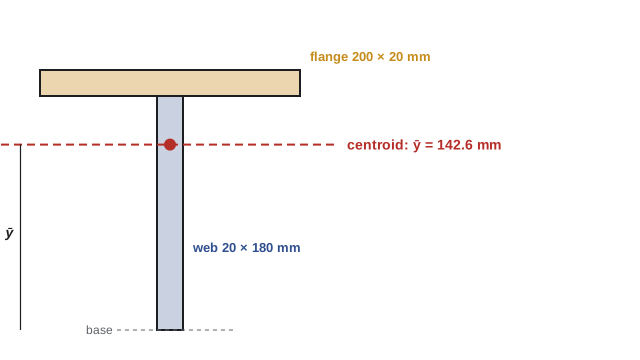
A T-beam has a 200 mm × 20 mm flange on top of a 20 mm × 180 mm web, giving an overall depth of 200 mm. Find the height of its centroid above the base.
Show solution
- Flange: area \(200 \times 20 = 4000\) mm², centroid \(180 + 10 = 190\) mm above the base.
- Web: area \(20 \times 180 = 3600\) mm², centroid 90 mm above the base.
- \[\bar{y} = \frac{4000(190) + 3600(90)}{4000 + 3600} = \frac{760\,000 + 324\,000}{7600} = 142.6 \text{ mm}\]
Answer: 142.6 mm above the base. The neutral axis of this beam is at this height
The theorem of Pappus
Centroids give a shortcut for volumes of revolution. When a region of area \(A\) is rotated about an axis it does not cross, the volume swept out is the area times the distance travelled by its centroid:
Worked problem
Volume of a ring
An O-ring is formed by rotating a circle of radius 0.1 m about an axis 0.5 m from its centre. Find its volume.
Show solution
- \(A = \pi(0.1)^2\) and \(\bar{r} = 0.5\).
- \(V = 2\pi(0.5)\cdot\pi(0.01) = 0.01\pi^2 \approx 0.0987\) m³.
Answer: About 0.099 m³. Doing this with shells would take a page of work
Second moment of area
The first moment, \(\int y\,dA\), finds where an area balances. The second moment of area, often called the area moment of inertia,
measures how far the area is spread from an axis. Squaring the distance means area far from the axis counts heavily. This is what makes a beam stiff in bending. The bending stress in a beam is \(\sigma = My/I\) and its deflection is inversely proportional to \(EI\), so a larger \(I\) means lower stresses and less sag.
Worked problem
Rectangle about its centroid
Find the second moment of area of a \(b \times h\) rectangle about the horizontal axis through its centroid.
Show solution
- Slice into horizontal strips at height \(y\) (measured from the centroid) with area \(dA = b\,dy\).
- \[I = \int_{-h/2}^{h/2} y^2\,b\,dy = b\left[\frac{y^3}{3}\right]_{-h/2}^{h/2} = \frac{bh^3}{12}\]
Answer: I = bh³/12. The height is cubed, so depth matters far more than width
Worked problem
A joist on edge versus flat
A 50 mm × 200 mm timber joist can be laid on edge (200 mm deep) or flat (50 mm deep). Compare the second moments of area.
Show solution
- On edge: \(I = \dfrac{50 \times 200^3}{12} \approx 33.3 \times 10^6\) mm⁴.
- Flat: \(I = \dfrac{200 \times 50^3}{12} \approx 2.08 \times 10^6\) mm⁴.
- Ratio: 16.
Answer: On edge it is 16 times stiffer, from exactly the same piece of wood. That is why joists are always installed on edge
The parallel axis theorem
To find \(I\) for a composite section about its centroid, you need each piece's \(I\) about that same axis. The parallel axis theorem shifts a second moment from a piece's own centroid to any parallel axis a distance \(d\) away:
Worked problem
Stiffness of the T-section
Find the second moment of area of the T-section above about its centroidal axis (ȳ = 142.6 mm).
Show solution
- Flange: \(I_c = \dfrac{200 \times 20^3}{12} = 133\,333\) mm⁴, and \(d = 190 - 142.6 = 47.4\) mm, so \(Ad^2 = 4000 \times 47.4^2 \approx 8.98 \times 10^6\). Total \(\approx 9.11 \times 10^6\) mm⁴.
- Web: \(I_c = \dfrac{20 \times 180^3}{12} = 9.72 \times 10^6\) mm⁴, and \(d = 142.6 - 90 = 52.6\) mm, so \(Ad^2 \approx 9.97 \times 10^6\). Total \(\approx 19.69 \times 10^6\) mm⁴.
- Sum: \(I \approx 28.8 \times 10^6\) mm⁴.
Answer: About 28.8 × 10⁶ mm⁴. Notice how much comes from the Ad² terms: moving area away from the centroid is what builds stiffness
This is the reason I-beams look the way they do. Most of the material sits in the flanges, far from the neutral axis, where it contributes the most to \(I\). The thin web holds the flanges apart and carries shear.
Mass moment of inertia
The second moment of area has a twin for rotating bodies. The mass moment of inertia,
measures how hard a body is to spin up or slow down, just as mass measures resistance to linear acceleration. You met it in Mechanics as \(I = \tfrac12 MR^2\) for a solid disk. Now you can derive it.
Worked problem
A solid disk
Find the moment of inertia of a uniform disk of mass \(M\) and radius \(R\) about its central axis.
Show solution
- Slice the disk into thin rings. A ring at radius \(r\) of width \(dr\) has area \(2\pi r\,dr\). With mass per unit area \(\sigma = M/(\pi R^2)\), its mass is \(dm = \sigma\,2\pi r\,dr\).
- Every bit of the ring is at distance \(r\) from the axis, so it contributes \(r^2\,dm\).
- \[I = \int_0^R r^2\,\sigma\,2\pi r\,dr = 2\pi\sigma\frac{R^4}{4} = \frac{\pi\sigma R^4}{2} = \frac12 MR^2\]
Answer: I = ½MR²
For a thin ring, where all the mass is at radius \(R\), the same idea gives \(I = MR^2\), twice as much. This is why flywheels are often built with heavy rims and light spokes: mass far from the axis stores more rotational energy for the same weight.
Worked problem
Energy in a flywheel
A 50 kg solid steel flywheel of radius 0.3 m spins at 3000 rpm. How much kinetic energy does it store?
Show solution
- \(I = \tfrac12(50)(0.3)^2 = 2.25\) kg·m².
- \(\omega = 3000 \times 2\pi/60 \approx 314.2\) rad/s.
- \(E = \tfrac12 I\omega^2 = \tfrac12(2.25)(314.2)^2 \approx 111\,000\) J.
Answer: About 111 kJ. As a thin rim of the same mass and radius it would store twice as much, about 222 kJ
The parallel axis theorem works for mass moments too: \(I = I_c + Md^2\). Engineers use it for connecting rods, robot arms and any part that rotates about a point other than its centre of mass.
Centre of pressure
The same ideas locate where a distributed force acts. On a vertical rectangular gate holding water of depth \(H\), the pressure grows linearly with depth. Its resultant acts at the centroid of the triangular pressure diagram: two-thirds of the way down, at depth \(\tfrac23H\). In general, the depth of the centre of pressure is \(\bar{h} + \dfrac{I_c}{A\bar{h}}\), which uses both a centroid and a second moment of area. Gates, dams and retaining walls are all designed using this result.
Common mistakes
MistakeForgetting to divide the moment by the total area or mass.
InsteadA centroid is a weighted average: x̄ = (∫x dA)/A. The moment alone has units of length cubed, not length.
MistakeUsing f(x) instead of ½f(x) in the ȳ integral.
InsteadEach vertical strip's centroid is at half its height, so its moment about the x-axis is ½[f(x)]² dx.
MistakeMeasuring each piece's centroid from different reference lines in a composite shape.
InsteadChoose one datum (often the base) and measure every ȳᵢ from it.
MistakeAdding second moments of pieces about their own centroids without shifting them.
InsteadMove each to the common axis with the parallel axis theorem, I = I_c + Ad², before adding.
MistakeMixing up first and second moments, or using bh³/12 with b and h swapped.
InsteadIn bh³/12, h is the dimension perpendicular to the bending axis: the depth. It is the one that is cubed.
Summary and key terms
- The moment of a mass or area about an axis is the amount times its distance. The balance point is total moment ÷ total amount.
- For a region under y = f(x): x̄ = (1/A)∫x f dx and ȳ = (1/A)∫½f² dx.
- Use symmetry first; any axis of symmetry contains the centroid.
- Composite shapes: ȳ = ΣAᵢȳᵢ / ΣAᵢ, with holes as negative areas.
- Pappus: a region rotated about an external axis sweeps out V = 2π r̄ A.
- The second moment of area I = ∫y² dA measures bending stiffness. For a rectangle about its centroid, I = bh³/12.
- The parallel axis theorem I = I_c + Ad² combines pieces into a composite I.
- Moment
- Quantity × distance from an axis; the tendency to rotate.
- Centre of mass
- The balance point of a body, weighting by mass.
- Centroid
- The geometric centre of an area; the centre of mass of a uniform plate.
- First moment of area
- Q = ∫y dA; used to find centroids and shear stress.
- Second moment of area
- I = ∫y² dA; the resistance of a section to bending.
- Parallel axis theorem
- I = I_c + Ad², shifting I to a parallel axis.
- Neutral axis
- The line through the centroid of a beam section where bending stress is zero.
- Theorem of Pappus
- Volume of revolution = area × distance travelled by its centroid.
Practice problems
Work each problem on paper first, then reveal the answer to check.
A 2 m rod has density \(\rho(x) = 3x^2\) kg/m. Find its mass and centre of mass.
Show answer
m = ∫ from 0 to 2 of 3x² dx = 8 kg. Moment = ∫3x³ dx = 12. x̄ = 12/8 = 1.5 m.
Find the centroid of the region under \(y = \sqrt{x}\) from 0 to 4.
Show answer
A = 16/3. x̄ = (3/16)∫x^(3/2) dx = (3/16)(64/5) = 2.4. ȳ = (3/16)∫½x dx = (3/16)(4) = 0.75. Centroid (2.4, 0.75).
Find the centroid of a right triangle with legs 6 (along x) and 3 (along y), right angle at the origin.
Show answer
The hypotenuse is y = 3 − x/2. A = 9. x̄ = (1/9)∫x(3 − x/2) dx = (1/9)(54 − 36) = 2. ȳ = (1/9)∫½(3 − x/2)² dx = 1. Centroid (2, 1): one-third of each leg.
A plate is a 100 × 60 mm rectangle with a 20 mm diameter hole whose centre is 30 mm from the left edge (and on the horizontal centreline). Find x̄ from the left edge.
Show answer
Rectangle: 6000 mm² at 50 mm. Hole: −314.16 mm² at 30 mm. x̄ = (300 000 − 9425)/5686 ≈ 51.1 mm.
An L-angle has a vertical leg 10 × 100 mm and a horizontal leg 90 × 10 mm (attached at the bottom right of the vertical leg). Find ȳ above the bottom.
Show answer
Vertical leg 1000 mm² at 50 mm; horizontal leg 900 mm² at 5 mm. ȳ = (50 000 + 4500)/1900 ≈ 28.7 mm.
Use Pappus to find the volume of a cone of radius r and height h, made by rotating a right triangle with legs r and h about the h side.
Show answer
Triangle area ½rh; its centroid is r/3 from the axis. V = 2π(r/3)(½rh) = πr²h/3.
Find I for a 100 mm wide, 300 mm deep rectangular beam about its centroidal axis.
Show answer
100 × 300³/12 = 225 × 10⁶ mm⁴.
Find I of a 40 × 10 mm rectangle about its base (not its centroid).
Show answer
I_c = 40 × 10³/12 = 3333 mm⁴, d = 5 mm, A = 400. I = 3333 + 400 × 25 = 13 333 mm⁴ (= bh³/3).
Two 200 × 20 mm plates are welded 260 mm apart (centre to centre) to make a box beam with negligible webs. Estimate I about the middle.
Show answer
Each plate: I_c = 200 × 20³/12 = 133 333, A = 4000, d = 130. Each gives 133 333 + 4000 × 16 900 = 67.7 × 10⁶. Total ≈ 135 × 10⁶ mm⁴.
A vertical gate holds water 4 m deep. At what depth does the resultant water force act?
Show answer
At the centroid of the triangular pressure diagram: ⅔ × 4 ≈ 2.67 m below the surface.
Lesson quiz · 5 questions
Score 60% or more to complete this lesson.
Create a free account to save your progress, take quizzes and earn a certificate.