
MATH-101 · Lesson 4 of 5 · 44 min
Improper integrals
Some of the most useful integrals in engineering run forever. How much total charge flows from a capacitor that discharges for all time? How much energy is needed to send a satellite infinitely far from Earth? What is the average life of a component that might fail at any moment? Each of these is an integral with an infinite limit, or with an integrand that becomes infinite, and each has a perfectly finite answer.
These are improper integrals. This lesson shows how to define them with limits, how to tell quickly whether they converge to a number, and how they appear in electrical circuits, orbital mechanics, reliability engineering and the Laplace transform.
Infinite limits of integration
An integral over an infinite interval is defined as a limit of ordinary integrals:
If the limit exists as a finite number, the integral converges. If it is infinite or does not exist, the integral diverges. Integrals over \((-\infty, b]\) are defined the same way, and an integral over \((-\infty, \infty)\) is split at any convenient point into two pieces, each of which must converge on its own.
Worked problem
A convergent integral
Evaluate \(\int_1^\infty \dfrac{1}{x^2}\,dx\).
Show solution
- \(\int_1^b x^{-2}\,dx = \left[-\dfrac1x\right]_1^b = 1 - \dfrac1b\).
- As \(b \to \infty\), \(1/b \to 0\), so the limit is 1.
Answer: 1
Worked problem
A divergent integral
Evaluate \(\int_1^\infty \dfrac{1}{x}\,dx\).
Show solution
- \(\int_1^b \dfrac{dx}{x} = \ln b\).
- As \(b \to \infty\), \(\ln b \to \infty\). The integral diverges.
Answer: It diverges, even though 1/x → 0
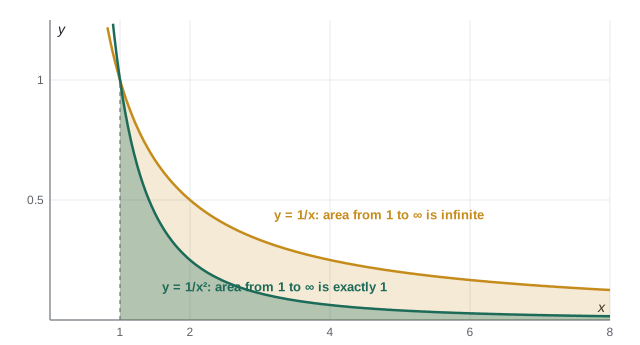
The contrast between these two examples is important. A function approaching zero is necessary for convergence, but not sufficient. What matters is how fast it approaches zero.
The p-test
Comparing against powers of \(x\) settles most questions. For the family \(1/x^p\):
So \(1/x^{1.01}\) has a finite area out to infinity, while \(1/x\) and \(1/\sqrt{x}\) do not.
Exponential decay always converges
Exponentials decay faster than any power, so integrals of decaying exponentials converge. For any \(k > 0\):
Worked problem
Total charge from a capacitor
A capacitor discharges through a resistor with current \(i(t) = I_0 e^{-t/\tau}\). What total charge flows?
Show solution
- \[Q = \int_0^\infty I_0e^{-t/\tau}\,dt = I_0\tau\]
Answer: Q = I₀τ. For a 100 μF capacitor charged to 12 V through 10 kΩ, I₀ = 1.2 mA and τ = 1 s, giving 1.2 mC, which equals CV, as it must
Worked problem
Energy in a decaying signal
The voltage across a resistor \(R\) decays as \(v(t) = V_0e^{-t/\tau}\). How much energy does the resistor dissipate in total?
Show solution
- Power is \(v^2/R = \dfrac{V_0^2}{R}e^{-2t/\tau}\).
- \[E = \frac{V_0^2}{R}\int_0^\infty e^{-2t/\tau}\,dt = \frac{V_0^2}{R}\cdot\frac{\tau}{2} = \frac{V_0^2\tau}{2R}\]
Answer: V₀²τ/(2R). With τ = RC this is ½CV₀², exactly the energy that was stored in the capacitor
Escape velocity
Gravity weakens with distance as \(F = \dfrac{GMm}{r^2}\). To move a mass \(m\) from Earth's surface (radius \(R\)) infinitely far away, the work needed is an improper integral:
The work is finite, even though the distance is infinite, because gravity fades fast enough (like \(1/r^2\), with \(p = 2 > 1\)). Setting the kinetic energy \(\tfrac12mv^2\) equal to this work gives the escape velocity:
About 11.2 km/s. A projectile launched at this speed (ignoring air resistance) never falls back. The same integral, applied to the Moon, gives about 2.4 km/s, which is why lunar missions could return with small rockets.
Integrands that blow up
The second kind of improper integral has a finite interval but an integrand that becomes infinite inside it, usually at an endpoint. Again, use a limit that stays away from the trouble:
Worked problem
Finite area under an infinite spike
Evaluate \(\int_0^1 \dfrac{1}{\sqrt{x}}\,dx\).
Show solution
- \(\int_t^1 x^{-1/2}\,dx = \big[2\sqrt{x}\big]_t^1 = 2 - 2\sqrt{t}\).
- As \(t \to 0^+\), this approaches 2.
Answer: 2. The graph is infinitely tall at x = 0, but the region is narrow enough to have finite area
Near zero the p-test reverses: \(\int_0^1 \dfrac{dx}{x^p}\) converges when \(p < 1\) and diverges when \(p \ge 1\). So \(1/\sqrt{x}\) is fine near 0, but \(1/x\) and \(1/x^2\) are not.
Be especially careful when the trouble is inside the interval. \(\int_{-1}^{1}\dfrac{dx}{x^2}\) looks like it might be \(\big[-1/x\big]_{-1}^{1} = -2\), a negative number for a positive integrand. That answer is wrong: the integrand blows up at \(x = 0\), and each half diverges. Always check the integrand for vertical asymptotes before applying the Fundamental Theorem.
The comparison test
Many improper integrals cannot be evaluated exactly, but you can still tell whether they converge by comparing with a simpler integral. For positive functions on \([a, \infty)\):
- If \(0 \le f(x) \le g(x)\) and \(\int g\) converges, then \(\int f\) converges.
- If \(f(x) \ge g(x) \ge 0\) and \(\int g\) diverges, then \(\int f\) diverges.
Worked problem
The bell curve
Show that \(\int_1^\infty e^{-x^2}\,dx\) converges, even though \(e^{-x^2}\) has no elementary antiderivative.
Show solution
- For \(x \ge 1\), \(x^2 \ge x\), so \(e^{-x^2} \le e^{-x}\).
- \(\int_1^\infty e^{-x}\,dx = e^{-1} \approx 0.368\) converges.
- By comparison, \(\int_1^\infty e^{-x^2}\,dx\) converges, and is at most 0.368. (Its actual value is about 0.139.)
Answer: It converges
Worked problem
Comparing with a power
Does \(\int_1^\infty \dfrac{dx}{x^3 + 5}\) converge?
Show solution
- For \(x \ge 1\), \(x^3 + 5 > x^3\), so \(\dfrac{1}{x^3 + 5} < \dfrac{1}{x^3}\).
- \(\int_1^\infty x^{-3}\,dx\) converges (\(p = 3\)), so the original does too.
Answer: Yes
Reliability and probability
Probability density functions describe random quantities such as component lifetimes, measurement errors and wind speeds. A density \(f(t)\) must satisfy \(\int_{-\infty}^{\infty} f(t)\,dt = 1\): the total probability is 1. These are often improper integrals.
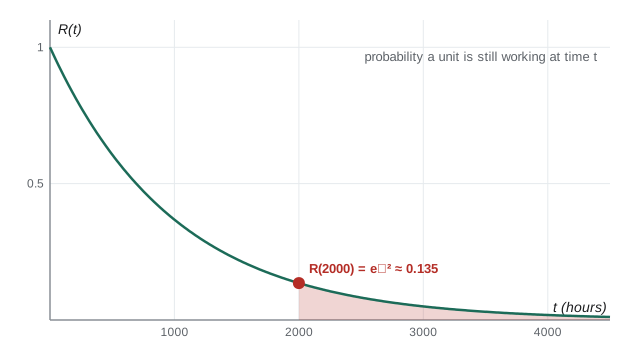
For components that fail at a constant rate (no wear-out, typical of electronics in their useful life), the lifetime has the exponential density
where \(\mu\) is the mean life. The probability of surviving past time \(t\), the reliability, is
Worked problem
Mean life
Show that the average lifetime for this density really is \(\mu\), using \(\int_0^\infty t\,f(t)\,dt\).
Show solution
- By parts, with \(u = t\) and \(dv = \frac1\mu e^{-t/\mu}dt\): \(\int t\,\tfrac1\mu e^{-t/\mu}\,dt = -te^{-t/\mu} - \mu e^{-t/\mu}\).
- As \(t \to \infty\), both terms vanish (the exponential beats \(t\)). At \(t = 0\) the expression is \(-\mu\).
- So the integral is \(0 - (-\mu) = \mu\).
Answer: The mean life is μ
Worked problem
Surviving a mission
A sensor has a mean life of 1000 hours. What is the probability it survives a 2000-hour deployment?
Show solution
- \(R(2000) = e^{-2000/1000} = e^{-2} \approx 0.135\).
Answer: About 13.5%. Only about 37% survive even to the mean life, since R(μ) = e⁻¹. Critical systems therefore use redundancy
The normal distribution and tolerances
Measurements, manufactured dimensions and material strengths usually scatter around an average in a bell-shaped pattern: the normal distribution. Its density, with mean \(\mu\) and standard deviation \(\sigma\), is
The strange-looking constant \(\dfrac{1}{\sigma\sqrt{2\pi}}\) is there to make the total probability 1. It comes from one of the most famous improper integrals:
The comparison test told us this integral converges; its exact value comes from a clever trick with double integrals that you will see in Multivariable Calculus. Because \(e^{-x^2}\) has no elementary antiderivative, probabilities for any finite range are found numerically and published in tables (or built into software). Three values are worth memorizing:
- About 68.3% of values fall within one standard deviation of the mean.
- About 95.4% fall within two standard deviations.
- About 99.7% fall within three standard deviations.
Worked problem
Parts within tolerance
A machine produces shafts with a mean diameter of 25.00 mm and a standard deviation of 0.02 mm. The drawing allows 25.00 ± 0.05 mm. What fraction of shafts will be within tolerance?
Show solution
- The tolerance limits are \(0.05/0.02 = 2.5\) standard deviations from the mean on each side.
- From a normal table (or software), the probability of falling within ±2.5σ is about 0.9876.
Answer: About 98.8% in tolerance, so roughly 12 rejects per 1000 shafts. Tightening the process to σ = 0.0167 mm (±3σ) would cut rejects to about 3 per 1000
This kind of calculation underlies process capability, quality control and statistical tolerancing. You will develop it fully in Probability and Statistics for Engineers.
A preview: the Laplace transform
Engineers analysing circuits, vibrations and control systems use the Laplace transform, which turns differential equations into algebra. It is defined by an improper integral:
For example, the transform of the constant function 1 is \(\int_0^\infty e^{-st}\,dt = \dfrac1s\) (for \(s > 0\)), and the transform of \(e^{at}\) is \(\int_0^\infty e^{-(s-a)t}\,dt = \dfrac{1}{s - a}\) (for \(s > a\)). The condition on \(s\) is exactly the condition for the improper integral to converge. You will use these transforms extensively in Differential Equations and Control Systems.
Common mistakes
MistakeTreating ∞ as a number: writing [−1/x] from 1 to ∞ as −1/∞ + 1 without a limit.
InsteadReplace ∞ with b, integrate, then take the limit as b → ∞.
MistakeConcluding that an integral converges because the integrand goes to zero.
InsteadIt must go to zero fast enough. 1/x → 0, but ∫ from 1 to ∞ of dx/x diverges.
MistakeApplying the Fundamental Theorem across a vertical asymptote, as in ∫ from −1 to 1 of dx/x² = −2.
InsteadCheck the integrand for points where it blows up. Split there and test each piece; here both diverge.
MistakeSplitting ∫ from −∞ to ∞ and letting the two infinite pieces "cancel".
InsteadEach piece must converge separately. If either diverges, the whole integral diverges.
MistakeUsing the comparison test in the wrong direction (a function smaller than a divergent one).
InsteadSmaller than convergent proves convergence; larger than divergent proves divergence. The other two cases prove nothing.
Summary and key terms
- Improper integrals have an infinite limit or an integrand that blows up. Define them as limits of ordinary integrals.
- They converge if the limit is finite and diverge otherwise.
- p-test: ∫ from 1 to ∞ of dx/xᵖ converges only for p > 1; ∫ from 0 to 1 of dx/xᵖ converges only for p < 1.
- Decaying exponentials always give convergent integrals: ∫ from 0 to ∞ of e^(−kx) dx = 1/k.
- Compare an unknown integral with a known one to decide convergence without evaluating it.
- Applications include total charge and energy in transients, escape velocity (11.2 km/s), and reliability, where R(t) = e^(−t/μ).
- The Laplace transform F(s) = ∫ from 0 to ∞ of e^(−st) f(t) dt is an improper integral.
- Improper integral
- An integral with an infinite limit or an unbounded integrand, defined by a limit.
- Converge / diverge
- Whether the defining limit is a finite number.
- p-test
- The rule for convergence of ∫ dx/xᵖ.
- Comparison test
- Deciding convergence by bounding a function above or below by a known one.
- Escape velocity
- The launch speed needed to leave a planet's gravity, √(2GM/R).
- Probability density
- A function whose integral over an interval gives a probability; total integral 1.
- Reliability
- The probability a component survives past time t.
- Laplace transform
- F(s) = ∫ from 0 to ∞ of e^(−st) f(t) dt.
Practice problems
Work each problem on paper first, then reveal the answer to check.
Evaluate \(\int_2^\infty \dfrac{dx}{x^3}\).
Show answer
[−1/(2x²)] from 2 to ∞ = 0 + 1/8 = 1/8.
Evaluate \(\int_0^\infty x e^{-x}\,dx\).
Show answer
By parts, the antiderivative is −e^(−x)(x + 1). From 0 to ∞: 0 − (−1) = 1.
Evaluate \(\int_{-\infty}^{\infty} \dfrac{dx}{1 + x^2}\).
Show answer
Split at 0. Each half is π/2 (arctan → π/2), so the total is π.
Does \(\int_1^\infty \dfrac{dx}{\sqrt{x}}\) converge?
Show answer
No. p = ½ ≤ 1, so it diverges. (2√b → ∞.)
Evaluate \(\int_0^4 \dfrac{dx}{\sqrt{4 - x}}\).
Show answer
The integrand blows up at x = 4. Antiderivative −2√(4 − x); limit as t → 4⁻ gives 0 − (−4) = 4.
Does \(\int_0^1 \dfrac{dx}{x^{3/2}}\) converge?
Show answer
No. Near 0 the p-test needs p < 1, and here p = 3/2.
Use comparison to decide whether \(\int_1^\infty \dfrac{1 + \sin^2 x}{x^2}\,dx\) converges.
Show answer
The integrand is at most 2/x², and ∫2/x² converges. So it converges.
A current \(i(t) = 5e^{-200t}\) mA flows from t = 0 onward. What total charge passes?
Show answer
Q = 5 × (1/200) = 0.025 mC = 25 μC.
Use the escape-velocity formula to estimate the Moon's escape velocity (GM = 4.90 × 10¹² m³/s², R = 1.737 × 10⁶ m).
Show answer
√(2 × 4.90 × 10¹² / 1.737 × 10⁶) = √(5.64 × 10⁶) ≈ 2380 m/s, about 2.4 km/s.
Pumps have a mean life of 20 000 hours (constant failure rate). What fraction survives a 5000-hour season?
Show answer
R = e^(−5000/20 000) = e^(−0.25) ≈ 0.779, about 78%.
Find the Laplace transform of \(f(t) = t\).
Show answer
By parts: ∫ from 0 to ∞ of t e^(−st) dt = 1/s² (for s > 0).
Lesson quiz · 5 questions
Score 60% or more to complete this lesson.
Create a free account to save your progress, take quizzes and earn a certificate.