
PHOT-102 · Lesson 6 of 12 · 28 min
Flash fundamentals
Flash gives photographers light that they can carry, place and control anywhere: enough power to compete with the sun, short enough to freeze a splash of water, and small enough to fit in a pocket. It also has a reputation for producing harsh, flat pictures with red eyes and black backgrounds. The difference lies in understanding how flash works and how it combines with the existing light. This lesson explains how an electronic flash produces light, its power and guide number, its very short duration, the camera's sync speed and high-speed sync, the central idea that every flash photograph is two exposures combined, and automatic (TTL) and manual flash control. Lessons 7 and 8 then apply these fundamentals on and off the camera.
How a flash works
An electronic flash stores energy from batteries or mains power in a capacitor, charged to a few hundred volts. When triggered, the capacitor discharges through a glass tube filled with xenon gas, producing an intense burst of light lasting a small fraction of a second. The light is close to daylight in colour, about 5,500 to 6,000 K, though it varies slightly with power and between models. After firing, the flash needs time to recharge, the recycle time, from a fraction of a second at low power to a few seconds at full power. Types of flash used by photographers include:
- Built-in flashes on some cameras: small and close to the lens, with limited power.
- Speedlights (hot-shoe flashes): battery-powered units that mount on the camera's hot shoe or work off-camera, with tilting and swivelling heads and zooming reflectors. The workhorse of event, wedding and location photography.
- Battery-powered strobes (monolights with batteries): more powerful, with modelling lights and fittings for large modifiers, increasingly popular for location portraits.
- Studio strobes: mains-powered monolights or pack-and-head systems with high power and fast recycling.
Continuous LED lights, which stay on, are covered in Lesson 9. They are easier to see and to use for video, but much less powerful than flash for a given size.
Power, stops and guide numbers
Flash power is set in fractions of full power, each halving being one stop: 1/1, 1/2, 1/4, 1/8, down to 1/128 or 1/256 on many units, often with intermediate thirds. Studio strobes are rated in watt-seconds (joules) of stored energy, though light output for a given rating varies between designs and modifiers.
The light output of speedlights is described by the guide number (GN), which relates aperture and distance for a correct exposure with direct flash at ISO 100:
where d is the flash-to-subject distance (in metres, for a metric guide number) and N is the f-number. A flash with GN 40 (metres, ISO 100) correctly exposes a subject at 5 m with f/8, or at 10 m with f/4. Guide numbers change with ISO: each doubling of ISO multiplies the guide number by √2, since it adds one stop and aperture numbers change by √2 per stop. They also change with the zoom setting of the flash head: zooming to a narrow beam concentrates the light, raising the guide number. Manufacturers usually quote the guide number at the longest zoom setting, so the practical figure at a wide setting is lower.
Worked problem
Using a guide number
A speedlight has GN 36 (m, ISO 100) at the zoom setting used. A subject is 4.5 m away. What aperture is needed at full power at ISO 100, and at ISO 400? What aperture at ISO 400 and 1/4 power?
Show solution
- ISO 100, full power: N = GN ÷ d = 36 ÷ 4.5 = 8, so f/8.
- ISO 400 is two stops more sensitive: GN becomes 36 × 2 = 72, so N = 72 ÷ 4.5 = 16, f/16.
- 1/4 power is two stops less light: back to f/8 at ISO 400.
Answer: f/8 at ISO 100 full power; f/16 at ISO 400; f/8 at ISO 400 and 1/4 power. Guide numbers assume direct flash in a typical room; bounced or modified flash needs more power, so in practice photographers check results on the histogram or use a flash meter.
Because flash obeys the inverse square law (Lesson 2), flash exposure is very sensitive to distance: a subject at twice the distance needs two stops more light. In a group photographed with direct flash, people at the front may be overexposed while those at the back are underexposed. Moving the flash further back, raising it, or bouncing it evens out the light.
Flash duration
A flash burst is extremely short, typically from about 1/1,000 s at full power to 1/10,000 s or shorter at low power for speedlights, since lower power settings work by cutting the discharge short. Studio strobes vary widely: some at full power have long durations of 1/300 s or so, while units designed for action reach 1/10,000 s or faster. Durations are quoted as t.5 (the time the output is above half its peak) or the longer and more honest t.1 (above 10 % of peak).
When flash provides most of the light on a subject, its duration, not the shutter speed, determines how motion is frozen. This is why flash can freeze droplets of water, a dancer's hair or a hummingbird's wings: at 1/200 s shutter speed, the ambient light may record a little blur, but the flash records a sharp image within it. For maximum freezing, use low flash power (shorter duration), bring the flash closer to compensate, and keep the ambient light low so it does not add a blurred ghost image.
Sync speed
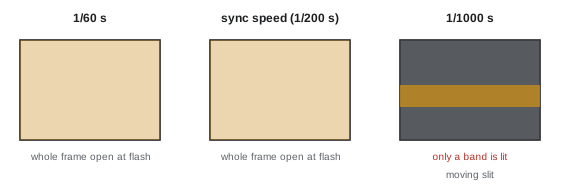
Most interchangeable-lens cameras use a focal-plane shutter with two curtains. At slow shutter speeds, the first curtain opens fully, exposing the whole sensor, then the second curtain closes it. At fast shutter speeds, the second curtain starts closing before the first has finished opening, so the sensor is exposed by a moving slit. A flash burst is so short that it must fire when the whole sensor is uncovered; otherwise, part of the frame is blocked by a curtain and appears as a black band. The fastest shutter speed at which the whole sensor is uncovered is the flash sync speed, typically 1/160 s to 1/250 s.
At shutter speeds at or below sync speed, normal flash works. Above sync speed, the camera either limits the shutter speed or the picture shows a dark band. Cameras with leaf shutters (built into the lens, used in some medium-format and compact cameras) can sync at all speeds, up to 1/2,000 s or faster. Electronic shutters scan the sensor too slowly for normal flash on most cameras, though stacked and global-shutter sensors are changing this.
High-speed sync
High-speed sync (HSS), also called FP mode, lets flash work above sync speed by firing a rapid series of pulses, so fast that the flash acts like a continuous light for the time the slit takes to cross the sensor. HSS allows wide apertures in bright sun (for example f/2 at 1/2,000 s for a shallow depth of field), and flash fill on fast-moving subjects. The cost is power: because the energy is spread over the whole travel time, and the slit exposes each part of the sensor for only a fraction of it, effective output drops sharply, typically by one and a half to two stops or more, and continues to fall as shutter speed rises. HSS also loses the motion-freezing benefit of a short flash burst. An alternative for working with wide apertures in bright light is a neutral density filter, which allows normal sync speeds with full flash power.
Two exposures in one
The most important idea in flash photography is that every flash picture made in the presence of ambient light is really two exposures recorded at once: one by the ambient light and one by the flash. The camera settings affect them differently:
- Shutter speed controls the ambient exposure only (as long as it stays at or below sync speed), because the flash burst is far shorter than the shutter opening.
- Aperture controls both the ambient exposure and the flash exposure.
- ISO controls both.
- Flash power and flash-to-subject distance control the flash exposure only.
This gives the photographer independent control over the two. To darken the background (lit by ambient light) without changing the flash on the subject, use a faster shutter speed, up to the sync speed. To brighten the background, use a slower shutter speed, a technique called dragging the shutter (Lesson 7). To change the flash exposure without affecting the background, change flash power or distance. To change both together, change aperture or ISO.
| Control | Ambient exposure | Flash exposure |
|---|---|---|
| Shutter speed (up to sync) | Changes | No change |
| Aperture | Changes | Changes |
| ISO | Changes | Changes |
| Flash power | No change | Changes |
| Flash distance | No change | Changes (inverse square) |
Worked problem
Balancing flash and ambient light
At dusk, a subject stands in front of a city skyline. A test shot at f/4, 1/200 s, ISO 400 with flash shows the subject well exposed but the skyline nearly black. The camera meter says the skyline would be correctly exposed at f/4, 1/25 s, ISO 400. How do you get both right?
Show solution
- The flash exposure on the subject is correct, so keep aperture, ISO, flash power and distance unchanged.
- Ambient exposure depends only on shutter speed here: change from 1/200 s to 1/25 s, three stops more ambient light.
- The skyline is now correctly exposed; the subject still receives the same flash, plus a little ambient light.
- If the subject moves during the 1/25 s, a faint ghost may appear; a tripod and a still subject help, as does keeping ambient light on the subject low.
Answer: Lengthen the shutter speed to 1/25 s to bring up the ambient exposure, leaving the flash exposure on the subject unchanged. Thinking in two separate exposures makes such adjustments quick and predictable.
TTL and manual flash
Flash exposure can be controlled automatically or manually:
- TTL (through-the-lens) flash fires a weak preflash just before the exposure, measures its reflection through the lens with the camera's meter, calculates the power needed and fires the main flash accordingly. TTL adapts automatically as distance changes, which makes it valuable when subjects and distances change constantly, as at weddings and events. Like any reflected-light metering, it can be fooled by very light or dark subjects and by bright reflective objects in the frame, and it varies from shot to shot. Flash exposure compensation (FEC) adjusts the TTL result up or down, independently of the ambient exposure compensation.
- Manual flash fires the same power every time, set by the photographer. It is consistent: when subject and flash distances are fixed, as in studio work and set-up portraits, every frame has the same flash exposure. Manual flash is set by guide number, by a handheld flash meter, or by test shots and the histogram.
Many photographers use TTL for moving events and switch to manual for controlled setups. Some systems offer a TTL-to-manual conversion that captures the TTL result as a manual setting as a starting point.
Flash modes also include front-curtain sync (the flash fires at the start of the exposure, the default) and rear-curtain sync (at the end). With slow shutter speeds and moving subjects, rear-curtain sync places the motion blur trail behind the subject, which looks natural, while front-curtain sync places it in front (Lesson 7). Red-eye reduction fires preflashes to constrict the subject's pupils, but moving the flash away from the lens axis is more effective (Lesson 7).
Flash and the eye
Flash has an unusual property: the photographer cannot see its effect until after the picture is taken. Studio strobes include continuous modelling lights that preview the direction and shadows, but speedlights usually do not. Learning to predict flash results, then checking each test shot carefully, especially highlights, shadows and catchlights, is part of the skill. Reviewing images at 100 % on the camera screen and using the histogram and highlight warning are essential, because the camera screen can be misleading in bright conditions.
Common mistakes
MistakeUsing shutter speeds above sync speed without HSS.
InsteadStay at or below sync speed, or enable HSS or use an ND filter.
MistakeChanging the shutter speed to adjust flash brightness.
InsteadUse flash power, distance, aperture or ISO for flash exposure.
MistakeAssuming the guide number applies at every zoom setting.
InsteadUse the guide number for the actual zoom setting and test.
MistakeRelying on TTL with very reflective or dark scenes.
InsteadUse flash exposure compensation or switch to manual.
MistakeExpecting HSS to have full flash power.
InsteadAllow for a loss of 1.5 to 2 stops or more.
Summary and key terms
- Electronic flashes discharge a capacitor through a xenon tube, giving a brief burst near daylight colour.
- Power is set in stops; guide number = distance × f-number at ISO 100.
- Flash duration, not shutter speed, freezes motion when flash dominates.
- Sync speed is the fastest shutter speed at which the whole sensor is exposed at once.
- High-speed sync pulses the flash above sync speed at a large cost in power.
- Shutter speed controls ambient only; flash power and distance control flash only; aperture and ISO control both.
- TTL flash adapts automatically; manual flash is consistent.
- Speedlight
- A battery-powered hot-shoe flash.
- Guide number
- Distance times f-number for correct direct flash exposure at ISO 100.
- Recycle time
- The time a flash needs to recharge.
- Flash duration
- The length of the flash burst, quoted as t.5 or t.1.
- Sync speed
- The fastest shutter speed usable with normal flash.
- High-speed sync
- Pulsed flash allowing shutter speeds above sync speed.
- TTL flash
- Automatic flash exposure measured through the lens using a preflash.
- Flash exposure compensation
- Adjustment of TTL flash output.
- Rear-curtain sync
- Firing the flash at the end of the exposure.
- Modelling light
- A continuous light in a strobe that previews its effect.
Practice problems
Work each problem on paper first, then reveal the answer to check.
A flash has GN 32 at ISO 100. What aperture is needed for a subject at 4 m?
Show answer
f/8.
By what factor does the guide number change from ISO 100 to ISO 200?
Show answer
√2, about 1.4.
A flash at 1/2 power gives f/11. What does 1/8 power give at the same distance?
Show answer
Two stops less: f/5.6.
Why does low flash power freeze motion better?
Show answer
The flash duration is shorter.
What happens above sync speed with normal flash?
Show answer
Part of the frame is blocked by a shutter curtain, giving a dark band.
What is the main cost of high-speed sync?
Show answer
A large loss of effective flash power.
Which control changes ambient exposure but not flash exposure?
Show answer
Shutter speed (at or below sync).
How do you darken the background without changing the flash on the subject?
Show answer
Use a faster shutter speed up to sync speed.
When is manual flash preferred over TTL?
Show answer
When subject and flash distances are fixed, for consistency.
Where does rear-curtain sync place motion trails?
Show answer
Behind the moving subject.
Lesson quiz · 5 questions
Score 60% or more to complete this lesson.
Create a free account to save your progress, take quizzes and earn a certificate.