
PHOT-210 · Lesson 6 of 12 · 25 min
Light modifiers
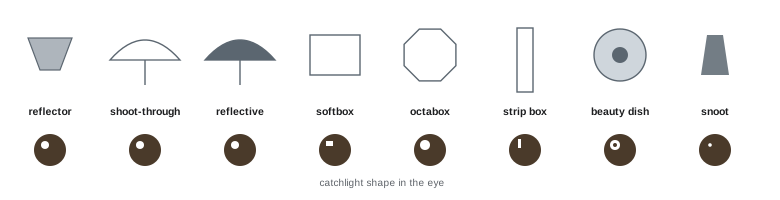
A bare flash tube or LED is a small, hard source that sprays light in all directions. Modifiers shape that light: they enlarge it to make it softer, narrow it to control where it falls, change its edge and fall-off, and define the shape of catchlights and reflections. Choosing a modifier is one of the most important creative decisions in studio lighting, because each has a distinctive character. This lesson covers reflectors and standard dishes, umbrellas, softboxes and octaboxes, strip boxes, beauty dishes, grids and honeycombs, snoots, barn doors and spotlights, scrims and diffusion panels, reflectors and bounce boards, flags, and how to choose and combine modifiers.
Standard reflectors
Most studio flashes come with a standard reflector, a metal bowl that directs light forward in a beam of about 50 to 90 degrees. It produces hard, fairly even light with a defined circular spread, useful for lighting backgrounds, bouncing light off walls, ceilings and boards, and for hard-light portraits with a grid. Narrow reflectors with smaller angles give more concentrated, punchy light and reach farther; wide reflectors spread light over large areas. Reflectors are also the mount for grids, gels and barn doors.
Umbrellas
Umbrellas are inexpensive, light and quick to set up, making them popular for beginners and location work. They come in three main types:
- Shoot-through umbrellas, made of translucent white fabric, are fired through toward the subject, creating a broad, soft, wide-spreading light that also bounces around the room, adding fill but reducing control.
- Reflective umbrellas, with a white, silver or gold inner surface and a black outer cover, are aimed away from the subject so that light reflects back from the inside; silver gives punchier, more specular light, white softer light.
- Parabolic umbrellas are deep umbrellas with a precise parabolic shape; with the flash positioned at the focal point, they produce a crisp, efficient, slightly contrasty light with good reach, and moving the flash forward or back changes the look from focused to more diffuse.
Umbrellas spill light widely, which can brighten backgrounds and reduce contrast in small rooms, and they produce round catchlights. Diffusion socks over reflective umbrellas soften them further.
Softboxes and octaboxes
Softboxes are enclosed fabric boxes with a reflective interior and one or two diffusion panels on the front. They produce soft, controlled light with defined edges, spilling less than umbrellas, and come in many sizes and shapes: rectangular softboxes give rectangular catchlights and are excellent for portraits and products; octaboxes, with eight sides, give round, natural-looking catchlights and very soft light in large sizes, from about 90 to 190 cm; deep octaboxes give more control and contrast; and very large softboxes and octas can light full-length figures and groups. A recessed front, where the diffusion panel sits behind the edge of the box, narrows the spread slightly. Inner baffles even out the light; removing the front diffuser gives punchier light with a brighter centre.
Strip boxes
Strip boxes are long, narrow softboxes, typically about 30 × 120 cm or 30 × 180 cm. They produce soft light along one dimension and controlled spread in the other, making them ideal as rim and edge lights that outline a subject from behind or beside, hair lights on booms, and lights for products such as bottles, where they create clean, elongated highlights. Pairs of strip boxes behind a subject on both sides are a classic setup for fitness, fashion and dramatic portraits. Grids fitted to strip boxes narrow the beam further, keeping light off the background and lens.
Beauty dishes
A beauty dish is a shallow dish, typically 40 to 70 cm across, with a central deflector that blocks direct light from the flash tube and bounces it back into the dish, which reflects it forward. The result is a distinctive light that falls between hard and soft: crisp yet smooth, with a bright centre, quick fall-off toward the edges and attractive highlights on cheekbones, giving a sculpted, glossy look popular in beauty, fashion and headshots. White interiors are softer, silver more contrasty. Beauty dishes are usually placed close to the subject, in front and above, often in butterfly lighting (Lesson 7), and can be fitted with diffusion socks to soften them or grids to control spill.
| Modifier | Light quality | Spill | Typical uses |
|---|---|---|---|
| Standard reflector | Hard | Medium | Backgrounds, bounce, hard portraits |
| Shoot-through umbrella | Soft | High | Quick soft light, groups |
| Reflective umbrella | Soft to medium | Medium to high | Portraits, events |
| Parabolic umbrella | Crisp, adjustable | Medium | Fashion, portraits |
| Softbox / octabox | Soft, controlled | Low to medium | Portraits, products |
| Strip box | Soft in one direction | Low | Rim, hair, bottles |
| Beauty dish | Crisp yet smooth | Medium | Beauty, fashion, headshots |
| Snoot / grid | Hard, narrow | Very low | Accents, hair, backgrounds |
Grids and honeycombs
Grids, also called honeycombs, are panels of small cells placed over the front of a reflector, softbox or strip box. They restrict the angle at which light can leave, narrowing the beam and creating a soft-edged pool of light with controlled spill. Grids are described by their angle, such as 10, 20, 30 or 40 degrees: smaller angles give tighter beams. Softbox grids, made of fabric, keep soft light off the background and out of the lens, essential for dramatic low-key portraits where the background must stay dark. Reflector grids create spotlight effects on backgrounds, hair or a single part of a subject.
Snoots, barn doors and spotlights
A snoot is a tube or cone that confines light to a small, defined circle, useful for hair lights, background spots and highlighting a small part of a product or face. Barn doors are hinged flaps on the front of a reflector or Fresnel light that shape the beam's edges, cutting light off the background, ceiling or lens. Optical spotlights or projection attachments use lenses to focus light into a hard-edged beam whose shape can be changed with shutters or metal cut-outs called gobos, projecting patterns such as window frames, blinds or leaves onto the subject or background. These tools allow very precise, theatrical lighting.
Scrims, diffusion panels and bounce
Large frames covered with diffusion fabric, called scrims, silks or diffusion panels, placed between a light and the subject, create very large, soft sources, equivalent to an enormous softbox, and can soften sunlight outdoors. A light fired through a 2 × 2 m diffusion frame gives soft, wraparound light suitable for beauty and fashion. Bouncing a light off a large white board, wall or ceiling also creates a soft source whose size is the area of the illuminated surface; bounce light is soft and natural but less controlled and loses power, roughly one to three stops depending on the surface and distance. V-flats, tall folding boards white on one side and black on the other, are versatile studio tools used as bounce surfaces, flags and backgrounds.
Reflectors and flags
Reflectors, collapsible discs or boards in white, silver or gold, bounce light back into shadows, providing fill without another light. White gives soft, natural fill; silver gives brighter, harder fill with more sparkle; gold warms the fill and should be used cautiously. A reflector held below the face in front of the subject, often with butterfly lighting, creates clamshell lighting with soft fill under the eyes and chin. Flags, black panels, cloths or cards, do the opposite: they block light, creating shadows, preventing spill onto backgrounds and stopping flare in the lens. Negative fill, placing a black flag on the shadow side of a subject, deepens shadows by absorbing light that would otherwise bounce in from white walls, adding contrast and shape in small, bright rooms.
Worked problem
Adding contrast in a white room
A photographer lights a portrait with a large octabox in a small studio with white walls. The images look flat, with very little shadow on the far side of the face, even with no fill light. How can contrast be increased?
Show solution
- Recognize that the white walls are acting as fill, bouncing light into the shadow side.
- Place a black V-flat or flag close to the shadow side of the face, out of frame, as negative fill.
- Fit a grid to the octabox to reduce spill onto the walls.
- Meter the shadow side before and after to confirm the increased ratio, aiming for perhaps 1.5 to 2 stops.
Answer: Use negative fill with a black flag on the shadow side and a grid on the octabox to reduce wall spill.
Choosing and combining modifiers
Choosing a modifier starts with the look you want: soft and flattering, crisp and sculpted, dramatic and hard, or graphic with shaped light. Consider the size of the subject and the area to be lit, the amount of spill you can tolerate in the space, the catchlight shape, and portability. Many professional portraits use a single large softbox or octabox as key, a reflector or second soft source as fill, and strip boxes or gridded reflectors as accents. Build a modifier collection gradually around a single mount system. Most importantly, learn each modifier thoroughly by photographing the same subject with each at different distances and angles: a known modifier used well produces better results than a large collection used without understanding.
Modifier efficiency
Modifiers absorb some light. A standard reflector might lose little or even concentrate light, while a large softbox with two diffusion layers may lose one to two stops compared with the bare flash, and bouncing off a ceiling may lose two to three stops or more. Efficiency matters when using low-power lights, when working at small apertures, or when trying to overpower ambient light. Parabolic and silver modifiers are generally the most efficient soft sources; white shoot-through umbrellas and double-diffused softboxes the least. Knowing the approximate loss of each modifier in your kit lets you choose power settings quickly.
Fresnel lights and hard-light modifiers
Fresnel lenses, stepped glass lenses in front of a light, focus it into a beam that can be adjusted from spot to flood by moving the lamp relative to the lens. Fresnel spotlights, traditional in film and theatre and available for strobes and LEDs, produce hard, even light with soft-edged pools and controllable spread, ideal for classic Hollywood portrait styles, theatrical looks and precise background effects. Combined with barn doors, they offer exceptional control over where light falls. Other hard-light modifiers include small reflectors with tight grids, optical snoots with lenses, and bare bulbs.
Choosing modifiers for different skin types and textures
Modifier choice affects how skin appears. Large, soft sources minimize texture and are forgiving for skin with blemishes or fine lines, while hard sources emphasize texture, pores and wrinkles. For oily skin, large sources produce broad, gentle highlights rather than small, shiny hot spots. For darker skin, larger sources with good reflectivity reveal the sheen and depth of skin tones, and silver or white interiors can add pleasing highlights. For older subjects, soft, frontal light with modest fill tends to be flattering. These are starting points; always look carefully at each person's face under the light.
Making and improvising modifiers
Many modifiers can be improvised. A white bedsheet or shower curtain becomes a diffusion panel; foam board from a craft store becomes reflectors, flags and V-flats; a cardboard tube becomes a snoot; drinking straws taped together form a grid; aluminium foil becomes a reflective surface. Improvised modifiers are useful for learning and for special effects, but take care with heat: keep flammable materials away from hot modelling lamps and continuous lights.
Storing and labelling modifiers
Modifiers are bulky and easily damaged. Store softboxes collapsed in their bags, keep grids flat, label bags with the size and mount type, and keep speed rings and adapters attached or bagged together. A tidy modifier store saves time during sessions and prevents bent rods and torn diffusion fabric.
When choosing between two modifiers that seem similar, photograph the same subject with each at the same distance and exposure, and compare shadow edges, catchlights and spill side by side before deciding which suits the look.
Common mistakes
MistakeUsing shoot-through umbrellas in small rooms without control.
InsteadExpect spill and use flags or softboxes instead.
MistakeLeaving soft light spilling onto a dark background.
InsteadAdd a fabric grid to the softbox.
MistakeUsing gold reflectors on every subject.
InsteadUse white fill by default and gold sparingly.
MistakeIgnoring white walls as uncontrolled fill.
InsteadUse negative fill and flags.
MistakeBuying many modifiers before learning one.
InsteadMaster a few modifiers thoroughly.
Summary and key terms
- Modifiers change the size, spread, edge and catchlight of light.
- Umbrellas are quick and soft but spill; parabolics are crisp and efficient.
- Softboxes and octaboxes give soft, controlled light; strip boxes create rims and highlights.
- Beauty dishes give crisp yet smooth, sculpted light.
- Grids, snoots, barn doors and spotlights narrow and shape light precisely.
- Scrims and bounce surfaces make very large soft sources.
- Reflectors add fill; flags and negative fill add contrast.
- Modifier
- Device that shapes light from a source.
- Shoot-through umbrella
- Translucent umbrella fired through.
- Parabolic umbrella
- Deep, precisely shaped reflective umbrella.
- Softbox
- Enclosed box with diffusion front.
- Octabox
- Eight-sided softbox.
- Strip box
- Long, narrow softbox.
- Beauty dish
- Dish with central deflector for crisp, smooth light.
- Grid
- Honeycomb that narrows a beam.
- Snoot
- Tube that confines light to a small circle.
- Negative fill
- Black surface that deepens shadows.
Practice problems
Work each problem on paper first, then reveal the answer to check.
Name the three umbrella types.
Show answer
Shoot-through, reflective, parabolic.
What catchlight does an octabox make?
Show answer
Round or octagonal.
What are strip boxes used for?
Show answer
Rim, hair and bottle highlights.
What does the beauty dish deflector do?
Show answer
Blocks direct light and bounces it into the dish.
What does a 20-degree grid do?
Show answer
Narrows the beam to a pool with little spill.
What is a gobo?
Show answer
A cut-out projected to create patterns.
What is a V-flat?
Show answer
Folding board, white one side, black the other.
What is clamshell lighting?
Show answer
Key above and reflector below the face.
What is negative fill?
Show answer
A black flag deepening shadows.
How should you learn a modifier?
Show answer
Test it at different distances and angles on one subject.
Lesson quiz · 5 questions
Score 60% or more to complete this lesson.
Create a free account to save your progress, take quizzes and earn a certificate.