
PHOT-211 · Lesson 9 of 12 · 25 min
Glass, liquids and reflective surfaces
Glass, liquids, polished metal, chrome, lacquer and glossy plastics are among the most challenging subjects in photography, because they do not show light falling on them so much as reflect or transmit their surroundings. A wine glass is defined not by its surface but by its edges and the highlights on its curves; a chrome kettle shows the studio, the camera and the photographer; a bottle of perfume must glow with colour while its label remains readable. Lighting these subjects means lighting what they reflect and what lies behind them. This lesson covers the family of angles, bright-field and dark-field lighting for glass, lighting liquids in glass, bottles and labels, polished metal, tenting and large diffusion, gradient reflections, controlling unwanted reflections, and polarization.
The family of angles
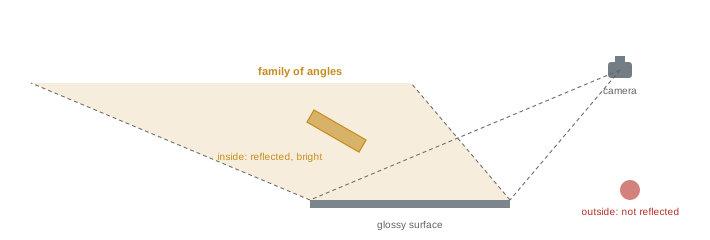
The key concept for reflective subjects comes from the classic book Light: Science and Magic by Fil Hunter, Steven Biver and Paul Fuqua: the family of angles. For a flat mirror-like surface, the camera sees a reflection of whatever lies at the mirror angle, where the angle of incidence equals the angle of reflection. The family of angles is the range of positions from which a light source would be reflected into the lens from the surface. If a light source is placed within the family of angles, the surface shows a bright reflection; if it is outside, the surface shows whatever else is there, often darkness. For curved surfaces, each point has its own family of angles, so a curved reflective object reflects a wide area of the surroundings, which is why large sources and controlled environments are needed. Determining where the family of angles lies, by imagining lines from the camera bouncing off the surface, tells you where to place sources and cards.
Bright-field and dark-field lighting for glass
Clear glass is lit by its edges, which refract light, and its surfaces, which reflect sources. Two classic approaches define the edges:
- Bright-field lighting: the glass is placed in front of a bright, evenly lit background, such as a backlit diffusion panel or an illuminated white sweep. Light passing through the glass is refracted at the edges, so the edges appear as dark lines against the bright background, and the glass looks clean and clearly outlined. Black cards placed just outside the frame on each side, within the family of angles of the glass edges, strengthen the dark edges.
- Dark-field lighting: the glass is placed in front of a dark background, with a bright source, such as a large diffused panel or two strip boxes, placed behind and to the sides, just outside the frame, so that light is refracted through the edges toward the camera. The edges appear as bright lines against black, giving an elegant, dramatic look.
In both techniques, the background directly behind the glass must be either fully bright or fully dark, since mixed backgrounds create confusing reflections. The size of the background relative to the glass, and the distance between glass and background, control the width of the edge lines: a small bright area behind the glass, surrounded by black, gives thick black edges in bright-field; a large bright area gives thin edges.
| Technique | Background | Edges appear | Typical use |
|---|---|---|---|
| Bright-field | Bright, evenly lit | Dark lines | Clean product images, labware, catalogues |
| Dark-field | Dark | Bright lines | Dramatic, luxury, spirits, perfume |
| Combined | Gradient or partial | Both, varying | Editorial and advertising |
Lighting liquids in glass
Liquids in glasses and bottles are usually lit from behind so that light passes through them and reveals their colour, clarity and glow. A backlit diffusion panel or white card behind the glass makes wine, juice, whisky or beer glow; the size and position of the backlight determine whether the whole liquid glows evenly or a gradient appears. Dark liquids, such as red wine, cola and coffee, need strong backlighting, or a white or silver card cut to the shape of the glass and placed directly behind it, out of view, to bounce light through the liquid. Condensation, created with glycerine and water sprays, and bubbles, from fresh pours or carefully added effervescent tablets, add freshness; artificial ice, made of acrylic, is used because real ice melts under lights. Front fill, usually from large soft sources or cards, adds highlights on the glass surface and lights the label.
Worked problem
Making red wine glow
A glass of red wine on a dark background looks almost black, with no colour. The background is lit, but the wine is too dense for light to pass through. How can it be made to glow ruby red?
Show solution
- Cut a piece of white or silver card to the shape of the wine in the glass, slightly smaller so it is hidden.
- Place it directly behind the glass, angled toward a light positioned out of frame, so that it bounces light through the wine.
- Alternatively, use a small gridded or snooted backlight aimed through the wine from behind.
- Adjust the card or light intensity until the wine glows with rich colour, checking the red channel on the histogram to avoid clipping.
Answer: Place a hidden white or silver card behind the wine to bounce light through it, or use a small backlight, and check the red channel.
Bottles and labels
Bottles combine glass, liquid and labels, each needing different light. A typical approach lights the glass and liquid from behind with a backlight or dark-field strips, defines the shape with strip highlights along the sides, and lights the label from the front with a soft source or card, flagged so that it does not reflect on the glass. Paper labels need even, glare-free light; metallic and embossed labels need angled light to reveal their texture and shine. Clear bottles with labels on the back may show the reverse of the label through the glass, which is often hidden with a card. Advertising images of bottles are frequently composites of separate exposures for the glass, liquid, label, condensation and background, combined in post-production (Lesson 11, PHOT-202).
Polished metal and chrome
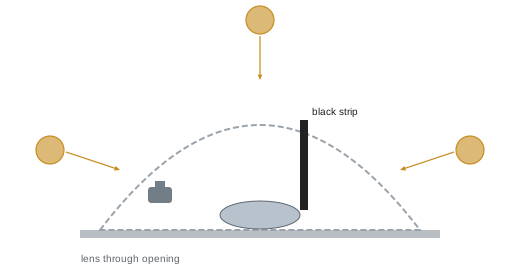
Polished metal reflects its surroundings almost completely, so lighting metal means designing the environment it reflects. Common approaches include surrounding the object with large diffused sources, white cards and scrims, so that it reflects smooth, bright areas, with black cards placed to create dark reflections that define its shape; using large gradient reflections, created by a large softbox with feathered light or a gradient on a diffusion panel, to give curved surfaces a smooth transition from light to dark; and keeping the camera, photographer and studio out of the reflection by hiding them behind a black or white panel with a hole for the lens, or by using longer lenses from farther away. Brushed metal, which scatters reflections, behaves partly like a matte surface and shows the direction of brushing under directional light. Dulling spray, a matte coating that reduces reflections temporarily, can help in difficult cases, but changes the appearance of the material and is used less often than careful lighting.
Tenting and large diffusion
Tenting surrounds a reflective object with translucent material, such as a light tent, a cone of diffusion fabric or large scrims, and lights it from outside. The object then reflects an even, bright, featureless environment, eliminating reflections of the studio. Tents are useful for jewellery, cutlery, small metal parts and glossy products in e-commerce. Their drawback is that fully even reflections can make objects look flat and featureless; adding black strips or cards inside the tent, or varying the light outside it, creates contrast and defines the object's form. A hole or slit in the tent allows the lens to see the object while minimizing its own reflection.
Gradient reflections
Gradients, smooth transitions from light to dark in reflections, are the signature of high-end product photography. They make curved glossy surfaces look three-dimensional and luxurious. Gradients are created by using a large softbox or diffusion panel with light concentrated at one end, by feathering a light across a diffusion panel, by placing a gradient-printed sheet or graduated filter in front of a source, or by positioning a source so that its fall-off is visible in the reflection. The direction and length of the gradient should follow the form of the product: vertical gradients for tall bottles and cylinders, curved gradients for round objects. Retouchers often refine gradients digitally, but starting with good gradients in camera gives more natural results.
Controlling unwanted reflections
Unwanted reflections, of lights, stands, the camera, the photographer, windows and the studio, are the main problem with reflective subjects. Techniques for controlling them include identifying each reflection by moving objects in the studio and watching the effect, or by turning lights on and off one at a time; covering bright objects and walls near the set with black fabric; using black or white panels around the set; moving the camera back and using a longer lens; changing the camera angle slightly, which changes the family of angles; and placing the object so that its surfaces reflect deliberate sources and cards. Photographers working with chrome and glass often build a complete enclosure of cards and scrims around the product, with every surface placed deliberately.
Polarization
Polarizing filters on the lens reduce reflections from non-metallic surfaces such as glass, water, varnish and plastic, by blocking light polarized by the reflection. They are effective at angles of about 30 to 40 degrees from the surface, and less effective head-on. Polarizers do not remove reflections from bare metal, which does not polarize reflected light in the same way. Cross-polarization, placing polarizing gels over the lights and a polarizing filter on the lens at right angles, removes almost all specular reflections from non-metallic surfaces, useful for art reproduction, cosmetics textures and reducing glare on labels, at a cost of about two to three stops of light. Polarizers can also reveal stress patterns in clear plastics, sometimes used for creative effect.
Clear plastics and acrylic
Clear plastics, such as acrylic, polycarbonate and packaging, behave much like glass but often have softer edges, visible scratches and internal stresses. Bright-field and dark-field techniques apply, but scratches and dust show clearly against both bright and dark backgrounds, so meticulous cleaning with anti-static cloths and air blowers is essential. Plastics can show rainbow stress patterns under polarized light, which may need to be avoided by adjusting the polarizer or the light angles.
Lacquer, ceramics and glossy plastics
Glossy painted and ceramic surfaces combine colour with reflection: the surface colour shows under diffuse light, while highlights reflect the sources. Large soft sources produce smooth, broad highlights that emphasize the form; small sources produce sharp spots that can look cheap. Placing sources so that highlights run along the edges and leave the main surface showing its colour is a common approach. Black cards control reflections on dark glossy objects, which otherwise show the bright studio.
Jewellery and gemstones
Jewellery combines polished metal and faceted gemstones. Metal is lit with large diffused sources and cards to create clean reflections and defined edges; gemstones sparkle when small, hard light sources or mirrors are reflected in their facets, and their colour is revealed by light passing through them. Many jewellery photographers use a tent or diffusion dome for the metal and add small spot lights for sparkle, often combining passes (Lesson 11). Clean jewellery meticulously, and handle it with gloves.
Building the environment first
For reflective subjects, many photographers build the environment before placing lights: arranging white and black cards, scrims and panels around the set, then lighting those surfaces. The object then reflects a designed world of bright and dark areas, and lights are added mainly to illuminate the panels. Thinking of the set as an environment to be reflected, rather than a subject to be lit, is the key shift in approach.
Common mistakes
MistakeFront-lighting clear glass.
InsteadUse bright-field or dark-field lighting from behind.
MistakeMixed backgrounds behind glass.
InsteadKeep the background fully bright or fully dark.
MistakeDark liquids with no glow.
InsteadUse hidden cards or backlights behind the liquid.
MistakeThe camera reflected in chrome.
InsteadHide the camera behind a panel and use a longer lens.
MistakeExpecting polarizers to remove metal reflections.
InsteadControl metal reflections with lighting and cards.
Summary and key terms
- Reflective subjects show their surroundings; light what they reflect.
- The family of angles shows where sources will appear in a surface.
- Bright-field gives dark glass edges; dark-field gives bright edges.
- Liquids glow when lit from behind, often with hidden cards.
- Bottles combine backlit glass, side highlights and front-lit labels.
- Metal needs designed environments, tents and gradient reflections.
- Polarizers and cross-polarization control non-metallic reflections.
- Family of angles
- Positions from which a source reflects into the lens.
- Bright-field
- Glass against a bright background with dark edges.
- Dark-field
- Glass against a dark background with bright edges.
- Refraction
- Bending of light passing through glass.
- Tenting
- Surrounding an object with diffusion.
- Gradient
- Smooth transition from light to dark.
- Dulling spray
- Temporary matte coating reducing reflections.
- Polarizer
- Filter blocking polarized reflected light.
- Cross-polarization
- Polarizers on lights and lens to remove reflections.
- Acrylic ice
- Artificial ice that does not melt.
Practice problems
Work each problem on paper first, then reveal the answer to check.
What is the family of angles?
Show answer
Positions from which a source would reflect into the lens.
How do glass edges appear in bright-field lighting?
Show answer
As dark lines.
How do glass edges appear in dark-field lighting?
Show answer
As bright lines.
What controls the width of edge lines?
Show answer
The size of the bright area and distances.
How can red wine be made to glow?
Show answer
A hidden card or backlight behind the wine.
Why use acrylic ice?
Show answer
Real ice melts under lights.
How is a label lit on a backlit bottle?
Show answer
With a flagged soft front source or card.
What creates dark reflections on chrome?
Show answer
Black cards.
What is a drawback of tenting?
Show answer
Objects can look flat without black strips.
What does cross-polarization remove?
Show answer
Specular reflections from non-metallic surfaces.
Lesson quiz · 5 questions
Score 60% or more to complete this lesson.
Create a free account to save your progress, take quizzes and earn a certificate.