
PHOT-220 · Lesson 1 of 12 · 25 min
Portraiture: history, purposes and approaches
A portrait is a photograph of a person in which the person is the point. It may show a face filling the frame, a figure in a room full of objects, a family on a sofa or a team of forty on a staircase, but in each case the photograph exists to show who someone is, or who they want to be seen as. Portraiture is the oldest commercial use of photography and still one of the most common: headshots for careers, family portraits for walls and albums, editorial portraits for magazines, social media images, graduation and wedding portraits, and personal projects that explore identity and community. This course is about photographing people well: understanding what a portrait is for, choosing lenses and distances, connecting with and directing subjects, posing bodies and faces, drawing out genuine expression, using light on location, and handling environmental, business, group, family and inclusive portraiture, releases, ethics and business. Lighting and retouching are covered in depth in PHOT-102, PHOT-210, PHOT-211 and PHOT-202; this course draws on them but concentrates on the person in front of the camera.
A short history of the photographic portrait
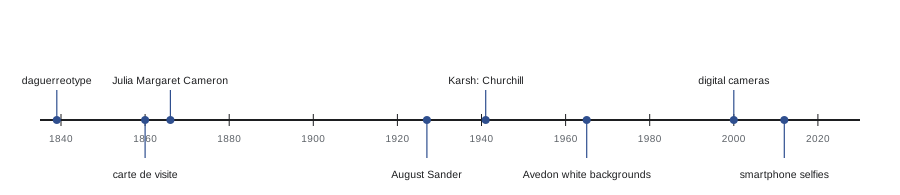
When the daguerreotype was announced in 1839, exposures lasted minutes, making portraits nearly impossible. Within a few years, faster lenses and more sensitive plates brought exposures down to seconds, and portrait studios spread rapidly through Europe and North America. Sitters were held still with hidden head braces, which is one reason early portraits look stiff and serious. In the 1850s and 1860s, the carte de visite, a small portrait mounted on card and produced cheaply in multiples, made portraits affordable to millions and created a fashion for collecting images of family, friends and celebrities. Studios developed painted backdrops, columns, drapes and furniture to suggest status.
Photographers soon pushed portraiture beyond record. Julia Margaret Cameron, working in England in the 1860s, made soft, intimate close-ups that sought character rather than flattery. Nadar in Paris photographed artists and writers against plain backgrounds with simple light. In the twentieth century, August Sander set out to photograph the people of Germany by profession and class; Yousuf Karsh, the Armenian-Canadian photographer based in Ottawa, became famous for dramatic, sculpted portraits of world figures, including his 1941 portrait of Winston Churchill; Richard Avedon made stark white-background portraits that revealed sitters with unsettling directness; Diane Arbus photographed people on the margins of society; and Annie Leibovitz built a career on staged, conceptual celebrity portraits. Contemporary photographers continue to expand the genre, from community portrait projects to fashion, documentary and social media self-representation. Studying this history shows the range of what a portrait can do, and how each approach reflects choices about power, collaboration and truth.
What is a portrait for?
Every portrait has a purpose, and the purpose shapes every decision about framing, light, expression, setting and editing. Common purposes include:
- Identification and record: passports, ID cards and staff photographs, which follow strict rules about neutral expression, lighting and background.
- Professional presentation: headshots and business portraits that communicate competence, approachability or authority (Lesson 8).
- Personal and family memory: portraits of children, couples, families and milestones, valued for decades as records of relationships.
- Editorial storytelling: magazine and newspaper portraits that illustrate an article about the subject, often revealing something about their work or character.
- Advertising and branding: portraits that sell a product, service or idea, in which the person may represent a type rather than themselves.
- Art and self-expression: portraits that explore identity, community, beauty or social issues, sometimes collaboratively with the subject.
Before any portrait session, ask: who will see this image, where, and what should they understand or feel about the person? A headshot for a lawyer's website, an album portrait for a grandparent and an editorial portrait of a protest organizer require quite different choices.
| Purpose | Typical audience | Priorities |
|---|---|---|
| Identification | Officials, systems | Neutral, consistent, rule-compliant |
| Business headshot | Clients, employers, colleagues | Approachable, credible, consistent with brand |
| Family portrait | Family, future generations | Relationships, warmth, timelessness |
| Editorial portrait | Readers of an article | Character, story, context |
| Advertising | Customers | Message, brand, aspiration |
| Fine art | Galleries, books, communities | Concept, identity, collaboration |
Approaches to portraiture
Portrait photographers work along several spectrums. One runs from formal to candid: formal portraits are posed and controlled, with the subject aware of the camera; candid portraits capture people unaware or absorbed in activity. Another runs from studio to environment: studio portraits isolate the person against a controlled background, while environmental portraits place them in a meaningful setting (Lesson 7). A third concerns the relationship between photographer and subject: the photographer may impose a vision, as in much advertising and celebrity work; collaborate, discussing how the person wants to be seen; or observe, letting the person present themselves. Many successful portraits combine approaches, for example a posed environmental portrait in which the subject chooses the location and clothing.
What makes a portrait strong
Strong portraits share several qualities. They have a clear subject: the eye goes to the person, usually to the eyes, without competing distractions. They reveal something: an expression, a gesture, a relationship or a context that tells the viewer about the person. They are technically sound: sharp where it matters, well exposed for skin, with light that flatters or deliberately characterizes. They have intention: the framing, background, pose and light seem chosen rather than accidental. And they respect the subject: people recognize themselves and feel fairly represented, even when the image is challenging. Of these, expression is usually the most important; viewers forgive imperfect light and composition far more readily than a forced smile or vacant eyes.
The portrait session as a collaboration
Most portraits are made with willing subjects, and the session is a social interaction as much as a technical exercise. People in front of a camera often feel self-conscious, judged or unsure what to do. The photographer's job is to make them comfortable, explain what is happening, direct them clearly, notice what works and build their confidence, all while managing camera settings, light and composition. A typical session moves through stages: preparation and planning, welcome and conversation, warm-up frames, the main sequence of setups and poses, variation, and a close in which the subject feels the session went well. Lesson 3 explores connection and direction in detail.
Worked problem
Defining the purpose before a session
A local bakery owner asks for "some nice photos of me" for a newspaper feature about her business and for her website. How should the photographer clarify the brief?
Show solution
- Ask where each image will appear: the newspaper will likely want an editorial environmental portrait; the website may need a headshot and a few images of her working.
- Ask what impression she wants to give: warm and welcoming, skilled and artisanal, or modern and efficient.
- Discuss setting, clothing, time of day (perhaps early morning baking) and whether staff or customers should appear.
- Agree on the number of images, formats (vertical for print, horizontal for the website banner) and usage rights for the newspaper and website.
Answer: Identify each use and its audience, the impression she wants, the setting and timing, and the deliverables and usage before planning the shoot.
Portraits, power and representation
Portraits shape how people are seen, and the choices photographers make carry ethical weight. Camera angle, framing, expression and context can make a person look powerful or vulnerable, admirable or ridiculous. Historically, photography was used to classify and stereotype people by race, class, disability and appearance, and to depict colonized and marginalized peoples without their consent or voice. Contemporary portrait photographers increasingly emphasize consent, collaboration and self-representation, inviting subjects to shape how they appear, choosing images together and telling their own stories. Lesson 11 discusses inclusive portraiture, and Lesson 12 covers consent, releases and ethics.
Self-portraits and selfies
Self-portraiture has a long history in painting and photography, from Vivian Maier's reflections in shop windows to Cindy Sherman's staged self-portraits exploring female identity. The smartphone selfie made self-portraiture universal. Practising self-portraits is useful for portrait photographers: it shows what it feels like to be photographed, builds empathy with subjects, and offers a patient model for testing light and poses. A tripod, remote or timer, and a mirror or tethered screen make self-portrait practice easy.
Course overview
Lesson 2 covers lenses, perspective and working distance; Lesson 3, connecting with and directing subjects; Lessons 4 and 5, posing bodies and faces and drawing out expression; Lesson 6, finding and shaping light on location; Lesson 7, environmental portraits; Lesson 8, headshots and business portraits; Lesson 9, group portraits; Lesson 10, families, children and pets; Lesson 11, inclusive portraiture; and Lesson 12, releases, ethics, business and the capstone portrait series.
Portraiture in Canada and beyond
Canadian photographers have contributed significantly to portraiture. Yousuf Karsh's studio in Ottawa's Château Laurier produced portraits of Albert Einstein, Ernest Hemingway, Audrey Hepburn and many others over six decades, characterized by controlled lighting, deep shadows and a sense of monumentality. William Notman's Montreal studio in the nineteenth century was one of the largest in North America, producing portraits and elaborate composite group images of clubs and societies. Contemporary Canadian and Indigenous photographers use portraiture to explore identity, community and land, often collaboratively with their subjects. Studying photographers from your own region, and from communities different from your own, broadens your sense of what portraits can be and whose stories they tell.
Portraits and the viewer
A portrait is a meeting between three people: the subject, the photographer and the viewer. Direct eye contact with the lens creates a relationship between subject and viewer, who feels looked at; a gaze away from the camera invites the viewer to observe, as if unseen. Framing tight on the face creates intimacy and intensity, while wider frames create distance and context. Lighting and colour set mood: soft, warm light feels gentle, while hard, high-contrast light feels dramatic or severe. Thinking about how a viewer will experience the portrait, rather than only how the subject looks, helps photographers make deliberate choices.
Learning from portraits you admire
A useful exercise is to collect portraits that move you and analyse them: where the light comes from and how hard it is, what lens and distance seem to have been used, how the subject is posed and framed, what the expression communicates, what the background adds, and how the image was edited. Try to recreate a few with friends, not to copy them permanently, but to understand how their effects were achieved. Over time, combining what you learn with your own sensibility produces a recognizable approach, the basis of a personal portrait style.
Portrait genres overlap
Portrait photographers rarely work in only one genre. A wedding photographer makes formal family groups, couple portraits and candid documentary images in a single day; a corporate photographer makes headshots, environmental portraits of executives and event coverage; an editorial photographer may make a studio portrait in the morning and a documentary series in the afternoon. The skills in this course transfer across genres, and versatility makes photographers more resilient in a changing market.
A portrait checklist
Before pressing the shutter, many photographers run through a mental checklist: is the purpose clear, is the light flattering or deliberately characterful, are the eyes sharp and alive, is the expression genuine, is the pose comfortable and purposeful, is the background supporting rather than distracting, and is the subject being represented fairly? Asking these questions repeatedly through a session builds habits that become automatic.
Above all, portraiture rewards curiosity about people: the more genuinely interested you are in who someone is, the more of them your portraits will reveal.
Common mistakes
MistakeStarting a session without a clear purpose.
InsteadDefine the audience, use and impression first.
MistakeFocusing on gear and ignoring the person.
InsteadPrioritize connection and expression.
MistakeCopying a famous style without understanding it.
InsteadStudy why historical approaches worked.
MistakeTreating subjects as props.
InsteadCollaborate and respect how they want to be seen.
MistakeJudging portraits only on technique.
InsteadJudge expression, intention and respect too.
Summary and key terms
- A portrait is a photograph in which the person is the point.
- Portraiture developed from long daguerreotype exposures to the carte de visite and modern genres.
- Cameron, Nadar, Sander, Karsh, Avedon, Arbus and Leibovitz show the range of approaches.
- Purpose determines framing, light, expression, setting and editing.
- Approaches range from formal to candid, studio to environment, imposed to collaborative.
- Strong portraits have a clear subject, reveal something and show intention and respect.
- Sessions are collaborations; portraits carry ethical weight.
- Portrait
- Photograph whose main purpose is to show a person.
- Daguerreotype
- Early photographic process announced in 1839.
- Carte de visite
- Small, cheap mounted portrait popular in the 1860s.
- Formal portrait
- Posed, controlled portrait.
- Candid portrait
- Portrait of a person unaware or absorbed.
- Environmental portrait
- Portrait showing the subject in a meaningful setting.
- Editorial portrait
- Portrait illustrating a story about the subject.
- Headshot
- Close portrait used for professional presentation.
- Self-representation
- People shaping how they are portrayed.
- Brief
- Statement of a portrait's purpose and requirements.
Practice problems
Work each problem on paper first, then reveal the answer to check.
Why do early portraits look stiff?
Show answer
Long exposures and head braces.
What did the carte de visite change?
Show answer
It made portraits cheap and widely collected.
Name a Canadian portrait photographer famous for Churchill.
Show answer
Yousuf Karsh.
What was August Sander's project?
Show answer
Photographing Germans by profession and class.
Name four purposes of portraits.
Show answer
Identification, business, family, editorial, advertising, art.
What question should come before every session?
Show answer
Who will see it, where, and what should they feel?
Name two spectrums of approach.
Show answer
Formal to candid; studio to environment; imposed to collaborative.
What is usually most important in a portrait?
Show answer
Expression.
Why practise self-portraits?
Show answer
Empathy and patient testing of light and poses.
Why do portraits carry ethical weight?
Show answer
They shape how people are seen.
Lesson quiz · 5 questions
Score 60% or more to complete this lesson.
Create a free account to save your progress, take quizzes and earn a certificate.