
PHOT-220 · Lesson 11 of 12 · 25 min
Inclusive portraiture
Everyone deserves to be photographed well. Yet many people have experienced portrait photography that did not serve them: dark skin rendered muddy or grey, bodies posed in ways that made them uncomfortable, wheelchairs awkwardly hidden, gender identities misread, cultural dress misunderstood, or features "corrected" without permission. Inclusive portraiture means having the technical skill, knowledge and attitude to photograph people of all skin tones, body types, ages, abilities, genders, cultures and identities with accuracy, dignity and respect, and to collaborate with them on how they want to be seen. This lesson covers the history of bias in photography, photographing all skin tones, photographing diverse bodies, disability and accessibility, gender identity and expression, cultural and religious considerations, age, language and communication, and building an inclusive practice.
Bias in photographic history
Photographic technology itself has carried bias. For decades, colour film and printing were calibrated using reference cards showing light-skinned models, such as the "Shirley cards" used by Kodak and photo labs from the 1950s, so that lab processing optimized the rendering of light skin, and dark skin was often poorly reproduced. Kodak improved film latitude for darker tones in later decades, partly in response to complaints from furniture and chocolate advertisers who could not show dark brown products well. Early digital cameras and some automatic exposure, face detection and processing systems also performed less well on darker skin. Beyond technology, photography has a history of stereotyping and objectifying people by race, disability, gender and culture. Inclusive practice starts with recognizing that defaults are not neutral, and that photographers must actively learn to serve everyone.
Photographing all skin tones
Skin tones range from very light to very dark, with a wide variety of undertones: warm, golden, olive, red, cool and neutral. Good technique for all skin tones includes:
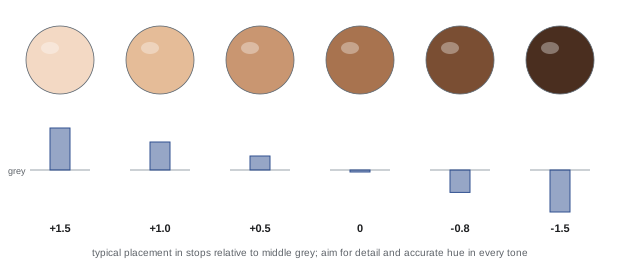
- Exposing for the skin, not the scene: meter or check the histogram and false colour on the face, and do not let a bright background push dark skin into underexposure. Darker skin may need one or more stops more exposure than a reflected meter suggests in a mixed scene.
- Using light that reveals texture and dimension: dark skin often benefits from larger soft sources that create broad, glowing highlights, and from a little more fill to show detail in shadows. Specular highlights, the reflective sheen of skin, give dark skin life and shape.
- Lighting each person individually in groups with different skin tones, so that both light and dark skin are well exposed in the same frame (CINE-202 and PHOT-210 discuss ratios).
- Choosing backgrounds and clothing that complement rather than merge with the skin.
- Correcting white balance on neutral references, then fine-tuning skin hue and saturation carefully in editing, avoiding grey, ashy or overly orange results.
- Never lightening, darkening or altering skin tone beyond accurate rendering without the person's explicit wish.
Photographing diverse bodies
Bodies come in every size and shape, and people's feelings about their bodies vary enormously. Some people want to look slimmer, some taller, some want their curves celebrated, and some simply want to look like themselves. Ask rather than assume: "is there anything you'd like me to know about how you like to be photographed?" Posing principles (Lesson 4), such as angling the body, creating space, good posture and a slightly higher camera, apply to everyone, but the goal is to flatter the person as they wish, not to impose a single ideal. Choose poses that feel comfortable and natural for the person's body; some positions are uncomfortable or impossible for some people. Use clothing guidance that suits different bodies, and never comment negatively on bodies. In editing, avoid reshaping bodies unless the subject asks, and respect choices such as keeping stretch marks, scars and natural features (PHOT-202).
Disability and accessibility
Disabled people are frequently under-represented in portraiture or depicted in stereotyped ways: as objects of pity, as inspirational figures, or with their disability hidden. Inclusive portraits show disabled people as they are and as they wish to be seen. Practical considerations include:
- Asking about access needs before the session: step-free access to the location, accessible washrooms, seating, rest breaks, lighting sensitivities, sensory sensitivities and communication preferences.
- Treating mobility aids such as wheelchairs, canes and prosthetics as part of the person, and asking how the person wants them shown, rather than automatically hiding or emphasizing them.
- Lowering the camera to the eye level of wheelchair users and seated subjects, and positioning group members so that a wheelchair user is integrated rather than placed at the edge or in front.
- Adapting poses to the person's comfort and range of motion, asking before moving or touching any equipment, and never assuming what someone can or cannot do.
- Communicating clearly: speaking directly to the person, not to a companion; using clear language and visual demonstrations for people who are deaf or hard of hearing; describing what you are doing for people who are blind or have low vision; and allowing extra time.
- Being aware of photosensitive conditions, such as epilepsy or migraine, that may be triggered by flash; offering continuous light instead.
| Situation | Inclusive practice |
|---|---|
| Wheelchair user | Camera at their eye level; wheelchair integrated as they prefer |
| Deaf or hard of hearing | Face the person, clear visual direction, interpreter if needed |
| Blind or low vision | Describe the setup and poses verbally; guide with consent |
| Neurodivergent subject | Predictable plan, sensory-friendly space, breaks, clear instructions |
| Photosensitivity | Continuous light rather than flash |
| Chronic pain or fatigue | Seated poses, shorter sessions, rest breaks |
Gender identity and expression
Gender identity and expression are personal, and portrait photography can affirm or undermine how people see themselves. Inclusive practice includes using the names and pronouns people ask you to use, including on forms, contracts, gallery labels and captions; avoiding assumptions about posing, clothing or "masculine" and "feminine" styles, and instead asking how the person wants to come across; being aware that some transgender and non-binary people have particular concerns about features such as jawlines, chests or hair, and discussing lighting, angles and posing that help them feel affirmed; and offering privacy for changing and a respectful, safe environment. Gender-affirming portrait sessions, for example to celebrate a transition, are a meaningful service, and many photographers collaborate with community organizations to offer them. Never disclose a person's gender history without their consent.
Cultural and religious considerations
Cultural and religious backgrounds can affect portrait sessions in several ways. Some people wear head coverings, such as hijabs, turbans, kippot or headscarves, which are part of their identity and should be respected and photographed well; avoid asking people to remove them. Some religious traditions have rules about physical contact, mixed-gender photography, modesty or images of people; ask clients about preferences, and offer a photographer or assistant of a particular gender if needed. Traditional dress and jewellery at weddings and ceremonies carry meanings; learn about them and photograph important details. Some communities have particular sensitivities about photographs of people who have died, sacred objects or ceremonies; for example, some Indigenous communities have protocols about photographing ceremonies or publishing images of deceased people. Research, ask and follow the guidance of the people you photograph.
Age
Older people are often under-photographed, and their portraits are frequently retouched to look younger. Many older subjects value images that show their character and life experience, including lines and grey hair, softened only slightly. Practical considerations include comfortable seating, steady support for standing poses, warm rooms, good light that flatters without flattening, and patience with mobility and hearing. In multi-generational sessions, photograph older relatives early and include them thoughtfully. Young people, too, deserve respect for their preferences; teenagers in particular often care deeply about how they are portrayed (Lesson 10).
Language and communication
Respectful language makes sessions comfortable. Ask how people want to be described, rather than assuming terms for ethnicity, disability, gender or family structure. Avoid comments on appearance that may be hurtful, such as "you'd look slimmer if", and frame direction positively and neutrally ("let's try turning toward the window"). For clients who speak a language you do not, simple demonstrations, translated key phrases or an interpreter help. In captions and descriptions, use accurate, respectful terms and the subject's preferred names, and avoid defining people by a single characteristic unless it is relevant and they agree.
Worked problem
Planning an inclusive team headshot day
A company asks for headshots of 40 employees, including a wheelchair user, an employee who wears a hijab, an employee with epilepsy and staff with a wide range of skin tones. What should the photographer plan?
Show solution
- Choose a step-free room with an accessible washroom, and ask the company to share an optional access-needs question with employees.
- Design lighting with a large soft key and fill that suits all skin tones, and check exposure on each person rather than locking a single value blindly.
- Plan a seated setup with the camera height adjustable to eye level, so the wheelchair user, and anyone else who prefers to sit, is photographed at eye level in the same style as others.
- Use continuous LED light, or at least offer a continuous-light option, for the employee with epilepsy.
- Ensure good lighting on the hijab fabric and the face, and offer a mirror and private space for adjustments.
Answer: Accessible space, an access-needs question, lighting and exposure that suit all skin tones, adjustable camera height, a continuous-light option, and respectful space for adjustments.
Building an inclusive practice
Inclusive portraiture is an ongoing practice. Steps include studying the work of photographers from diverse communities and photographers who specialize in inclusive portraiture; practising with people of varied skin tones, bodies and abilities; building a portfolio that reflects the diversity of your community, since potential clients look for themselves in it; using intake forms that ask about pronouns, access needs and preferences in a welcoming way; seeking feedback from clients; and partnering with community organizations. Mistakes happen; when they do, apologize sincerely, correct them and learn. People remember how a photographer made them feel, and inclusive practice builds trust and reputation.
Hair, makeup and styling across identities
Hair and makeup vary across cultures and identities, and photographers and stylists should be skilled in serving everyone. Textured and coily hair, protective styles, locs and braids reflect light differently from straight hair and may need different lighting and handling; avoid touching people's hair without permission. Makeup artists should carry products for the full range of skin tones, and photographers should avoid suggesting changes to hairstyles or features that people have not asked for. When hiring stylists for diverse sessions, choose professionals experienced with different hair textures and skin tones.
Representation in your marketing
The images photographers use in their own marketing signal who they serve. A portfolio showing only one kind of person tells others that they may not be welcome. Seek out opportunities to photograph a diverse range of people, with their consent, and show that work. Collaborate with community organizations, offer accessible sessions, and ensure websites and booking forms are accessible, for example with alt text, readable fonts and simple navigation.
Listening and learning
Inclusive practice depends on listening. Ask clients what has made them uncomfortable in past photography experiences and what would help this time. Many people have never been asked, and the question itself builds trust. Learning from the communities you photograph, rather than assuming, leads to better images and better relationships.
Intake forms done well
A welcoming intake form might ask for the name the client would like used, pronouns if they wish to share them, any access needs, preferences or concerns about being photographed, and anything else they would like the photographer to know. Making every question optional and explaining why you ask builds trust and prevents uncomfortable surprises during the session.
Common mistakes
MistakeExposing for the scene and underexposing dark skin.
InsteadExpose and light for detail in every skin tone.
MistakeHiding wheelchairs or mobility aids automatically.
InsteadAsk how the person wants them shown.
MistakeAssuming gendered poses and styles.
InsteadAsk how the person wants to come across and use their pronouns.
MistakeAsking people to remove religious head coverings.
InsteadRespect and photograph them well.
MistakeRetouching age or features without asking.
InsteadFollow the subject's wishes.
Summary and key terms
- Photographic technology and practice have carried bias; defaults are not neutral.
- Expose and light for detail and accurate colour in every skin tone.
- Ask people how they want their bodies photographed and adapt poses.
- Plan for access needs, integrate mobility aids and communicate clearly.
- Use correct names and pronouns and affirm gender identity.
- Respect cultural and religious dress, practices and protocols.
- Build inclusive practice through learning, portfolio, intake and feedback.
- Inclusive portraiture
- Photographing all people accurately and respectfully.
- Shirley card
- Historical lab reference card with light-skinned models.
- Undertone
- Underlying warm, cool or neutral hue of skin.
- Specular highlight
- Reflective sheen on skin.
- Access needs
- Requirements for a person to participate fully.
- Mobility aid
- Wheelchair, cane, walker or prosthetic.
- Photosensitivity
- Sensitivity to flashing or bright light.
- Pronouns
- Words used to refer to a person, such as she, he or they.
- Gender-affirming portrait
- Portrait celebrating a person's gender identity.
- Intake form
- Pre-session questionnaire about preferences and needs.
Practice problems
Work each problem on paper first, then reveal the answer to check.
What were Shirley cards?
Show answer
Lab reference cards with light-skinned models.
How should dark skin be exposed?
Show answer
For detail and colour in the skin, not the scene.
What light often suits dark skin?
Show answer
Large soft sources with glowing highlights and some fill.
How should you approach body preferences?
Show answer
Ask rather than assume.
How should a wheelchair user be photographed?
Show answer
At eye level, with the chair shown as they prefer.
Why offer continuous light?
Show answer
For photosensitive people.
What should you use on forms and captions?
Show answer
People's chosen names and pronouns.
What should you never ask about head coverings?
Show answer
To remove them.
How do many older subjects want to be portrayed?
Show answer
With character and life experience, lightly softened.
Name two steps to build inclusive practice.
Show answer
Study, practise, diverse portfolio, intake forms, feedback.
Lesson quiz · 5 questions
Score 60% or more to complete this lesson.
Create a free account to save your progress, take quizzes and earn a certificate.