
PHOT-310 · Lesson 1 of 12 · 29 min
The commercial photography industry
Commercial photography is photography made to sell, explain or promote something on behalf of a client. The client might be a global consumer brand launching a new phone, a regional grocery chain refreshing its weekly flyer, a start-up selling candles online, an architect, a restaurant or a manufacturer of industrial pumps. What unites these jobs is that the photograph has a business purpose defined by someone other than the photographer, it must meet a brief, and it will be used in specific media for a specific period. This course concentrates on the largest and most technically demanding part of that world: product photography for advertising, packaging, catalogues and e-commerce, together with the closely related fields of food and beverage photography and lifestyle product shoots with talent. Earlier courses gave you the foundations. PHOT-211 and PHOT-220 covered studio lighting, light modifiers and the behaviour of light on surfaces; PHOT-301 covered colour management; PHOT-302 introduced estimates, call sheets and rights in a fashion context. Here those skills are applied to the problems that commercial clients pay to have solved.
This first lesson maps the industry: who buys photography, the kinds of commercial work, the people involved in a production, how photographers find work and specialize, how technology and artificial intelligence are changing the field, and what clients actually value when they hire a commercial photographer.
Who buys commercial photography
Commercial photography is bought by organizations, not by consumers. Understanding who those buyers are, and what they need, explains most of the business decisions you will make.
- Brands and manufacturers commission images of their products for packaging, websites, advertising, trade shows, sales sheets and social media. Large brands may run dozens of shoots a year through an in-house creative team or an advertising agency.
- Advertising and design agencies act for brands. An art director or creative director at the agency develops the concept, writes or approves the brief, hires the photographer and supervises the shoot on behalf of the client.
- Retailers and e-commerce businesses need a constant flow of consistent product images. A mid-sized online retailer may photograph hundreds of new products every week, often in an in-house studio or through a specialist e-commerce studio.
- Marketplaces and platforms such as Amazon, Etsy, Shopify stores and wholesale portals set technical rules for images, and sellers hire photographers to meet them.
- Publishers, restaurants, hospitality businesses, food producers and packaged goods companies commission food and beverage photography for menus, packaging, recipes and advertising.
- Industrial, technical and business-to-business companies need clear images of machinery, components, medical devices and tools for catalogues, manuals, tenders and sales presentations.
Each buyer values different things. An agency running a national campaign values ideas, craft and the ability to execute a complex concept flawlessly on a single day. An e-commerce manager values consistency, throughput, accurate colour and reliable turnaround at a predictable cost per image. A small business owner may value guidance, because they may never have commissioned photography before and may not know what they need.
Kinds of commercial product work
Product photography is not one job but several, with different workflows, budgets and skills.
| Type | Typical client | Main goal | Typical volume and budget |
|---|---|---|---|
| Advertising and campaign | Brand through an agency | Create desire and express a concept | Few images, high budget per image |
| Packaging and hero shots | Brand or design agency | Show the product perfectly for packs, posters and websites | Few images, highly retouched |
| E-commerce and catalogue | Retailer or marketplace seller | Show the product accurately and consistently | Many images, low cost per image |
| Lifestyle and in-context | Brand or retailer | Show the product in use, often with talent | Moderate volume and budget |
| Food and beverage | Food producer, restaurant, publisher | Make food look appetizing and truthful | Varies widely |
| Technical and industrial | Manufacturer, B2B company | Explain function, scale and detail | Moderate, often on location |
Advertising hero shots and packaging images are the top of the craft. A single image of a bottle of whisky, a watch or a perfume flacon may take a full day to light and many more hours to retouch, because it will be printed large, scrutinized by the brand and seen by millions of people. E-commerce photography is at the other end: the craft lies in building a repeatable system that produces hundreds of accurate, consistent images a day with minimal variation. Many commercial photographers move between these levels, and the best e-commerce studios apply hero-shot thinking to their lighting templates, while the best advertising photographers are rigorous about systems and file management.
Lifestyle product photography places the product in a believable setting, often with people using it: a family in a kitchen with a new blender, a cyclist wearing a jacket on a mountain road, hands holding a phone in a café. These shoots combine product lighting with location, casting, styling and direction of talent, and they bring legal issues such as model releases and property releases that pure product work avoids. Food and beverage photography is a specialty of its own, with food stylists, prop stylists and techniques for keeping food looking fresh under lights.
The production team
A small e-commerce job may involve only the photographer and a client contact. A large advertising shoot can involve twenty or more people. Knowing the roles helps you plan, estimate and communicate.
- Client: the brand or business paying for the work. The brand manager or marketing manager is usually the final decision maker, even when an agency runs the job.
- Art director (AD) and creative director (CD): at an agency or in-house, they own the concept and layout and approve images on set. The art director usually attends the shoot and signs off each frame.
- Art buyer or producer: at larger agencies, the art buyer finds photographers, requests estimates, negotiates fees and usage, and manages contracts. In smaller agencies the producer or the art director does this.
- Photographer: responsible for the images, the lighting, the crew and often the production. The photographer is usually the employer of the crew and the party who issues the estimate and invoice.
- Photo assistants: rig lights, manage cables and grip, help with set construction and keep the set safe. A first assistant often manages the lighting crew and the equipment.
- Digital technician (digi tech): manages tethered capture, colour, file naming, backups and on-set previews. On many commercial shoots the digi tech is the person who keeps the files and the client's screen in order.
- Producer: plans logistics, budgets, locations, permits, catering, transport and insurance. Photographers on large jobs often hire a freelance producer.
- Stylists: a prop stylist sources and arranges props and surfaces; a food stylist prepares and arranges food; a wardrobe stylist handles clothing; a set builder or set designer constructs sets.
- Hair and makeup artists and talent: on lifestyle shoots, models or actors and the people who prepare them.
- Retoucher and post-production: retouching, compositing and sometimes CGI artists who finish the images, either in the photographer's studio or at a specialist house.
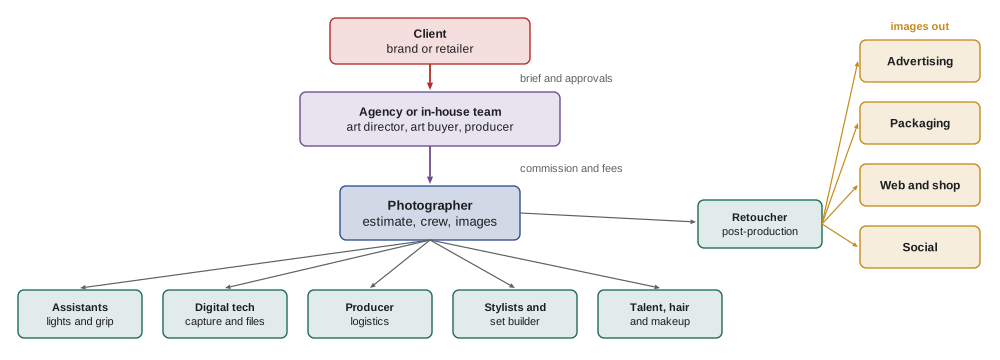
The flow of money and authority matters. The client pays the agency, the agency pays the photographer, and the photographer pays the crew and suppliers. Approvals flow the same way: the art director approves on set, but the client may reject images later. A photographer who understands this chain will make sure that the brief, the estimate and the approval process are agreed in writing before the shoot, and that the person approving images on set has the authority to do so.
In-house studios, agencies and independent photographers
Commercial photographers work in several business models. Many large retailers run in-house studios with salaried photographers, stylists and retouchers producing e-commerce images to strict templates. These jobs offer stability, regular hours and the chance to master high-volume workflows, but less creative variety. Independent photographers work for many clients, often specializing in a category such as beverages, jewellery, cosmetics, food or technology. Some run their own studios with permanent staff; others rent studios by the day and hire crew for each job. Production companies and studios that combine photography, video, CGI and retouching under one roof have grown as clients demand still and motion content from the same shoot.
Specialization is common because each product category has its own technical problems and its own buyers. A beverage photographer learns to light glass, liquids, condensation and splashes; a jewellery photographer learns macro, focus stacking and the control of reflections in polished metal and gemstones; a food photographer learns to work with food stylists and to shoot quickly before food wilts. Clients search for specialists, look at specialist portfolios and pay more for proven experience in their category. Generalists can thrive too, especially in smaller markets, but they must still show the client work that resembles the job at hand.
How photographers find commercial work
Commercial work rarely comes from public job postings. Most of it comes from relationships, referrals and visibility to the people who commission photography.
- Portfolio and website: a focused portfolio of the kind of work you want to be hired for, organized by category, with the best images first. Art buyers look at dozens of portfolios a week, so clarity and consistency matter more than quantity.
- Direct outreach: researching agencies, brands and retailers, identifying the art buyers, art directors and marketing managers, and contacting them with targeted emails, printed promotions or portfolio meetings.
- Representation: established commercial photographers are often represented by agents who market them, negotiate fees and manage estimates in exchange for a commission, commonly in the range of 25 to 30 percent of fees.
- Directories and platforms: paid directories and marketplaces for commercial photographers, as well as e-commerce photography platforms that match studios with sellers.
- Repeat business: in commercial work the most valuable client is the one who books again. Reliability, communication and on-time delivery generate repeat work more than any single spectacular image.
Personal projects play a special role. Because commercial portfolios are built from client work, photographers who want to move into a new category, for example from e-commerce to beverage advertising, often shoot test projects or personal work that shows what they can do. A carefully planned test shoot of a product you choose, lit and retouched to advertising standards, is a legitimate and common way to show capability before a client takes the risk.
Technology and change in the industry
Commercial photography has been transformed several times in recent decades. Digital capture replaced film in the early 2000s and made tethered shooting, instant client approval and digital retouching standard. Medium-format digital backs and high-resolution full-frame cameras now deliver files large enough for billboards. Automated e-commerce systems with turntables, robotic arms and fixed lighting rigs can photograph hundreds of products a day with minimal staff. Smartphone photography and social media have increased the demand for images enormously while pushing prices for simple work down.
Computer-generated imagery (CGI) has become a major part of product imagery. Many furniture, appliance and automotive images in catalogues and advertising are entirely rendered from 3D models, because a 3D model can be placed in unlimited settings and colours without building sets or manufacturing samples. Generative artificial intelligence tools now produce backgrounds, props, models and even whole scenes from text prompts or reference images. These tools change what clients will pay for: simple product cut-outs and generic backgrounds are increasingly automated, while authentic photography of real products, skilled lighting, complex physical effects and trustworthy representation remain valuable. Lesson 10 examines the ethics and the legal duty not to mislead consumers when images are composited, rendered or generated.
The practical lesson is that commercial photographers succeed by solving problems that clients cannot solve cheaply themselves. Knowing how to light a difficult product, how to build an efficient workflow, how to coordinate a team and how to deliver images that are accurate, legal and fit for every channel is what clients pay for.
What clients value
Surveys of art buyers and creative directors, and the experience of working photographers, consistently point to the same qualities:
- Reliability: arriving prepared, keeping to schedule and budget, and delivering on time. A missed deadline can delay a product launch or a print run.
- Problem solving: the ability to translate a vague idea into a workable plan, and to solve technical problems such as reflections, colour accuracy or tight deadlines without drama.
- Communication: clear estimates, confirmed briefs, regular updates and calm collaboration on set.
- Consistency: images that match the brand's established look and that are consistent across a range of products and shoots.
- Craft: lighting, composition and retouching good enough that the client does not have to think about them.
- Professionalism: insurance, contracts, safe sets, respectful treatment of crew and talent, secure file handling and confidentiality for unreleased products.
Confidentiality deserves special mention. Commercial photographers often handle products months before launch. Clients may require non-disclosure agreements (NDAs), restrict phones on set, demand secure file transfer and prohibit the photographer from showing the images in a portfolio until after the launch, or at all. Respecting these obligations is essential to keeping clients.
Worked problem
Choosing a business model for a first year
A photographer leaving college has a small portfolio of product tests. She can take a full-time job at a retailer's e-commerce studio photographing about 120 products a day, or freelance as a second assistant to a beverage photographer at about 2 days a week while building her own client list. What factors should she weigh?
Show solution
- In-house: steady salary, mastery of high-volume lighting templates, tethering, file naming and colour workflows; less creative range and fewer portfolio images she can show.
- Assisting: exposure to high-end lighting, crew management, clients and estimates; irregular income; a mentor and industry contacts.
- Portfolio: in-house images are often similar and the employer may restrict their use; assisting gives no portfolio images but personal tests can fill the gap.
- Long-term goal: if she wants to run her own advertising studio, assisting builds the relationships and production knowledge she needs; if she wants a stable career in retail imaging, in-house is the direct route.
Answer: Neither choice is wrong. The decision depends on her income needs and goals: in-house builds systems and stability, assisting builds high-end craft and contacts. Many photographers do one and then the other.
Professional bodies and standards
In Canada, photographers can join organizations such as the Canadian Association of Professional Image Creators (CAPIC), which publishes resources on business practices, licensing and contracts for commercial image makers, and the Professional Photographers of Canada (PPOC), which offers accreditation. Advertising in Canada is guided by the Canadian Code of Advertising Standards administered by Ad Standards, alongside the Competition Act enforced by the Competition Bureau.
These bodies are useful sources of model contracts, pricing surveys, legal updates and community. Joining one early in a career is a practical way to learn current business practice and to meet the people who hire photographers.
The course ahead
The lessons that follow move through a commercial job from beginning to end: reading a brief, setting up a product studio, lighting products, solving the hardest product surfaces, food and beverage work, e-commerce systems, macro and focus stacking, lifestyle shoots with talent, retouching and the ethics of composited and generated images, estimating and licensing, and finally delivering a complete campaign in the capstone. Each lesson includes worked calculations so that the technical decisions, such as light distance, flash power, depth of field and pricing, rest on numbers rather than guesswork.
Common mistakes
MistakeShowing a general portfolio of everything you have shot.
InsteadShow a focused portfolio that matches the kind of work you want to be hired for.
MistakeAssuming the art director on set has final authority.
InsteadConfirm who approves images and whether the client can reject them later.
MistakePosting unreleased products on social media.
InsteadRespect NDAs and embargoes; ask before showing any client work.
MistakeCompeting only on price for simple work.
InsteadCompete on reliability, problem solving and quality as well as cost.
MistakeTreating CGI and AI as irrelevant to product photography.
InsteadUnderstand them, use them honestly and focus on what real photography does best.
Summary and key terms
- Commercial photography serves a client's business purpose under a brief and a defined use.
- Buyers include brands, agencies, retailers, marketplaces, food businesses and industrial firms.
- Product work ranges from advertising hero shots to high-volume e-commerce.
- Large productions involve art directors, art buyers, producers, assistants, digi techs, stylists and retouchers.
- Most work comes from relationships, focused portfolios, agents and repeat clients.
- Digital capture, automation, CGI and generative AI have reshaped the market.
- Clients value reliability, problem solving, communication, consistency, craft and confidentiality.
- Commercial photography
- Photography commissioned for a client's business purpose.
- Hero shot
- The principal, most polished image of a product.
- Art director
- The agency or in-house person who owns the visual concept and approves images.
- Art buyer
- Agency staff who hire photographers and negotiate fees and usage.
- Digital technician
- Crew member who manages tethered capture, colour and files.
- Prop stylist
- Specialist who sources and arranges props and surfaces.
- Lifestyle photography
- Product images showing the product in use in a real setting.
- NDA
- Non-disclosure agreement protecting confidential information.
- CGI
- Computer-generated imagery rendered from 3D models.
- Representation
- An agent who markets a photographer for a commission.
Practice problems
Work each problem on paper first, then reveal the answer to check.
Name four kinds of commercial product photography.
Show answer
Advertising, packaging hero shots, e-commerce, lifestyle, food and beverage, technical.
Who usually hires the photographer at a large agency?
Show answer
The art buyer, with the art director.
Who usually employs the crew on a shoot?
Show answer
The photographer.
What does a digi tech do?
Show answer
Runs tethered capture, colour, file naming and backups.
Why do photographers specialize?
Show answer
Each category has distinct technical problems and buyers.
What commission range is common for agents?
Show answer
About 25 to 30 percent of fees.
Why shoot personal test projects?
Show answer
To show capability in a category before clients take a risk.
Which simple product work is most affected by automation?
Show answer
Simple cut-outs and generic backgrounds.
What is an embargo?
Show answer
A restriction on showing images before a release date.
What generates most repeat business?
Show answer
Reliability, communication and on-time delivery.
Lesson quiz · 5 questions
Score 60% or more to complete this lesson.
Create a free account to save your progress, take quizzes and earn a certificate.