
PHOT-420 · Lesson 11 of 12 · 31 min
Authenticity, provenance and content credentials
When any image can be generated or altered convincingly, the value of a photograph as evidence depends on being able to show where it came from and what was done to it. Two broad strategies exist. Detection tries to decide, from the pixels alone, whether an image is real, edited or synthetic. Provenance attaches a verifiable record of origin and history to the image, so that the question becomes "can this image prove where it came from?" rather than "does it look fake?". This lesson explains the C2PA content credentials standard in technical detail, camera and phone signing, invisible watermarks and fingerprints, the statistical limits of AI detectors, classical image forensics, and the law on synthetic images and AI authorship in Canada and the United States as of October 2026. PHOT-201 lesson 11 introduced provenance settings on cameras, and CRE-410 lessons 9 and 10 cover platform labels and creator law; here the focus is on how provenance works and what photographers can rely on.
Why detection alone fails
It is tempting to hope that software can simply tell real photographs from fakes. Detection tools exist and can be useful, but they face structural problems. Generators improve continuously, and a detector trained on yesterday's models may miss tomorrow's. Ordinary processing such as resizing, compression and screenshots destroys many of the subtle traces detectors rely on. Real photographs processed heavily by phone pipelines, which use AI throughout (lessons 2 to 8), can be flagged as synthetic. And the base rate problem means that even an accurate detector produces many false alarms when genuine images vastly outnumber fakes, or misses many fakes when they are common.
for prevalence in (0.01, 0.10, 0.50):
    n = 100_000
    fake = n * prevalence; real = n - fake
    tpr, fpr = 0.95, 0.03                         # detector: catches 95 % of fakes, flags 3 % of real images
    tp = fake * tpr; fp = real * fpr; fn = fake - tp
    precision = tp / (tp + fp); recall = tp / (tp + fn)
print(f"{prevalence * 100:4.0f} % fakes: flagged {tp + fp:7.0f}, of which real {fp:6.0f}; precision {precision:.2f}, recall {recall:.2f}")1 % fakes: flagged 3920, of which real 2970; precision 0.24, recall 0.95 10 % fakes: flagged 12200, of which real 2700; precision 0.78, recall 0.95 50 % fakes: flagged 49000, of which real 1500; precision 0.97, recall 0.95
With a detector that catches 95 per cent of fakes and wrongly flags only 3 per cent of real images, a stream in which 1 per cent of images are fake yields flagged sets that are about three-quarters genuine photographs. Precision rises only when fakes are common. For a newsroom or court, a detector's verdict is therefore at most one piece of evidence, never proof, and a wrongly accused photographer can suffer real harm.
Worked problem
Interpreting a detector alert
A contest receives 2,000 entries, of which an estimated 40 are AI-generated. Its detector has a true positive rate of 90 per cent and a false positive rate of 5 per cent. How many entries will be flagged, and how many of those are genuine?
Show solution
- Fakes flagged: \( 40 \times 0.90 = 36 \).
- Genuine entries flagged: \( 1960 \times 0.05 = 98 \).
- Total flagged: \( 134 \); genuine share \( 98 / 134 \approx 73 \) per cent.
Answer: About 134 flags, of which about 98 are genuine photographs; the contest should ask flagged entrants for raw files and provenance rather than disqualify on the detector alone.
Classical image forensics
Forensic analysts use several techniques beyond AI classifiers. Metadata analysis examines EXIF fields, software tags and inconsistencies in dates or camera models, though metadata is easily edited or stripped. Error level analysis (ELA) re-saves a JPEG and looks for regions that compress differently, which can reveal pasted areas but produces many misleading results. Sensor pattern noise analysis exploits photo-response non-uniformity (PRNU): each sensor has a unique, faint pattern of pixel sensitivity variations, a kind of fingerprint, that can link an image to a specific camera when reference images from that camera are available. Physics-based analysis checks whether shadows, reflections, perspective and lighting directions are consistent, an approach developed by researchers such as Hany Farid. Each technique has limits, and computational photography complicates all of them: multi-frame merging and AI processing alter noise patterns and compression traces even in authentic phone photos.
| Approach | What it examines | Strength | Weakness |
|---|---|---|---|
| Metadata review | EXIF, software and date fields | Quick, sometimes decisive | Easily edited or stripped |
| Error level analysis | JPEG recompression differences | Can reveal pasted regions | Many false signals |
| Sensor noise (PRNU) | Camera-specific pixel pattern | Links images to a device | Needs reference images; weakened by processing |
| Physics and lighting analysis | Shadows, reflections, perspective | Hard for fakers to get right | Expert time, subjective |
| AI classifiers | Statistical traces of generators | Scales to large volumes | Base rates, evasion, new models |
| Provenance (C2PA) | Signed history attached to the file | Verifiable when present | Absent or stripped on most images |
How content credentials work
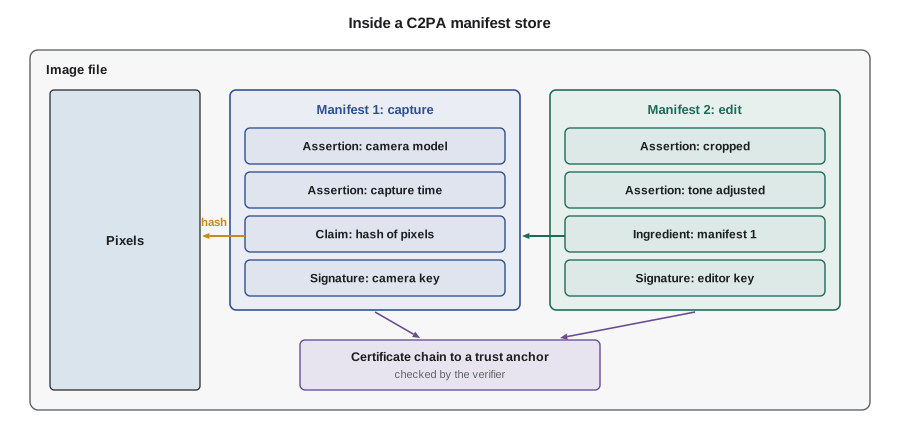
The Coalition for Content Provenance and Authenticity (C2PA), founded in 2021 by Adobe, Microsoft, the BBC, Intel and others and now including camera makers, news organizations and AI companies, publishes an open technical standard for provenance. The Content Authenticity Initiative, led by Adobe, promotes adoption and open-source tools, and "Content Credentials" is the consumer-facing name. A C2PA manifest is embedded in or linked to a media file and contains the following parts.
- Assertions: statements about the content, such as the capturing device, capture time, actions performed (cropped, colour adjusted, generative fill applied), the AI model used, ingredients (earlier versions or source images) and, optionally, the creator's identity.
- A claim: a bundle referencing the assertions together with a cryptographic hash of the image data, binding the manifest to these exact pixels.
- A claim signature: a digital signature over the claim made with a private key whose certificate identifies the signer, such as a camera model, an editing application or a news organization.
- A manifest store: the sequence of manifests from each step in the image's life, so that a camera's original capture manifest can be followed by an editor's manifest listing changes, each referencing the previous version as an ingredient.
Verification recomputes the hash of the image, checks it matches the claim, verifies the signature with the signer's certificate and checks whether the certificate chains to a trusted authority. If a single pixel has changed outside a signed editing step, the hash no longer matches and the credential shows as invalid. The C2PA maintains a trust list and a conformance programme for products; specification version 2.3, published in December 2025, extended signing to live streams. Viewers such as the Content Authenticity Initiative's verify tool display the history.
import hashlib
import numpy as np
rng = np.random.default_rng(420)
pixels = rng.integers(0, 256, (64, 64, 3), dtype=np.uint8)
signed_hash = hashlib.sha256(pixels.tobytes()).hexdigest()
print("hash recorded in the claim:", signed_hash[:16], "...")
edited = pixels.copy(); edited[10, 10, 0] ^= 1          # change one bit of one pixel
for name, img in [("unchanged image", pixels), ("one bit changed", edited)]:
    h = hashlib.sha256(img.tobytes()).hexdigest()
print(f"{name:16s} {h[:16]} ... match: {h == signed_hash}")hash recorded in the claim: e3e832b8662a9e0f ... unchanged image e3e832b8662a9e0f ... match: True one bit changed 6361507672254752 ... match: False
Real C2PA hard bindings hash the file's bytes with exclusions for the manifest itself, and the claim is then signed with public-key cryptography so that anyone can verify it but only the key holder could have produced it. Because hard bindings break on any re-encoding, C2PA also defines soft bindings: an invisible watermark or a perceptual fingerprint that survives resizing and compression and can be used to look up the manifest in a cloud repository when it has been stripped from the file. Combining a manifest, a watermark and a fingerprint is sometimes called durable content credentials.
Signing at capture
Provenance is strongest when it starts at the moment of capture, before any opportunity to alter the image. Leica's M11-P (2023) was the first commercial camera to sign images with content credentials, followed by its SL3-S in 2025. Sony offers in-camera digital signatures for stills on models including the Alpha 1 II and Alpha 9 III, supplied under paid annual licences mainly for news organizations, and extended signing to video with C2PA compliance in late 2025 (Sony announcement, October 2025). Nikon added content credentials to the Z6III by firmware in 2025 but suspended the service after a vulnerability in its signing process was reported, revoking certificates. Google's Pixel 10 phones (2025) sign every photo taken with the built-in camera by default, using hardware-backed keys, and Google Photos records edits including AI changes; Samsung's Galaxy S25 series attaches credentials to images created or edited with its generative AI features rather than to ordinary captures. Product support changes rapidly; check the C2PA conformance list for current products.
The Nikon episode illustrates that provenance depends on key security: if a signing key can be extracted or misused, false images could be signed as genuine. Hardware secure elements, certificate revocation and audits are part of a credible system. It also illustrates a cost of trust: once certificates are revoked, previously signed images may show as unverified.
| Device or service | Provenance approach | Notes |
|---|---|---|
| Leica M11-P and SL3-S | C2PA content credentials in camera | First commercial cameras with built-in credentials |
| Sony Alpha 1 II, Alpha 9 III and others | In-camera digital signatures; C2PA for video | Paid annual licence, aimed at news organizations |
| Nikon Z6III | C2PA by firmware | Suspended after a signing vulnerability; certificates revoked |
| Google Pixel 10 | Signs all built-in camera photos by default | Hardware-backed keys; edits recorded in Google Photos |
| Samsung Galaxy S25 | Credentials on generative AI edits and creations | Not applied to ordinary captures |
Watermarks and their limits
Invisible watermarking embeds a signal in the pixels themselves, imperceptible to viewers but detectable by software. Google DeepMind's SynthID watermarks images generated by Google's models, and other AI companies use their own watermarks or attach C2PA manifests to generated images. Digimarc and others offer watermarking for photographers to track their work. Watermarks survive more processing than metadata, but no watermark is perfectly robust: heavy cropping, regeneration through another model, or adversarial attacks can remove or weaken them, and an absent watermark proves nothing because most generators, especially open-source models run locally, add none. Watermarks also raise their own questions: a detector for one company's watermark says nothing about images from other systems.
Provenance therefore works asymmetrically. A valid credential from a trusted capture device is strong positive evidence that an image is an authentic capture, with a known history of edits. The absence of a credential is weak evidence of nothing, because most images, genuine or not, carry none, and many platforms strip metadata on upload. Studies around 2025 found that only a very small share of images published online carried C2PA data. For photographers whose credibility matters, the practical response is to enable signing where available, keep originals, and choose platforms and workflows that preserve credentials.
The law on synthetic images
Laws on deepfakes and synthetic imagery are changing quickly.
Canada has no single deepfake statute. Bill C-16, which received royal assent on June 18, 2026, extended the Criminal Code offence of publishing intimate images without consent (section 162.1) to sexually explicit synthetic images, including "nearly nude" depictions, and added an offence of threatening to distribute such images, with most provisions in force from July 18, 2026 (reported at the time; confirm current text). Provinces including British Columbia, Manitoba and Alberta give victims civil remedies for non-consensual intimate images, and Alberta announced amendments to cover deepfakes. The proposed Online Harms Act (Bill C-63) died when Parliament was prorogued in January 2025. Defamation, privacy torts such as appropriation of personality, the Competition Act's rules against misleading advertising and the Canada Elections Act's prohibitions on impersonation can also apply to deceptive synthetic images.
Photographers selling into Europe should also know that the EU AI Act's transparency obligations under Article 50 became applicable on August 2, 2026: providers of generative systems must mark outputs as AI-generated in a machine-readable way (with a grace period for that marking duty to December 2, 2026 under amendments adopted in 2026), and those who deploy deepfakes must disclose that the content is artificially generated or manipulated, with lighter requirements for evidently artistic, creative or satirical work (as reported; verify current guidance).
Copyright in AI-generated images
Copyright law in both countries is built around human authorship, and its application to AI output is still developing.
Canada's Copyright Act does not define "author", but courts have tied originality to an author's exercise of skill and judgment, which most commentators read as requiring a human. The Canadian Intellectual Property Office registers copyright without examining originality, and in 2021 it registered an artwork, "SURYAST", listing a human and an AI system as co-authors; a legal clinic later asked the Federal Court to correct or expunge that registration (status not confirmed at the time of writing). The federal government consulted on copyright and generative AI in 2023 and 2024, but no amendments addressing AI training or AI authorship had been enacted at the time of writing. Photographs taken by a human with AI-assisted processing remain protected in the ordinary way; purely generated images may not be.
Worked problem
Assessing copyright in a hybrid image
A photographer shoots a product, then uses generative expand to widen the background for a banner and generative fill to add a vase. Which parts are most clearly protected?
Show solution
- The photograph of the product: human authorship in composition, lighting and capture, clearly protected.
- The arrangement of the final banner, if the photographer made creative choices in selection and placement: likely protectable as a compilation or modification.
- The generated background extension and vase themselves: least likely to be protected, especially where generated from a prompt with little human control.
Answer: The original photograph and the human creative arrangement are protected; the purely generated elements may not be, which matters if the client needs exclusive rights. Disclose AI elements in contracts and, in the United States, when registering.
Practical provenance for photographers
For most photographers, a few practices cover the essentials. Enable content credentials on cameras and phones that support them, especially for documentary and news work. Keep original raw files and an unbroken archive, because originals remain the most persuasive evidence of authenticity. Use editing software that records C2PA edit history when exporting, and preserve credentials when delivering to clients and publishers. Describe processing accurately in captions and metadata, using the ladder vocabulary from lesson 10. Treat detector results with caution, both when judging others' images and when your own are questioned. And keep up with change: standards, product support and laws in this area are moving faster than in almost any other part of photography.
Common mistakes
MistakeTreating a detector score as proof
InsteadConsider base rates and false positives, and seek originals and provenance before concluding.
MistakeAssuming a missing credential means an image is fake
InsteadRemember most authentic images carry no credential and platforms often strip them.
MistakeBelieving a watermark cannot be removed
InsteadExpect watermarks to weaken under cropping, regeneration or attack, and use them as one signal.
MistakeAssuming generated elements are protected by copyright like photographs
InsteadRecognize that purely generated material may lack protection and disclose it.
MistakeRelying on old summaries of deepfake law
InsteadCheck current statutes and guidance, which changed significantly in 2025 and 2026.
Summary and key terms
- Detection faces base-rate, evasion and processing problems, so its results are evidence, not proof.
- Classical forensics include metadata, error level analysis, sensor noise and physics-based checks.
- C2PA manifests hold assertions, a hash binding and a signature, chained across editing steps.
- Capture-time signing exists on some Leica, Sony and Google devices; key security is essential, as the Nikon suspension showed.
- Watermarks and fingerprints provide soft bindings that survive processing but can be defeated.
- Canada's Bill C-16 and the US TAKE IT DOWN Act address sexual deepfakes; the EU AI Act requires marking and deepfake disclosure.
- Copyright in both countries requires human authorship; purely generated images may not be protected.
- Provenance
- A verifiable record of an image's origin and history.
- C2PA
- The Coalition for Content Provenance and Authenticity and its open standard for content credentials.
- Manifest
- A C2PA record containing assertions, a claim and a signature attached to a media file.
- Assertion
- A statement in a manifest about the content, such as the device or actions taken.
- Hard binding
- A cryptographic hash tying a manifest to exact file contents.
- Soft binding
- A watermark or fingerprint linking content to its manifest even after re-encoding.
- PRNU
- Photo-response non-uniformity, a sensor-specific noise pattern used to link images to cameras.
- Error level analysis
- A forensic method that looks for regions compressing differently in a JPEG.
- Base rate
- The proportion of a population that has a property, affecting detector precision.
- Digital forgery
- A term in US law for an intimate image created or altered with technology to appear authentic.
Practice problems
Work each problem on paper first, then reveal the answer to check.
A detector has 95 per cent recall and 2 per cent false positives; 1 per cent of 10,000 images are fake. How many real images are flagged?
Show answer
\( 9900 \times 0.02 = 198 \).
In that case, what is the precision?
Show answer
\( 95 / (95 + 198) \approx 0.32 \).
What are the three main parts of a C2PA manifest?
Show answer
Assertions, a claim with a hash binding, and a claim signature.
Why does changing one pixel invalidate a hard binding?
Show answer
The cryptographic hash of the file changes completely, so it no longer matches the signed claim.
What is a soft binding used for?
Show answer
Finding a manifest again after it has been stripped, using a watermark or fingerprint.
Why did Nikon suspend its content credentials service?
Show answer
A vulnerability in its signing process was reported, so certificates were revoked.
Why is a missing credential weak evidence?
Show answer
Most genuine images carry none, and many platforms strip them.
What does Canada's Bill C-16 do regarding deepfakes?
Show answer
Extends the non-consensual intimate image offence to sexually explicit synthetic images and criminalizes threats to distribute them.
What must US platforms do under the TAKE IT DOWN Act?
Show answer
Remove reported non-consensual intimate images and known copies within 48 hours of a valid request.
What did the US Copyright Office conclude about prompts?
Show answer
Prompts alone do not give enough human control for authorship of generated output.
Lesson quiz · 5 questions
Score 60% or more to complete this lesson.
Create a free account to save your progress, take quizzes and earn a certificate.