
PHOT-440 · Lesson 1 of 12 · 30 min
From stills to motion: the hybrid photographer
Clients increasingly ask photographers for "a few clips too". A wedding couple wants a highlight film, a restaurant wants vertical videos for social media, a manufacturer wants a sixty-second product piece to go with its catalogue images, and a non-profit wants interview clips for its annual report website. Modern mirrorless cameras record excellent video, so the technical barrier is low. What is not low is the craft: motion work has its own grammar, its own sound problems, its own post-production load and its own pricing. This course is written for the working stills photographer who wants to add motion to client jobs professionally, not for someone training as a cinematographer. The Cinematography stream (CINE-101 to CINE-499) and the Film stream go much deeper into camera departments, lighting crews and narrative production; this course points to them where you want more depth and concentrates on what a hybrid shooter needs to deliver reliable, well-priced photo-and-video packages.
What transfers from stills
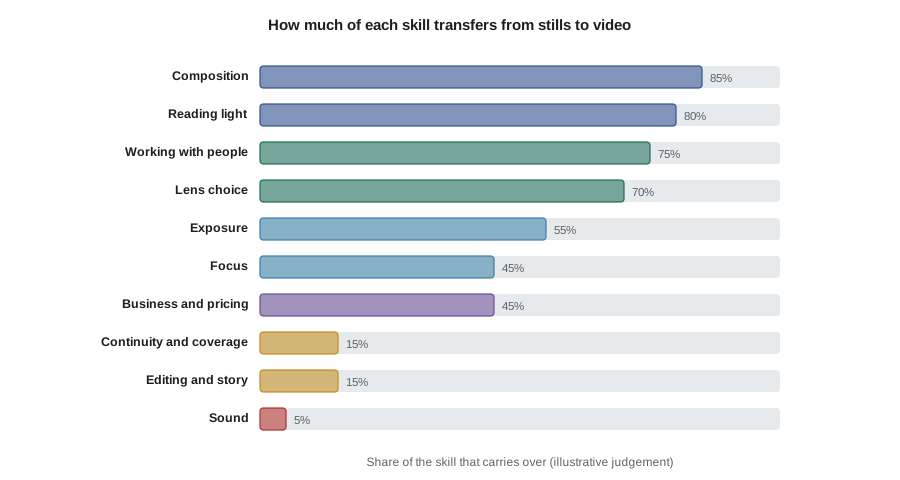
A great deal of what you already know carries straight over. Composition, the reading of light, lens choice, colour temperature, working with people, location scouting, client communication and file management are the same skills whether the camera records one frame or thousands. A photographer who can find the best angle in a room in thirty seconds, who knows what a window will do to a face at 3 p.m., and who can relax a nervous subject already has the hardest skills of video production.
Exposure theory transfers too, with one important change discussed in lesson 2: in video the shutter speed is no longer a free creative control, because it governs motion blur and must stay tied to the frame rate. Aperture and ISO, and neutral density filters, take over the job of controlling brightness. Focus skills transfer partly. A photographer focuses once per frame; a video shooter must hold focus through movement, often while the subject walks, turns or leans, and must decide when and how to move focus between subjects as part of the storytelling.
What does not transfer
Four things trip up photographers new to video. The first is time. A photograph is a decision about one instant; a clip is a decision about duration, movement and change. A beautiful composition that holds for ten seconds with nothing happening is usually a dull shot. The second is sound. Viewers forgive soft or grainy pictures far more readily than bad audio, and photographers have usually never had to think about microphones, room noise or levels. The third is continuity: shots have to cut together, so the direction people face, the light, the props and the action must match across shots taken minutes apart. The fourth is the edit. A photographer delivers a selection of finished frames; a video shooter delivers a structured piece with a beginning, middle and end, music, titles and sound mix, and that work can take longer than the shoot.
| Skill area | Carries over | What changes for video |
|---|---|---|
| Composition | Framing, lines, layers, negative space | Frames must allow for movement and for cutting between shots |
| Light | Quality, direction, ratio, colour | Light must stay consistent for the duration of a scene; flicker matters |
| Exposure | Aperture, ISO, metering | Shutter is tied to frame rate; ND filters become essential |
| Focus | Choosing the point of interest | Holding and pulling focus through time |
| People | Directing, rapport, consent | Subjects must speak and move naturally; releases cover voice and likeness |
| Post-production | Culling, editing, colour | Story structure, sound mix, music licensing, exports, captions |
| Business | Quotes, usage, contracts | Post time per finished minute, music, more crew and gear |
Hybrid deliverables clients actually buy
Most hybrid work falls into a small number of products. Knowing them helps you plan gear, crew and pricing. The first is the short brand or event piece, typically 60 to 180 seconds, cut to music with some natural sound or a few interview lines. The second is social-first short-form video: vertical clips of 7 to 60 seconds for Reels, TikTok or YouTube Shorts, often several from one shoot. The third is the interview or testimonial piece, where a person talks to camera or to an interviewer, supported by cutaway footage called B-roll. The fourth is the highlight film for weddings and events, typically three to six minutes. The fifth is product and process footage: short loops, close-ups and simple demonstrations used on websites and in online stores. A sixth, less common, is the motion portrait or cinemagraph, where most of the frame is still and a small element moves.
Each product has a different ratio of shooting time to editing time. A day's shoot for a three-minute event film can require two or three days of editing, while ten social clips with simple cuts may take a day. Lesson 11 turns this into pricing; for now, notice that video is rarely "just pressing the red button" on a photo job.
The hybrid shoot: one person, two jobs
The hardest version of hybrid work is when one person must deliver both a full photo set and usable video from the same event. It can be done, but it requires a plan that recognizes conflicts. Stills want the decisive moment; video wants the lead-in and follow-through. Stills often use flash; flash pops ruin video clips. Stills shooters move constantly to find angles; video wants steady, held shots of at least eight to ten seconds. Audio needs a microphone placed before the speech starts, not after.
Practical hybrid shooters solve this in three ways. They separate time: video is captured in dedicated blocks, such as the venue details before guests arrive, the speeches on a locked-off second camera, and a short interview after the main event. They separate cameras: one body is set up for stills and one for video, so nobody fiddles with settings during a key moment. Or they separate people: a second shooter handles video while the lead handles stills, which is the most reliable option for important events. Lesson 11 discusses staffing and pricing these options.
Worked problem
Splitting a two-hour corporate event between stills and video
A client books you alone for a two-hour product launch. They want 80 edited photographs and a 90-second highlight video. The agenda is: 30 minutes of arrivals, 20 minutes of speeches, a 10-minute product reveal and an hour of networking. How could you allocate time?
Show solution
- Arrivals (30 minutes): spend the first 15 minutes on video of the room, signage, product displays and guests arriving, using a gimbal or monopod. Spend the second 15 minutes on stills of guests and details.
- Speeches (20 minutes): set a second body on a tripod at the back with a wide-to-medium frame of the stage and a feed from the venue's sound desk or a recorder on the lectern. Shoot stills of the speakers yourself from the side aisle without flash.
- Product reveal (10 minutes): this is the key moment for both. Let the locked-off camera record the wide shot while you shoot stills; capture 30 seconds of handheld close-up video immediately afterwards as people react and approach the product.
- Networking (60 minutes): stills for about 40 minutes, then 20 minutes of video including two or three short guest comments recorded with a lavalier or shotgun microphone.
Answer: The plan delivers both products by separating time and cameras. The client should know in writing that the video is a highlight piece built from these windows, not full coverage of every speech.
Equipment you probably have and what you will add
Most current mirrorless cameras record 4K video at 24, 25, 30 and 60 frames per second, many record 10-bit files and log profiles, and many have in-body stabilization and reliable face and eye tracking autofocus. Your existing lenses will work, with some caveats: lenses with noisy autofocus motors can be heard by on-camera microphones, some lenses change apparent framing as they focus (called focus breathing), and variable-aperture zooms change exposure as you zoom.
The additions that make the biggest difference are not exotic. In order of value for most photographers, they are: a good external microphone kit (a wireless lavalier set and a small shotgun), variable or fixed neutral density filters, larger or additional batteries and a USB-C power option, fast memory cards rated for sustained video writing, a fluid-head video tripod, a continuous LED light with a soft modifier, and a gimbal or other stabilizer. A small field monitor with waveform and focus peaking is useful but optional, because many cameras now provide these tools. CINE-201 covers cinema cameras and full camera packages if you want to go further.
| Item | Why it matters | Typical price band |
|---|---|---|
| Wireless lavalier kit with two transmitters | Clean dialogue from interviews and speeches | $400 to $900 |
| Small on-camera shotgun microphone | Natural sound and backup audio | $150 to $400 |
| Variable ND filter or set of fixed NDs | Correct shutter speed in daylight | $150 to $500 |
| Fluid-head video tripod | Smooth pans and locked-off shots | $300 to $900 |
| Bi-colour LED panel with softbox | Consistent, flicker-free light | $250 to $800 |
| Extra batteries and USB-C power bank | Video drains batteries quickly | $150 to $400 |
| Fast V60 or V90 cards, or CFexpress | Sustained high bitrates without dropped frames | $100 to $500 |
| Gimbal | Smooth moving shots | $350 to $900 |
How audiences watch and what that means for you
Most client video is watched on phones, often without sound at first, in feeds that reward the first one or two seconds. That changes priorities. A clear, readable first frame and on-screen captions matter more than a subtle colour grade. Vertical framing is often the primary format rather than an afterthought. Many viewers watch with sound off until something catches them, so captions and visual storytelling are essential, while those who do turn sound on will judge your work harshly if dialogue is muddy. CRE-210 covers short-form structure and retention in depth from a creator's point of view; in this course we look at the same problem from the commissioned photographer's side, where the client's brief, brand rules and usage terms shape the result.
Video versus extracting stills from video
A common question is whether shooting high-resolution video and pulling frames can replace stills. For some uses it can: an 8K frame is about 33 megapixels, and a 4K frame is about 8.3 megapixels, enough for web and social use. But video frames are captured with a shutter speed chosen for motion blur (often 1/50 or 1/60 second), so moving subjects are soft, and video compression is designed for moving pictures rather than for single frames. Frame grabs also lack the flash, posing and timing that make strong portraits. Treat frame extraction as a bonus, not as a replacement for a stills set, and tell clients so in advance.
sizes = {'Full HD': (1920, 1080), 'UHD 4K': (3840, 2160), 'DCI 4K': (4096, 2160), '6K 3:2': (6144, 4096), '8K UHD': (7680, 4320)}
for name, (w, h) in sizes.items():
print(f'{name:8s} {w}x{h} {w * h / 1e6:5.1f} MP')Full HD 1920x1080 2.1 MP UHD 4K 3840x2160 8.3 MP DCI 4K 4096x2160 8.8 MP 6K 3:2 6144x4096 25.2 MP 8K UHD 7680x4320 33.2 MP
The output shows why 4K frame grabs work for a website hero image at screen size but not for a large print, and why 8K or open-gate 6K modes are more useful when a client wants stills from motion.
Professional responsibilities that change with video
Video raises the stakes on several professional duties you already have. Releases must cover voice as well as image, and a person who agrees to be photographed may not agree to being recorded speaking. Music must be licensed for the specific use; using a popular song in a client video can lead to takedowns and legal claims. Recording conversations raises privacy issues: in Canada and the United States, recording audio in a public setting is usually lawful when you are a party to the conversation, but secretly recording other people's private conversations is restricted by criminal and privacy laws, and some US states require consent from everyone recorded. Captions are an accessibility requirement for many clients. And the client's expectations about edits, revisions and raw footage must be agreed in writing. Lessons 7, 8, 10 and 11 address each of these.
Worked problem
Deciding whether a request is a hybrid job or a video production
A tourism board asks a photographer for 40 destination images plus a 2-minute film with drone shots, a voice-over in English and French, and three actors. Is this a hybrid job the photographer should accept alone?
Show solution
- List the components: stills set, scripted film, drone operation, voice-over recording in two languages, casting and directing actors, music licensing, translation and captioning.
- Compare with the hybrid products above: this is closer to a small commercial production than to a highlight piece.
- Identify roles needed: producer, director, camera, drone pilot with the right certificate, sound recordist, editor, voice talent and translator.
Answer: The photographer can lead the stills and perhaps shoot the film, but should either quote as a production with a crew (see CINE-330 for commercial production) or partner with a video producer. Accepting it as a one-person hybrid job would put quality and schedule at risk.
A learning path through this course
Lessons 2 and 3 cover camera settings, exposure, focus and stabilization from a stills shooter's starting point. Lessons 4 and 5 cover coverage, sequences, movement and composition in motion. Lessons 6 and 7 cover light and sound. Lesson 8 covers interviews and short documentary pieces. Lessons 9 and 10 cover editing, colour, audio finishing, captions and delivery. Lesson 11 covers planning, pricing and contracts for hybrid jobs, and lesson 12 brings everything together in a capstone client package. Throughout, worked examples use illustrative numbers; check current platform specifications, equipment data sheets and laws before relying on them for a job.
Common mistakes
MistakeTreating video as "photos that move" and holding pretty but static shots for too long
InsteadPlan shots around change and action: something should move, reveal or develop in each clip.
MistakeAssuming camera audio will be good enough
InsteadUse a dedicated microphone close to the speaker and monitor with headphones.
MistakePromising a full photo set and full video coverage from one person without a plan
InsteadSeparate time, cameras or people, and tell the client what each product will include.
MistakePricing video by shooting time only
InsteadInclude editing, music, revisions and delivery time, which often exceed shooting time.
MistakeRelying on frame grabs to replace a stills set
InsteadShoot stills deliberately and treat frame grabs as an occasional bonus.
Summary and key terms
- Composition, light, people skills and client management transfer directly from stills to video.
- Time, sound, continuity and editing are the main new skills for photographers adding motion.
- Common hybrid products are short brand pieces, social clips, interviews, highlight films and product loops.
- One person can deliver both stills and video by separating time, cameras or people, but must plan conflicts.
- Microphones, ND filters, power, fast cards, a fluid head, continuous light and a stabilizer are the key additions to a stills kit.
- Frame grabs from 4K video are about 8.3 MP and suit web use, but they are not a substitute for a stills set.
- Video adds duties around voice releases, music licensing, recording consent, captions and revision terms.
- Hybrid shooter
- A photographer who delivers both stills and video, often on the same job.
- B-roll
- Supporting footage that is cut over interviews or narration.
- Locked-off shot
- A shot from a fixed camera on a tripod with no movement.
- Highlight film
- A short edited film of the best moments of an event, usually set to music.
- Frame grab
- A still image extracted from a video frame.
- Focus breathing
- A change in apparent framing as a lens focuses.
- Continuity
- Matching action, direction, light and props across shots so they cut together.
- Social-first video
- Video designed primarily for social platforms, often vertical and short.
- Cinemagraph
- A still image in which a small part of the frame moves in a loop.
- Neutral density (ND) filter
- A filter that reduces light evenly to allow wider apertures or slower shutters.
Practice problems
Work each problem on paper first, then reveal the answer to check.
Name three stills skills that transfer directly to video.
Show answer
Composition, reading light and directing people (also lens choice and colour temperature).
Why does flash cause problems on a hybrid shoot?
Show answer
Flash pops appear in video clips and ruin them; video needs continuous light.
How many megapixels is a UHD 4K frame?
Show answer
\( 3840 \times 2160 \approx 8.3 \) MP.
What are the three ways to separate stills and video on a one-person job?
Show answer
Separate time, separate cameras, or separate people.
Why are frame grabs from video often soft on moving subjects?
Show answer
Video shutter speeds are slow, typically 1/50 or 1/60 second, to give natural motion blur.
List four common hybrid products.
Show answer
Short brand pieces, social clips, interview pieces, highlight films, product loops.
Which item usually gives the biggest quality jump for a photographer starting video?
Show answer
A good external microphone kit.
Why might a variable-aperture zoom be a problem for video?
Show answer
Exposure changes as you zoom.
What must a video release cover that a photo release might not?
Show answer
The person's voice and recorded words, as well as likeness.
Why is a scripted film with actors and drones not a typical one-person hybrid job?
Show answer
It needs production roles such as director, sound recordist, drone pilot and editor.
Lesson quiz · 5 questions
Score 60% or more to complete this lesson.
Create a free account to save your progress, take quizzes and earn a certificate.