
PMP-101 · Lesson 4 of 12 · 27 min
The 35 hours: meeting the education requirement and choosing training
Alongside experience, every PMP applicant must show 35 hours of project management education, unless they hold an active CAPM. The requirement sounds simple, but it raises practical questions: what counts as an hour, which courses qualify, whether self-study counts, what changes for live classes at the end of 2026, and how to choose training that helps you pass rather than merely ticking a box. This lesson explains the requirement as it stood at the time of writing, the different ways of meeting it, the new rule for live instruction, how to evaluate providers, how to document your hours, and how to combine formal training with independent study such as this program.
What the requirement says
At the time of writing, PMI required PMP applicants to complete 35 contact hours of project management education aligned with the exam content outline, or to hold an active CAPM, which PMI treats as meeting the requirement. A contact hour is an hour of instruction or learning in a structured course: classroom time, a live online class or time in a structured on-demand course with learning objectives. PMI's outline states that reading books and taking practice exams on your own do not count. The education does not have to be recent; there is no time limit on when you completed it, as long as you can document it. It can come from a single course or several courses added together, and from university or college courses, corporate training, PMI chapters, PMI itself or commercial training providers.
| Way to meet the requirement | Counts? | Notes |
|---|---|---|
| On-demand online course with structured lessons and assessments | Yes | Self-paced; keep the completion certificate |
| Live instructor-led class, in person or online | Yes, subject to the provider rule from 1 December 2026 | See the next section |
| University or college project management course | Yes | Count instructional hours only; GAC programs count |
| Active CAPM certification | Yes | Treated as meeting the requirement |
| Reading the PMBOK Guide or prep books alone | No | Independent reading is not a course |
| Taking practice exams alone | No | Practice is valuable but does not count |
| Chapter meetings without structured instruction | Usually no | May count toward PDUs after certification instead |
The live-class rule from 1 December 2026
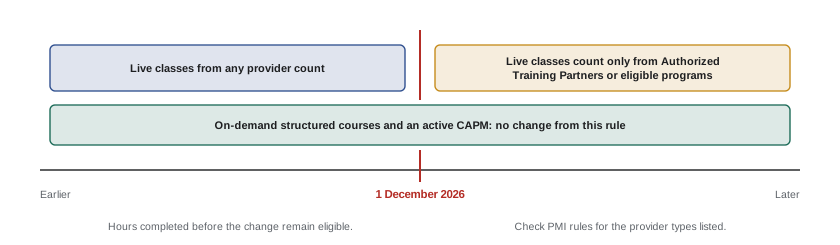
PMI announced that, starting on 1 December 2026, live instructor-led classes will count toward the 35 hours only if they are delivered by a PMI Authorized Training Partner (ATP), a China Registered Education Provider, or an eligible accredited higher education program, including PMI GAC-accredited programs. PMI stated that education completed before the start date remains eligible under the earlier rules. On-demand courses, such as PMI's own PMP exam prep course and self-paced courses from other organizations, were described separately as a way to meet the requirement. Because rules like this are sometimes clarified after announcement, check PMI's current guidance before buying a live class, and if you plan to use one, ask the provider in writing whether it is an ATP and whether its hours will count under the rule in force when you apply.
Authorized Training Partners
PMI's Authorized Training Partner program licenses organizations to deliver PMI-developed exam preparation content using PMI-approved instructors. ATPs include commercial training companies, universities and colleges, and some PMI chapters. Advantages of ATP courses include content maintained by PMI and aligned with the current exam outline, instructors trained and approved by PMI, and, after the rule change, certainty that live hours count. Disadvantages may include cost and less flexibility in teaching style. Non-ATP courses vary widely in quality: some are excellent, built by experienced instructors with strong practice questions, while others are outdated, still teaching the pre-2021 or pre-2026 exam. Check what version of the exam outline a course is built on before enrolling.
Choosing a course
Because the 35 hours are a requirement anyway, choose training that genuinely helps you pass. Useful questions to ask include:
- Is the course built on the PMP exam content outline launched in July 2026, including the new weighting toward the business environment and case-study items?
- Does it cover predictive, agile and hybrid approaches in proportion to the exam, which PMI describes as roughly 40 % predictive and 60 % adaptive or hybrid?
- Does it include realistic practice questions in the new formats, full-length timed simulations and explanations of why each answer is right or wrong?
- Will it provide a certificate showing the number of hours, the provider and the dates, suitable for an audit?
- Who are the instructors, and do they hold the PMP and have real project experience?
- What is the format: intensive boot camp, weekly evening sessions or self-paced? Which suits your schedule and learning style?
- What does it cost, and does your employer have preferred providers or funding?
- Does it include support after the course, such as question banks, forums or office hours?
Course formats compared
Intensive boot camps compress the 35 hours into four or five consecutive days, often followed by self-study. They suit people who can take time off and like immersive learning, but the volume can be overwhelming and retention can suffer without follow-up practice. Weekly evening or weekend classes spread learning over six to ten weeks, allowing time to absorb and practise, which suits many working professionals. Self-paced on-demand courses offer maximum flexibility and are often the cheapest option, but require discipline. University and college courses provide deep learning and academic credit but may not be focused on the exam. Many candidates combine an on-demand course for the hours with additional practice questions and study groups.
| Format | Typical duration | Strengths | Watch for |
|---|---|---|---|
| Boot camp | 4–5 days | Immersive, fast | Overload, needs follow-up practice |
| Weekly live class | 6–10 weeks | Paced, interactive, cohort support | Schedule conflicts |
| On-demand course | Self-paced | Flexible, low cost | Requires discipline |
| University or college course | One term | Depth, credit | May not target the exam |
| Chapter prep course | Several weeks | Low cost, local network | Check ATP status for live hours |
Costs and funding
Training costs range from low-cost on-demand courses to several thousand dollars for live boot camps with exam guarantees. Many employers fund training as professional development, sometimes with conditions such as passing within a set period or staying with the employer for a time afterward. Public funding programs and tax measures may help in some cases, as the next section notes. When comparing prices, consider what is included: practice exam access, materials, application support, retake support and post-course help.
In Canada, some provinces and federal programs fund workforce training, and employers may claim training costs as business expenses. For individuals, fees for courses at eligible educational institutions, and fees for occupational, trade or professional examinations, may qualify for the federal tuition tax credit and the Canada Training Credit, subject to conditions set by the Canada Revenue Agency. Whether a particular PMP course or exam fee qualifies depends on the provider and the circumstances, so check CRA guidance or ask a tax professional before relying on it.
Documenting your hours
In the application, you list each course with the provider, dates and number of qualifying hours. Keep certificates or transcripts showing these details, because they are among the documents requested in an audit. If a course mixes project management with other content, count only the project management hours. If a certificate does not show hours, ask the provider for a letter that does. For university courses, a transcript plus the course outline showing contact hours is usually sufficient. Keep everything in one folder with your experience records.
Worked problem
Adding up hours from several sources
Sofia completed a university course called Project Management Fundamentals in 2019 with 39 contact hours, a one-day company workshop on agile methods in 2023 of 7 hours, and a 12-hour online course on risk management in 2025. She also read two prep books. How many qualifying hours can she claim, and what documents does she need?
Show solution
- University course: 39 hours, documented with a transcript and course outline.
- Agile workshop: 7 hours, documented with an attendance certificate from the employer.
- Risk course: 12 hours, documented with a completion certificate.
- Books: 0 hours, since self-study reading does not count.
- Total: 39 + 7 + 12 = 58 hours, more than the 35 required; she could list only the university course, but listing all three is fine.
Answer: 58 qualifying hours from the three courses; the books do not count. She should keep the transcript, outline and two certificates for a possible audit.
Where this program fits
This program is independent study written to help you understand the PMP and its content. It is not an ATP course and does not issue contact-hour certificates that PMI recognizes for the 35-hour requirement. Use it alongside a qualifying course: for example, complete an on-demand ATP course or a university course for your hours, and use this program to deepen understanding, review topics and plan your preparation. Lessons in later courses cover people, process, agile and hybrid delivery, the business environment and exam strategy.
Making training stick
Training is most effective when you engage actively. Take notes in your own words, connect each topic to projects you have led, answer practice questions after each module rather than at the end, and review weak areas within a few days. If you attend a boot camp, schedule study time in the weeks immediately after it, while the material is fresh. If you use on-demand courses, set weekly targets and track completion. Remember that the training is a foundation; most candidates need further practice to be ready for the exam.
Evaluating a training provider
Not all courses are equal, even among those that meet the formal requirement. Before paying, check a few practical points. Is the course aligned with the July 2026 outline, and does it say so explicitly? Does it include practice with case studies and the newer question formats? Who are the instructors, and do they hold the PMP and have real project experience across predictive, agile and hybrid work? What materials are included: slides only, or a workbook, a question bank and full-length simulations? Is there support after the course, such as office hours or a forum? What do recent students say, ideally in independent reviews rather than testimonials chosen by the provider?
Price is a weak guide to quality. Some inexpensive self-paced courses are excellent preparation, while some costly bootcamps rely heavily on memorization tricks. For live classes completed from 1 December 2026, however, the provider's status matters for eligibility, so confirm that a live course comes from a PMI Authorized Training Partner or another eligible program before relying on it for the 35 hours.
Fitting training into a plan
Many candidates take their training early in their preparation, because it provides structure and meets the application requirement. Others complete some self-study first, so that they get more out of a live course. Either can work. What matters is that the training is finished, and its certificate in hand, before you submit the application, because you must list the hours and may be asked to prove them in an audit. If you choose a bootcamp of four or five consecutive days, plan for fatigue: a short, intense course is effective for some people but can leave others with notes they never consolidate. Schedule review sessions in the weeks immediately after a bootcamp to turn what you heard into lasting understanding.
Worked problem
Counting hours from mixed sources
Wei completed a 20-hour live online course from an Authorized Training Partner in October 2026, a 12-hour self-paced module from another provider in January 2027, and a 6-hour university workshop on scheduling in 2019 that was part of a degree program. Does Wei reach 35 hours?
Show solution
- The October 2026 live course counts: 20 hours.
- The self-paced module is not a live class, so the December 2026 rule for live classes does not restrict it, subject to PMI accepting its content: 12 hours, giving 32.
- The 2019 workshop was completed before December 2026, and project management education taken earlier remains eligible: 6 hours, giving 38.
- Wei should keep certificates showing hours for all three in case of audit.
Answer: About 38 hours, enough to meet the requirement, provided each activity covers project management content and is documented; check PMI rules for self-paced content.
Common mistakes
MistakeCounting book reading or practice exams as contact hours.
InsteadOnly structured courses or an active CAPM count.
MistakeBuying a live class after 1 December 2026 without checking ATP status.
InsteadConfirm in writing that hours will count under current rules.
MistakeChoosing a course built on an outdated exam outline.
InsteadCheck alignment with the July 2026 outline.
MistakeLosing course certificates.
InsteadKeep certificates showing provider, dates and hours.
MistakeTreating the 35 hours as all the preparation needed.
InsteadAdd practice questions and simulations.
Summary and key terms
- Applicants need 35 contact hours of project management education or an active CAPM.
- Structured courses count; reading and practice exams alone do not.
- From 1 December 2026, live classes count only from ATPs or eligible accredited programs.
- Education completed before the change remains eligible.
- Choose courses aligned with the 2026 outline, with realistic practice.
- Formats range from boot camps to on-demand courses and university classes.
- Keep certificates showing hours, and use independent study as a supplement.
- Contact hour
- One hour of structured project management instruction.
- 35-hour requirement
- Education requirement for PMP applicants.
- ATP
- On-demand course
- Structured self-paced online course.
- Live class
- Instructor-led class in person or online.
- Boot camp
- Intensive multi-day exam preparation course.
- Exam simulation
- Full-length timed practice exam.
- Completion certificate
- Document showing course, provider, dates and hours.
- Tuition tax credit
- Tax credit for eligible education fees (Canada).
- Educational assistance
- Employer-provided education funding.
Practice problems
Work each problem on paper first, then reveal the answer to check.
How many contact hours are required?
Show answer
35.
What credential satisfies the requirement instead?
Show answer
An active CAPM.
Does reading the PMBOK Guide count?
Show answer
No.
What changes on 1 December 2026?
Show answer
Live classes count only from ATPs, China REPs or eligible accredited programs.
Do hours completed before the change still count?
Show answer
Yes, under PMI's announcement.
Approximate predictive vs adaptive/hybrid split on the exam?
Show answer
About 40 % predictive, 60 % adaptive or hybrid.
Name two formats for training.
Show answer
Boot camp, weekly class, on-demand, university course.
Total hours from courses of 21, 10 and 8 hours?
Show answer
39 hours.
What should a certificate show?
Show answer
Provider, dates and number of hours.
Does this HSM program count toward the 35 hours?
Show answer
No, it is independent study.
Lesson quiz · 5 questions
Score 60% or more to complete this lesson.
Create a free account to save your progress, take quizzes and earn a certificate.