
PMP-101 · Lesson 7 of 12 · 30 min
The Business Environment domain and integrating approaches
The Business Environment domain grew from 8 % of the exam in the 2021 outline to 26 % in the 2026 outline, making it the area where many candidates, and many older study materials, are least prepared. It covers how projects connect to the organization and the world around them: governance, compliance, change control, issues and impediments, risk, continuous improvement, organizational change and changes in the external environment. This lesson maps the domain's tasks as listed by PMI at the time of writing, explains what they involve, looks at how sustainability and artificial intelligence appear in the exam, and shows how to recognize the approach a scenario describes and choose responses that fit it. As in Lesson 6, task descriptions are paraphrased summaries; read PMI's outline for the official text.
The Business Environment tasks
At the time of writing, PMI's outline listed eight tasks in this domain:
| Task (as named by PMI) | What it involves in practice | Studied in |
|---|---|---|
| Define and establish project governance | Setting up decision rights, escalation paths, oversight bodies and approval gates | PMP-150 |
| Plan and manage project compliance | Identifying legal, regulatory, contractual and organizational requirements and ensuring they are met | PMP-150 |
| Manage and control changes | Assessing, approving and implementing changes in a controlled way, in any approach | PMP-131, PMP-150 |
| Remove impediments and manage issues | Clearing obstacles, logging and resolving issues and escalating when appropriate | PMP-120, PMP-131 |
| Plan and manage risk | Identifying, analysing and responding to threats and opportunities | PMP-131 |
| Continuous improvement | Using lessons learned, retrospectives and metrics to improve processes | PMP-140, PMP-150 |
| Support organizational change | Helping the organization adopt the changes the project delivers | PMP-150 |
| Evaluate external business environment changes | Monitoring market, regulatory, economic, social and technological changes and adapting the project | PMP-150 |
Notice that several tasks that earlier outlines placed in Process, such as risk and change control, now sit in Business Environment. This reflects a view of risk and change as matters of organizational governance and strategy, not only technical project control.
Governance and compliance
Governance defines who can make which decisions and how the project is overseen: sponsors, steering committees, project management offices, phase gates, approval thresholds and escalation paths. In predictive projects, governance often uses stage gates with formal approvals; in agile organizations, governance may rely on product roadmaps, regular reviews and lightweight funding decisions at the portfolio level. Compliance involves identifying the requirements a project must meet, such as health and safety laws, privacy and data protection rules, environmental permits, accessibility standards, industry regulations, contract terms and internal policies, and building them into planning, quality and reporting. Exam questions in this area often present a situation where a shortcut would save time but breach a requirement; the right answer almost always respects the requirement and uses proper channels to resolve the conflict.
Worked problem
A compliance scenario
A software project is two weeks from a major release. During a sprint review, a team member mentions that a new feature stores customer location data that the privacy impact assessment did not cover. The product owner wants to release on schedule. What should the project leader do first?
Show solution
- Identify the task: plan and manage project compliance, with links to manage and control changes and risk.
- Recognize the issue: storing personal data outside the approved assessment may breach privacy law and organizational policy.
- The first step is to raise the issue with the appropriate people, such as the privacy office or compliance lead and the sponsor, and assess the requirement, rather than ignoring it or delaying the release unilaterally.
- Options then include removing or disabling the feature for this release, updating the assessment, or adjusting the release plan through governance.
Answer: Escalate to the privacy or compliance function and the sponsor and assess the requirement before release, using governance to decide whether to remove the feature or update the assessment.
Change, issues and impediments
Change control applies in every approach, but it looks different. In predictive projects, changes to baselines go through a change control process, often with a change control board, impact analysis and documentation. In agile projects, change is expected: new requirements are added to the backlog and prioritized by the product owner, and changes within an iteration are discouraged to protect the team's commitment. In hybrid projects, contractual or regulatory baselines may be controlled formally while detailed work is adapted iteratively. Issues are problems that are happening now, as opposed to risks, which may happen; impediments are obstacles that block a team's progress. Effective leaders remove impediments quickly, keep an issue log, resolve issues at the lowest appropriate level and escalate when they exceed their authority or tolerance.
Risk
Risk management covers both threats and opportunities. Typical activities include identifying risks with the team and stakeholders, analysing likelihood and impact qualitatively and sometimes quantitatively, planning responses (for threats: avoid, transfer, mitigate, accept or escalate; for opportunities: exploit, share, enhance, accept or escalate), assigning owners, monitoring triggers and reserves, and reviewing risks regularly. In agile projects, risk is often managed through short iterations, early delivery of risky features, spikes and visible risk boards. The exam frequently tests the difference between risks and issues, the use of reserves, and appropriate response strategies.
Expected monetary value (EMV) sums the probability \(P_i\) times the impact \(I_i\) of each risk, with threats as negative values and opportunities as positive values, and is a common simple calculation in risk questions.
Continuous improvement and organizational change
Continuous improvement means learning from experience during the project, not only at the end: retrospectives in agile, lessons-learned sessions at phase ends, process metrics and small experiments. Supporting organizational change means recognizing that projects deliver value only when people adopt the new product, system or way of working. It involves understanding the impact on people, engaging change champions, planning communication and training, addressing resistance, and measuring adoption. Many projects technically succeed but fail to deliver benefits because adoption was neglected; the 2026 outline makes this a clear responsibility of the project leader.
The external environment, sustainability and AI
Projects operate in changing environments: new regulations, market shifts, supply chain disruptions, economic changes, social expectations and technological developments. The task evaluate external business environment changes asks project leaders to monitor these and adapt scope, schedule, risk responses or even the project's continuation. Two themes appear increasingly in PMI's materials. Sustainability, one of the principles of the PMBOK Guide 8th edition, asks project leaders to consider environmental, social and economic impacts across the product life cycle, not only within the project. Artificial intelligence, a focus area in the 2025 guide, appears both as a tool for project work, such as forecasting, documentation and analysis, and as a subject requiring governance, for example data privacy, bias, transparency and accountability for AI outputs. Expect scenarios where using AI responsibly, under organizational policy and with human oversight, is the better answer.
Recognizing the approach in a scenario
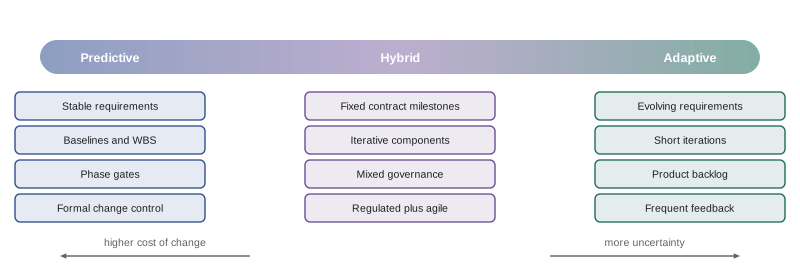
Since approaches run through all domains, a key skill is to identify the approach from clues in the question. Useful signals include:
| Clue in the scenario | Likely approach |
|---|---|
| Iterations, sprints, backlog, product owner, Scrum Master, daily stand-ups, retrospectives | Adaptive (agile) |
| Kanban board, work-in-progress limits, flow, cycle time | Adaptive (flow-based) |
| Baselines, WBS, Gantt chart, change control board, phase gates | Predictive |
| Fixed contract milestones with iterative development of components | Hybrid |
| Regulated design approval followed by agile software delivery | Hybrid |
| Requirements unclear and likely to change, frequent customer feedback needed | Adaptive suits best |
| Requirements stable, high cost of change, physical construction | Predictive suits best |
Worked problem
Choosing a response that fits the approach
A stakeholder asks for a significant new feature in the middle of a two-week sprint on an agile project. What is the best response, and how would the answer differ on a predictive project?
Show solution
- Agile: protect the sprint commitment; explain that the request will be added to the product backlog, where the product owner will prioritize it for a future sprint, perhaps the next one.
- Agile: only the product owner can cancel a sprint in extreme cases if the sprint goal becomes obsolete.
- Predictive: assess the impact on scope, schedule, cost and risk, document the change request and submit it to the change control process for a decision.
- In both, avoid simply refusing the stakeholder or adding the feature without due process.
Answer: In agile, add the request to the backlog for the product owner to prioritize without disrupting the sprint; in predictive, analyse impacts and process a formal change request.
Thinking like the exam
Across all domains, especially the business environment, the exam tends to reward responses that reflect PMI's values and principles: act ethically and comply with laws and policies; focus on delivering value; engage stakeholders collaboratively; empower teams; assess before acting; resolve problems at the right level; use proper governance rather than bypassing it; and adapt the approach to the context. Answers that ignore a problem, act unilaterally beyond authority, blame others, or rigidly apply one method regardless of context are usually wrong. Lesson 10 discusses question strategy in more detail.
Governance in different organizational settings
Governance varies widely. A government infrastructure project may involve ministerial approval, independent assurance reviews, public reporting and strict procurement rules. A technology start-up may have a founder who decides most matters informally. A large company may run a portfolio office that approves funding in quarterly cycles and requires standard status reports. The project leader's job is not to impose one model but to understand the governance that applies, work within it, and propose improvements where it hinders value. In exam scenarios, if a decision is outside the project leader's authority, the right step is usually to prepare information and options for the person or body that holds that authority.
Compliance as part of planning
Compliance is cheaper and less disruptive when built into plans from the start. Early in a project, the leader can work with legal, procurement, safety, privacy and quality specialists to identify applicable requirements, assign owners, and define how compliance will be demonstrated: inspections, audits, test evidence, sign-offs or certificates. In agile work, compliance requirements can be expressed as acceptance criteria or as part of the definition of done, so that each increment is compliant rather than leaving compliance to a final phase.
Risk thresholds and escalation
Organizations differ in how much risk they will accept. Risk appetite describes the general level of risk an organization is willing to take in pursuit of its objectives; risk thresholds set specific limits, such as a maximum acceptable schedule delay or cost exposure. When a risk exceeds the project's thresholds or lies outside its scope, escalation to the program, portfolio or sponsor level is appropriate. Exam questions sometimes test this by describing a risk that affects the wider organization rather than the project alone; in those cases, escalation is a legitimate response, not an avoidance of responsibility.
Lessons learned throughout the project
Continuous improvement depends on capturing lessons when they are fresh. Many organizations keep a lessons-learned register updated throughout the project, not only at closure, and review relevant lessons from earlier projects during planning. Agile retrospectives perform a similar function at the end of each iteration, producing a small number of concrete improvement actions for the next. A good test of any lessons process is whether it changes behaviour: lessons that are written down but never read add little value.
Worked problem
Calculating expected monetary value
A project faces a 30 % chance of a supplier delay costing 40,000 and a 20 % chance of a regulatory change costing 25,000. It also has a 25 % chance of a bulk discount saving 12,000. What is the net EMV, and what contingency might be considered?
Show solution
- Supplier delay: 0.30 × −40,000 = −12,000.
- Regulatory change: 0.20 × −25,000 = −5,000.
- Bulk discount: 0.25 × +12,000 = +3,000.
- Net EMV = −12,000 − 5,000 + 3,000 = −14,000.
Answer: Net EMV is −14,000, suggesting a contingency reserve of about 14,000 for these identified risks, alongside response actions to reduce them.
Practising Business Environment questions
Because this domain is newer in its current form, question banks vary in how well they cover it. Look for practice sets that include governance decisions, compliance conflicts, organizational change and external events such as new regulations or market shifts, and read the explanations closely to learn the reasoning that the exam rewards.
Common mistakes
MistakeTreating risk and change as purely technical topics.
InsteadSee them as governance and business matters too.
MistakeConfusing risks with issues.
InsteadRisks may happen; issues are happening now.
MistakeTaking compliance shortcuts to meet deadlines.
InsteadRespect requirements and use governance to resolve conflicts.
MistakeIgnoring adoption of project outputs.
InsteadSupport organizational change to realize benefits.
MistakeUsing AI tools without policy or oversight.
InsteadApply AI responsibly with governance and human review.
Summary and key terms
- Business Environment is 26 % of the 2026 exam, up from 8 %.
- Its eight tasks cover governance, compliance, change, issues, risk, improvement, organizational change and external change.
- Risk and change control are now framed as business environment tasks.
- Compliance scenarios reward respecting requirements and using proper channels.
- Organizational change and adoption are project leader responsibilities.
- Sustainability and AI appear increasingly in PMI materials.
- Identify the approach from scenario clues and choose responses that fit it.
- Governance
- The framework of decision rights and oversight.
- Compliance
- Meeting legal, regulatory, contractual and policy requirements.
- Change control
- Process for evaluating and approving changes.
- Issue
- A problem that is currently affecting the project.
- Impediment
- An obstacle blocking a team's progress.
- Risk
- An uncertain event that could affect objectives.
- EMV
- Expected monetary value, probability times impact.
- Retrospective
- Agile meeting to reflect and improve.
- Organizational change
- Helping people adopt new ways of working.
- Sustainability
- Considering environmental, social and economic impacts.
Practice problems
Work each problem on paper first, then reveal the answer to check.
How many Business Environment tasks are there?
Show answer
Eight.
Name three Business Environment tasks.
Show answer
Governance, compliance, change, issues, risk, improvement, organizational change, external changes.
What is the difference between a risk and an issue?
Show answer
A risk may happen; an issue is happening now.
Name two threat response strategies.
Show answer
Avoid, transfer, mitigate, accept, escalate.
EMV of a 20 % chance of losing 50,000?
Show answer
−10,000.
Where do new requests go in agile?
Show answer
Into the product backlog for the product owner to prioritize.
What clues suggest a predictive approach?
Show answer
Baselines, WBS, Gantt charts, change control boards, phase gates.
Why does organizational change matter?
Show answer
Benefits require people to adopt the outputs.
Name a governance concern with AI.
Show answer
Privacy, bias, transparency, accountability.
What kinds of answers are usually wrong?
Show answer
Ignoring problems, acting beyond authority, bypassing governance.
Lesson quiz · 5 questions
Score 60% or more to complete this lesson.
Create a free account to save your progress, take quizzes and earn a certificate.