
PMP-101 · Lesson 8 of 12 · 29 min
The application, fees and the audit
Once you are confident that you meet the eligibility requirements, the next step is the online application. It is not difficult, but it rewards preparation: a well-organized application is approved quickly, while a careless one can be delayed, returned for corrections or selected for audit with evidence that is hard to gather. This lesson walks through the application process as it worked at the time of writing, explains the eligibility period and exam attempts, the fees and whether PMI membership is worthwhile, how audits work and how to prepare for one, and the policies on cancellations, rescheduling and ethics that every applicant agrees to.
Before you start
Gather what you need before opening the application, because PMI allows you to save and return but gives a limited time to complete it once started. You will need: details of your highest education (institution, dates, credential); a list of qualifying projects with dates, organizations, your role, and contact information for a person who can confirm each project; written experience descriptions (Lesson 3); and your project management education records with provider, course titles, dates and hours (Lesson 4). Having everything in a single document makes it easy to copy into the online form. Read the current PMP certification handbook, which sets out the rules you agree to, including eligibility, audit, exam policies and the code of ethics.
The application steps
At the time of writing, the process ran roughly as follows:
- Create or sign in to a PMI account and start the PMP application.
- Enter personal details exactly as they appear on the government-issued identification you will use at the exam; a mismatch can cause problems on exam day.
- Enter education details.
- Enter each project: title, organization, dates, your role, a contact person, and a description of the objective, your role, responsibilities and outcomes, within the form's word limits.
- Enter your 35 hours of project management education, or your CAPM details.
- Agree to the certification terms and the code of ethics, and submit.
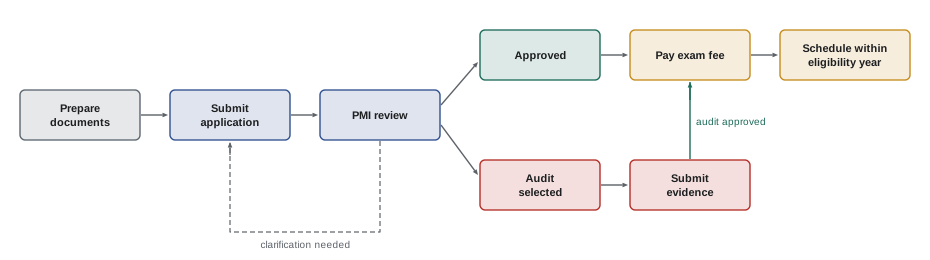
PMI then reviews the application, typically within several business days for online applications according to PMI's published guidance, and either approves it, asks for clarification or selects it for audit. Once approved, you pay the exam fee, and only then can you schedule the exam.
The eligibility period and exam attempts
When your application is approved, PMI gives you an eligibility period, which at the time of writing was one year, in which to take the exam. Within that year you can attempt the exam up to three times, paying a re-examination fee for each retake. If you do not pass within three attempts, you must wait a set period, which PMI has set at one year from the last attempt, before reapplying. These rules make planning important: applying too early, before you have time to prepare, uses up the eligibility period; applying too late may push your exam beyond a deadline you care about, such as a promotion or job application. Many candidates apply after completing their training and about halfway through their study, so that the application and any audit are resolved while they continue to prepare.
Fees
PMI charges exam fees in US dollars, with lower fees for PMI members. At the time of writing, published figures for the PMP exam were in the region of US$400 to US$450 for members and about US$650 to US$675 for non-members, and re-examination fees were lower (in the region of US$275 for members and US$375 for non-members). PMI adjusts fees periodically, and published secondary sources disagreed slightly about the exact amounts after mid-2026, so check the current fees on PMI's website before budgeting. PMI membership itself cost roughly US$139 per year, plus a small one-time application fee, with chapter dues added separately.
Worked problem
Does membership pay for itself?
Assume a member exam fee of US$425, a non-member fee of US$675, a member retake fee of US$275 and a non-member retake fee of US$375, membership of US$139 plus a US$10 application fee. Compare the costs for a candidate who passes first time, and for one who needs one retake.
Show solution
- Pass first time as non-member: US$675.
- Pass first time as member: 425 + 139 + 10 = US$574, a saving of US$101.
- One retake as non-member: 675 + 375 = US$1,050.
- One retake as member (within the membership year): 425 + 275 + 149 = US$849, a saving of US$201.
- Membership also includes the digital PMBOK Guide and discounts on renewal later.
Answer: With these figures, membership saves about US$101 for a first-time pass and about US$201 with one retake, plus resources; check current fees before deciding.
Canadian candidates pay PMI's fees in US dollars, so the cost in Canadian dollars depends on the exchange rate and any foreign transaction fee charged by the card issuer, often around 2.5 %. For example, a US$425 fee at an exchange rate of 1.38 Canadian dollars per US dollar costs about C$587, plus about C$15 in foreign transaction fees. Exam fees for professional examinations may qualify for the federal tuition tax credit if conditions set by the Canada Revenue Agency are met; check current CRA guidance. Employers often reimburse fees, sometimes on condition of passing.
The audit
PMI randomly selects a percentage of applications for audit, and may also audit applications for specific reasons. Being selected does not mean anything is wrong. If you are audited, you are notified after submitting and before paying, and you must provide evidence within a set time, which PMI has typically given as 90 days: copies of your diploma or degree, signatures from the contacts for each project confirming your experience descriptions, and certificates for your project management education. Until the audit is completed, you cannot schedule the exam. Most audits are completed within a week or so of receiving complete materials, according to PMI's guidance. If you cannot supply evidence or the evidence contradicts your application, the application can be rejected, and dishonesty can lead to sanctions under the code of ethics.
| Audit item | What PMI typically asks for | Preparation tip |
|---|---|---|
| Education | Copy of diploma, degree or transcript | Locate originals early; foreign credentials may need evaluation |
| Experience | Signature from a supervisor or contact for each project | Contact referees before applying and share your descriptions |
| Project management education | Certificates showing provider, dates and hours | Ask providers for documents if certificates lack hours |
Worked problem
Planning for an audit
Elena applied in May. Two of her three projects were at a company where her former manager has retired, and her course certificate does not show hours. What should she do before applying, to reduce audit risk and delay?
Show solution
- Identify another person who can confirm the two projects, such as the sponsor, a senior colleague or the client contact, and ask them in advance.
- Share her experience descriptions with each referee to make sure they agree.
- Ask the training provider for a letter or new certificate stating the number of contact hours.
- Scan her degree certificate and keep all documents in one folder.
Answer: Arrange alternative referees, confirm descriptions, obtain an hours statement from the provider and organize documents before applying.
Policies you agree to
The PMP handbook sets policies on rescheduling and cancelling exams (with fees or forfeiture for late changes), on exam security and confidentiality (you may not disclose exam questions), on accommodations for disabilities, on identification requirements and on conduct during the exam. Breaching exam security, for example by sharing questions or using unauthorized materials, can result in an invalid result, loss of eligibility and revocation of the credential. The code of ethics, based on responsibility, respect, fairness and honesty, applies from the moment you apply.
Accommodations
Candidates with disabilities or medical conditions can request testing accommodations, such as extra time, separate rooms or assistive technology. Requests are made through PMI before scheduling and usually require documentation from a qualified professional. Approval takes time, so request accommodations early in the process. Accommodations are typically available only at test centres, so plan accordingly if you need them.
Writing descriptions that pass review
Experience descriptions are the part of the application most often returned for clarification. Reviewers look for evidence that you led and directed project work across the life cycle, not that you merely took part. A strong description names the project objective in one sentence, states your role, summarizes the work you led in initiating, planning, executing, monitoring and controlling, and closing, and ends with the outcome. It uses active verbs, such as defined, planned, coordinated, negotiated, tracked, resolved and handed over, and avoids vague phrases such as was involved in or helped with. It uses plain language rather than internal jargon or acronyms the reviewer may not know.
A description should also match the dates and role in the rest of the entry and be something your referee would recognize and agree with. If your referee would describe your role differently, discuss it with them before submitting; a mismatch discovered during an audit is far harder to resolve.
Timing the application
Think about the order of events. You cannot submit until your 35 hours are complete, and you cannot schedule the exam until the application is approved and the fee paid. If you are selected for audit, add the time it takes to gather signatures and documents, which can be weeks if referees are slow to respond. Meanwhile, the one-year eligibility period starts at approval, not at the exam booking. A sensible approach for most candidates is to complete training, gather evidence and contact referees, submit the application, and continue studying while it is reviewed, booking the exam once practice results show steady progress.
Budgeting the whole journey
The exam fee is only part of the cost. A realistic budget might include training (from a few hundred to a few thousand dollars, depending on format and provider), a prep book or question bank, PMI membership, the exam fee, a possible re-examination fee, travel to a test centre, and time away from work for a bootcamp or the exam itself. Many employers will pay some or all of these costs, especially if the credential supports bids or client requirements; it is worth preparing a short business case for your manager that links the PMP to your role and the organization's goals.
Handling a returned application
If PMI asks for clarification, read the request carefully, revise only what is asked, and resubmit promptly. Common reasons include descriptions that do not show leadership of project work, unclear dates or overlaps, and education records missing hours. A returned application is a normal part of the process and does not count against you.
Worked problem
A full cost budget in two currencies
A candidate budgets a US$1,200 online course, a US$60 question bank, membership of US$149 and a member exam fee of US$425, and wants to allow for one member retake at US$275. At 1.38 Canadian dollars per US dollar, what is the total in each currency?
Show solution
- Without retake: 1,200 + 60 + 149 + 425 = US$1,834.
- With one retake: 1,834 + 275 = US$2,109.
- In Canadian dollars: 1,834 × 1.38 ≈ C$2,531, and 2,109 × 1.38 ≈ C$2,910.
- Card foreign transaction fees of about 2.5 % would add roughly C$63 to C$73.
Answer: About US$1,834 (C$2,531) without a retake and US$2,109 (C$2,910) with one, before card fees; actual fees and exchange rates should be checked.
| Item | Typical range (at the time of writing) |
|---|---|
| Training (35 hours) | Free to several thousand dollars |
| Prep book or question bank | About US$30 to US$200 |
| PMI membership | About US$139 per year plus a one-time fee |
| Exam fee | About US$405 to US$445 member; US$655 to US$675 non-member |
| Re-examination fee | About US$275 member; US$375 non-member |
A checklist before you submit
Before pressing submit, check that your name matches your identification exactly, that every project has accurate start and end months, that overlaps are not double-counted, that each description shows leadership across the life cycle, that each referee has agreed to confirm the project, that the training hours are complete and documented, and that you have read the current handbook. Save a copy of everything you submitted, since you may need to refer to it if audited or asked for clarification.
Common mistakes
MistakeEntering a name that does not match your ID.
InsteadUse your name exactly as on government identification.
MistakeApplying before you have time to study.
InsteadApply when you can test within the eligibility year.
MistakeNot preparing referees.
InsteadContact referees and share descriptions before applying.
MistakeBudgeting with outdated fees.
InsteadCheck current PMI fees and exchange rates.
MistakeRequesting accommodations at the last minute.
InsteadRequest them early, before scheduling.
Summary and key terms
- Gather education, experience and training records before applying.
- Enter your name exactly as on your identification.
- Approved applicants receive a one-year eligibility period with up to three attempts.
- Fees are charged in US dollars and are lower for members.
- Membership often pays for itself through fee savings and resources.
- Audits require diplomas, referee signatures and training certificates.
- Policies cover rescheduling, exam security, accommodations and ethics.
- Application
- Online submission of education, experience and training.
- Eligibility period
- Time after approval in which to take the exam.
- Re-examination fee
- Fee charged for each retake.
- Audit
- Verification of application details with evidence.
- Referee
- Person who confirms your project experience.
- Handbook
- PMI document setting certification policies.
- Exam security
- Rules protecting confidentiality of exam content.
- Accommodation
- Adjustment for a candidate with a disability or condition.
- Membership
- Optional PMI membership with reduced fees.
- Foreign transaction fee
- Card fee on purchases in another currency.
Practice problems
Work each problem on paper first, then reveal the answer to check.
What must your application name match?
Show answer
Your government-issued identification.
How long is the eligibility period?
Show answer
One year.
How many attempts are allowed in that period?
Show answer
Three.
In what currency are PMI fees charged?
Show answer
US dollars.
Saving from membership if fees are 425 vs 675 and membership costs 149?
Show answer
US$101.
C$ cost of US$400 at 1.40 before card fees?
Show answer
C$560.
Name three audit items.
Show answer
Education copy, referee signatures, training certificates.
Can you schedule the exam during an audit?
Show answer
No.
What happens if exam questions are shared?
Show answer
Results can be invalidated and credentials revoked.
When should accommodations be requested?
Show answer
Early, before scheduling.
Lesson quiz · 5 questions
Score 60% or more to complete this lesson.
Create a free account to save your progress, take quizzes and earn a certificate.