
PMP-121 · Lesson 3 of 12 · 29 min
Planning stakeholder engagement
Analysis tells you who matters and why. Planning decides what you will do about it. A stakeholder engagement plan sets out, for each significant stakeholder or group, where their engagement is now, where it needs to be, and the actions, owners and timing that will close the gap. It also aligns expectations early, before disagreements about scope, success criteria or trade-offs harden into conflict. This lesson covers the stakeholder engagement assessment matrix, writing engagement strategies, aligning expectations at the start of a project, and how planning differs across predictive, agile and hybrid delivery.
Levels of engagement
PMI guidance describes five levels of stakeholder engagement. They form a scale from no awareness to active advocacy, and they are the basis of the engagement assessment matrix.
| Level | Description | Typical signs |
|---|---|---|
| Unaware | Does not know about the project or its potential impacts | No questions, no attendance, surprised when told |
| Resistant | Aware of the project and its impacts, and resistant to change | Objections, delays in approvals, lobbying against decisions |
| Neutral | Aware, but neither supportive nor resistant | Attends when asked, offers little, accepts outcomes passively |
| Supportive | Aware and supportive of the project and its outcomes | Provides resources, answers quickly, speaks positively |
| Leading | Aware and actively engaged in ensuring success | Champions the project, removes obstacles, recruits others |
Notably, the desired level is not always leading. A regulator should be appropriately engaged but independent; asking a safety regulator to champion the project would be inappropriate. Many stakeholders need only to be neutral or supportive. The target for each stakeholder depends on what the project needs from them.
The stakeholder engagement assessment matrix
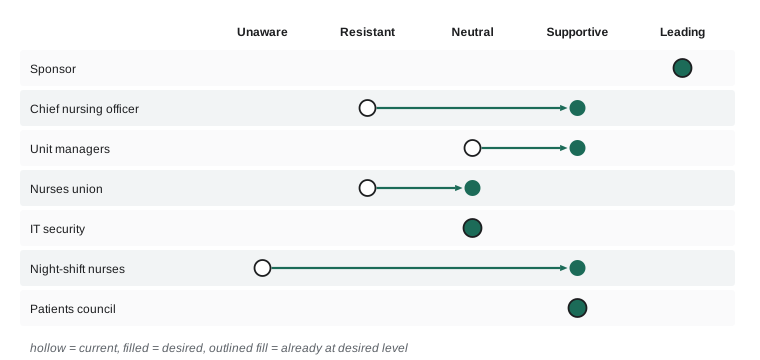
The engagement assessment matrix lists stakeholders against the five levels and marks each person's current level (C) and desired level (D). The gaps show where effort is needed. A stakeholder whose C and D are in the same column needs maintenance, not intervention. A stakeholder whose C is two or more columns to the left of D needs a specific strategy and probably a named owner.
| Stakeholder | Unaware | Resistant | Neutral | Supportive | Leading |
|---|---|---|---|---|---|
| Sponsor (VP Operations) | C D | ||||
| Chief nursing officer | C | D | |||
| Unit managers | C | D | |||
| Nurses' union | C | D | |||
| IT security | C D | ||||
| Night-shift nurses | C | D | |||
| Patients' council | C D |
Worked problem
Reading the matrix
Using the matrix above, decide where the project manager should focus effort first and what kind of action each gap suggests.
Show solution
- Night-shift nurses: unaware to supportive, a three-step gap. They need awareness first: briefings at shift change, not only daytime meetings, then involvement in testing.
- Chief nursing officer: resistant to supportive, a two-step gap and a high-power stakeholder. The sponsor should meet her to understand her concerns, likely patient safety and staffing rules, and invite her to set acceptance criteria.
- Unit managers: neutral to supportive. Involve a few as super-users in design workshops.
- Nurses' union: resistant to neutral. The labour relations lead should consult on how the system enforces collective agreement rules; the aim is not advocacy but no grievance.
- Sponsor, IT security and patients' council: maintain current engagement.
Answer: Focus first on the chief nursing officer (high power, two-step gap) and night-shift nurses (three-step gap), with tailored actions for each, then the union and unit managers.
Writing engagement strategies
For each stakeholder with a significant gap, a good strategy answers five questions. What is their interest and concern? What do we need from them? What will move them from current to desired engagement? Who owns the relationship? When and how will we check whether it is working? Strategies should address the stakeholder's interests, not just the project's needs. A resistant stakeholder rarely becomes supportive because of more information about the project's benefits; they move when their own concerns are addressed or when they gain a real voice in decisions.
| Stakeholder | Interest or concern | What we need | Strategy | Owner | Check |
|---|---|---|---|---|---|
| Chief nursing officer | Safe staffing ratios enforced; no extra admin for nurses | Approval of go-live; direction to nursing units | Sponsor meeting; invite her to define safety acceptance criteria; monthly one-page update | Sponsor | Attitude in monthly review; approval at gate |
| Night-shift nurses | Fair allocation of weekend and night shifts; mobile access | Testing feedback; adoption | Shift-change briefings; two night-shift super-users; mobile pilot | Project manager | Attendance; test feedback; pilot usage |
| Nurses' union | Collective agreement rules applied correctly | No grievance; early warning of concerns | Consult on rule configuration; share test results for rule checks | Labour relations lead | Issues raised; formal concerns |
The stakeholder engagement plan collects these strategies with other content: the desired and current engagement levels, the scope and impact of change for each stakeholder, interrelationships between stakeholders (for example, unit managers follow the chief nursing officer's lead), information to be distributed and its format, and how the plan will be updated. Some content, such as strategies for resistant stakeholders, is sensitive and should not be shared widely.
Aligning expectations at the start
The exam outline's align stakeholder expectations task is about agreeing, early, what the project will deliver and how success will be judged. Misaligned expectations are one of the most common sources of later conflict. A sponsor who expects a full system replacement and a finance director who expects a minimal upgrade can both sign the same vague charter and discover the disagreement only when the first invoice arrives.
Practical alignment techniques include a kickoff meeting with key stakeholders that confirms objectives, scope boundaries, constraints and success criteria; explicit in-scope and out-of-scope lists; agreed acceptance criteria and a definition of done; a priority order for the constraints (for example, "the date is fixed, scope is flexible, budget has 10 per cent tolerance"); and a shared view of major risks and assumptions. Writing down trade-off priorities is especially valuable, because it gives the project manager a pre-agreed basis for decisions when something has to give.
Worked problem
Turning vague expectations into agreed criteria
At kickoff, the sponsor of a customer portal project says success means "customers love it". The operations director says success means "fewer calls to the contact centre". The finance director wants "no more than $1.2 million". Turn these into aligned, measurable expectations.
Show solution
- Clarify each statement with the stakeholder: what would you see if the project succeeded?
- Sponsor: customer satisfaction with online self-service of at least 4 out of 5 in post-launch surveys.
- Operations: a 20 per cent reduction in calls about billing and address changes within six months of launch.
- Finance: a budget of $1.2 million with a 10 per cent management reserve requiring sponsor approval to use.
- Agree the priority order: budget is the firmest constraint, then call reduction, then satisfaction; scope will flex first.
- Record the criteria and priorities in the charter or project brief, and confirm in writing.
Answer: Three vague hopes become measurable success criteria with an agreed order of priority, giving the project manager a basis for later trade-off decisions.
Planning in agile and hybrid projects
Agile approaches build stakeholder engagement into the delivery rhythm. The product owner represents users and customers, maintains the backlog and makes priority decisions; sprint reviews give stakeholders a regular look at working results and a chance to change direction. Planning is lighter and more frequent: instead of a detailed engagement plan written once, teams review stakeholders at release planning and adjust each iteration. Personas, journey maps and story maps help the team keep real users in mind.
Agile does not remove the need for planning, however. Stakeholders outside the product owner's reach, such as regulators, security, finance and operations, still need deliberate engagement, and their requirements often arrive late if nobody plans for them. Hybrid projects commonly use a lightweight engagement plan for governance and external stakeholders alongside agile ceremonies for users.
| Aspect | Predictive | Agile | Hybrid |
|---|---|---|---|
| Main engagement document | Stakeholder engagement plan | Backlog, personas, stakeholder board | Light plan plus agile artefacts |
| Who represents users | Business analyst, user representatives | Product owner | Product owner for the product; project manager for governance |
| Feedback timing | Phase gates, reviews and acceptance testing | Every sprint review | Sprint reviews plus gate reviews |
| Replanning | At phase boundaries or when triggered | Every iteration or release | Both |
When planning involves the public
Projects with public impact often follow a recognized engagement spectrum, such as the one published by the International Association for Public Participation (IAP2). It describes increasing levels of public influence: inform, consult, involve, collaborate and empower. The most important planning decision is to be honest about which level applies. Consulting the public while implying they will decide is a reliable way to destroy trust. Lesson 11 returns to public, Indigenous and international engagement in more depth.
Reviewing and updating the plan
An engagement plan should be reviewed on a rhythm and when triggers occur. A sensible rhythm is monthly on most projects and at each phase gate or release. Triggers include a change of sponsor or key executive, a new regulation, a major change request, a sudden drop in a stakeholder's engagement, a public complaint, and the start of a new phase that brings new groups into play, such as operations staff before go-live. Each review asks the same questions: Are the right stakeholders on the list? Have current levels changed? Are the desired levels still right? Are the strategies working, and do owners still have time to carry them out?
Keep a short change history in the plan, noting what changed and why. That history is useful in lessons learned and helps a new project manager understand why particular stakeholders are handled as they are. It also discourages the common habit of writing a plan at the start and never reading it again.
Worked problem
Updating the plan after a sponsor change
Midway through the hospital scheduling project, the sponsor moves to another role and is replaced by the chief financial officer, who sees the project mainly as a cost-reduction exercise. What should the project manager do with the engagement plan?
Show solution
- Meet the new sponsor quickly to understand his priorities and confirm the success criteria, including safety criteria agreed with the chief nursing officer.
- Reassess the chief nursing officer's engagement: she may fear that safety will be traded for savings, so her level may drop.
- Add a strategy: a joint meeting between the new sponsor and the chief nursing officer to agree how cost and safety criteria will be balanced.
- Update the communication plan: the new sponsor wants a financial dashboard in addition to the status report.
- Record the changes and the reasons in the plan's change history.
Answer: A sponsor change is a trigger for a full review. The plan is updated for the new sponsor's interests and for knock-on effects on other stakeholders.
Common mistakes
MistakeSetting "leading" as the desired level for every stakeholder.
InsteadSet the desired level by what the project needs; regulators and many others should be appropriately engaged, not champions.
MistakeTrying to move resistant stakeholders with more promotional information.
InsteadAddress their specific interests and give them a genuine voice in relevant decisions.
MistakeLeaving success criteria vague to avoid argument at kickoff.
InsteadAgree measurable criteria and constraint priorities early, when disagreement is cheapest to resolve.
MistakeAssuming the product owner covers all stakeholders on an agile project.
InsteadPlan engagement for governance, regulatory and operational stakeholders outside the product owner's reach.
MistakePublishing the full engagement plan, including strategies for resistant stakeholders.
InsteadShare appropriate parts widely and keep sensitive strategies restricted.
Summary and key terms
- The five engagement levels are unaware, resistant, neutral, supportive and leading.
- The engagement assessment matrix marks current and desired levels; gaps show where to focus.
- Desired levels depend on what the project needs; not everyone should be a champion.
- Strategies address stakeholders' interests, name an owner and define how progress is checked.
- Aligning expectations early means measurable success criteria, scope boundaries and an agreed priority among constraints.
- Agile projects build engagement into product ownership and sprint reviews but still need deliberate planning for other stakeholders.
- For public engagement, be honest about the level of influence the public will have.
- Stakeholder engagement plan
- A plan describing strategies and actions to promote productive involvement of stakeholders.
- Engagement assessment matrix
- A grid comparing each stakeholder's current and desired engagement level.
- Unaware
- An engagement level in which the stakeholder does not know about the project or its impacts.
- Resistant
- An engagement level in which the stakeholder is aware and opposes the change.
- Neutral
- An engagement level in which the stakeholder is aware but neither supportive nor resistant.
- Supportive
- An engagement level in which the stakeholder is aware and supports the project.
- Leading
- An engagement level in which the stakeholder is actively engaged in ensuring success.
- Success criteria
- Measurable conditions that stakeholders agree will show the project has succeeded.
- Constraint priority
- An agreed order of firmness among scope, schedule, cost and other constraints.
- Engagement spectrum
- A scale of public influence, such as inform, consult, involve, collaborate and empower.
Practice problems
Work each problem on paper first, then reveal the answer to check.
List the five engagement levels in order.
Show answer
Unaware, resistant, neutral, supportive, leading.
What do C and D mean in the engagement assessment matrix?
Show answer
Current and desired engagement levels.
Why might the desired level for a regulator be neutral or supportive rather than leading?
Show answer
Regulators must remain independent; the project needs appropriate engagement, not advocacy.
What five questions should an engagement strategy answer?
Show answer
Their interest, what the project needs, what will move them, who owns the relationship, and how progress will be checked.
Why is a constraint priority order useful?
Show answer
It gives a pre-agreed basis for trade-off decisions when something has to give.
Who represents users on an agile team?
Show answer
The product owner.
Which stakeholders are often missed on agile projects?
Show answer
Governance, regulatory, security, finance and operations stakeholders outside the product owner's reach.
Name the five levels of the IAP2 spectrum.
Show answer
Inform, consult, involve, collaborate and empower.
In the hospital matrix, which stakeholder had the largest gap?
Show answer
Night-shift nurses, from unaware to supportive.
Why should parts of the engagement plan be restricted?
Show answer
Strategies for resistant stakeholders and frank assessments could damage relationships if widely shared.
Lesson quiz · 5 questions
Score 60% or more to complete this lesson.
Create a free account to save your progress, take quizzes and earn a certificate.